


 Claim Ownership
KPFA - APEX Express
Subscribed: 9Played: 126
Subscribe

© 2025KPFA 312700
Description
Apex Express is a proud collective member of AACRE, Asian Americans for Civil Rights and Equality. AACRE focuses on long-term movement building, capacity infrastructure, and leadership support for Asian Americans and Pacific Islanders committed to social justice.
1061 Episodes
Reverse
A weekly magazine-style radio show featuring the voices and stories of Asians and Pacific Islanders from all corners of our community. The show is produced by a collective of media makers, deejays, and activists.
A weekly magazine-style radio show featuring the voices and stories of Asians and Pacific Islanders from all corners of our community. The show is produced by a collective of media makers, deejays, and activists.
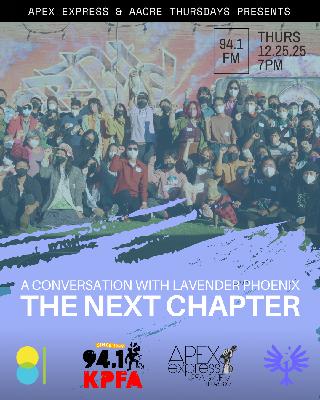
APEX Express and Lavender Phoenix are both members of AACRE, Asian Americans for Civil Rights and Equality. AACRE focuses on long-term movement building, capacity infrastructure, and leadership support for Asian Americans and Pacific Islanders committed to social justice.
To learn more about Lavender Phoenix, please visit their website. You can also listen to a previous APEX Express episode honoring Lavender Phoenix’s name change.
Miata Tan: [00:00:00] Hello and welcome. You are tuning in to APEX Express, a weekly radio show uplifting the voices and stories of Asian Americans. I am your host, Miata Tan. And before we get started, I wanted to let you know that this show was recorded on December 16th, 2025. Things may have changed by the time you hear this.
I also wanted to take a moment to acknowledge [00:01:00] some recent gun violence tragedies, not only in the US but globally. As you might be able to tell from my accent, I’m Australian.
Over the weekend, 15 people were killed in Sydney, on Bondi Beach in a mass shooting. The likes not seen in 30 years. . Australia’s gun control laws are different to the US in a number of ways that I won’t get into right now, but this massacre is one of the few we’ve seen since the nineties.
In the US we’ve also seen the shooting at Brown University where two of their students were killed by a still active shooter.
It’s strange. Guns and weapons are horrific. Tools used to take the life of people every day globally. An everyday occurrence now brings a degree of complacency. Although you personally might not have been [00:02:00] impacted by these recent shootings, the wars going on abroad, or government attacks on immigrant communities, and ICE deportation cases taking place here in America, the impact of horrific acts of violence have ripple effects that spread across this country and world.
Careless violence motivated by hate for another be that racially charged conflicting ideologies. It’s all awful. And I, and I guess I wanted to acknowledge that here at the top of this episode.
Profound hatred and judgment toward others is not only incredibly sad, it’s self-defeating. And I don’t mean to sound all preachy and I understand it’s December 25th and perhaps you’re sick of the sound of my voice and you’re about to change the station.
In all honesty, I, I would’ve by [00:03:00] now. It’s easy to tune out suffering. It’s easy to tune out violence, but if you’re still listening. Today, as many of us are gathering for the holiday ,season, whether or not you believe in a higher power or acknowledge that big guy in a red suit that brings kids presents, I invite you to sit with some of these thoughts. To acknowledge and reflect on the violence that exists around us, the hatred and dehumanization. We as humans are capable of feeling toward one another. Let’s just sit here for a moment with that uncomfortability.
Now. Think, what can I do today to make another’s life [00:04:00] just that tiny bit brighter?
Okay. Now to reintroduce myself and this show, my name is Miata Tan and this is APEX Express. A show that honors Asian American communities far and wide, uplifting the voices of artists, activists, organizers, and more. We have two incredible guests today from Lavender Phoenix, a Bay Area based organization supporting queer and trans Asian and Pacific Islander youth.
I really enjoyed my conversation with these two, and I’m sure you will as well.
And a quick note throughout both of these conversations, you’ll hear us referring to the organization as both Lavender Phoenix and it’s very cute nickname Lav Nix. Without further ado, here’s [00:05:00] my conversation with Yuan Wang, the outgoing director at Lavender Phoenix.
Miata Tan: Yuan, thank you so much for joining us today. Would you be able to share a little bit about yourself with our listeners to get started?
Yuan Wang: Yeah. I’m so excited to be here.
, My name is Yuan. My pronouns are she, and they, and I’m actually the outgoing executive director of Lavender Phoenix. You’re catching me on my second to last week in this role after about four years as the executive director, and more years on our staff team as an organizer and also as a part of our youth summer organizer program.
So this is a really exciting and special time and I’m really excited to reflect about it with you.
Miata Tan: Yay. I’m so excited. I’d love for you to give us an overview of Lavender Phoenix and the work that y’all do, what communities you support,
Yuan Wang: Lavender Phoenix was founded about 21 years ago, and we are based in the Bay [00:06:00] Area. We’re a grassroots organization that builds the power of transgender non-binary and queer Asian and Pacific Islander communities right here in the Bay. Right now our work focuses on three major Areas.
The first is around fighting for true community safety. There are so, so many ways that queer, trans, and more broadly, uh, working class communities in the San Francisco Bay Area. Are needing ways to keep ourselves and each other safe, that don’t rely on things like policing, that don’t rely on things like incarceration that are actually taking people out of our communities and making us less safe.
The second big pillar of our work is around healing justice. We know that a lot of folks in our community. Struggle with violence, struggle with trauma, struggle with isolation, and that a lot of the systems that exist aren’t actually really designed for queer and trans API people, to thrive and feel connected.
And [00:07:00] so, we’ve been leading programs and campaigns around healing justice. And the last thing is we’re trying to build a really principled, high integrity leaderful movement. So we do a ton of base building work, which just means that, everyday queer and trans API people in our community can come to Lavender Phoenix, who want to be involved in organizing and political work.
And we train folks to become organizers.
Miata Tan: And you yourself came into Lavender Phoenix through one of those programs, is that right?
Yuan Wang: Yeah. Um, that is so true. I came into Lavender Phoenix about seven or eight years ago through the Summer organizer program, which is kind of our flagship youth organizing fellowship.
And I was super lucky to be a part of that.
Miata Tan: How has that felt coming into Lavender Phoenix? Like as a participant of one of those programs? Yeah. And now, uh, over the past few years, being able to [00:08:00] lead the organization?
Yuan Wang: Yeah. It feels like the most incredible gift. I share this a lot, but you know, when I had come into Lavender Phoenix through the summer organizer program, I had already had some experience, doing organizing work, you know, doing door knocking, working on campaigns.
but I really wanted to be in a space where I felt like I could be all of myself, and that included being trans, you know, that included. Being in a really vulnerable part of my gender transition journey and wanting to feel like I was around people all the time who maybe were in a similar journey or could understand that in a really intimate way.
I really found that at Lavender Phoenix. It was pretty unbelievable, to be honest. I remember, uh, the first day that I walked in. There were members and volunteers leading a two hour long political education that was just about the histories of trans and non-binary people in different Asian and Pacific Islander communities.
So just being in a room [00:09:00] full of people who shared my identities and where, where we were prioritizing these histories was really, really exciting. I think for the years it’s just been so amazing to see Lavender Phoenix grow. The time when I joined, we had a totally different name. It was API equality, Northern California, or we called ourselves a pink and we were really focused on projects like the Dragon Fruit Project, which was a, a series of more than a hundred oral histories that we did with elders and other members members of our community.
Things like the Trans Justice Initiative, which were our first efforts at really building a community that was trans centered and that was, was building trans leaders. And now those things are so deeply integrated into our work that they’ve allowed us to be focused on some more, I think what we call like issue based work, and that that is that community safety, healing justice work.
That I mentioned earlier. So, it’s just been amazing to witness multiple generations of the organization that has shaped [00:10:00] me so much as a person.
Miata Tan: That’s really nice. Seven, eight years that, that whole
Yuan Wang: Yeah, I joined in 2018 in June, so you can maybe do, I think that’s about seven and a half years. Yeah.
I’m bad at math though.
Miata Tan: Me too. So you’ve been executive director since late 2021 then? This, these few years since then we’ve seen a lot of shifts and changes in our I guess global political culture and the way conversations around racial solidarity issues mm-hmm.
as you’ve navigated being executive director, what, what has changed in your approach maybe from 2021 till this year? 2025?
Yuan Wang: Wow, that’s such an interesting question. You’re so right to say that. I think for anyone who’s listening, I, I imagine this resonates that the last four years have [00:11:00] been. Really a period of extraordinary violence and brutality and grief in our world.
And that’s definitely true for a lot of folks in Lavender Phoenix. You mentioned that we’ve been living through, you know, continued pandemic that our government is

A weekly magazine-style radio show featuring the voices and stories of Asians and Pacific Islanders from all corners of our community. The show is produced by a collective of media makers, deejays, and activists.
The post APEX Express – December 4, 2025 appeared first on KPFA.
A weekly magazine-style radio show featuring the voices and stories of Asians and Pacific Islanders from all corners of our community. The show is produced by a collective of media makers, deejays, and activists.
Important Links
We Belong Here campaign page
We Belong Here Partner organizations: Asian Law Caucus |Asian Refugees United | Hmong Innovating Politics | Hmong Family Association of Lansing | Rising Voices
Transcript
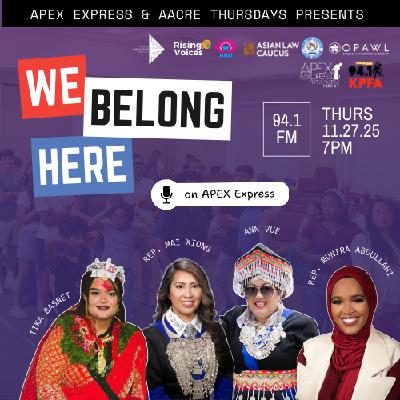
Nina Phillips: Hello and welcome. You are tuning into APEX Express, a weekly radio show uplifting the voices and stories of Asian Americans. I’m your host Nina Phillips, and tonight we are doing something a little different. Earlier this month on Monday, November 3rd, communities of Hmong and Nepali speaking, Bhutanese Americans, fellow immigrants and allies, gathered together at a virtual [00:01:00] community event called We Belong Here.
The goal: to shed light on the continued detainment and deportation of immigrant communities in the United States and the specific challenges faced by Bhutanese, Hmong, and Southeast Asian folks.
Tika Basnet: When, uh, my husband got detained on April 8, I took one week after to reach out Aisa and she told me, Hey Tika, come forward, you know, your story is powerful. People need to know your story.
Nina Phillips: That was the voice of Tika Basnet. Her husband, Mohan Karki is a Nepali speaking Bhutanese refugee from Ohio who has spent months in ICE detention, trapped in legal limbo. Tika has been working tirelessly to bring her husband home and shared her story with us at We Belong Here.
Tonight, we are bringing you a recording of this virtual community gathering. You’ll hear more from Tika about the Free Mohan Karki campaign and from Ann Vue, [00:02:00] the spouse of Lue Yang, a Hmong community leader from Michigan, who is also currently detained and facing deportation. Ann is leading the movement to Bring Lue Home, and we’ll be sharing more later about how you can get involved as well and support both of these campaigns.
You will also hear from state representatives of Michigan and Ohio, the music and spoken word performance of Asian Refugees United, and community tools and resources that a vital in helping to keep our immigrant loved ones safe. The host of this community event was Miko Lee, APEX producer, and a voice that you might be familiar with. Alrighty, without further ado, here’s Miko.
Miko Lee: We belong here. What we recognize right now is there’s almost. 60,000 people being held in detention right now, immigrants that are being held in detention.
It is a pandemic that is happening in our country that’s impacting all of our people, and we need [00:03:00] to be able to take action. Tonight we’re talking very specifically, not with this 60,000 people that are in detention now, but just two of those stories, so that you can get a sense of what is happening in the Bhutanese and Hmong communities and what’s happening right now, and to talk about those particular stories and some actions you can take.
First I wanna recognize that right now we are on native lands, so all of us except our original indigenous people, are from other places and I’d invite you to go into the chat and find your native land. I am speaking with you from the unceded Ohlone land, and I wanna honor these ancestors, these elders that have provided for us and provided this beautiful land for us to be on.
So I invite you to share into the chat your name, your pronoun, and also what indigenous land you are living on right now in this Native American Heritage Month.
Thank you so much to all of you that have joined [00:04:00] us. We are really seeing the impact of this administration on all of our peoples, and particularly tonight in terms of the Hmong and Nepali speaking, Bhutanese communities.
These are communities that have been impacted, specifically refugee communities that have been impacted in incredible detrimental ways by this administration. And tonight what we really wanna do is talk to you about what is going on in our communities. We wanted to make sure we translated so that we have as much access into our communities as possible because we wanna be as inclusive of our world as we can. We Belong Here is focusing on the fact that all of us belong here.
We belong in this land, and we are telling these stories tonight in the context of these sets of people particularly that have so many similarities in terms of Hmong folks who worked with our US government and worked with our US military during the Vietnam War and then came [00:05:00] here as refugees and stayed in this country to the Nepali speaking Bhutanese folks, who left their country from ethnic cleansing and then went into refugee camps and now took refuge in the United States.
So these are all stories that are impactful and powerful, and it’s really what it means to be American. we have come from different places. We see these attacks on our people. right now I would like to bring to the fore two empowering women, refugees themselves. Hailing from places as different as Somalia and Southeast Asia, and they’re gonna talk about some of the detention and deportations that are happening right now.
First I’d like to focus on Rep Mai Xiong, who’s from Michigan’s 13th District. I hand it over to the representative.
Rep. Mai Xiong: Good evening everyone. I’m state representative, Mai Xiong, and it is a pleasure to meet all of you virtually. I’m coming to you from Warren, Macomb County, Michigan, and I represent the 13th [00:06:00] house of district, uh, the communities of Warren Roseville and St. Claire Shores. I’ve lived here in Michigan for over 20 years now. I came to the United States at a very young age, was born in a refugee camp and came here when I was three years old. So I grew up in Ohio. And then I moved to Michigan to attend college.
Never thought that I would ever be serving in the State House. I previously served as a county commissioner here in Macomb. And, uh, last year when President Trump got elected, I had very quiet fears that as a naturalized citizen, that even I did not feel safe given the, um. The failure in our immigration system.
So we have seen that play out, uh, with this administration, with the, attempts to get rid of birthright citizenship de-naturalization. And, you hear the rhetoric from officials about, deporting the worst of the worst criminal, illegal aliens. And we [00:07:00] know, as Miko mentioned in, in her introduction, that, refugees came here through a legal pathway.
The Hmong in particular served alongside America during the Vietnam War and were persecuted from Laos. So my parents fled Laos. And so growing up I didn’t have, uh, citizenship. Um, and so we have seen, uh, in this administration that refugees are now caught up in this, immigration effort to get rid of
people who came here through legal pathways Lue is a father. He is a community leader. Uh, he is a well-respected member of our community as all of these individuals are. And at some point our system failed them and we are working extremely hard, to get their stories out. But what I have found with many of these families is that they are, uh, afraid to come forward.
They are ashamed. There is a stigma involved and, uh, culturally, as many of you may [00:08:00] know, if you are of Asian American descent, and a fear of, uh, retaliation. And as the only Hmong American elected here in Michigan, I’m grateful that I have, uh, the ability to.
have those connections and to be such a visible, uh, member of my community that many of these individuals. Felt comfortable enough to reach out to me. But the reality is back in July we didn’t know anything other than, the number of people who were detained. And that was through a firsthand account from loved ones who you know, were accompanying their loved one and got detained.
And so it was literally like trying to find missing people and then getting the word out to let them know that, hey, there’s actually, there’s help out there. The volunteer attorneys, the nonprofits, the Immigration Rights Center, uh, here in Michigan, I mean, everybody has been doing a phenomenal job because I think the majority, the vast majority of Americans understand that, um, these [00:09:00] individuals that are being taken out of our communities are not a, a threat to society. They are members of our community.
They’ve lived here for decades. They have jobs, they have children. And when you when you take an individual out of our community, it actually does more harm then it does to make any one of us safe. So that’s the message that I have been sharing with others, uh, not only in having a connection and being a refugee just like these individuals, but
advocating for them and making it clear that these are our neighbors, these are our children’s classmates, parents, and it doesn’t make any one of us feel safer. One of the things I am. Upset about that I continue to talk about is that we’re not actually in a immigration crisis. We share here in Michigan, we share an international border with Canada, and we have never had an issue with border security.
The [00:10:00] problem is the policies that have been put in place, that these individuals have been caught up in our immigration system for decades, and it is extremely hard for them to obtain citizenship or to even know what their rights are.
And so we really need, in addition to advocating for these families, we need immigration reform. Throwing money at a problem is not going to solve the problem. If anything, we have are, we are in an economic crisis.
Miko Lee: Thank you so much for joining. Um, I’d love to turn the baton over to another one of our powerful women representatives, Rep. Munira Abdullah from Ohio’s Ninth District. Rep Abdullah. We pass it over to you. Thank you so much.
Rep. Munira Abdullahi: Uh, thank you for having me and also Rep Mai Xiong, it is really great to see you. I’m grateful to have been able to see you go from Commissione

A weekly magazine-style radio show featuring the voices and stories of Asians and Pacific Islanders from all corners of our community. The show is produced by a collective of media makers, deejays, and activists.
Powerleegirl hosts, the mother daughter team of Miko Lee, Jalena & Ayame Keane-Lee speak with artists about their craft and the works that you can catch in the Bay Area. Featured are filmmaker Yuriko Gamo Romer, playwright Jessica Huang and photographer Joyce Xi.
More info about their work here:
Diamond Diplomacy
Yuriko Gamo Romer
Jessica Huang’s Mother of Exiles at Berkeley Rep
Joyce Xi’s Our Language Our Story at Galeria de la Raza
Show Transcript
Opening: [00:00:00] Apex Express Asian Pacific expression. Community and cultural coverage, music and calendar, new visions and voices, coming to you with an Asian Pacific Islander point of view. It’s time to get on board the Apex Express.
Ayame Keane-Lee: [00:00:46] Thank you for joining us on Apex Express Tonight. Join the PowerLeeGirls as we talk with some powerful Asian American women artists. My mom and sister speak with filmmaker Yuriko Gamo Romer, playwright Jessica Huang, and photographer Joyce Xi. Each of these artists have works that you can enjoy right now in the Bay Area.
First up, let’s listen in to my mom Miko Lee chat with Yuriko Gamo Romer about her film Diamond Diplomacy.
Miko Lee: [00:01:19] Welcome, Yuriko Gamo Romer to Apex Express, amazing filmmaker, award-winning director and producer. Welcome to Apex Express.
Yuriko Gamo Romer: [00:01:29] Thank you for having me.
Miko Lee: [00:01:31] It’s so great to see your work after this many years. We were just chatting that we knew each other maybe 30 years ago and have not reconnected. So it’s lovely to see your work. I’m gonna start with asking you a question. I ask all of my Apex guests, which is, who are your people and what legacy do you carry with you?
Yuriko Gamo Romer: [00:01:49] Oh, who are my people? That’s a hard one. I guess I’m Japanese American. I’m Asian American, but I’m also Japanese. I still have a lot of people in Japan. That’s not everything. Creative people, artists, filmmakers, all the people that I work with, which I love. And I don’t know, I can’t pare it down to one narrow sentence or phrase. And I don’t know what my legacy is. My legacy is that I was born in Japan, but I have grown up in the United States and so I carry with me all that is, technically I’m an immigrant, so I have little bits and pieces of that and, but I’m also very much grew up in the United States and from that perspective, I’m an American. So too many words.
Miko Lee: [00:02:44] Thank you so much for sharing. Your latest film was called Diamond Diplomacy. Can you tell us what inspired this film?
Yuriko Gamo Romer: [00:02:52] I have a friend named Dave Dempsey and his father, Con Dempsey, was a pitcher for the San Francisco Seals. And the Seals were the minor league team that was in the West Coast was called the Pacific Coast League They were here before the Major League teams came to the West Coast. So the seals were San Francisco’s team, and Con Dempsey was their pitcher. And it so happened that he was part of the 1949 tour when General MacArthur sent the San Francisco Seals to Allied occupied Japan after World War II. And. It was a story that I had never heard. There was a museum exhibit south of Market in San Francisco, and I was completely wowed and awed because here’s this lovely story about baseball playing a role in diplomacy and in reuniting a friendship between two countries. And I had never heard of it before and I’m pretty sure most people don’t know the story. Con Dempsey had a movie camera with him when he went to Japan I saw the home movies playing on a little TV set in the corner at the museum, and I thought, oh, this has to be a film. I was in the middle of finishing Mrs. Judo, so I, it was something I had to tuck into the back of my mind Several years later, I dug it up again and I made Dave go into his mother’s garage and dig out the actual films. And that was the beginning. But then I started opening history books and doing research, and suddenly it was a much bigger, much deeper, much longer story.
Miko Lee: [00:04:32] So you fell in, it was like synchronicity that you have this friend that had this footage, and then you just fell into the research. What stood out to you?
Yuriko Gamo Romer: [00:04:41] It was completely amazing to me that baseball had been in Japan since 1872. I had no idea. And most people,
Miko Lee: [00:04:49] Yeah, I learned that too, from your film. That was so fascinating.
Yuriko Gamo Romer: [00:04:53] So that was the first kind of. Wow. And then I started to pick up little bits and pieces like in 1934, there was an American All Star team that went to Japan. And Babe Ruth was the headliner on that team. And he was a big star. People just loved him in Japan. And then I started to read the history and understanding that. Not that a baseball team or even Babe Ruth can go to Japan and prevent the war from happening. But there was a warming moment when the people of Japan were so enamored of this baseball team coming and so excited about it that maybe there was a moment where it felt like. Things had thawed out a little bit. So there were other points in history where I started to see this trend where baseball had a moment or had an influence in something, and I just thought, wow, this is really a fascinating history that goes back a long way and is surprising. And then of course today we have all these Japanese faces in Major League baseball.
Miko Lee: [00:06:01] So have you always been a baseball fan?
Yuriko Gamo Romer: [00:06:04] I think I really became a fan of Major League Baseball when I was living in New York. Before that, I knew what it was. I played softball, I had a small connection to it, but I really became a fan when I was living in New York and then my son started to play baseball and he would come home from the games and he would start to give us the play by play and I started to learn more about it. And it is a fascinating game ’cause it’s much more complex than I think some people don’t like it ’cause it’s complex.
Miko Lee: [00:06:33] I must confess, I have not been a big baseball fan. I’m also thinking, oh, a film about baseball. But I actually found it so fascinating with especially in the world that we live in right now, where there’s so much strife that there was this way to speak a different language. And many times we do that through art or music and I thought it was so great how your film really showcased how baseball was used as a tool for political repair and change. I’m wondering how you think this film applies to the time that we live in now where there’s such an incredible division, and not necessarily with Japan, but just with everything in the world.
Yuriko Gamo Romer: [00:07:13] I think when it comes down to it, if we actually get to know people. We learn that we’re all human beings and that we probably have more in common than we give ourselves credit for. And if we can find a space that is common ground, whether it’s a baseball field or the kitchen, or an art studio, or a music studio, I think it gives us a different place where we can exist and acknowledge That we’re human beings and that we maybe have more in common than we’re willing to give ourselves credit for. So I like to see things where people can have a moment where you step outside of yourself and go, oh wait, I do have something in common with that person over there. And maybe it doesn’t solve the problem. But once you have that awakening, I think there’s something. that happens, it opens you up. And I think sports is one of those things that has a little bit of that magical power. And every time I watch the Olympics, I’m just completely in awe.
Miko Lee: [00:08:18] Yeah, I absolutely agree with you. And speaking of that kind of repair and that aspect that sports can have, you ended up making a short film called Baseball Behind Barbed Wire, about the incarcerated Japanese Americans and baseball. And I wondered where in the filmmaking process did you decide, oh, I gotta pull this out of the bigger film and make it its own thing?
Yuriko Gamo Romer: [00:08:41] I had been working with Carrie Yonakegawa. From Fresno and he’s really the keeper of the history of Japanese American baseball and especially of the story of the World War II Japanese American incarceration through the baseball stories. And he was one of my scholars and consultants on the longer film. And I have been working on diamond diplomacy for 11 years. So I got to know a lot of my experts quite well. I knew. All along that there was more to that part of the story that sort of deserved its own story, and I was very fortunate to get a grant from the National Parks Foundation, and I got that grant right when the pandemic started. It was a good thing. I had a chunk of money and I was able to do historical research, which can be done on a computer. Nobody was doing any production at that beginning of the COVID time. And then it’s a short film, so it was a little more contained and I was able to release that one in 2023.
Miko Lee: [00:09:45] Oh, so you actually made the short before Diamond Diplomacy.
Yuriko Gamo Romer: [00:09:49] Yeah. The funny thing is that I finished it before diamond diplomacy, it’s always been intrinsically part of the longer film and you’ll see the longer film and you’ll understand that part of baseball behind Barbed Wire becomes a part of telling that part of the story in Diamond Diplomacy.
Miko Lee: [00:10:08] Yeah, I appreciate it. So you almost use it like research, background research for the longer film, is that right?
Yuriko Gamo Romer: [00:10:15] I had been doing the research about the World War II, Japanese American incarceration because it was part of the story of the 150 years between Japan and the United States and Japa

How has the classical music industry approached representation and how has the new music community forged new paths to embrace diverse musics? On tonight’s episode of Obbligato on APEX Express, Isabel Li is joined by violinist Shalini Vijayan, who discusses her vibrant career and reflects upon the ways contemporary classical music can build community.
Violinist Shalini Vijayan, deemed “a vibrant violinist” by Mark Swed of the Los Angeles Times is an established performer and collaborator on both coasts. Always an advocate for modern music, Shalini was a founding member and Principal Second Violin of Kristjan Jarvi’s Absolute Ensemble, having recorded several albums with them including 2001 Grammy nominee, Absolution. Shalini was also a founding member of the Lyris Quartet, one of Los Angeles’ most beloved chamber ensembles. With Lyris, she has performed regularly at Walt Disney Concert Hall on the Green Umbrella series, for Jacaranda Music and helped to found the Hear Now Music Festival in Venice, California, a festival dedicated to the music of living composers in Los Angeles.
Shalini performed for over a decade with Southwest Chamber Music and can be heard on their Grammy nominated Complete Chamber Works of Carlos Chávez, Vol. 3. She has been a featured soloist with the Los Angeles Master Chorale in Chinary Ung’s Spiral XII and Tan Dun’s Water Passion, including performances at the Ravinia Festival. As a chamber musician, Shalini has collaborated with such luminaries as Billy Childs, Chinary Ung, Gabriela Ortiz, and Wadada Leo Smith on whose Ten Freedom Summers she was a soloist. Shalini joined acclaimed LA ensemble, Brightwork New Music in 2019 and also serves as the curator for Brightwork’s Tuesdays@Monkspace series, a home for contemporary music and performance in Los Angeles. As a teacher, she has been on the faculty of the Nirmita Composers Workshop in both Siem Reap and Bangkok and coaches composition students through the Impulse New Music Festival.
Shalini received her B.M. and M.M. degrees from Manhattan School of Music as a student of Lucie Robert and Ariana Bronne. As a member of the New World Symphony in Miami Beach, Florida, Shalini served as concertmaster for Michael Tilson Thomas, John Adams, Reinbert de Leeuw and Oliver Knussen. She was also concertmaster for the world premiere performances and recording of Steven Mackey’s Tuck and Roll for RCA records in 2000. Shalini was a member of the Pacific Symphony Orchestra for ten seasons and also served as Principal Second Violin of Opera Pacific. She lives in Los Angeles with her son, husband and two dogs and spends her free time cooking Indian food and exploring the culinary landscape of Southern California.
Check out more of her work at:
https://brightworknewmusic.com/tuesdays-at-monk-space/
https://www.lyrisquartet.com/
Transcript
Opening: [00:00:00] Apex Express Asian Pacific expression. Community and cultural coverage, music and calendar, new visions and voices, coming to you with an Asian Pacific Islander point of view. It’s time to get on board the APEX Express.
00:01:03 Isabel Li
You’re listening to Obbligato, which is a segment about the Asian American Pacific Islander community, specifically in classical music.
00:01:11 Isabel Li
I’m your host, Isabel Li, and today joining me is Shalini Vijayan, who is a violinist, established performer, and always an advocate for modern music.
00:01:21 Isabel Li
Shalini is also a founding member of the Lyris Quartet, one of Los Angeles most beloved chamber ensembles. With Lyris, she has performed regularly at Walt Disney Concert Hall on the Green Umbrella series for Jacaranda Music, and helped to found the Here and Now Music Festival in Venice, California, a festival dedicated to the music of living composers in Los Angeles. She joined acclaimed LA ensemble Brightwork New Music in 2019, and also serves as the curator for Brightwork’s Tuesdays at Monk Space series. She currently lives in Los Angeles with her son, husband and two dogs, and spends her free time cooking Indian food and exploring the culinary landscape of Southern California.
00:02:04 Isabel Li
Well, Shalini, thank you so much for joining me in this conversation today.
00:02:09 Shalini Vijayan
I’m so happy to be with you.
00:02:11 Isabel Li
Awesome. I’d like to just get to know you and your story. How do you identify and what communities do you consider yourself a part of?
00:02:18 Shalini Vijayan
I use the pronouns she, her, and I. Um, I identify as South Asian. I grew up in an Indian family. My parents immigrated to the US in the sixties to teach at medical school. And I grew up with a great deal of Indian culture. And I’ve spent a lot of time going back and forth to India from the time that I was very young. You know, it’s interesting because I feel like in LA, where I live and work specifically, there is so much overlap between all of our different musical communities. You know, I went to school in New York, and I feel like there I was much more, I’m very connected to the new music community in New York and felt really kind of entrenched in that at the time I was there. And after coming to LA, I realized that, um, there are a lot of musicians doing so many different things. That’s one of the things I love about Los Angeles, actually. And, you know, I’m definitely very, very rooted in the new music community in LA. And that was where I made my first sort of connections when I first moved to Los Angeles. But I also, you know, worked in an orchestra when I first came to LA. I played in the Pacific Symphony for almost ten seasons, and so I became a part of that community as well. And you know, as the years went on, I also became much more involved in the studio music community of LA studio musicians playing on movie scores, playing on television shows, records, what have you, Awards shows, all sorts of things. And these are all very distinct communities in LA in music. But I see a ton of overlap between all of them. There are so many incredibly versatile musicians in Los Angeles that people are able to really very easily move from one of these groups to the other and, you know, with a great deal of success. And I feel like it gives us so much variety in our lives as musicians in LA, you don’t feel like you’re ever just in one lane. You can really occupy all these different kinds of spaces.
00:04:23 Isabel Li
Right, yeah. So you’re classically trained, from what I know, and you describe yourself as an advocate for modern music. So why modern music?
00:04:33 Shalini Vijayan
That’s a great question. I have have had to answer this question quite a bit over the years, especially to non-musicians. And it’s always an interesting story for me. You know, as a violinist in particular, you know, we have such a storied history of repertoire and pedagogy, and there is such an incredible, um, library of music that we have access to from the very standard classical repertoire. And there is a great deal to be learned about the instrument and about music from playing all that repertoire. I think at some point when I was in high school, I started to become interested in more modern music. And actually I grew up in Davis in Northern California.
My parents both taught at the university there, at the medical school and in Sacramento. Nearby there was a festival of modern American music that I think still goes on to this day at Cal State University, Sacramento. And it was really a great festival. And at that time, you know, they would bring professional artists, they’d have composers, they’d have commissions, all sorts of things. But at the time that I was like in high school, they also had a junior division to the festival, and I was asked to play a couple pieces in the Festival of, um, Modern Works, and I can’t remember at this time what the pieces were, but it left such a huge impression on me. And I think what I really took away from that experience as a kid is that in my studies as a violinist, I was always being asked to sort of live up to this history and this legacy of violin music and violin playing in Western classical music. And it’s a very high bar. And it’s, um, you know, of course, there’s so much great stuff there. But there was something so freeing about playing this music that had either never been played or not been recorded. So there was nothing to reference in terms of listening to a recording, um, and listening to how you, you know, quote, should be playing it that it made me feel, uh, you know, all this, this freedom to really interpret the music, how I felt, rather than feeling like I had to live up to a standard that had been set for me, you know, decades or centuries before. And I think that really something really clicked for me with that, that I wanted to have that kind of freedom when I, when I was playing. And so from there on out, um, you know, when I went to college and I really sought out opportunities in new music as much as I could.
00:07:00 Isabel Li
So you were first exposed to new music when you were in high school. Did that influence your decision to become a musician at all? Or were you already set on becoming a musician and that was just part of what shaped your works over the years.
00:07:15 Shalini Vijayan
I think by that time, I had already decided that I wanted to be a musician. I mean, as you know, so many of us as musicians and I think particularly string players, we decide so young because we start our instruments at such a young age and we start studying so early. Um, that I think by that time I, I had decided I wanted to do music, but this sort of opened another door for me that made me realize that it wasn’t just one path in music necessarily. I think it’s very easy as a, as a kid and as a violinist to think you admire these great soloists that you see and, you know, people like Perlman and, you know, Isaac Stern, who were the stars of the time when I was growing up. But, you kno
A weekly magazine-style radio show featuring the voices and stories of Asians and Pacific Islanders from all corners of our community. The show is produced by a collective of media makers, deejays, and activists.
The post APEX Express – November 6, 2025 appeared first on KPFA.
A weekly magazine-style radio show featuring the voices and stories of Asians and Pacific Islanders from all corners of our community. The show is produced by a collective of media makers, deejays, and activists.
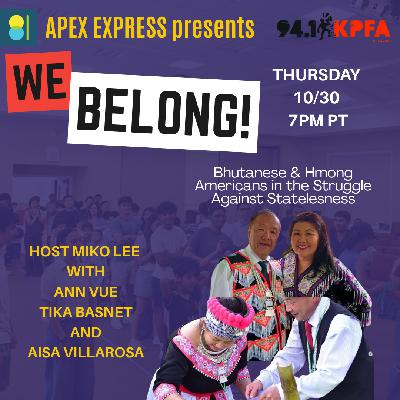
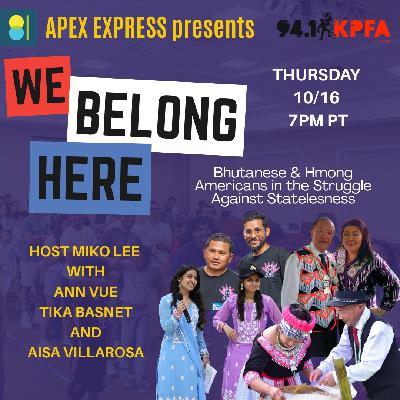
Tonight on APEX Express Host Miko Lee speaks with spouses of detained refugees. We hear about the similarities and challenges of Hmong and Nepali speaking Bhutanese refugees. We also speak with Asian Law Caucus’ Aisa Villarosa about the ongoing campaigns for freedom that ALC has been leading along with a host of other community based organizations.
Join us:
November 3, 4pm Pacific time, 7pm Eastern Time, Join us for “We Belong Here, Bhutanese & Hmong Americans in the Struggle Against Statelessness” a live virtual event featuring my three guests tonight, along with performances and conversations. bit.ly/WBH-2025
TAKE ACTION
Rising Voices campaign for Lue Yang
Mohan Karki’s GoFundMe
And please help support these organizations working to support detained and deported folx:
Asian Law Caucus
Asian Refugees United
Ba Lo Project in Vietnam
Collective Freedom in Vietnam & Laos
Asian Prisoner Support Committee & New Light Wellness in Cambodia
November 1–2, people nationwide are joining the Disappeared In America Weekend of Action to stand up for immigrant families and defend due process. Actions include protests at Home Depots, candlelight Freedom Vigils, and Day of the Dead events honoring lives lost to detention.
We Belong! Transcript
Miko Lee: Welcome to Apex Express.This is your host, Miko Lee. Today we’re talking about detentions and potential deportations and the atrocities that the Trump administration is creating in our communities.We originally recorded this episode a month ago, and today is October 29th. 2025 and I have with me Aisa Villarosa a lawyer with Asian Law Caucus, giving us an update in the cases that we’re talking about. Welcome Aisa Apex Express.
Aisa Villarosa: Thanks so much, Miko.
Miko Lee: Tonight we’re gonna be talking with two spouses of detained folks. One is a Nepali speaking Bhutanese community member, and the other is Hmong community member. In the time since we recorded this, there has been a big update with Lue Young’s case, and I wonder if you could provide us with that update.
Aisa Villarosa: Miko since we last spoke, due to some really hard fought campaigning, both behind the scenes and drawing upon allies across Michigan and really across the country. Lue Yang, received a successful pardon from Governor Gretchen Whitmer. We actually received word shortly before Lue Yang was set to be placed on a very large deportation flight. Once we got word of the pardon, it was off to the races for the legal team to quickly draft some emergency motions for Lue Yang and to realize the power of the pardon before the deportation.
Miko Lee: Can we back up for a moment and give for an audience a sense of what that means? Lue Young was incarcerated at a detention facility, which Trump has called the FedEx of detention facilities in, Louisana, and explain to us what happened to him and the other members that were suddenly pulled together onto an airplane.
Aisa Villarosa: When these removal flights happen, there’s so much confusion, there’s so much fear that families undergo, and often it’s due to the perseverance of the families that we honestly even know where folks are. Shortly before what we call final staging happens, someone is moved from, in Lue’s case, a facility in Michigan to a facility like Alexandria in Louisiana where the planes do take off from. Families typically look up their loved one on something called the “ice detainee locator.” What’s challenging is when final staging starts. Often that person completely disappears from the detainee locator or information gets a bit scrambled.
Because ICE has a bit of a sealed box as far as even telling families where, their loved one is. Families are either left to guess or rely on each other. So for Lue Yang and the pardon what is critical for folks to know is that as powerful, as rare as a pardon is, I can’t stress how extraordinary this is in these very difficult times. A pardon does not instantly, allow someone to say, walk out of an ice facility. There’s, numerous legal filings that need to happen. That is why , the team was so up against the clock.
Miko Lee: So let’s break this down a little bit around a pardon. What does a pardon mean in our current system? Because as a lay person, you think, oh, they’re pardoned. That means they’re free and they can go home and be with their family. Tell us a little bit about what a pardon means in our legal system right now.
Aisa Villarosa: A pardon is different from a criminal expungement, which folks might be familiar with. In Lue’s case, for example, when Lue was younger, he successfully expunged this record, in criminal court. The challenge is that immigration court, is basically the entity that issues something called a “final order of removal.” This document, is basically what powers deportation for folks. An expungement does not get at the final removal order.
However, a pardon has that more direct link. The pardon has the weight of what we call “vacating a conviction.” To explain more legalese and hopefully folks can stay with me. A final order of removal is an immigration court order document where , it gives ice the power to do all these deportations We’re seeing for the refugee community that Lue Yang belongs to. Often these are quite old orders, and so sometimes a loved one might be detained and they might not even realize that they have a criminal conviction or a final order of removal.
Miko Lee: Thank you so much for breaking that down. So we described how he was pulled off the plane that was going for his deportation. Tell us where Lue is at right now. What is happening with his case?
Aisa Villarosa: The call to action very much remains what it has been, which is we’re calling to bring Lue home. At the moment, Lue is in a facility in Louisiana. Our hope is that Lue can return to Michigan. There is also a call to release Lue on a supervised release.
The other component of the legal journey for Lue is something called a motion to reopen. Basically this is how the full weight of the pardon is realized. The motion to reopen calls on the Board of Immigration Appeals to reopen Lue’s case, because years ago he got that final removal order, so when someone gets that order, typically their immigration case is closed.
This petition says, Hey, he got a pardon. Please reopen Lue’s case because the underlying conviction that led to the final removal order. Has been pardoned, right? We are hoping that this motion to reopen will be heard in front of the Board of Immigration Appeals, that we can get a great result and that as the campaign calls for that, Lue can come home.
Miko Lee: I know lawyers like you are doing incredible work around the scenes. You did not sleep for two days, filing paperwork to be able to make sure that Lue was pulled off that plane. But what can regular people, what can our audience do to get involved right now?
Aisa Villarosa: There’s myriad actions along this really terrible deportation pipeline. We’re seeing that folks who might not have, any deep knowledge of the immigration system can still be so impactful. We have partners in LA in the faith community and they’ve started working with community organizations to do things like accompaniment, which is, joining community members like Lue, who often have these ice check-ins.
As folks have seen on the news, these check-ins can be really risky because that is where ice arrests can happen. If someone misses their ice check-in, typically that means that a warrant is issued, that immigration forces can come after you. In these cases, community members, particularly folks who are US citizens, accompaniment can be a great way to dig in to show up for our immigrant and refugee siblings.
Miko Lee: Thank you so much for breaking down how folks can get involved. It’s so important right now in a time where we feel so utterly helpless to be able to make change. Now we’re gonna go back to listen to our interview that is with the two spouses, Tika, Basnet, and Ann Vue, and also our current guest, Aisa Villarosa
Tika and Ann they’re part of a horrible club, which is both of their spouses are currently in detention from our immigration system. I just wanna start on a real personal note in a way that I often do with my guests. Anne, I just would love to hear from you, who are your people and what legacy do you carry with you?
Ann Vue: Thank you again, Miko and Isa, for having me on. We are Hmong. We helped Americans during the Vietnam War. In Laos, a lot of our pilots needed a communication. Because we’re indigenous and we are in the mountains they were able to speak with us and use us. Our Hmong, helped a lot of the pilots rescued a lot, like thousands and thousands of Americans, so that they can make it back home.
That is our contribution to the American people. When we were brought to America, was to resettle because of humanitarian purpose. Our legacy of helping Americans with the war. that is who we are and what we bring to America. That’s who I am. I’m actually the first generation Hmong American. I was born right here in the capital of Lansing, Michigan.
Miko Lee: Thanks so much ann. Tika, can you share who are your people and what legacy you carry with you?
Tika Basnet: Hi, my name is Tika Basnet. I am Bhutanese Nepali community. My parents and all the Bhutanese, they ran away from Bhutan in 1990 due to the ethnic cleansing. They came to Nepal, seeking for asylum, and that is where we born. I was born in Nepal, in refugee camp. Even though I was born in Nepal, Nepal never gave us identity. They never give us citizenship. We were known as Bhutanese Nepali, but as known as Stateless. My husband also born in Nepal in a refugee camp.
Miko Lee: Thank you. Aisa, I’m gonna ask the same question for you Aisa, that works at Asian L
A weekly magazine-style radio show featuring the voices and stories of Asians and Pacific Islanders from all corners of our community. The show is produced by a collective of media makers, deejays, and activists.
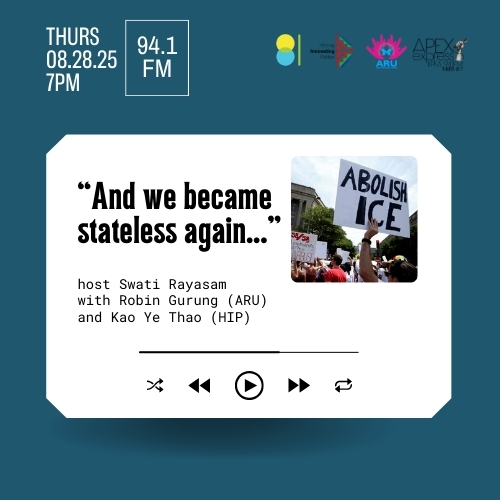
On tonight’s episode, we’re focusing on a particular segment of our immigrant and refugee community, Hmong and Bhutanese refugees.
Both of these targeted communities are stateless with no land to call their own, and their deportation carries the very real danger of disappearance and death. Robin Gurung from Asian Refugees United and Kao Ye Thao from Hmong innovating Politics, discuss their community and personal refugee stories, and talk about the intersection of the US’ deeply broken immigration and criminal legal systems, otherwise known as crimmigration.
We also get to hear from the wives of two detained refugees, one Bhutanese and one Hmong, who are currently fighting to keep their families together and to protect their loved ones from the dangers of deportation as stateless people.
Important Links:
Hmong Innovating Politics: Website | Instagram
Asian Refugees United: Website | Instagram
Bhutanese American Refugee Rights website
Transcript
Swati Rayasam: You are tuned in to Apex Express on KPFA. My name is Swati Rayasam.
Since the onset of the Trump administration, immigrant and refugee communities have been under increased attack, being kidnapped in broad daylight, detained in unsanitary and unsafe conditions, and deported to countries many of them barely know. All without due process or communication to their loved ones and communities.
On tonight’s episode, we’re focusing on a particular segment of our immigrant and refugee community, Hmong and Bhutanese refugees.
Both of these targeted communities are stateless with no land to call their own, and their deportation carries the very real danger of disappearance and death. Robin Gurung from Asian Refugees United and Kao Ye Thao from Hmong innovating Politics, discuss their community and personal refugee stories, and talk about the intersection of the US’ deeply broken immigration and criminal legal systems, otherwise known as crimmigration.
We also get to hear from the wives of two detained refugees, one Bhutanese and one Hmong, who are currently fighting to keep their families together and to protect their loved ones from the dangers of deportation as stateless people.
I also want to note because this is a rapidly developing situation, that this episode was recorded on August 13th, 2025, and is being released on August 28th, 2025.
For the most recent updates, please go to bhutaneserefugeerights.org or check out the Pardon Refugees campaign. Now, here’s Miko.
Miko: Welcome to Apex Express. Thank you so much for being here today. I’m so glad to bring you all together in this time. I’m wondering if I could ask you each to introduce yourselves and tell us a little bit about the community your organization serves and what you do, and let’s start with Kao Ye.
Kao Ye: Hello everyone, and thank you for making space- my name is Kao Ye Tao. I use she her pronouns, and I work as the director of policy and partnerships with an organization called Hmong Innovating Politics. We are an organization that serves Hmong youth and families in Sacramento and Fresno, which holds two of our largest Hmong American communities in California. And our work with Hmong youth and families is really about developing their leadership to organize towards social justice and to get the resources that their communities deserve.
Miko: Thank you, Kao Ye and Robin, could you please introduce yourself?
Robin: Sure. My name is Robin Gurung. I use he, him, his, I’m from the Nepali speaking Bhutanese community. I live in Harrisburg, Pennsylvania. my role at Asian Refugees United is the co-founder and the co-executive director. We have our program in California and Pennsylvania. California programs are, are serving Asian diaspora and then, Pennsylvania programs are focused serving the Nepal speaking Bhutanese community. We work in the intersection of arts and healing, storytelling, civic engagement, leadership development. Thank you.
Miko: Thanks Robin and I am your host Miko Lee, lead producer at Apex Express. And all of us are part of a network called AACRE Asian Americans for Civil Rights and Equality, which is a network of progressive Asian American groups.
So you all work with refugee populations. I’m wondering if you could tell a little bit more about the backstory of your community, and also if you feel comfortable about how you personally came to be a refugee in the United States. And, Robin, I’d love to start with you on that one.
Robin: Sure. My community is Nepali speaking, Bhutanese refugee community. And we are ethnically Nepali, which means culture wise and language wise we speak Nepali and follow the Nepali culture tradition. Our ancestors like maybe in 18 hundreds, 19 hundreds migrated from Nepal to Bhutan and became the citizen of that country.
And most people don’t know about Bhutan, it’s a very tiny country between China and India. And, if people know about Bhutan, then people know it through the cross national happiness concept, Bhutan is considered the happiest country in the world.
So our ancestors were in mostly in the southern area of Bhutan for generations, they became the citizen. They had their own home, their own land. And then later, 1980s, early nineties, there was a policy by the government of Bhutan, which is the monarchy government system- king rules the country. They brought a policy called One Nation, One People Policy. Which means all different groups of people would have to follow the same culture, same religion, kind of follow the same dress code and because of that policy all people were forced to stay away from following our own culture or our own religion, which, most of our folks were Hindu. Our people protested against it and because of that, the government expelled over a hundred thousand of our community members.
And, they expelled to India and then from like India wouldn’t allow us to stay and we had to resettle in Nepal in seven different refugee camps under different international agencies like U-N-H-C-R and other agencies.
Miko: And then Robin, can you tell a little bit about your personal story and how you came here?
Robin: Yeah. Yeah. So 1992 is when my family had to leave Bhutan. And at that time I was three years old. I remember growing up in a refugee camp in Nepal, from three years until I was 23 years. So 20 years of my life I was in a refugee camp in Nepal. And in 2012, I came to US through the refugee resettlement program introduced to our camps in 2008, and through it US agreed to resettle 60,000 of our committee members. By 2017, I think US has resettled about 70 to 80,000 of our Bhutanese community members.
Miko: Thank you so much for sharing. Kao Ye I wonder if you could talk about your community and the refugee resettlement program that your community was a part of.
Kao Ye: The Hmong American community, or just the Hmong community overall, is a group that’s indigenous to East and Southeast Asia. And through our ancient history, we’ve always been a stateless, people fighting for our autonomy to live to practice our customs and our culture. And particularly where we come into this history of refugee is during the Vietnam War where many Hmong people, alongside other ethnic groups in Laos, were caught in the crossfire of the United States conflict in Southeast Asia.
And so with the Vietnam War. The Hmong as well as many other ethnic communities that lived, in the hills and the mountains were recruited in covert operations by the CIA to fight back against the Vietnamese, the Northern Vietnamese communist forces, as well as the Putet Lao. And so once the US withdrew from Southeast Asia, it created a vacuum of conflict and violence that our people had to escape from in order to survive. And so after the Vietnam War in 1975, we saw the mass displacement of many Southeast Asian ethnic communities, including Hmong families. And that is where my history starts because my parents were born in Laos and because of this war, they fled to Thailand refugee camps and lived there for a few years until they were able to come to the United States in 1992. And I’m actually I’m a child of refugees and so what I know about this part of my history comes from the stories of my grandparents who raised me as well as what little I could learn in the textbooks of public education.
And so it wasn’t actually until going to college and. Being able to access more of this literature, this history that I really learned about what the United States had done in Southeast Asia and the ramifications of that for myself and my family and so many others, refugees that. Have to have had to resettle in the United States.
And so it’s definitely a history that runs very close, because we have relatives that live through that refugee experience. And so it is very well and alive. And so as we now approach this conversation around ICE and deportations, it really is a reminder of the trauma that our people face, but are still facing as a people that have been seen as disposable to the United States government.
Miko: Thanks, Kao Ye. Let’s talk a little bit more about that. But first I wanna say, did either of you ever hear about refugees in your textbooks? I never did. So I’m wondering if, you said you learned a little bit about that from textbooks. Was that something you learned in public education.
Kao Ye: I did not learn about refugees or refugees experience. I learned about the war and as a Hmong kid it brought me so much delight to try to scroll through the history books just to see if Hmong people were mentioned. And even then the refugee experience was not ever something that we talked about.
I felt like definitely not in, in high school. I think it was college really, that then started to articulate those terms and that Southeast Asian identity, that is really wher
A weekly magazine-style radio show featuring the voices and stories of Asians and Pacific Islanders from all corners of our community. The show is produced by a collective of media makers, deejays, and activists.
TAKE ACTION
Rising Voices campaign for Lue Yang
Mohan Karki’s GoFundMe
And please help support these organizations working to support detained and deported folx:
Asian Law Caucus
Asian Refugees United
Ba Lo Project in Vietnam
Collective Freedom in Vietnam & Laos
Asian Prisoner Support Committee & New Light Wellness in Cambodia
November 1–2, people nationwide are joining the Disappeared In America Weekend of Action to stand up for immigrant families and defend due process. Actions include protests at Home Depots, candlelight Freedom Vigils, and Day of the Dead events honoring lives lost to detention.
The following day, November 3, 4pm Pacific time, 7pm Eastern Time, Join us for “We Belong Here, Bhutanese & Hmong Americans in the Struggle Against Statelessness” a live virtual event featuring my three guests tonight, along with performances and conversations. bit.ly/WBH-2025
We Belong Here! Show Transcript
Miko Lee: Welcome to Apex Express. This is your host, Miko Lee. Today we’re talking about detentions and potential deportations and the atrocities that the Trump administration is creating in our communities. And today I am so honored to have three guests with me, Tika Basnet, and Ann Vu, and Aisa Villarosa. Tika and Ann they’re part of a horrible club, which is both of their spouses are currently in detention from our immigration system. But I just wanna start on a real personal note in a way that I often do with my guests. Anne, I’m gonna start with you. I just would love to hear from you, who are your people and what legacy do you carry with you?
Ann Vue: Thank you again, Miko and Isa, you guys for having me on. So we are Hmong. And we helped Americans during the Vietnam War. And so, during the Vietnam War in Laos, a lot of our pilots needed a communication. And because we’re indigenous and we are in the mountains, they were able to speak with us and use us. And so a lot of our Hmong, what they did or what they contributed helped a lot of the pilots rescued a lot, like thousands and thousands of Americans, really, so that that way they can make it back home, right?
And so that is our contribution to the American people. And so when we were brought to America, was to resettle because of humanitarian purpose. Really because of our legacy of helping Americans with the war, right? So that is who we are and what we bring to America. And that’s who I am. I’m, and I’m actually the first generation Hmong American too. So I was born right here in the capital of Lansing, Michigan.
Miko Lee: Thanks so much ann. And Tika, can you share who are your people and what legacy you carry with you?
Tika Basnet: Yes. Hi, my name is Tika Basnet. So I am Bhutanese Nepali community. My parents and all the Bhutanese, they ran away from Bhutan in 1990 due to the ethnic cleansing. And they came to Nepal, seeking for asylum, and that is where we born. I was born in Nepal, in refugee camp. Even though I was born in Nepal, Nepal never gave us identity. They never give us citizenship, so we were known as Bhutanese Nepali, but as known as Stateless. And yeah, my husband also born in Nepal in a refugee camp.
Miko Lee: Thank you, Tika. And Aisa, I’m gonna ask the same question for you Aisa, my friend that works at Asian Law Caucus. Who are your people and what legacy do you carry with you?
Aisa Villarosa: So much love to you, Miko and to you Ann and Tika for being here today. I just am, I’m so honored.My name is Aisa and I carry the love and, Maki Baka spirit of Filipino Americans both in my family across the diaspora. A little bit about the Filipino American story. We came to the United States as part of the colonial machine. The first Filipinos were brought as part of the Spanish Gallian trade. We made California home, parts of Louisiana home, and it’s quite a contrast to a lot of the sort of model minority seduction that many of my people, and myself as a younger person tended to fall into that if we kept our heads down, if we were quiet, we would be left alone.
I’m struck because at this moment of just unprecedented government attacks, so many of our communities have this story where someone somewhere said to us, yeah, just keep your head down and it’ll be fine. And we’re seeing the exact opposite, that this is the time to really use our voices, both individually and as one. And I’m also an artist and try to infuse that into my work in fighting government systems.
Miko Lee: Thank you Aisa. And in the interest of fairness, I will say I’m Miko. I am fifth generation Chinese American. I grew up knowing that my family was full of fighters that built the railroads, worked in the gold mines in laundromats and restaurants, and my parents walked with Dr. King and Cesar Chavez and Dolores Huerta, and I was raised in a family of social justice activists. So I feel like our legacy is to continue that work and to fight for the rights of our peoples. That being said, I’m so honored to have both of all three of you powerful women join me today. And as I was saying in the beginning, Tika and Anne are sadly a part of this club. Nobody wants to be a part of this club with the sudden, unexpected, harmful detentions of both of your husbands. I wonder if you can each just share the story about what happened and how you first found out about your husband being detained. And let’s start with you Tika.
Tika Basnet: So, my husband got his removal in 2014 when he was like minor. Just 17 years old, high school student going from school to home and, he’s a teenager and with his friend, like they were playing around and they wanna go home really fast. So they just cross from private property. And I think that is where someone saw and call 911. So we came from the culture that we love to go people home , walking around, playing around. So my husband came here in 2011. The incident happened on 2013. So he was just, came here without knowing culture, without knowing languages, So he has no idea.
So when somebody called 911, he could not explain what happened. First of all, English is his second language, he was barely here without knowing rules and regulation, without knowing culture.
The police get them and then they took him to jail I think police gave a lot of charges. And even until now, my husband doesn’t know what are those charges? At that time, nobody explained, this is the three charges you got, and this could lead to deportation. And he feel guilty without knowing those charges. And just because he trusts Nepali translate guy, and he told my husband, like, if you don’t say I’m guilty, you will end up in prison for 20 to 25 years, but if you say I’m guilty, you’ll go home.
And my husband said, guilty. And at that time, neither criminal lawyer told my husband, like, if you say I’m guilty, you’ll end up getting deport. Deport to the contrary that you are you never born. Deport To the contrary, you doesn’t even speak their language. And even the lawyer did not explain my husband like, you will not gonna get your green card.
You cannot apply your citizenship in your life. If all of, if those things like the lawyer told my husband at that time, he will never gonna say, I am guilty to the crime that he did not even commit. And so when they tried to deport my husband back then, Bhutan say, he’s not my citizenship, he’s not from my country, We don’t know this guy. He’s not belongs to here.
And when US Embassy reach out to, Nepal, do you know this guy? They told, ICE no, we don’t know this guy, like he’s not belongs here. And then the ICE officer, they told my husband, like, we can let you go, you need to come here, like order of supervision every years, every three months, every six months, whenever we call you.
And it been 11 years. My husband is following rules and regulation. After that incident, never police arrest him. He did not even get criminal record. He did not even get misdemeanor record. So basically he never did any violation after that. So he was following, he got married, he has a life, he pay taxes. He was taking care of his family and in 11 years he was doing everything. And in 2025 for the first time they target Bhutanese Nepali community. And at that time I knew that this is the last time I’m gonna see my husband. And that is a time I think I broke down. Like, when they detained my husband in April 8, I was eight months pregnant. And um, like we dream a lot of things like, you know, we are gonna take care of our daughter. We are gonna buy home, we are gonna work, we are gonna give her the life that we, I’m sorry.
Miko Lee: Totally. Okay.
Tika Basnet: So, yeah. Um, like I never thought like Bhutanese community can, like deport. Like my parent already , go through this trauma, you know, when Bhutan throw them away due to ethnic cleansing and same thing happening to us. It is unbelievable. I cannot believe that, we’re going through this again and I don’t know when this gonna be stopped. I don’t know whether like my husband gonna come home.
I dunno. Like I’m fighting and it is been five month and I really want my husband back. Like my daughter today is, she’s three month old. She need her dad in life. ’cause I cannot provide everything by myself. My husband is the main provider for her aging parent. ’cause even now they cannot pay bills. Like they have really hard time paying bills.
And this is the reason, like I’m fighting for my husband case and I want my husband back. And I think he deserve second chance because if you see his record is clean, like for one incident that happened like 12 years ago, that cannot define my husband. Like who he is right now, you know?
So yeah, this is what happened. Like I cannot believe that my husband is able to get deport to the country that doesn’t even accept. And I don’t know whether he gonna get ki
A weekly magazine-style radio show featuring the voices and stories of Asians and Pacific Islanders from all corners of our community. The show is produced by a collective of media makers, deejays, and activists.
The post APEX Express – September 25, 2025 appeared first on KPFA.
A weekly magazine-style radio show featuring the voices and stories of Asians and Pacific Islanders from all corners of our community. The show is produced by a collective of media makers, deejays, and activists.
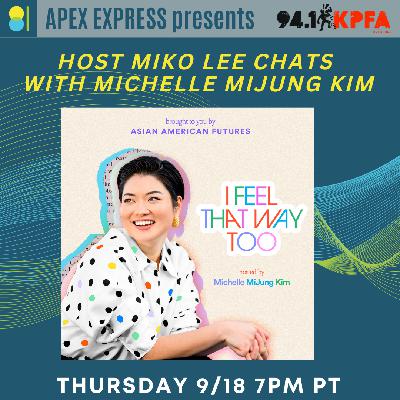
Host Miko Lee speaks with author, activist Michelle MiJung Kim about her new Podcast, I Feel That Way Too. Then we listen to the first episode.
Michelle MiJung Kim Website
I Feel That Way Too podcast
I FEEL THAT WAY TOO show Transcript
Miko Lee: Welcome to APEX Express. I’m your host, Miko Lee, and tonight I’ll be talking with author, speaker, and activist, Michelle MiJung Kim, about the new podcast. So we get to listen after the interview to the very first episode, and you get a little behind the scenes with activist Michelle MiJung. Kim, stay tuned. welcome, Michelle MiJung Kim to Apex Express. I’m so excited to chat with you. You are an award-winning author, activist, and now a podcast host. Hello girl. Welcome. Yay.
Michelle MiJung Kim: Hello. Thank you so much for having me, Miko. I’m so excited.
Miko Lee: I wanna start with my big question, who are your people and what legacy do you carry with you?
Michelle MiJung Kim: Hmm. What a deep question that I can go on forever about. My people are, first and foremost people who are in my life, who have supported me throughout. Everything that I’ve gone through in my life, including my friends and family who have different lineages, people, most of the people that I hold near and dear carry with them, a deep understanding of their historical trauma, their familial trauma, and people who are courageous enough to share them [00:02:00] with me. So that really creates this bond that I have with my people. A lot of my people are in the queer and trans community and in the physical space of the Ohlone land, also known as Oakland, California. A lot of my community rooted in my Asian American identity.
Miko Lee: Love this. My follow up, what is the legacy you carry with you from your people?
Michelle MiJung Kim: The legacy that I carry from my people that jumps out to me right now is the legacy of my grandparents. My grandparents were both born in Korea. My grandpa from the north, my grandma from the south, and I am always thinking about how my grandpa was fighting for the Korea’s liberation from Japanese occupation, and he was a writer himself. I always saw him writing and he had [00:03:00] stacks of paper ready to be published, but he ended up not being able to publish before he passed.
So my book dedication starts with my gratitude to my grandparents and my grandpa specifically. The legacy of his work, his spirit, his love for philosophy, social justice language I carry with me. My grandmother, who was part of the first class of women in her generation to go to a university she was a badass matriarch of our family and her energy, her audacity, her courage, her confidence in her herself and her community is what I try to channel. I think about them every day.
Miko Lee: Ugh. I love that. I’m wondering if you could share a little bit about your book.
Michelle MiJung Kim: My book is called The Wake Up Closing The Gap Between Good Intentions and Real Change and really it’s part memoir, part [00:04:00] principles of Social justice that I hold near to my heart. I really wanted to write a book that could be timeless and that could put into accessible ways how we can embody these values that are important for our collective liberation.
So much of the social justice work that I encountered throughout my education journey had been highly intellectualized and theoretical and sometimes not unpacked in ways that feel human. I wanna see how people are struggling to hold social justice values while living their daily lives.
How sometimes it gets challenging to embody the values that we say are important to us because it asks us to trade off our comfort and safety sometimes. I wanted to be really honest about my experience trying to live in alignment with my values, including the parts of my own contradictions and struggles and paradoxes that I’ve had to navigate.
Miko Lee: Such a powerful [00:05:00] book for the time of now in that it does have the personal story, but then also recognizing what’s happening in our world. It’s really action forward. Tell me how you got from this book to creating a podcast series called. I feel that way too. Tell me what inspired this whole series?
Michelle MiJung Kim: I think it is an extension of the work that I’ve been doing, which really marries personal storytelling and social justice values. I Feel that way too, exploring these tricky life questions like, can we be friends if we politically disagree? What if I’m not above revenge, even though I am a self-proclaimed abolitionist? Why do I have this urge to, be vengeful and why do I feel gleeful when people that have done harm get punished, right? Am I supposed to sleep with one person for the rest of my life? Am I a bad daughter? These are all the questions that I’ve struggled [00:06:00] with. I wanted to have an opportunity to unpack them with raw honesty and with guests that could really help guide me in thinking about these things while trying to stay tethered to my values around social justice.
I’ve always been a fan of audio storytelling. So this was the perfect opportunity to explore that, especially in an era where the world is constantly insisting we solve these issues in isolation and we deal with our traumas in shame and without each other’s witnessing. This is my way of hopefully making people feel a little bit less alone in their struggles and also in a way that, helps us to build more courage and community through stories.
Miko Lee: I binge the entire season. Super fun, super personal., I was wondering how did you decide on these topics? Did they come naturally [00:07:00] or did you create an arc? Tell me about your process.
Michelle MiJung Kim: I had probably two, three pages long list of topics that I wanted to explore and we had to pick and narrow it down. I wanted to tackle questions that felt existential in the collective psyche. I look at and feel into the zeitgeist of what is happening in the world . These are the questions that I wanted to explore because of my own life, but also some of these questions bring up a lot of shame and tension. when I looked at other podcasts that were exploring similar topics, I just felt as though a lot of these issues were being talked about in a very intellectualized way, in a very theoretical way without the raw sort of personal storytelling aspect that I was craving.
So this was my attempt at being, courageous and practicing what I preach and being able to share some of the more vulnerable [00:08:00] tensions that aren’t typically explored in the public arena.
Miko Lee: Oh wow. So two whole more pages for future seasons of shows to do. I was, struck by how vulnerable the episodes are, how they’re so personal. The first one being around, supporting your single mom and around financial and really emotional stability that really struck me as being so very personal and deep. I just wonder, has your mom and dad listened to the series or particularly that episode and what has been any response?
Michelle MiJung Kim: Yeah. Um, my dad, no, but my mom, yes. I wanted my mom to listen to it before it aired. ’cause I thought that was the only fair thing to do. I gave her the option also to not have this air if she didn’t want it to go live.
And I was. So [00:09:00] scared about how she was gonna receive it. And for the listeners, the story really goes deep into my struggle around prioritizing her needs over my desires, and constantly living in this. Feeling of guilt for not doing more to support my mom. And also our definition of love and sacrifice being entangled in ways that feel sometimes impossible to navigate.
I had attempted to have this conversation years ago with my mom that like completely backfire that I talk about on the podcast and, since then, I just never broached the subject because I was so nervous about how she was gonna take it. , And my biggest fear was her feeling less loved and feeling, hurt by my honesty.
And so when it came time for me to present this podcast to her, I was incredibly nervous. What ended up happening was we ended up listening to the episode together. She was sitting [00:10:00] right there on the couch behind me and the, I played the episode and I just couldn’t look at her face. So instead of looking directly at her, I had my camera on , so I could look at her through my phone.
And I had my back toward her, and within the first five minutes she started crying. So I would pause the episode, talk to her about what was coming up for her. We would cry, we would fight, we would argue, we would apologize and we would cry again. So the entire episode that’s 30 minutes long, took us three hours to get through.
Miko Lee: Wow.
Michelle MiJung Kim: It was incredibly difficult emotionally. And it was probably one of the most pivotal interactions I’ve ever had with my mom. I’ve been able to be more honest than ever with her. [00:11:00] She got to also be honest in her reaction and response, and we were able to be really brave with our vulnerability, which we had never done because most of our lives, our love and , especially our pain was communicated through silence.
Just pretending that we’re not hurting because we don’t wanna hurt the other person. Very Asian. It was hard, very Asian, but it was also really healing.
Miko Lee: Wow. I would love, love, love a follow up episode with you interviewing your mom.
Michelle MiJung Kim: Yeah. I don’t if request that.
Miko Lee: I dunno if she’d be downed for that, but that would, I’m curious if you could share a little bit more about your needing to have your back toward her in the beginning and if that shifted over those three hours.
Michelle MiJung Kim: Yeah. I think it was my fear of my truth being seen by her , and the inability for me to face her [00:12:00] when I knew my
A weekly magazine-style radio show featuring the voices and stories of Asians and Pacific Islanders from all corners of our community. The show is produced by a collective of media makers, deejays, and activists.
The post APEX Express – September 11, 2025 appeared first on KPFA.
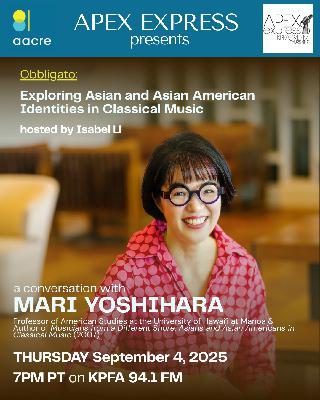
Asians and Asian Americans are numerous within the classical music industry, but their identities are often politicized and racialized in this Eurocentric musical genre. For the third episode of Obbligato on APEX Express, Isabel Li discusses this intersection with Mari Yoshihara, Professor of American Studies at the University of Hawaiʻi at Mānoa and Professor at the Center for Global Education at the University of Tokyo, Japan; author of many books, including Musicians from a Different Shore: Asians and Asian Americans in Classical Music (2007) and Dearest Lenny: Letters from Japan and the Making of the World Maestro (2019). Tonight’s episode features music by Chinese American composer Zhou Tian.
To learn more about Mari and her work, please visit her website: https://www.mariyoshihara.com/index.html
Musicians from a Different Shore: https://tupress.temple.edu/books/musicians-from-a-different-shore-2
Dearest Lenny: https://global.oup.com/academic/product/dearest-lenny-9780190465780?cc=jp⟨=en&
Transcript
Opening: [00:00:00] Apex Express Asian Pacific expression. Community and cultural coverage, music and calendar, new visions and voices, coming to you with an Asian Pacific Islander point of view. It’s time to get on board the Apex Express.
00:00:53 Isabel Li
Good evening. You’re listening to KPFA 94.1 FM. My name is Isabel Li and I’m delighted to be hosting a new edition of Obbligato on Apex Express, which is a semimonthly segment specifically about AAPI identities in classical music. Tonight’s guest is someone I have been incredibly excited to speak to because her writings have actually very much informed my studies and research. In fact, her books are exactly about the subject matter of Obbligato. I am honored to be speaking to Mario Yoshihara, Professor of American Studies at the University of Hawaiʻi at Mānoa and Professor at the Center for Global Education at the University of Tokyo, Japan; author of many books, including Musicians from a Different Shore: Asians and Asian Americans in Classical Music, published in 2007, and Dearest Lenny: Letters from Japan and the Making of the World Maestro, which was published in 2019. Welcome to Obbligato on Apex Express. Mari, how are you doing?
00:01:55 Mari Yoshihara
I’m doing fine. Thank you for having me.
00:01:58 Isabel Li
Of course, my first question for you is how do you identify and what communities are you a part of?
00:02:06 Mari Yoshihara
Oh well, that’s actually a little bit complicated I am. I am a Japanese woman who have spent a little bit over well, maybe not more than a little more than half of my life in the United States. Born in New York but raised in Tokyo, educated mostly in Japan, but also earned my graduate degrees in the United States and most of my academic career has been in Hawaii, so I’ve been in American academia for almost 30 years now, but I also have a dual appointment with the University of Tokyo in Japan. So I split my time between Japan and Hawaii now.
00:02:54 Isabel Li
Can you tell us a little bit about your work and your books? I had a chance to read Musicians from a Different Shore, but how would you summarize your research to someone who might not have read your book?
00:03:04 Mari Yoshihara
So I am a scholar of American studies, which is an interdisciplinary field that has anything to do with America broadly defined. And within that, my area of expertise is about, well, I would say I’m a scholar of US cultural history. US Asian relations, mostly US, East Asian relations, especially in the cultural dimension, cultural studies, gender studies, Asian American studies, etc. And so I have written a number of books, both in English and Japanese, but the one that you’re referring to, Musicians from a Different Shore, is a book that I did research for more than 20 years ago and was published in 2007. It’s a study of Asians and Asian Americans and classical music. So it was partly historical in that I examined the ways. which Western music, so-called western classical music, was introduced to East Asia and how also East Asians became have become so successful and prominent in this field that is generally considered a white European elite art form, so it was partly historical, but then the rest of the book was based on my ethnographic field work and interviews among Asians and Asian Americans in classical music looking at how well who these people are in the first place and then also how musicians, Asian and Asian musicians themselves, understand the relationship between their racial and cultural identity on the one hand, and their practice of Western classical music on the other, so that was my study.
And then I also wrote another book called Dearest Lenny. It’s about—the subtitle is Letters from Japan and the Making of the World Maestro. It’s about Leonard Bernstein’s relationship with two very special individuals in Japan. And through that story, I interweave an account of various things. For one thing, how Leonard Bernstein became a world maestro and also the relationship between politics and arts, gender, sexuality, art and commerce, etcetera, etcetera. So that was my most recent book published in English and then, I’m sure we’ll talk more about this, but I’m currently doing a follow up research on the on Musicians from a Different Shore, taking into account all the changes that have been taking place in the classical music industry in the United States in the past, I would say five years or so especially so that’s my that’s the abbreviated version of my research.
00:05:55 Isabel Li
That’s really cool, and I also want to ask you about these changes, if you can talk a little bit about the classical music world. I feel like classical music is one of those genres that seems to be unchanging on the outside. But as a scholar of classical music, what types of changes have you observed that has influenced how AAPI identities play into this world?
00:06:18 Mari Yoshihara
Yeah, I think especially in the last, I would say, yeah, 5 to 10 years, especially in the last five years, classical music industry in the United, I mean I say specifically in the United States because I don’t see the similar kind of changes taking place in Japan where I’m currently located. And I also don’t really know the situation in Europe. But the field of classical music in the US is changing. I think most significantly because of movements like the Black Lives Matter movement and also with the onset of COVID and the rise of anti Asian hate, there’s been a lot more heightened awareness about how issues of race and also class shapes classical music. So there’s a lot more vibrant conversations and debates about these topics in the industry and also in terms of AAPI community, are the biggest changes, the biggest change I’m seeing is that Asian and Asian American musicians themselves are being a lot more vocal and active in issues of race and racism in the field and there I’ve encountered many Asian and Asian American musicians who have, for instance, you know organized events or organizations, or taken up various forms of advocacy and activism on these issues. So compared to, say, 20 years ago, 20, 25 years ago, when I was doing the original research, I see a lot more kind of, you know, explicit awareness and awareness and articulation of these issues by Asian and Asian American musicians themselves.
00:08:12 Isabel Li
That’s really interesting. Just because classical music is also one of those genres, that doesn’t seem like a genre that most people explicitly associate with politics or activism. What are some examples of these, like activist movements that you’ve observed within the Asian American community in classical music?
00:08:32 Mari Yoshihara
So for instance, some Asian and Asian American musicians are are becoming a lot more vocal about the actual like racism or sexism that they have themselves experienced, or that they witness in the industry, like in in schools, conservatories, orchestras, opera companies, etc. Either through the media or you know their own writing, and also like speaking up within the organizations that they work in. So that’s one. There are other kinds of advocacy and activism in that they demand more diverse repertoire, and I think the repertoire is in terms of the industry industry changes. That’s the area that’s changing the most, the the kind of repertoire that many orchestras for instance perform have become a lot more– I mean overall it’s still very white, European centered– but in terms of the actual numbers of pieces that are performed, works by living, composers and composers of color, women composers, etcetera. That is significantly increased in the last 10 years and that is, you know significantly to do with the advocacy and activism on the part of, you know, artists of color.
So yeah, so things like that and then, you know, many Asian, Asian American artists are doing their own programming, for instance, like event organizing programming. So yeah, those are the areas that I see changes. I see things happening that I didn’t see 25 years ago.
00:10:20 Isabel Li
Definitely. I remember reading your book, and your book has been published since 2007, so a lot of changes have happened since then. But in general, when you did your research at first, what how would you summarize the dynamic of Asian identities, Asian American identities in this very Eurocentric field, it’s a juxtaposition of two different cultures and identities that a lot of people also observe in orchestras. There’s a large population of Asian and Asian American musicians, conductors just in general. It’s a very large population, but yet this identity is still not quite represented in media. It’s not quite seen, so talk to us a bit about this juxtaposition and how you observe these dynamics in your research.
00:11:10 Mari Yoshihara
Yeah. So. The thing is, Asians and Asian Americans are indeed numerically overrepresented in classical m
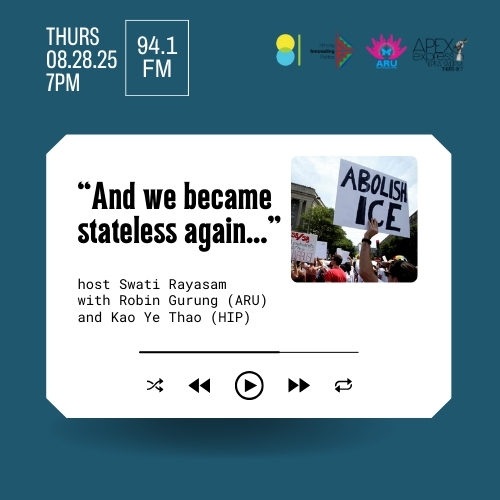
A weekly magazine-style radio show featuring the voices and stories of Asians and Pacific Islanders from all corners of our community. The show is produced by a collective of media makers, deejays, and activists.
Important Links:
Hmong Innovating Politics: Website | Instagram
Asian Refugees United: Website | Instagram
Bhutanese American Refugee Rights website
Transcript
Swati Rayasam: You are tuned in to Apex Express on KPFA. My name is Swati Rayasam.
Since the onset of the Trump administration, immigrant and refugee communities have been under increased attack, being kidnapped in broad daylight, detained in unsanitary and unsafe conditions, and deported to countries many of them barely know. All without due process or communication to their loved ones and communities.
On tonight’s episode, we’re focusing on a particular segment of our immigrant and refugee community, Hmong and Bhutanese refugees.
Both of these targeted communities are stateless with no land to call their own, and their deportation carries the very real danger of disappearance and death. Robin Gurung from Asian Refugees United and Kao Ye Thao from Hmong innovating Politics, discuss their community and personal refugee stories, and talk about the intersection of the US’ deeply broken immigration and criminal legal systems, otherwise known as crimmigration.
We also get to hear from the wives of two detained refugees, one Bhutanese and one Hmong, who are currently fighting to keep their families together and to protect their loved ones from the dangers of deportation as stateless people.
I also want to note because this is a rapidly developing situation, that this episode was recorded on August 13th, 2025, and is being released on August 28th, 2025.
For the most recent updates, please go to bhutaneserefugeerights.org or check out the Pardon Refugees campaign. Now, here’s Miko.
Miko: Welcome to Apex Express. Thank you so much for being here today. I’m so glad to bring you all together in this time. I’m wondering if I could ask you each to introduce yourselves and tell us a little bit about the community your organization serves and what you do, and let’s start with Kao Ye.
Kao Ye: Hello everyone, and thank you for making space- my name is Kao Ye Tao. I use she her pronouns, and I work as the director of policy and partnerships with an organization called Hmong Innovating Politics. We are an organization that serves Hmong youth and families in Sacramento and Fresno, which holds two of our largest Hmong American communities in California. And our work with Hmong youth and families is really about developing their leadership to organize towards social justice and to get the resources that their communities deserve.
Miko: Thank you, Kao Ye and Robin, could you please introduce yourself?
Robin: Sure. My name is Robin Gurung. I use he, him, his, I’m from the Nepali speaking Bhutanese community. I live in Harrisburg, Pennsylvania. my role at Asian Refugees United is the co-founder and the co-executive director. We have our program in California and Pennsylvania. California programs are, are serving Asian diaspora and then, Pennsylvania programs are focused serving the Nepal speaking Bhutanese community. We work in the intersection of arts and healing, storytelling, civic engagement, leadership development. Thank you.
Miko: Thanks Robin and I am your host Miko Lee, lead producer at Apex Express. And all of us are part of a network called AACRE Asian Americans for Civil Rights and Equality, which is a network of progressive Asian American groups.
So you all work with refugee populations. I’m wondering if you could tell a little bit more about the backstory of your community, and also if you feel comfortable about how you personally came to be a refugee in the United States. And, Robin, I’d love to start with you on that one.
Robin: Sure. My community is Nepali speaking, Bhutanese refugee community. And we are ethnically Nepali, which means culture wise and language wise we speak Nepali and follow the Nepali culture tradition. Our ancestors like maybe in 18 hundreds, 19 hundreds migrated from Nepal to Bhutan and became the citizen of that country.
And most people don’t know about Bhutan, it’s a very tiny country between China and India. And, if people know about Bhutan, then people know it through the cross national happiness concept, Bhutan is considered the happiest country in the world.
So our ancestors were in mostly in the southern area of Bhutan for generations, they became the citizen. They had their own home, their own land. And then later, 1980s, early nineties, there was a policy by the government of Bhutan, which is the monarchy government system- king rules the country. They brought a policy called One Nation, One People Policy. Which means all different groups of people would have to follow the same culture, same religion, kind of follow the same dress code and because of that policy all people were forced to stay away from following our own culture or our own religion, which, most of our folks were Hindu. Our people protested against it and because of that, the government expelled over a hundred thousand of our community members.
And, they expelled to India and then from like India wouldn’t allow us to stay and we had to resettle in Nepal in seven different refugee camps under different international agencies like U-N-H-C-R and other agencies.
Miko: And then Robin, can you tell a little bit about your personal story and how you came here?
Robin: Yeah. Yeah. So 1992 is when my family had to leave Bhutan. And at that time I was three years old. I remember growing up in a refugee camp in Nepal, from three years until I was 23 years. So 20 years of my life I was in a refugee camp in Nepal. And in 2012, I came to US through the refugee resettlement program introduced to our camps in 2008, and through it US agreed to resettle 60,000 of our committee members. By 2017, I think US has resettled about 70 to 80,000 of our Bhutanese community members.
Miko: Thank you so much for sharing. Kao Ye I wonder if you could talk about your community and the refugee resettlement program that your community was a part of.
Kao Ye: The Hmong American community, or just the Hmong community overall, is a group that’s indigenous to East and Southeast Asia. And through our ancient history, we’ve always been a stateless, people fighting for our autonomy to live to practice our customs and our culture. And particularly where we come into this history of refugee is during the Vietnam War where many Hmong people, alongside other ethnic groups in Laos, were caught in the crossfire of the United States conflict in Southeast Asia.
And so with the Vietnam War. The Hmong as well as many other ethnic communities that lived, in the hills and the mountains were recruited in covert operations by the CIA to fight back against the Vietnamese, the Northern Vietnamese communist forces, as well as the Putet Lao. And so once the US withdrew from Southeast Asia, it created a vacuum of conflict and violence that our people had to escape from in order to survive. And so after the Vietnam War in 1975, we saw the mass displacement of many Southeast Asian ethnic communities, including Hmong families. And that is where my history starts because my parents were born in Laos and because of this war, they fled to Thailand refugee camps and lived there for a few years until they were able to come to the United States in 1992. And I’m actually I’m a child of refugees and so what I know about this part of my history comes from the stories of my grandparents who raised me as well as what little I could learn in the textbooks of public education.
And so it wasn’t actually until going to college and. Being able to access more of this literature, this history that I really learned about what the United States had done in Southeast Asia and the ramifications of that for myself and my family and so many others, refugees that. Have to have had to resettle in the United States.
And so it’s definitely a history that runs very close, because we have relatives that live through that refugee experience. And so it is very well and alive. And so as we now approach this conversation around ICE and deportations, it really is a reminder of the trauma that our people face, but are still facing as a people that have been seen as disposable to the United States government.
Miko: Thanks, Kao Ye. Let’s talk a little bit more about that. But first I wanna say, did either of you ever hear about refugees in your textbooks? I never did. So I’m wondering if, you said you learned a little bit about that from textbooks. Was that something you learned in public education.
Kao Ye: I did not learn about refugees or refugees experience. I learned about the war and as a Hmong kid it brought me so much delight to try to scroll through the history books just to see if Hmong people were mentioned. And even then the refugee experience was not ever something that we talked about.
I felt like definitely not in, in high school. I think it was college really, that then started to articulate those terms and that Southeast Asian identity, that is really where I think I also became politicized in that.
Miko: Yeah, because I think in textbooks there might be a little section on the Vietnam War, but it does not talk about the, all the Southeast Asian ethnic peoples that actually fought in the war. We have to dig that information out on our own, but I wanna move us to what is happening right now.
So the Trump administration has created. Culture of fear among immigrants and refugees, these ICE raids and disappearances. It is so intense and using immigrants as a fear tool to prop up white supremacy is so blatant right now. I’m wondering if you can each talk about, how this administration’s policies are impacting your communities. And, Robin, let’s start with you. What is happening right now? I know since the end of March, can you share a little b
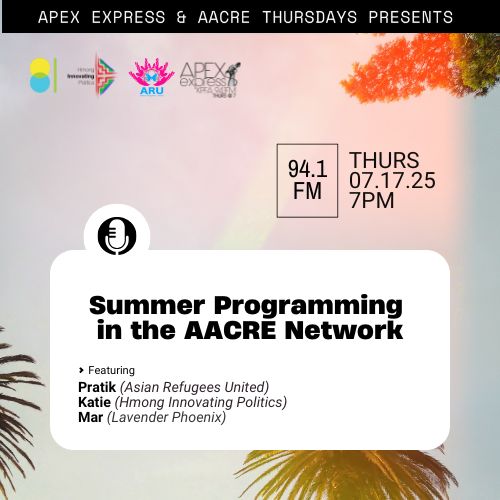
A weekly magazine-style radio show featuring the voices and stories of Asians and Pacific Islanders from all corners of our community. The show is produced by a collective of media makers, deejays, and activists.
Important Resources:
Asian Refugees United: Website | Instagram |
Learn about the Disappearances of Bhutanese American refugees: Website | Toolkit
Hmong Innovating Politics: Website | Instagram
Lavender Phoenix: Website | Instagram
Minjoona Music: Instagram
Transcript:
Cheryl (Host): Good evening. You’re tuned in to Apex Express. I’m your host, Cheryl, and tonight we’re diving into the vibrant summer programming happening across the AACRE network. That’s the Asian Americans for Civil Rights and Equality Network. AACRE is made up of 11 Asian American social justice organizations working together to build collective power and create lasting movements .
Throughout tonight’s show, we’ll be spotlighting a few of these groups [00:01:00] and the incredible work they’re leading this summer. First up, we’re joined by Pratik from Asian refugees United Pratik. Thank you so much for being here. Do you mind introducing yourself and to kick things off in the spirit of tonight’s show, maybe share what’s something that’s been bringing you joy this summer?
Pratik (ARU): Hello, namaste everyone. My name is Pratik Chhetri. He, him. I’m the program manager at ARU, Asian Refugees United in Pennsylvania.
I’m originally from Nepal. I grew up in Nepal. I am an immigrant, came to the for college long time ago. And I’ve been working in social justice, health justice field for over 15 years now. Initially it was mostly around advocacy policy relating to access to medicines, issues, especially in lower and middle income countries, and the past six, seven.
More than seven [00:02:00] years. I also started an organization, a nonprofit organization in Nepal, that works at the intersection of social, economic and climate justice. And with ARU, I got introduced to ARU back in 2020. So by that time I had some skills that I felt I could bring to the community. Even though I’m not from Bhutanese refugee community, I speak the language, I understand the culture to a certain extent. So I felt with the linguistic skill I could be of some help. I think right around that time COVID happened, everything and end of 2021 is when I reconnected with Robin and started talking about possibilities. For about two years, I was part of the CAMP for Emerging Leaders, the leadership program ARU has, and [00:03:00] starting last year, early this year formally, I am a staff, for ARU. I’m in charge of programs under wellness, education, and civic engagement largely but depending on time and resources, I become available for other programs as well. It’s a joy working with ARU. I was just telling Cheryl earlier that it doesn’t feel like work ‘ cause I enjoy it, working with people, getting to work on impactful programs, and being a part of an organization that has so much potential, so much responsibility, but also trying to find new ways to become, useful for the community. That’s very exciting. Yeah.
Cheryl (Host): That’s great. I’m glad that your work is what’s bringing you joy this summer. That’s so special. And before we get into some of that impactful programming that you’ve been running this summer, could you [00:04:00] tell us a little bit about, ARU, Asian Refugees United
Pratik (ARU): Sure. ARU started back in 2016 in California and back then all of the programs used to be in California. The community that ARU serves since then, and even to this day are Nepali speaking, Bhutanese refugee community and Vietnamese community, Korean and other Pan-Asian community.
After the pandemic, there has been a lot of secondary migration of the Bhutanese folks from across the United States to two major locations. One being central PA around Harrisburg area and Pennsylvania, and the second one around Columbus, Ohio, and other major cities in Ohio. The secondary migration mostly to Pennsylvania triggered a, shifting of ARU programs, to Pennsylvania as well in addition to [00:05:00] California. So at this point in 2025, the Pennsylvania side of ARU caters to the Nepali speaking Bhutanese folks. And the California side of ARU works with Vietnamese, Korean, and other Asian communities. I work with the Pennsylvania, ARU, and here we have four different pillars around health and wellness, education, art and storytelling. And the fourth one is civic engagement, and that is the newest one. I can talk about programs under each of the pillars but for summer the programs that is bringing me joy, not only for me, but also ARU’s staffs is this longitudinal five month long leadership program called Camp for Emerging Leaders, where we recruit Nepali speaking folks from all across United States, and they go through virtual sessions every other [00:06:00] week on, history to the story of displacement, intergenerational trauma. How it started, how it used to be back in Bhutan, how it used to be in the refugee camps in Nepal, and now how it is in the US and Canada, wherever they are. So end of summer, end of July, early August is when all of those cohort members, the youth leaders will come physically to Harrisburg and we’ll spend a few days here connecting with each other, building that trust, but also working together to build projects for the community, addressing community challenges that’s happening. And for that I think five or six of the ARU staff from California are also coming. We have guest speakers. I think one of them is coming from all the way from Australia. It’s fun. Largely I think [00:07:00] I’m looking forward to meeting with all of these youth leaders who have so much potential to do, so much good, not only for Bhutanese community, Nepali speaking, south Asian community, but also, their potential goes beyond that, yeah.
Cheryl (Host): It is powerful to hear how ARU’s work has evolved and now spans across the nation, and also how Camp for Emerging Leaders is creating space for Nepali speaking Bhutanese youth to reflect their community’s history, build deep connections, and grow as leaders. You mentioned that during the summer youth leaders gather in Harrisburg to create community projects. Could you share more about what kinds of projects they’re working on and what kind of issues they’re hoping to address?
Pratik (ARU): For education, one of the main ones that we just concluded is, so we started high school success program called First Step Forward. And the interesting thing, the exciting thing about this program [00:08:00] is the concept of First Step forward from one of the Camp for Emerging Leaders cohort from two years ago. And similarly so that’s how most of ARU programs have been. The ARU Youth Center, the ARU Office, that concept also started from the camp for emerging leaders.
There are a couple other programs ARU does. Youth Wellness Day. That started from the camp as well. For the First Step Forward, what we do is early winter of, I think January or February we accepted a cohort of 10. These were high school juniors and seniors, and largely the purpose of the program is to make sure that they are well equipped for college and for any other professional avenues they end up going even if higher education is not for them. We did a lot of like leadership sessions, public speaking [00:09:00] sessions, like how to write essays, how to apply for different scholarships. We just concluded it literally last Saturday, we went hiking and went to one of the Six Flags amusement parks. But learning from that program, we are scaling it up. We’re taking 20 people next year, and we will do it a year long cohort. So starting from September up until May, June. We’ll integrate college tours, not only for the kids, but also for their family because in Bhutanese community and Nepali speaking folks a lot of the times the parents do not understand how the system works, even with their best intent and best intention. So along with the students, it is very important for us to work with the family, the parents as much as possible to take them through the process, right? On education, we also do a lot of cultural navigation training to [00:10:00] different county level and different governance agencies. Some of the cultural navigation trainings that we did in the past year that I can think of is we did one for the. Panel of judges from Dauphin County, which is where Harrisburg is. We did similar thing for different school districts in Dauphin and Cumberland County, different nearby counties for juvenile probation unit, child and youth services. And while we do that, as an organization, it gave us a better sense of where the gaps are, especially for parents to run into difficulties. ’cause a lot of times, for example, if a kid is sent home with a sheet of paper, even when it’s bilingual, because their movement happened from Nepal to Bhutan, such a long time ago, a lot of the folks in the community speak the language but do not understand how to read or write the [00:11:00] language. So there are double language barrier, right? When a kid is called into a meeting or a disciplinary meeting, the parents a lot of times don’t even look at the sheet of paper or don’t know where to show up or how to show up or what to expect. Based on those things we’re using that knowledge and experience to design further programs in the future. That’s just for education. With civic engagement, for example, this 2024 cycle was the first election for our community members to vote in their lifetime. Back in Bhutan they didn’t have that opportunity and then they spent decades in refugee camps, and it took most of them some time to get the green cards and five years after Green card to secure their citizenship. So we saw a lot of even elderly folks show up to voting. That was their first time that they were voting. And when that happens, it’s not [00:12:00] just generic voter education. It’s teaching
A weekly magazine-style radio show featuring the voices and stories of Asians and Pacific Islanders from all corners of our community. The show is produced by a collective of media makers, deejays, and activists.
In this two-part series of Oakland Asian Cultural Center’s “Let’s Talk” podcast Eastside Arts Alliance is featured. Elena Serrano and Susanne Takehara, two of the founders of Eastside Arts Alliance, and staff member Aubrey Pandori will discuss the history that led to the formation of Eastside and their deep work around multi-racial solidarity.
Transcript:
Let’s Talk podcast episode 9
[00:00:00] Emma: My name is Emma Grover, and I am the program and communications coordinator at the Oakland Asian Cultural Center, known also as OACC. Today we are sharing the ninth episode of our Let’s Talk Audio Series. Let’s Talk is part of OACC’S Open Ears for Change Initiative, which was established in 2020. With this series, our goals are to address anti-Blackness in the APIA communities, discuss the effects of colorism and racism in a safe space, and highlight Black and Asian solidarity and community efforts specifically in the Oakland Chinatown area. Today’s episode is a round table discussion with Elena Serrano, Susanne Takahara, and Aubrey Pandori of Eastside Arts Alliance.
[00:00:53] Aubrey: Hello everybody. This is Aubrey from Eastside Arts Alliance, and I am back here for the second part of our Let’s Talk with Suzanne and Elena. We’re gonna be talking about what else Eastside is doing right now in the community. The importance of art in activism, and the importance of Black and Asian solidarity in Oakland and beyond.
So I am the community archivist here at Eastside Arts Alliances. I run CARP, which stands for Community Archival Resource Project. It is a project brought on by one of our co-founders, Greg Morozumi. And it is primarily a large chunk of his own collection from over the years, but it is a Third World archive with many artifacts, journals, pens, newspapers from social movements in the Bay Area and beyond, international social movements from the 1960s forward. We do a few different programs through CARP. I sometimes have archival exhibitions. We do public engagement through panels, community archiving days. We collaborate with other community archives like the Bay Area Lesbian Archives and Freedom Archives here in Oakland and the Bay Area. And we are also working on opening up our Greg Morozumi Reading Room in May. So that is an opportunity for people to come in and relax, read books, host reading groups, or discussions with their community. We’re also gonna be opening a lending system so people are able to check out books to take home and read. There’ll be library cards coming soon for that and other fun things to come.
[00:02:44] So Suzanne, what are you working on at Eastside right now?
[00:02:48] Susanne: Well, for the past like eight or nine years I’ve been working with Jose Ome Navarrete and Debbie Kajiyama of NAKA Dance Theater to produce Live Arts and Resistance (LAIR), which is a Dance Theater Performance series. We’ve included many artists who, some of them started out here at Eastside and then grew to international fame, such as Dohee Lee, and then Amara Tabor-Smith has graced our stages for several years with House Full of Black Women. This year we’re working with Joti Singh on Ghadar Geet: Blood and Ink, a piece she choreographed, and shot in film and it’s a multimedia kind of experience. We’ve worked with Cat Brooks and many emerging other artists who are emerging or from all over, mostly Oakland, but beyond. It’s a place where people can just experiment and not worry about a lot of the regulations that bigger theaters have. Using the outside, the inside, the walls, the ceiling sometimes. It’s been an exciting experience to work with so many different artists in our space.
[00:04:03] Elena: And I have been trying to just get the word out to as many different folks who can help sustain the organization as possible about the importance of the work we do here. So my main job with Eastside has been raising money. But what we’re doing now is looking at cultural centers like Eastside, like Oakland Asian Cultural Center, like the Malonga Casquelord Center, like Black Cultural Zone, like the Fruitvale Plaza and CURJ’s work. These really integral cultural hubs. In neighborhoods and how important those spaces are.
[00:04:42] So looking at, you know, what we bring to the table with the archives, which serve the artistic community, the organizing community. There’s a big emphasis, and we had mentioned some of this in the first episode around knowing the history and context of how we got here so we can kind of maneuver our way out. And that’s where books and movies and posters and artists who have been doing this work for so long before us come into play in the archives and then having it all manifest on the stage through programs like LAIR, where theater artists and dancers and musicians, and it’s totally multimedia, and there’s so much information like how to keep those types of places going is really critical.
[00:05:28] And especially now when public dollars have mostly been cut, like the City of Oakland hardly gave money to the arts anyway, and they tried to eliminate the entire thing. Then they’re coming back with tiny bits of money. But we’re trying
to take the approach like, please, let’s look at where our tax dollars go. What’s important in a neighborhood? What has to stay and how can we all work together to make that happen?
[00:05:52] Susanne: And I want to say that our Cultural Center theater is a space that is rented out very affordably to not just artists, but also many organizations that are doing Movement work, such as Palestinian Youth Movement, Bala, Mujeres Unidas Y Activas, QT at Cafe Duo Refugees, United Haiti Action Committee, Freedom Archives, Oakland Sin Fronteras, Center for CPE, and many artists connected groups.
[00:06:22] Aubrey: Yeah, I mean, we do so much more than what’s in the theater and Archive too, we do a lot of different youth programs such as Girl Project, Neighborhood Arts, where we do public murals. One of our collective members, Angie and Leslie, worked on Paint the Town this past year. We also have our gallery in between the Cultural Center and Bandung Books, our bookstore, which houses our archive. We are celebrating our 25th anniversary exhibition.
[00:06:54] Susanne: And one of the other exhibits we just wrapped up was Style Messengers, an exhibit of graffiti work from Dime, Spy and Surge, Bay Area artists and Surge is from New York City, kind of illustrating the history of graffiti and social commentary.
[00:07:30] Elena: We are in this studio here recording and this is the studio of our youth music program Beats Flows, and I love we’re sitting here with this portrait of Amiri Baraka, who had a lot to say to us all the time. So it’s so appropriate that when the young people are in the studio, they have this elder, magician, poet activist looking at him, and then when you look out the window, you see Sister Souljah, Public Enemy, and then a poster we did during, when Black Lives Matter came out, we produced these posters that said Black Power Matters, and we sent them all over the country to different sister cultural centers and I see them pop up somewhere sometimes and people’s zooms when they’re home all over the country. It’s really amazing and it just really shows when you have a bunch of artists and poets and radical imagination, people sitting around, you know, what kind of things come out of it.
[00:08:31] Aubrey: I had one of those Black Power Matters posters in my kitchen window when I lived in Chinatown before I worked here, or visited here actually. I don’t even know how I acquired it, but it just ended up in my house somehow.
[00:08:45] Elena: That’s perfect. I remember when we did, I mean we still do, Malcolm X Jazz Festival and it was a young Chicana student who put the Jazz Festival poster up and she was like, her parents were like, why is Malcolm X? What has that got to do with anything? And she was able to just tell the whole story about Malcolm believing that people, communities of color coming together
is a good thing. It’s a powerful thing. And it was amazing how the festival and the youth and the posters can start those kind of conversations.
[00:09:15] Aubrey: Malcolm X has his famous quote that says “Culture is an indispensable weapon in the freedom struggle.” And Elena, we think a lot about Malcolm X and his message here at Eastside about culture, but also about the importance of art. Can we speak more about the importance of art in our activism?
[00:09:35] Elena: Well, that was some of the things we were touching on around radical imagination and the power of the arts. But where I am going again, is around this power of the art spaces, like the power of spaces like this, and to be sure that it’s not just a community center, it’s a cultural center, which means we invested in sound good, sound good lighting, sprung floors. You know, just like the dignity and respect that the artists and our audiences have, and that those things are expensive but critical. So I feel like that’s, it’s like to advocate for this type of space where, again, all those groups that we listed off that have come in here and there’s countless more. They needed a space to reach constituencies, you know, and how important that is. It’s like back in the civil rights organizing the Black church was that kind of space, very important space where those kind of things came together. People still go to church and there’s still churches, but there’s a space for cultural centers and to have that type of space where artists and activists can come together and be more powerful together.
[00:10:50] Aubrey: I think art is a really powerful way of reaching people.
[00:10:54] Elena: You know, we’re looking at this just because I, being in the development

A weekly magazine-style radio show featuring the voices and stories of Asians and Pacific Islanders from all corners of our community. The show is produced by a collective of media makers, deejays, and activists.
On tonight’s edition of Obbligato on APEX Express, which focuses on AAPI artists, musicians, and composers in the classical music world, host Isabel Li is joined by LA based performer and composer Richard An, who plays and creates new avant-garde music, usually with the ensemble House on Fire, and his music has been performed by the LA Phil and the Calder Quartet to name a few. Join us in our conversation, exploring the possibilities of avant-garde music, raising questions regarding Asian identities in the classical music world, and Richard’s insights on art making during a time when Trump’s cuts to the NEA are affecting artists and institutions nationwide.
Featured Music: Sonatrinas: https://richardan.bandcamp.com/album/sonatrinas i got the electroshock blues: https://rasprecords.bandcamp.com/album/i-got-the-electroshock-blues
RICHARD AN (b.1995) is a performer and composer, born and raised in Los Angeles.
Richard plays new music – usually with House on Fire – co-founded the tiny backpack new music series, and has performed with Monday Evening Concerts’ Echoi Ensemble, Piano Spheres, The Industry and on Bang on a Can’s LOUD Weekend. Richard plays piano and percussion, and has been known to sing, conduct, and teach. Richard’s music has been performed by the Los Angeles Philharmonic Orchestra, Calder Quartet, HOCKET, C3LA, and more. His music has been released on CMNTX Records. Richard has a BM in Composition from USC and an MFA from CalArts. He is on faculty at the Pasadena Waldorf School, Glendale Community College and Harvard-Westlake. He plays taiko and tabla, and makes YouTube videos. Learn more about Richard’s work on his website: https://richardanmusic.com/ Richard’s social media: https://www.instagram.com/richardanmusic/
If you are in LA and want hear Richard’s work, he’s playing with House on Fire at the Sierra Madre Playhouse on August 17! https://www.sierramadreplayhouse.org/event/richardan2025
Transcript
Opening: [00:00:00] APEX Express. Asian Pacific expression. Community and cultural coverage, music and calendar, new visions and voices, coming to you with an Asian Pacific Islander point of view. It’s time to get on board the APEX Express.
00:00:46 Isabel Li
Good evening and welcome back to a new episode of Apex Express on KPFA, 94.1 FM. We are bringing you an Asian and Asian American view from the Bay and around the world. I’m your host, Isabel Li, and tonight is a new edition of Obbligato, which explores AAPI identities and classical music.
Tonight I’m joined by LA based performer and composer Richard An, who plays and creates new avant-garde music, usually with the ensemble House on Fire, and his music has been performed by the LA Phil and the Calder Quartet to name a few. Join us in our conversation, exploring the possibilities of avant-garde music, raising questions regarding Asian identities in the classical music world, and Richard’s insights on art making during a time when Trump’s cuts to the NEA are affecting artists and institutions nationwide.
00:01:41 Isabel Li
Welcome to the show. Welcome to APEX Express, Richard. My first question for you is how do you identify and what communities would you say that you’re a part of?
00:01:50 Richard An
My name is Richard An I use he/him pronouns and I’m a second generation Korean American. My parents are both Korean. My dad came from Busan, which is a large city in South Korea, and my mom was born in Seoul and then moved to South America and then made her way up to Los Angeles where they met. And as for identity, like, I think Korean American would be the most accurate one. This is and I think an ever evolving part of first of all my identity and the way that it intersects with my practice and also I think that’s the case with many Asian American artists, I mean artists from immigrant families, you know, the the matter of your identity, especially if you feel more distanced from it for one reason or another, is like an unsolved question for everyone like there is no one answer. That works for people and that’s a thing that me people like myself I think will be exploring for our entire lives. When I introduce myself to people, I say that I’m a classical musician. And at the very core of it, that is true. That’s not a lie. And I am, you know, a part of the classical music community in Los Angeles. But as time goes on, I have noticed and realized. That I tend to align myself more with like the avant-garde and experimental contemporary music communities of Los Angeles, which has certainly an overlap with the classical community, both in practice and historically, but yeah, I I would say those are the sort of two biggest ones, classical musicians and experimental avant-garde, contemporary musicians, whatever label you want to use for that.
00:03:47 Isabel Li
Yeah. Some of our listeners might not know what avant-garde music entails. Can you — how would you describe avant-garde music to someone who might not be as familiar with this particular movement?
00:03:57 Richard An
Yeah. So avant-garde music, a sort of flippant and joking way to to talk about it is ugly music or music. You know, my dad, for example, wouldn’t like, but I think. It’s music that either interfaces with elements or confronts facets or issues in music that aren’t typical of other kinds of music. The music that you might hear that is labeled of on guard might be noisy or dissonant or uncomfortable, or any kind of, you know, adjectives that are synonyms for noisy or ugly, but I have come to love that kind of music, you know 1. Because of the the kind of questions that they might ask about our perceptions of music and two, because I guess one way to put it is that to be a classical musician, you need to be in a practice room for many hours a day for many years and go to what is unfortunately a college, which is usually very expensive and I guess for lack of a better term, paywalled for like you need to have the kind of resources that allow you to attend a four year undergrad and then a two year masters and then a three-year doctorate. But avant-garde music, contemporary music, experimental music doesn’t necessitate that kind of thing. Often those musicians do have a background that gives them some amount of, you know, virtuosity or facility in an instrument. But like some of the best experimental musicians. Alive and some of the best ones that I know have no, like extensive training in a particular instrument and some may not have a degree in music at all. And that’s one thing that I in like that separates it from classical music is that.
00:05:44 Richard An
Classical music can be, unfortunately a little bit exclusionary. I don’t think by any one specific design, but the fact that you need so many hours and very specific instructions from a mentor that necessitate that kind of relationship. But experimental music, I think does a little bit better job of diversifying or making it feel more equitable.
00:06:12 Isabel Li
That’s a great point, actually. One of my questions following up with that was what do you think is possible with this genre, which you kind of mentioned earlier with perhaps how this genre makes classical music a little bit more equitable for those who are interested in this field. In your experience, composing, what do you think makes the genre special, and how do you go about it?
00:06:35 Richard An
One thing that I’ve noticed about being involved in the sort of contemporary experimental avant-garde music sphere is that it makes me a better listener, and I think other people who attend these concerts will agree. Like for example a large part of this kind of music is drone or repetition or, you know, like long spans of unchanging sound. And if the the sound that is being produced at face value is not changing, well then what do you notice about it? What do you grab on to and one of the most, I think, gratifying experiences is listening deeper and realizing that, ohh, even though you know for example this piano playing two notes for 30 minutes might not like the instructions will say to do the same thing for 30 minutes, but your experience as a human being will certainly change over those 30 minutes, even if the the notes are not like you will notice the slight fluctuations in the way that someone is playing, you will notice the beating patterns in the pitches on an instrument that may not be perfectly in tune, you will note other ambient sounds, you will note like you will notice so much more about the world when you are confronted with the kind of music that you know. You can say it forces you to listen to these sounds but also invites you to listen to these things. And I think that’s really, really special. That’s not to say that that can’t happen with other kinds of music. Or even with classical music. Surely you know there are many, many ways to listen to everything. But I’ve noticed this within myself. When I listen to long, repetitive drone based music that it really opens my ears and makes me a more active participant as a listener.
00:08:30 Isabel Li
It’s a great point actually. Part of my work– because I studied music, history and theory in college– was how music can engage various listeners to participate. Have you composed anything that perhaps engages the listener in this more of a participatory setting?
00:08:47 Richard An
Yeah. So I guess in order the some of the stuff that I’ve done to engage the audience, I guess both literally, and maybe more figuratively is, I wrote a piece last year for the Dog Star festival, which is a a contemporary and experimental music festival that is actually happening right now, at the time of this recording. It’s a multi week long festival that focuses on music of this type that was founded by people in the sort of
A weekly magazine-style radio show featuring the voices and stories of Asians and Pacific Islanders from all corners of our community. The show is produced by a collective of media makers, deejays, and activists.
The post APEX Express – July 31, 2025 appeared first on KPFA.
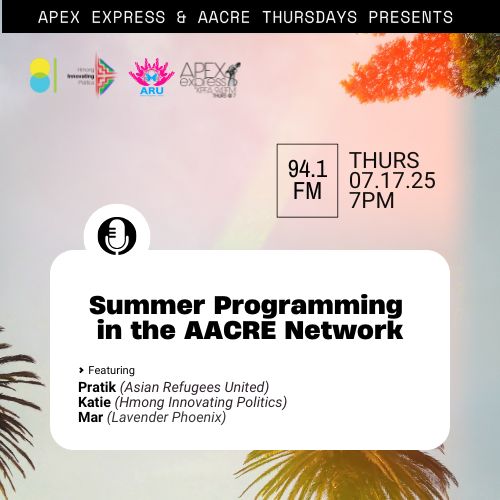
A weekly magazine-style radio show featuring the voices and stories of Asians and Pacific Islanders from all corners of our community. The show is produced by a collective of media makers, deejays, and activists.
Important Resources:
Asian Refugees United: Website | Instagram |
Learn about the Disappearances of Bhutanese American refugees: Website | Toolkit
Hmong Innovating Politics: Website | Instagram
Lavender Phoenix: Website | Instagram
Minjoona Music: Instagram
Transcript:
Cheryl (Host): Good evening. You’re tuned in to Apex Express. I’m your host, Cheryl, and tonight we’re diving into the vibrant summer programming happening across the AACRE network. That’s the Asian Americans for Civil Rights and Equality Network. AACRE is made up of 11 Asian American social justice organizations working together to build collective power and create lasting movements .
Throughout tonight’s show, we’ll be spotlighting a few of these groups [00:01:00] and the incredible work they’re leading this summer. First up, we’re joined by Pratik from Asian refugees United Pratik. Thank you so much for being here. Do you mind introducing yourself and to kick things off in the spirit of tonight’s show, maybe share what’s something that’s been bringing you joy this summer?
Pratik (ARU): Hello, namaste everyone. My name is Pratik Chhetri. He, him. I’m the program manager at ARU, Asian Refugees United in Pennsylvania.
I’m originally from Nepal. I grew up in Nepal. I am an immigrant, came to the for college long time ago. And I’ve been working in social justice, health justice field for over 15 years now. Initially it was mostly around advocacy policy relating to access to medicines, issues, especially in lower and middle income countries, and the past six, seven.
More than seven [00:02:00] years. I also started an organization, a nonprofit organization in Nepal, that works at the intersection of social, economic and climate justice. And with ARU, I got introduced to ARU back in 2020. So by that time I had some skills that I felt I could bring to the community. Even though I’m not from Bhutanese refugee community, I speak the language, I understand the culture to a certain extent. So I felt with the linguistic skill I could be of some help. I think right around that time COVID happened, everything and end of 2021 is when I reconnected with Robin and started talking about possibilities. For about two years, I was part of the CAMP for Emerging Leaders, the leadership program ARU has, and [00:03:00] starting last year, early this year formally, I am a staff, for ARU. I’m in charge of programs under wellness, education, and civic engagement largely but depending on time and resources, I become available for other programs as well. It’s a joy working with ARU. I was just telling Cheryl earlier that it doesn’t feel like work ‘ cause I enjoy it, working with people, getting to work on impactful programs, and being a part of an organization that has so much potential, so much responsibility, but also trying to find new ways to become, useful for the community. That’s very exciting. Yeah.
Cheryl (Host): That’s great. I’m glad that your work is what’s bringing you joy this summer. That’s so special. And before we get into some of that impactful programming that you’ve been running this summer, could you [00:04:00] tell us a little bit about, ARU, Asian Refugees United
Pratik (ARU): Sure. ARU started back in 2016 in California and back then all of the programs used to be in California. The community that ARU serves since then, and even to this day are Nepali speaking, Bhutanese refugee community and Vietnamese community, Korean and other Pan-Asian community.
After the pandemic, there has been a lot of secondary migration of the Bhutanese folks from across the United States to two major locations. One being central PA around Harrisburg area and Pennsylvania, and the second one around Columbus, Ohio, and other major cities in Ohio. The secondary migration mostly to Pennsylvania triggered a, shifting of ARU programs, to Pennsylvania as well in addition to [00:05:00] California. So at this point in 2025, the Pennsylvania side of ARU caters to the Nepali speaking Bhutanese folks. And the California side of ARU works with Vietnamese, Korean, and other Asian communities. I work with the Pennsylvania, ARU, and here we have four different pillars around health and wellness, education, art and storytelling. And the fourth one is civic engagement, and that is the newest one. I can talk about programs under each of the pillars but for summer the programs that is bringing me joy, not only for me, but also ARU’s staffs is this longitudinal five month long leadership program called Camp for Emerging Leaders, where we recruit Nepali speaking folks from all across United States, and they go through virtual sessions every other [00:06:00] week on, history to the story of displacement, intergenerational trauma. How it started, how it used to be back in Bhutan, how it used to be in the refugee camps in Nepal, and now how it is in the US and Canada, wherever they are. So end of summer, end of July, early August is when all of those cohort members, the youth leaders will come physically to Harrisburg and we’ll spend a few days here connecting with each other, building that trust, but also working together to build projects for the community, addressing community challenges that’s happening. And for that I think five or six of the ARU staff from California are also coming. We have guest speakers. I think one of them is coming from all the way from Australia. It’s fun. Largely I think [00:07:00] I’m looking forward to meeting with all of these youth leaders who have so much potential to do, so much good, not only for Bhutanese community, Nepali speaking, south Asian community, but also, their potential goes beyond that, yeah.
Cheryl (Host): It is powerful to hear how ARU’s work has evolved and now spans across the nation, and also how Camp for Emerging Leaders is creating space for Nepali speaking Bhutanese youth to reflect their community’s history, build deep connections, and grow as leaders. You mentioned that during the summer youth leaders gather in Harrisburg to create community projects. Could you share more about what kinds of projects they’re working on and what kind of issues they’re hoping to address?
Pratik (ARU): For education, one of the main ones that we just concluded is, so we started high school success program called First Step Forward. And the interesting thing, the exciting thing about this program [00:08:00] is the concept of First Step forward from one of the Camp for Emerging Leaders cohort from two years ago. And similarly so that’s how most of ARU programs have been. The ARU Youth Center, the ARU Office, that concept also started from the camp for emerging leaders.
There are a couple other programs ARU does. Youth Wellness Day. That started from the camp as well. For the First Step Forward, what we do is early winter of, I think January or February we accepted a cohort of 10. These were high school juniors and seniors, and largely the purpose of the program is to make sure that they are well equipped for college and for any other professional avenues they end up going even if higher education is not for them. We did a lot of like leadership sessions, public speaking [00:09:00] sessions, like how to write essays, how to apply for different scholarships. We just concluded it literally last Saturday, we went hiking and went to one of the Six Flags amusement parks. But learning from that program, we are scaling it up. We’re taking 20 people next year, and we will do it a year long cohort. So starting from September up until May, June. We’ll integrate college tours, not only for the kids, but also for their family because in Bhutanese community and Nepali speaking folks a lot of the times the parents do not understand how the system works, even with their best intent and best intention. So along with the students, it is very important for us to work with the family, the parents as much as possible to take them through the process, right? On education, we also do a lot of cultural navigation training to [00:10:00] different county level and different governance agencies. Some of the cultural navigation trainings that we did in the past year that I can think of is we did one for the. Panel of judges from Dauphin County, which is where Harrisburg is. We did similar thing for different school districts in Dauphin and Cumberland County, different nearby counties for juvenile probation unit, child and youth services. And while we do that, as an organization, it gave us a better sense of where the gaps are, especially for parents to run into difficulties. ’cause a lot of times, for example, if a kid is sent home with a sheet of paper, even when it’s bilingual, because their movement happened from Nepal to Bhutan, such a long time ago, a lot of the folks in the community speak the language but do not understand how to read or write the [00:11:00] language. So there are double language barrier, right? When a kid is called into a meeting or a disciplinary meeting, the parents a lot of times don’t even look at the sheet of paper or don’t know where to show up or how to show up or what to expect. Based on those things we’re using that knowledge and experience to design further programs in the future. That’s just for education. With civic engagement, for example, this 2024 cycle was the first election for our community members to vote in their lifetime. Back in Bhutan they didn’t have that opportunity and then they spent decades in refugee camps, and it took most of them some time to get the green cards and five years after Green card to secure their citizenship. So we saw a lot of even elderly folks show up to voting. That was their first time that they were voting. And when that happens, it’s not [00:12:00] just generic voter education. It’s teaching
A weekly magazine-style radio show featuring the voices and stories of Asians and Pacific Islanders from all corners of our community. The show is produced by a collective of media makers, deejays, and activists.
The post APEX Express – July 10, 2025 appeared first on KPFA.

Comments

Download from Google Play

Download from App Store
 United States