


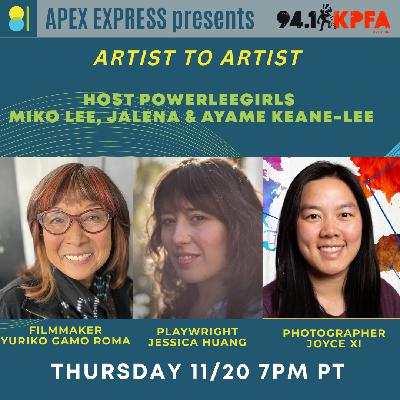
APEX Express – 11.20.25 – Artist to Artist
Description
 A weekly magazine-style radio show featuring the voices and stories of Asians and Pacific Islanders from all corners of our community. The show is produced by a collective of media makers, deejays, and activists.
Powerleegirl hosts, the mother daughter team of Miko Lee, Jalena & Ayame Keane-Lee speak with artists about their craft and the works that you can catch in the Bay Area. Featured are filmmaker Yuriko Gamo Romer, playwright Jessica Huang and photographer Joyce Xi.
More info about their work here:
Jessica Huang’s Mother of Exiles at Berkeley Rep
Joyce Xi’s Our Language Our Story at Galeria de la Raza
Show Transcript
Opening: [00:00:00 ] Apex Express Asian Pacific expression. Community and cultural coverage, music and calendar, new visions and voices, coming to you with an Asian Pacific Islander point of view. It’s time to get on board the Apex Express.
Ayame Keane-Lee: [00:00:46 ] Thank you for joining us on Apex Express Tonight. Join the PowerLeeGirls as we talk with some powerful Asian American women artists. My mom and sister speak with filmmaker Yuriko Gamo Romer, playwright Jessica Huang, and photographer Joyce Xi. Each of these artists have works that you can enjoy right now in the Bay Area.
First up, let’s listen in to my mom Miko Lee chat with Yuriko Gamo Romer about her film Diamond Diplomacy.
Miko Lee: [00:01:19 ] Welcome, Yuriko Gamo Romer to Apex Express, amazing filmmaker, award-winning director and producer. Welcome to Apex Express.
Yuriko Gamo Romer: [00:01:29 ] Thank you for having me.
Miko Lee: [00:01:31 ] It’s so great to see your work after this many years. We were just chatting that we knew each other maybe 30 years ago and have not reconnected. So it’s lovely to see your work. I’m gonna start with asking you a question. I ask all of my Apex guests, which is, who are your people and what legacy do you carry with you?
Yuriko Gamo Romer: [00:01:49 ] Oh, who are my people? That’s a hard one. I guess I’m Japanese American. I’m Asian American, but I’m also Japanese. I still have a lot of people in Japan. That’s not everything. Creative people, artists, filmmakers, all the people that I work with, which I love. And I don’t know, I can’t pare it down to one narrow sentence or phrase. And I don’t know what my legacy is. My legacy is that I was born in Japan, but I have grown up in the United States and so I carry with me all that is, technically I’m an immigrant, so I have little bits and pieces of that and, but I’m also very much grew up in the United States and from that perspective, I’m an American. So too many words.
Miko Lee: [00:02:44 ] Thank you so much for sharing. Your latest film was called Diamond Diplomacy. Can you tell us what inspired this film?
Yuriko Gamo Romer: [00:02:52 ] I have a friend named Dave Dempsey and his father, Con Dempsey, was a pitcher for the San Francisco Seals. And the Seals were the minor league team that was in the West Coast was called the Pacific Coast League They were here before the Major League teams came to the West Coast. So the seals were San Francisco’s team, and Con Dempsey was their pitcher. And it so happened that he was part of the 1949 tour when General MacArthur sent the San Francisco Seals to Allied occupied Japan after World War II. And. It was a story that I had never heard. There was a museum exhibit south of Market in San Francisco, and I was completely wowed and awed because here’s this lovely story about baseball playing a role in diplomacy and in reuniting a friendship between two countries. And I had never heard of it before and I’m pretty sure most people don’t know the story. Con Dempsey had a movie camera with him when he went to Japan I saw the home movies playing on a little TV set in the corner at the museum, and I thought, oh, this has to be a film. I was in the middle of finishing Mrs. Judo, so I, it was something I had to tuck into the back of my mind Several years later, I dug it up again and I made Dave go into his mother’s garage and dig out the actual films. And that was the beginning. But then I started opening history books and doing research, and suddenly it was a much bigger, much deeper, much longer story.
Miko Lee: [00:04:32 ] So you fell in, it was like synchronicity that you have this friend that had this footage, and then you just fell into the research. What stood out to you?
Yuriko Gamo Romer: [00:04:41 ] It was completely amazing to me that baseball had been in Japan since 1872. I had no idea. And most people,
Miko Lee: [00:04:49 ] Yeah, I learned that too, from your film. That was so fascinating.
Yuriko Gamo Romer: [00:04:53 ] So that was the first kind of. Wow. And then I started to pick up little bits and pieces like in 1934, there was an American All Star team that went to Japan. And Babe Ruth was the headliner on that team. And he was a big star. People just loved him in Japan. And then I started to read the history and understanding that. Not that a baseball team or even Babe Ruth can go to Japan and prevent the war from happening. But there was a warming moment when the people of Japan were so enamored of this baseball team coming and so excited about it that maybe there was a moment where it felt like. Things had thawed out a little bit. So there were other points in history where I started to see this trend where baseball had a moment or had an influence in something, and I just thought, wow, this is really a fascinating history that goes back a long way and is surprising. And then of course today we have all these Japanese faces in Major League baseball.
Miko Lee: [00:06:01 ] So have you always been a baseball fan?
Yuriko Gamo Romer: [00:06:04 ] I think I really became a fan of Major League Baseball when I was living in New York. Before that, I knew what it was. I played softball, I had a small connection to it, but I really became a fan when I was living in New York and then my son started to play baseball and he would come home from the games and he would start to give us the play by play and I started to learn more about it. And it is a fascinating game ’cause it’s much more complex than I think some people don’t like it ’cause it’s complex.
Miko Lee: [00:06:33 ] I must confess, I have not been a big baseball fan. I’m also thinking, oh, a film about baseball. But I actually found it so fascinating with especially in the world that we live in right now, where there’s so much strife that there was this way to speak a different language. And many times we do that through art or music and I thought it was so great how your film really showcased how baseball was used as a tool for political repair and change. I’m wondering how you think this film applies to the time that we live in now where there’s such an incredible division, and not necessarily with Japan, but just with everything in the world.
Yuriko Gamo Romer: [00:07:13 ] I think when it comes down to it, if we actually get to know people. We learn that we’re all human beings and that we probably have more in common than we give ourselves credit for. And if we can find a space that is common ground, whether it’s a baseball field or the kitchen, or an art studio, or a music studio, I think it gives us a different place where we can exist and acknowledge That we’re human beings and that we maybe have more in common than we’re willing to give ourselves credit for. So I like to see things where people can have a moment where you step outside of yourself and go, oh wait, I do have something in common with that person over there. And maybe it doesn’t solve the problem. But once you have that awakening, I think there’s something. that happens, it opens you up. And I think sports is one of those things that has a little bit of that magical power. And every time I watch the Olympics, I’m just completely in awe.
Miko Lee: [00:08:18 ] Yeah, I absolutely agree with you. And speaking of that kind of repair and that aspect that sports can have, you ended up making a short film called Baseball Behind Barbed Wire, about the incarcerated Japanese Americans and baseball. And I wondered where in the filmmaking process did you decide, oh, I gotta pull this out of the bigger film and make it its own thing?
Yuriko Gamo Romer: [00:08:41 ] I had been working with Carrie Yonakegawa. From Fresn





 United States
