


 Claim Ownership
Philosophics
— Philosophical and Political Ramblings
Subscribed: 5Played: 256
Subscribe

© Bry Willis
Description
Join me as I relate with the world philosophically.
This content can also be found on my blog: https://philosophicsblog.wordpress.com
This content can also be found on my blog: https://philosophicsblog.wordpress.com
335 Episodes
Reverse

Many people conflate ownership with control, but this is a limited perspective. This perspective bleeds in democracy, where there is only an illusion of control. I discuss this in this brief segment. Come listen.
This episode is also available as a blog post: https://philosophicsblog.wordpress.com/2021/05/04/ownership-and-democracy/
This podcast is an extension of the Philosophics blog at http://philosophicsblog.wordpress.com, where you can find related content.
Patreon site: https://www.patreon.com/philosophics
YouTube: https://www.youtube.com/channel/UCjiu3TlvFJw59SDByK0-yCg

In this philosophical essay, Bry Willis argues against the concept of unmediated access to reality, suggesting that truth is not a gift but an earned practice. He contends that facts are not simple, neutral pieces of the world but are instead stabilised closures formed through institutional agreement and repeated human encounter. Rather than viewing language and mediation as barriers that distance us from the world, the author frames them as the essential conditions for any encounter with existence. Reality, according to the text, reveals itself most clearly through constraint and resistance—the moments when our models fail and our expectations collapse. Ultimately, the source advocates for a "refusal of innocence," urging readers to accept that knowledge is always mediated and never a final, perfect mirror of nature.👉 http://philosophics.blogSource Video: 👉 https://www.youtube.com/watch?v=DbUatLXVq4c

The provided text explores the moral contamination reflex, a social phenomenon where applying rigorous logic to sensitive taboos is interpreted as evidence of guilt or hidden desire. By drawing on thinkers like Michel Foucault and Hannah Arendt, the author argues that modern discourse often pathologises inquiry, treating the act of neutral analysis as a form of confession or endorsement. Rather than refuting an argument’s merits, society frequently reframes the speaker as a villain to avoid confronting the logical inconsistencies within its own moral norms. This defensive mechanism ensures that emotional consensus remains unchallenged by dismissing intellectual distance as a betrayal of communal values. Ultimately, the source suggests that liberal societies punish those who scrutinise the structural seams of their laws to maintain a façade of moral certainty.👉 https://philosophics.blog/2025/01/02/when-logic-becomes-evidence-of-guilt/

In this reflective essay, Bry Willis introduces post-position thinking as a rejection of the modern pressure to adopt static, simplified intellectual labels. The author argues that modernism's desire to build and postmodernism’s drive to deconstruct both mistakenly treat philosophy as a final destination rather than an ongoing process. Instead of adhering to rigid ideologies for the sake of administrative convenience, Willis advocates for a philosophy of intellectual maintenance. This approach prioritises continuous repair and context-driven responses over the comfort of tidy, predictable stances. By embracing complexity and instability, the text suggests that true moral work lies in staying responsive to reality rather than defending a pre-packaged worldview. Ultimately, the source serves as a manifesto for intellectual honesty, valuing the messy work of navigation over the false clarity of a fixed position.https://philosophics.blog/

This research by Bry Willis examines the contradiction between how democratic participation is justified and how it is actually managed. While political theorists often claim that suffrage is grounded in rational competence and autonomy, the author argues that modern states actually allocate rights using arbitrary proxies, such as age thresholds. These categorical boundaries fail to reflect individual capacity, yet they are maintained because they provide administrative stability and ease of governance. Ultimately, the paper concludes that competence talk functions as a stabilising rhetoric that makes inclusion seem principled while masking the arbitrary nature of legal boundaries. By highlighting this disjunction, Willis suggests that the gap between theory and practice is a structural necessity for maintaining democratic legitimacy.👉 https://philosophics.blog/2025/12/26/democracy-competence-and-the-curious-case-of-the-missing-test/

The provided text explores the social repercussions that occur when individuals apply rigorous logic to deeply sensitive moral taboos. Using the historical example of French intellectuals and modern debates on legal age thresholds, the author argues that society often views rational analysis as a form of moral guilt. This "moral contamination reflex" suggests that merely questioning a law's philosophical consistency is frequently misinterpreted as an endorsement of harmful behaviour. Consequently, the author asserts that liberal societies prioritise emotional consensus over intellectual inquiry, treating logic as a personal liability rather than a tool for clarity. This process ultimately ensures that legal frameworks remain incoherent because the act of scrutinising them is itself treated as a moral transgression.👉 https://philosophics.blog/2025/12/30/statutory-rape-is-an-outdated-concept/

This critique deconstructs the opening sentence of the Declaration of Independence, arguing that its famous claims are rhetorical tools rather than logical truths. The author contends that the term "self-evident" functions as a labour-saving device designed to bypass critical inquiry and enforce political silence. By examining the text clause by clause, the source suggests that the document’s universal language intentionally masked strict social exclusions based on literacy and status. Ultimately, the analysis presents the Declaration as a prototype of political engineering where rights are not inherent, but are administratively granted or revoked based on who is granted the status of personhood. The author concludes that the sentence's conceptual vagueness is a functional necessity that allows it to maintain moral authority while remaining operationally evasive.👉 https://philosophics.blog/2025/12/27/we-hold-these-truths-an-annotated-failure/

The provided text argues that "good" and "bad" are not objective truths but rather subjective signals used to coordinate social behaviour and express approval. These labels act as tools of power, allowing institutions like the law or religion to flatten complex, multi-valent situations into a single, enforced verdict. True moral complexity is often overridden by authority, which uses both punishment and mercy to train individuals and maintain control. Ultimately, the author suggests that moral certainty is a retroactive justification for power rather than a discovery of universal facts. This perspective reframes ethics as a system of material consequences and social management rather than a reflection of metaphysical reality.👉 https://philosophics.blog/2025/12/26/good-bad-and-the-quiet-arithmetic-of-power/
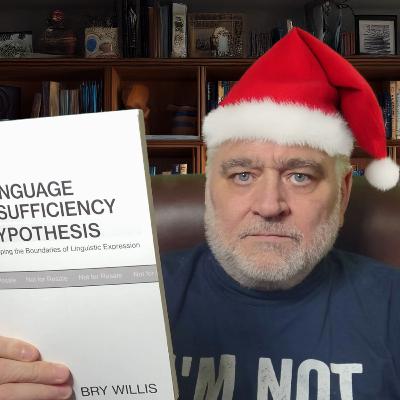
In this reflective essay, the author examines the concept of legibility through the lens of a viral video featuring a deaf child interacting with Santa Claus. While usually critical of how institutions simplify and flatten human identity for efficiency, the writer argues that true visibility occurs when a performance adapts to the individual rather than forcing the individual to conform. By using sign language, the performer moves beyond mere commercial spectacle to offer a rare moment of genuine recognition that does not diminish the child’s complexity. The text suggests that meaningful human connection arises when we are seen on our own terms rather than being treated as curated metrics or marketing segments. Ultimately, the piece champions a form of porous artifice where rituals become flexible enough to accommodate the specific needs of others.

The provided text explores the hidden philosophical infrastructure of retributive justice, focusing on how the concepts of fairness and commensurability dictate legal outcomes. The author argues that fairness is not an objective metric but a rhetorical tool used to legitimise systemic decisions after they have already been made. Central to this process is commensurability, the mandatory assumption that diverse human harms can be quantified on a single mathematical scale. This framework creates a scalar model of value that suppresses alternative perspectives, such as the belief that certain losses are categorically incomparable. Consequently, the legal system pathologises those who reject these comparisons, labelling their dissent as unreasonable or emotional. Ultimately, the source suggests that justice functions like a rigged game where participants mistake procedural fluency for absolute truth.👉 https://philosophics.blog/2025/12/24/the-felt-beneath-the-table/

This text argues that the legal system operates like a rigged casino, where the "house" secures specific outcomes by pre-selecting the metaphysical rules of the game. The author contends that justice relies on artificial ontological assumptions, such as the existence of a continuous self and robust individual agency, to ensure that responsibility and punishment can be easily assigned. By favouring linear causation and discrete choice points, the law intentionally ignores complex factors like systemic pressure or psychological fragmentation that would make cases harder to resolve. This framework suggests that "reasonableness" acts as a tool for cultural enforcement, silencing atypical perspectives to maintain institutional stability. Ultimately, the source claims that true legal reform is impossible without challenging these hidden philosophical foundations that prioritise administrative efficiency over objective truth. Since the system is designed to terminate cases rather than discover reality, any debate within the courtroom remains a form of rigged theatre.👉 https://philosophics.blog/2025/12/23/footnotes-from-the-house-justice-as-a-casino-game/
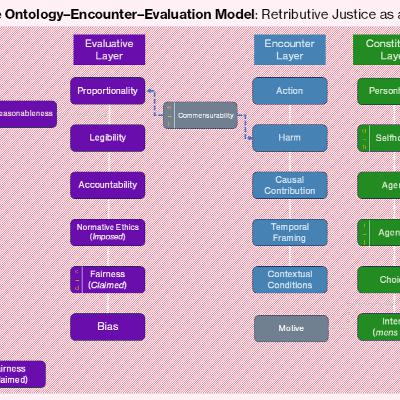
The provided text introduces the Ontology–Encounter–Evaluation Model, a framework that characterises retributive justice as a manufactured product rather than a moral discovery. By applying the Language Insufficiency Hypothesis, the author argues that justice systems rely on unspoken ontological assumptions regarding personhood and agency that are imposed rather than debated. The model illustrates a three-layered process where power dictates which harms are visible and which identities are valid before any judgment occurs. This "justice engine" functions by forcibly closing uncertainty, transforming subjective assessments into an appearance of objective inevitability. Consequently, deep-seated legal disagreements are often not about facts, but about incompatible metaphysical premises that the system refuses to acknowledge. Ultimately, the source suggests that justice is a fragile assembly that remains functional only by silencing alternative ways of understanding the world.👉 https://philosophics.blog/2025/12/21/the-ontology-encounter-evaluation-model-retributive-justice-as-an-instantiation/
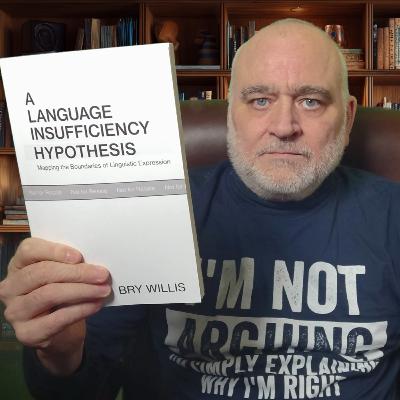
In this personal reflection, the author introduces the Language Insufficiency Hypothesis, a concept suggesting that human communication often fails because our words cannot support the heavy social and legal burdens we place upon them. Drawing from a lifelong perspective as an outsider, the writer challenges the validity of subjective legal terms like fairness and reasonableness, arguing that these "weasel words" mask deep-seated ontological disagreements. The text posits that people frequently operate under a false illusion of agreement because their individual interpretations of a single word may overlap only slightly. Ultimately, the author suggests that when linguistic meaning breaks down at these fundamental levels, institutional power and authority inevitably step in to resolve the resulting conflicts. This work serves as a critique of the civic myths that assume shared understanding is always possible through more education or context. 👉 https://philosophics.blog/2025/12/20/a-history-of-language-insufficiency/

In this blog post, author Bry Willis announces the publication of his latest book, which explores the Language Insufficiency Hypothesis. Although the writer has released nine previous works under various names, he considers this specific philosophical project his most significant achievement to date. The text describes his rigorous editing process, noting how he condensed a much larger manuscript into a concise 132-page volume. Willis reflects on the unique physicality of a bound book compared to digital drafts and outlines his immediate plans for a page-by-page review. The source also hints at future expansions of these ideas and mentions public academic discourse regarding the book's core concepts. Finally, the author emphasises that this post serves as a personal milestone announcement rather than a traditional marketing effort.📖 https://philosophics.blog/2025/12/18/proof-language-insufficiency-hypothesis/

The source, an essay by language philosopher Bry Willis, explores how everyday grammar subtly enforces deep philosophical assumptions and contributes to institutional "gatekeeping" within philosophy. Willis uses the seemingly trivial example of how different languages express feeling cold—as something one "is" (I am cold) versus something one "has" (I have cold)—to argue that grammatical structures are never neutral. These linguistic habits, which the author calls "ontological scaffolding," predispose speakers toward certain metaphysical commitments regarding identity, possession, and consciousness. The essay suggests that this subtle influence of language makes certain philosophical traditions, like the Analytic or Continental divide, feel intuitively correct to their practitioners, and further argues that institutional peer review systems maintain these divisions by rejecting hybrid work as a "genre violation." Ultimately, the text proposes that philosophers must examine the linguistic foundations of their questions, especially because grammatical comfort is often mistaken for ontological agreement.👉 https://philosophics.blog/2025/12/19/cold-grammar-and-the-quiet-gatekeeping-of-philosophy/

The source, an excerpt from a philosophical blog post titled "Cold, Aliens, and the Grammar That Thinks It Knows Too Much," presents a socio-political and philosophical musing that critically examines the relationship between language, grammar, and metaphysical assumptions. The author, Bry Willis, shares a discussion that began elsewhere regarding whether one "is" cold, "has" cold, or merely "senses" it, using this linguistic variation (comparing être, avoir, and sentir) to argue that grammatical structures can deceptively imply underlying ontologies or essences, which the text refers to as a 'category error.' The central argument is that familiar grammatical scaffolding is often mistaken for shared metaphysics, and that slowing down the linguistic encounter, such as when considering how to translate concepts like 'cold' or communicate with aliens, exposes the philosophical work quietly performed by grammar itself. Ultimately, the post suggests that language does more than describe experience; it categorises it and dictates conceptual boundaries.👽 https://philosophics.blog/2025/12/18/cold-aliens-and-the-grammar-that-thinks-it-knows-too-much/

The provided text, "The Ontological Fragility of Retributive Justice," argues that disagreements over concepts like justice and retribution are not technical but ontological, meaning they stem from fundamentally different background assumptions rather than simple miscommunication. The author employs the Language Insufficiency Hypothesis (LIH) to explain how clarifying terms such as choice, agency, responsibility, and desert often fractures their meaning instead of leading to consensus, as these terms rely on incompatible, assumed moral universes. To illustrate this fragility, the text uses a set of five Magic: The Gathering-themed cards representing these concepts, showing that retributive justice is a structure that collapses if its supporting metaphysical assumptions (like contra-causal choice) are removed. Ultimately, the essay concludes that retribution persists not because it is inevitable, but because its core premises are left unexamined, operating as non sequiturs when viewed from an alternative, system-based ontology.👉 https://philosophics.blog/2025/12/18/justice-as-a-house-of-cards/

The source introduces the central premise of the upcoming book, A Language Insufficiency Hypothesis (LIH), by clarifying what the hypothesis is not concerned with and identifying its true focus. The author establishes that the LIH does not address trivial misunderstandings that are easily resolved with context, such as basic polysemy or syntactic jokes like the Groucho Marx line, since these examples show language merely being flexible, not fundamentally failing. Instead, the hypothesis concentrates on Contestables, which are terms like 'justice' or 'freedom' that appear stable but conceal structurally incompatible conceptual frameworks between different groups, leading to the illusion of shared meaning. The text argues that when these words are used, communication often proceeds only because the term is misleadingly taken as agreed upon, forcing concrete discussion to abandon the contested word to gain clarity. This abandonment, according to the author, confirms the primary insufficiency of language at complex conceptual levels, demonstrating that words can fundamentally mislead rather than just underperform.👉 http://philosophics.blog

This excerpt, drawn from "The Indeterminacy of Law and Morality," presents a highly personal and intellectual journey into the foundational flaws of jurisprudence. The author begins by describing their intense, continuous cycle of reading and writing, driven by caffeine and a relentless pursuit of clarity in their work. The narrative then shifts to the author’s use of AI tools like ChatGPT to refine arguments and discover essential, previously missed intellectual references, specifically highlighting the influence of Bernard Williams on their moral philosophy. The central crisis of the text revolves around the author's discovery of admissions in legal textbooks, such as those by Endicott, which openly state that law is fundamentally vague, its application is often unconstrained by rules, and its moral value is optional, suggesting it operates primarily as a power structure. This revelation causes the author significant professional distress, leading them to question the widespread wilful ignorance and silence within the legal profession regarding these inherent limitations of the rule of law.👉 https://philosophics.blog/2025/12/16/i-need-a-break/
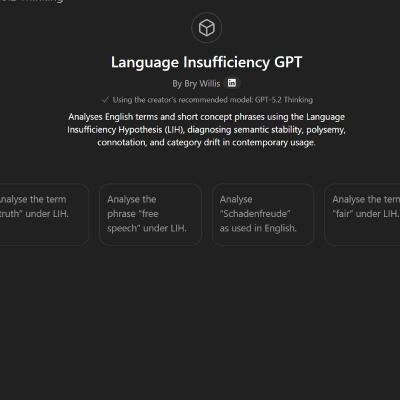
The provided text announces the launch of a new tool, the Language Insufficiency GPT, created in anticipation of the January 2026 publication of the author’s book, A Language Insufficiency Hypothesis. This GPT is designed to exploit a familiar failure mode in communication, which the author describes as the common assumption that language is stable and that concrete words mean what one thinks they mean. The core hypothesis suggests that while simple words like 'table' are reliable, abstract concepts such as 'freedom', 'justice', or 'truth' are inherently unstable units that allow people to glide over hard problems while sounding reasonable. The author presents the tool as something that can offer entertainment and mild discomfort before the book is released, challenging users to recognise when they are arguing with an opponent based on their own assumptions.👉 https://philosophics.blog/2025/12/15/meet-the-language-insufficiency-gpt/

Comments

Download from Google Play

Download from App Store
 United States