


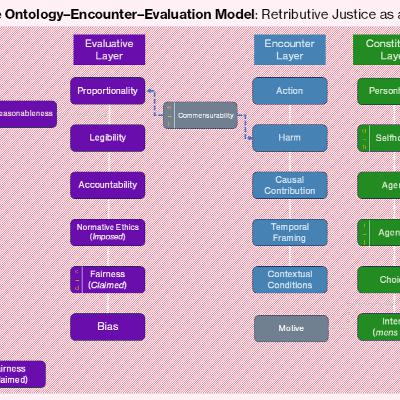
Ontology–Encounter–Evaluation Model: Retributive Justice
Description
The provided text introduces the Ontology–Encounter–Evaluation Model, a framework that characterises retributive justice as a manufactured product rather than a moral discovery. By applying the Language Insufficiency Hypothesis, the author argues that justice systems rely on unspoken ontological assumptions regarding personhood and agency that are imposed rather than debated. The model illustrates a three-layered process where power dictates which harms are visible and which identities are valid before any judgment occurs. This "justice engine" functions by forcibly closing uncertainty, transforming subjective assessments into an appearance of objective inevitability. Consequently, deep-seated legal disagreements are often not about facts, but about incompatible metaphysical premises that the system refuses to acknowledge. Ultimately, the source suggests that justice is a fragile assembly that remains functional only by silencing alternative ways of understanding the world.👉 https://philosophics.blog/2025/12/21/the-ontology-encounter-evaluation-model-retributive-justice-as-an-instantiation/





















 United States
