


 Claim Ownership
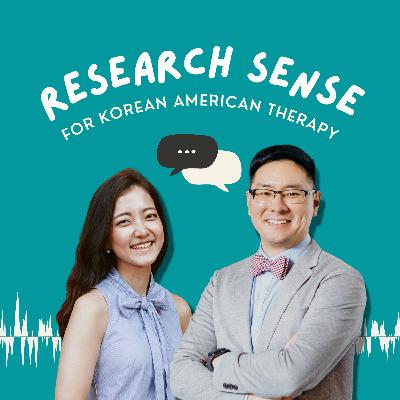
Research Sense for Korean American Therapy
Subscribed: 18Played: 44
Subscribe

© Samuel Y. Kim
Description
Dr. Samuel Y. Kim and Ms. Sharon Kim discuss the latest mental health research pertinent to Korean Americans in a way that can lead to actual change for therapists and clients. Each episode is a rundown of a research article and how it relates to mental health for Korean Americans. This podcast is for Korean American therapists, consumers of therapy, those who work with Korean Americans, and those just curious about research.
Dr. Kim is an associate professor at Texas Woman's University and Ms. Kim is the former Executive Director of the nonprofit organization, Mustard Seed Generation.
Dr. Kim is an associate professor at Texas Woman's University and Ms. Kim is the former Executive Director of the nonprofit organization, Mustard Seed Generation.
41 Episodes
Reverse
In this episode, we discuss a 2023 study on successful aging among Asian Americans, highlighting differences from models based on White Americans. While traditional models emphasize physical and mental health, mastery, and life engagement, the study identifies positive emotions and higher education as the key predictors of successful aging for Asian Americans. We also share personal stories about our grandparents to stress the importance of fostering relationships for positive aging experiences. Join us for our last episode of Season 4!
You can find the abstract here: https://psycnet.apa.org/record/2022-53108-001
In this episode, we uncover the hidden dynamics shaping the academic success of Asian American students. Is it all about "tiger parenting," or are there more profound influences at work? We explore the findings of Chang and Shi’s meta-analysis, revealing how warm family environments, supportive schools, and tight-knit communities create the foundation for thriving students. Contrary to the model minority myth, high-achieving students often come from warm and supportive homes rather than strict, authoritarian parenting. Join us as we unpack the pressures, myths, and truths that define the Asian American experience—and discover how families and communities can foster resilience and excellence without burning out.
You can find the abstract here: https://psycnet.apa.org/doiLanding?doi=10.1037%2Faap0000252
In this episode, we delve into the complexities of disordered eating and body image pressures that Asian American women experience. Despite eating disorders having the highest mortality rate of any mental illness, studies show that while 74% of individuals recognize their need for help, only 28% pursue treatment – and among Asian American women, this number drops to a mere 6%. Join us as we explore the nuances of navigating dual cultural expectations—both American and Asian—and how these can lead to heightened pressures around body ideals. This episode offers insight into the social, structural, and personal barriers preventing treatment and highlights the importance of family support and self-compassion in fostering healthier perspectives on body image.
You can find the abstract here: https://psycnet.apa.org/doiLanding?doi=10.1037%2Faap0000270
In this episode, we dive into a fascinating topic: the relationship between acculturation and the use of complementary and alternative medicine (CAM) among Asian Americans. While only one-third of Americans use alternative medicine practices like acupuncture, herbal remedies, and meditation, a striking 75% of Asian Americans engage in at least one form of CAM annually. From Sam's memories of his grandmother’s homemade hanyak to Sharon’s experiences with acupuncture, we bring personal stories that highlight the cultural significance and complexity of these practices. Tune in to learn how CAM is intertwined with cultural identity, generational differences, and the modern healthcare landscape, as well as what these findings mean for both Asian American patients and their healthcare providers.
You can find the abstract here: https://psycnet.apa.org/record/2022-53007-001
In this episode, we delve into the complex issue of intimate partner violence (IPV) among Korean Americans, discussing key insights from chapter 10 in Understanding Korean Americans’ Mental Health: A Guide to Culturally Competent Practices, Program Developments, and Policies. We uncover alarming statistics that show high rates of IPV in the Korean American community, explore unique cultural factors contributing to this issue—such as traditional patriarchal values, immigration stress, and cultural barriers—and discuss the stigma and barriers that hinder victims from seeking help. We also highlight encouraging developments, including faith leader training programs and community-based organizations working to support survivors. Tune in to learn more about these cultural nuances, the importance of education and awareness, and available resources for those affected.
You can find the abstract here: https://www.researchgate.net/publication/353445933_Intimate_Partner_Violence_among_Korean_Americans_in_the_United_States
In this episode, we unpack the "model minority" stereotype, exploring how it affects Asian Americans' self-esteem and identity. We trace the term’s origins to the 1960s, when it was used to praise Asian Americans for hard work and determination. Over time, however, it has evolved into a double-edged sword, setting unrealistic expectations and being weaponized to downplay systemic racism. We discuss how mindsets—whether fixed or growth-oriented—play a crucial role in how these stereotypes impact self-esteem, as explored in recent research. The study found that Asian Americans who internalize the "hard work" aspect often exhibit higher grit and self-esteem, whereas those with a fixed mindset tend to struggle more. We conclude with the implications for parents, educators, and therapists, emphasizing the importance of fostering growth mindsets to navigate these societal pressures.
You can find the abstract here: https://psycnet.apa.org/record/2024-42205-001
We’re diving into Chapter 1 of "Understanding Korean Americans’ Mental Health: A Guide to Culturally Competent Practices, Program Developments, and Policies.”
Join us as we unpack the critical issues facing Korean American youth and their families, drawing from groundbreaking research and poignant case studies. From academic pressures to identity crises, this episode offers a nuanced look at the unique mental health landscape of Korean American adolescents. We'll also explore the barriers to and facilitators of mental health service use, providing valuable insights for families and professionals alike. Whether you're a parent, a mental health practitioner, or simply interested in cross-cultural psychology, this episode promises to be an eye-opening and informative discussion that highlights the importance of culturally competent mental health care.
You can find the abstract here: https://psycnet.apa.org/record/2021-78166-013
We're delving into Chapter 7 of "Korean American Families in Immigrant America: How Teens and Parents Navigate Race" by Sumi Okazaki and Nancy Abelmann. In this episode, we focus on the Hyun family, who immigrated to the US in 2003 with their teenage sons. Their story offers a raw and authentic glimpse into the challenges of late immigration, cultural adaptation, and family dynamics. The chapter provides a unique perspective on the immigrant experience, following the family's journey from their initial struggles to a 10-year follow-up. Through the Hyuns' story, we reflect on the complexities of immigrant life, generational differences, and the ongoing process of finding one's place in a new country. Join us as we unpack these multifaceted experiences, drawing parallels to our own lives and gaining deeper insights into the Korean American immigrant experience.
Link to the book: https://nyupress.org/9781479836680/korean-american-families-in-immigrant-america/
We're diving into Chapter 5 of "Korean American Families in Immigrant America: How Teens and Parents Navigate Race" by Sumi Okazaki and Nancy Abelmann. This insightful ethnographic study explores the nuanced dynamics of Korean American families, focusing on the unique challenges and experiences they face. In our previous episode, we laid the groundwork for understanding the broader context of these stories. In this episode, we zoom in on the Park family. Mrs. Park, an accomplished musician, and her daughter Jenny, a high school student with a burgeoning musical career, exemplify the blend of cultural expectations and personal aspirations. Through their story, we explore themes of parental pressure, cultural identity, and the complexities of immigrant life. Join us as we reflect on these intricate relationships and how they mirror our own experiences, offering a rich tapestry of insights into the Korean American family experience.
Link to the book: https://nyupress.org/9781479836680/korean-american-families-in-immigrant-america/
Welcome back, everyone! We're excited to kick off Season Four with something a bit different. In this three-part series, we'll delve into the book Korean American Families in Immigrant America: How Teens and Parents Navigate Race by Sumi Okazaki and Nancy Abelman. This captivating work offers an in-depth exploration of the experiences of Korean American families, shedding light on their unique challenges and triumphs. Over the next three episodes, we'll unpack three chapters of this book, beginning with today's episode, where we set the stage by discussing the book's background and the fascinating methodologies used by the authors. Join us as we explore the intricate dynamics of these families and the profound insights that Okazaki and Abelman bring to the table.
Link to the book: https://nyupress.org/9781479836680/korean-american-families-in-immigrant-america
We are excited to announce that Season 3 is here! Co-hosts Dr. Samuel Kim and Sharon Kim share their experiences during the one-year hiatus and their goals for the upcoming season
We discuss a study entitled: The mediating role of Korean immigrant mothers' psychological well-being in the associations between social support and authoritarian parenting style by Seo, Cheah, Özdemir, Hart, Leung, & Sun published in 2018.
Many of us are familiar with strict parenting and may know of others who had a "tiger" mom growing up. What if the mother's "tiger mom-ness" was partially due to the mother's psychological well-being? Moreover, what if her psychological well-being was because of the loss of social supports after immigrating to the US? This study looks that the relationship among the mother's social supports, well-being, and authoritarian parenting style.
You can find the abstract here: https://psycnet.apa.org/record/2017-51188-001
We discuss a study entitled: Racial Discrimination, Distress, Coping Motives, and Alcohol-Related Problems Among U.S. - Born Asian American Young Adults by Iwamoto, Kane, Negi, Collado, Tofighi published in 2022.
It's not secret that there are a lot of Asian American college students who drink alcohol during their university days. But, does it mean that if a student drinks a beer, that it's a problem? Not exactly. This jumps into the nuance of not so much the problem of drinking, but the why these students drink as being the source of drinking problems.
You can find the abstract here: https://psycnet.apa.org/record/2022-18589-001
We discuss a study entitled: Willingness to use mental health counseling and antidepressants in older Korean Americans: the role of beliefs and stigma about depression by Park, Jang, and Chiriboga published in 2018.
There is considerable stigma against mental health within the Korean American community, but how does that stigma affect a vulnerable group such as older Korean Americans? This episode dives into a study looking at older Korean Americans and what contributes to their willingness to take medications and seek out professional help for mental health issues.
You can find the abstract here: https://pubmed.ncbi.nlm.nih.gov/27764962/
We discuss a study entitled: Predicting Psychological Distress Amid the COVID-19 Pandemic by Machine Learning: Discrimination and Coping Mechanisms of Korean Immigrants in the U.S. by Choi, Hong, Kim, & Park published in 2020.
The pandemic and acts of hate and racial discrimination all took a toll on the Korean and Asian American communities. Though there were many atrocities and so many people feeling burnt out, there were many who were able to carry on in some way. What was so special about those who were able to carry on and what does resilience really mean?
You can find the abstract here: https://pubmed.ncbi.nlm.nih.gov/32825349/
We discuss a study entitled: Culturally Specific Parent Mental Distress, Parent-Child Relations and Youth Depression Among Korean American Families by Yasui, Kim, and Choi published in 2018.
Families are a major part of a Korean American's mental health, whether it's the presence or absence of them, whether they provide resilience or bring about frustration. How do Korean American families talk about mental health? Why do immigrant parents so often talk about their digestion when there is something going on? And how does the family system contribute to the mental health of both the parents and the children?
You can find the abstract here: https://psycnet.apa.org/record/2018-29409-001
We discuss a study entitled: The Intersectional Prototypicality Model: Understanding the Discriminatory Experiences of Asian American Women and Men by Wong and McCullough published in 2021.
Why aren't you ___ enough? Whether that is being Asian, American, masculine, feminine, strong, and caring, Asian Americans experience a lot of discrimination. We go over a paper that discusses the Intersectional Prototypicality Model to help understand these discriminatory experiences such as Asian American women not being seen as leaders or Asian American men being viewed as unattractive in dating apps.
You can find the abstract here: https://psycnet.apa.org/record/2021-28159-001

We discuss a study entitled: Acculturative Strategies and Mental Distress Among Asian American College Students: The Role of Asian Values Across Acculturative Strategies by Suh, Goergen, Nelson, & Flores published in 2020.
It's not unusual to get asked or even being criticized for how Asian or American you're acting, especially as an Asian American. This article explores the nuances of that question and how it relates to the mental health of Asian Americans.
You can find the abstract here: https://psycnet.apa.org/record/2020-59608-001
We discuss a study entitled: Discrimination and Ethnic-Racial Socialization Among Youth Adopted from South Korea into White American Families by Schires, Buchanan, Lee, McGue, Iacono, and Burt published in 2018.
Thus far, the studies we have covered were largely about Asian or Korean Americans living with their Asian and Korean American families. This episode, we take a look at the experiences of Korean Americans who have been adopted into White American families and discuss what protects them from later mental health issues.
You can find the abstract here: https://srcd.onlinelibrary.wiley.com/doi/abs/10.1111/cdev.13167
We discuss a study entitled: Asian Americans’ Mental Health Help-Seeking Attitudes: The Relative and Unique Roles of Cultural Values and Ethnic Identity by Shahid, Weiss, Stoner, and Dewsbury published in 2021.
So few Asian Americans seek out mental health help. The authors of this paper thought that Asian American cultural values may be influencing the desire to seek out help from a mental health professional. Is it really possible that cultural values can have a part in whether or not we get help?
You can find the abstract here: https://psycnet.apa.org/record/2021-22808-001

Comments

Download from Google Play

Download from App Store
 United States