


 Claim Ownership
The ISO Show
Subscribed: 54Played: 1,855
Subscribe

© All rights reserved
Description
Blackmores is a pioneering consultancy firm with a distinctive approach to working with our clients to achieve and sustain high standards in Quality, Risk and Environmental Management. We'll be posting podcasts discussing ISO standards here very soon!
237 Episodes
Reverse

When embarking on your ISO journey, a crucial first step is evaluating your current level of compliance and identifying what gaps need to be filled to gain certification or fully align with a Standard. This is typically done by conducting a Gap Analysis. This exercise sets the foundations for your ISO Implementation project, from setting key actions and objectives, to resourcing and establishing a project timeline. In this episode, Ian Battersby dives into the purpose of a Gap Analysis, who should be involved in the exercise and what inputs and outputs you should expect to have from conducting a Gap Analysis. You'll learn · What is a Gap Analysis? · What is the aim of a Gap Analysis? · What is the process of conducting a Gap Analysis? · Who should be involved in a Gap Analysis? · What inputs should be included in a Gap Analysis? · What outputs can you expect from a Gap Analysis? Resources · Isologyhub In this episode, we talk about: [02:05] Episode Summary – Ian Battersby dives into the first step on any ISO Implementation journey, breaking down what a Gap Analysis is, it's purpose and what you should expect to get out of conducting one. [02:50] What is a Gap Analysis?: Simply put, it's the start of the process. It's a key to understanding where an organisation is right now and establishing what it needs to do on its journey to ISO certification. But it's not just for certification, as certification isn't always what people are trying to achieve. Many businesses opt to align themselves to a standard to ensure they're doing the right thing, but may not go through with full certification. [04:05] Who is the aim of a Gap Analysis? The objective of a Gap Analysis is to carry out a review of your organisation against the requirements of the respective standard. This will help to establish the following: · Areas where you conform to the standard, where you may have established the required processes, procedures, roles, responsibilities, systems, methods, documents · Areas of nonconformity, where such things will need to be developed · You may partly conform, so it's important to understand that as well From that understanding, you can build key actions, timescales and responsibilities for implementing an ISO Standard. It's also very useful to leadership; to clarify what's needed, to look at priorities, to resource what's required and to establish a timeline to your end goal. [06:25] What is the process of conducting a Gap Analysis? It's important to do this in a very structured manner. It's also important to get access to existing documentation and personnel in key roles; they'll be helpful during the gap analysis in providing understanding. You'll need to evaluate your current level of compliance against the following clauses within your desired ISO Standard(s): 4 Context: Understanding the world in which you operate, the people and organisations which are important to you. This is where you will determine the scope of your system (what to include, what parts of the standard are relevant). 5 Leadership: Top management's commitment, how involved they are, their accountability and their commitment to resourcing, promoting, to giving people authority through clear roles and responsibilities. 6 Planning: This is about assessing risks and opportunities; understanding the uncertainty caused by your operating environment (context). It also involves setting objectives and then establishing meaningful plans to address the risks/opportunities and objectives; mitigations; establishing controls; operational processes. 7 Support: This is where you look at people, competence Infrastructure and environment (are your facilities/equipment appropriate to what you need to do). You will also need to identify what you need to monitor and measure to demonstrate the effectiveness of your ISO Management System. Next, you need to cover awareness and communication, i.e. how do you make people aware of your system, policy, processes; what do you tell other interested parties? Lastly, ensure you address how you control the documentation which supports your system. 8 Operation: This address the delivery of a product or service to the customer, including all the processes for doing so. For example, in ISO 9001 this clause defines what's required when designing, developing, controlling externally provided products/services and controlling anything which goes wrong. This is typically the clause that contains the largest difference between ISO Standard, with each one focusing requirements on it's topic focus. For example, ISO 14001 includes requirements for emergency preparedness and response in the event of an environmental incident. 9 Performance evaluation: This is where you review and report on the results of the monitoring and measurement that you've put in place. For those familiar with ISO, this is where the internal audit and management review requirements sit. 10 Improvement: This clause states requirements for addressing any non-conformities that pop-up during your Internal Audits. It also encourages you to address opportunities for improvement to help drive continual improvement and innovation. [13:50] Who should be involved in a Gap Analysis? One key myth that we'd like to clear up is that not everyone in the business needs to be involved in this process, however, we do recommend the following are included: The person responsible for the day-to-day running of the Management System. This may not be known at this early stage, which is fine as the purpose of the Gap Analysis is to identify gaps such as this. Leadership; someone in a senior role; responsible for resourcing the system, communicating its importance to the workforce; responsible for setting the strategic direction and objectives. People who understand the context of the organisation; understanding interested parties (stakeholders); needs of customers and others; the regulatory environment Those involved in risk management; operational, financial, commercial, regulatory, safety or environmental. Someone with knowledge of the legal requirements and how they're evaluated; relative to specific standard. Anyone setting objectives related to the specific standard. Those with knowledge of competence arrangements; not just those responsible for co-ordinating the Management System, but across the board, for delivering operational processes. Those responsible for facilities and equipment; maintenance, service, test, inspection, etc. People responsible for developing and delivering operational processes. People with knowledge of how things are monitored or measured; possibly operations people, data analysis or those who report performance to management. Those who control nonconformity and those who run improvement processes. It can be quite a range of people! However, in smaller organisations there may be quite a limited number who likely wear many hats. Again, that's not a problem, as the Gap Analysis exists to discover that. [21:55] What inputs should be included in a Gap Analysis? This can include a number of things, as not everything will necessarily be a document. Typically, we as consultants will look at: · Management System manual or System Scope · Organisational chart · Mission, vision, values and culture · SWOT/PESTLE and Interested Parties · Policy relevant to the standard · Job descriptions · Risk and opportunities analysis; methodology · Objectives · Legislation register and methods of evaluation · Competence arrangements, training records · Management System awareness, training completion · Details of version and document control in place · Monitoring and measuring plans (KPIs, SLAs, internal performance metrics) · Internal audit programme and audit reports · Management review records · Agendas for any regular management meetings · Nonconformities, incident report and corrective action records · Customer complaints/feedback · Emergency Plans · Process Documentation · Examples of process documentation: · Change control documentation · Sales, tendering, order processing · Procedures for the design and development of products and services · Design and development records stating inputs, verification and validation activities, outputs, and approval of changes · Procedures to approve products and services for release to customers including quality checks · Supplier / third party evaluation and onboarding documents · Non-conformity/complaint information · Traceability documentation [29:40] What is the output from a Gap Analysis? We look at all of this and compare it against the requirements of the Standard to see where you currently stand. In our case, we do this on a spreadsheet with a simple scoring system to give you an overview of what you already have in place and what needs to be addressed. In many cases, businesses already have a lot of the required documentation, but don't have it tied together in one cohesive system. So a large part of implementation is consolidating that existing documentation, process ect. Into an accessible and easily understood system. The key thing to remember is that this is not an audit. The evidence required does not have to be as detailed as an audit; some things can be taken on trust or face value. At this stage we aren't demonstrating anything to a certification body, and you are not being judged. We are simply looking at what needs to be done to achieve full Implementation or certification. If you'd like assistance with carrying out a Gap Analysis, get in contact with us, we'd be happy to help. We'd love to hear your views and comments about the ISO Show, here's how: ● Share the ISO Show on Twitter or Linkedin ● Leave an honest review on
Watch the video interview here One of the common pain points when calculating your carbon emissions is simply gathering the data. When collating data from different departments and suppliers, it can be easy to get overwhelmed. The struggle doesn't stop there, as after obtaining all that data you have to find the best way to capture and display it in a way that's useable for the necessary number crunching. Many will turn to an old favourite, spreadsheets, but these can quickly become very unwieldy and impractical if you've got a lot of data to process. Thankfully, there's a lot of new tech and tools available to help make this task both approachable and integrated within your business. In this episode, Mel Blackmore is joined by Jessica Matthys, Lead Product Manager at Pulsora, to discuss how you can take data complexity from spreadsheets to supply chains, diving into data fragmentation, optimisation and how this can all be balanced for practicality. You'll learn · Who is Jessica Matthys? · Who are Pulsora? · What does data complexity mean in the context of carbon accounting? · What are the requirements for CSRD in California? · What are the biggest pain points relating to data collection? · How can you prevent data fragmentation across your business? · What does 'Comprehensive data' mean in the context of sustainability? · How can Pulsora help a business take their carbon data from spreadsheets to integrated data systems? · How can you make you carbon data more auditable and traceable? · How can new carbon focused technology, such as AI tools, help with seeking investment? · How can you get information from your supply chain to cover scope 3 emissions? Resources · Pulsora · CSRD – California Regulations · SB-253 & SB-261 · Carbonology In this episode, we talk about: [00:25] Episode Summary – Mel Blackmore is joined by Jessica Matthys, Lead Product Manager at Pulsora, to explore how you can take data complexity from spreadsheets to supply chains, diving into data fragmentation, optimisation and how this can all be balanced for practicality. [01:40] Who is Jessica Matthys: Is the Lead Product Manager for carbon solutions at Pulsora. She's been with Pulsora for a year and a half, but has worked within the ESG / carbon / sustainability space for over 8 years in total. Something that people might not know about Jessica is that her passion for sustainability started much earlier than her working career, starting in high school where she opted to live on a farm for one semester. That unique experience of working closely with nature and animals set her on the path that she still walks today. [02:30] Who are Pulsora? Pulsora is an end to end sustainability management AI powered platform. They can manage anything from data collection and carbon accounting all the way towards ESG reporting and audit support. The focus of their platform is auditability and transparency . [04:40] What does data complexity mean in the context of carbon accounting? Jessica breaks this down into three main elements: Disparate nature of data – When compiling data for greenhouse gas accounting, you have to take a lot into consideration including your own production and consumption in addition to all the upstream and downstream relationships across your value chain. The data for all of this will be scattered and will need to be brought together in order to get a full comprehensive view of your emissions data. Missing primary data – Some data may be very difficult to obtain, say from a supplier in a remote region, so in those cases you may need to make estimations to fill those gaps. However, you need to establish a proven and trusted methodology that can be repeated for such instances. Auditability and transparency – Your data needs to be robust enough to hold up to scrutiny in an audit. New and upcoming regulatory requirements will have stricter rules around how you collect and report your emissions. We can see this in regulations such as SB 253 and 261 within CSRD that will affect businesses in California. There's a new focus on mandatory reporting as opposed to voluntary, so you will need to ensure your data is in a good place to be audited when this starts to effect other organisations globally. [07:30] What are the requirements for CSRD in California? There are two main climate bills coming into effect in California in 2026, these are SB-253 and SB-261, which are supported by CARB (California Air Resources Board). These two regulations affect businesses who are either doing business in, have employees located in, or selling products over a certain revenue threshold in California. Affected businesses will be required to report on their scope 1, 2 and 3 emissions. There isn't anything new in these regulations that we haven't already seen in other European focused requirements, aside from the mandatory element. The first deadline for this reporting is expected to be due by June 2026, and this first year they will only be expecting reports for your scope 1 and 2 data. SB-261 has a slightly different focus, with it requiring climate risk reporting. This is similar to existing frameworks like ISSB or TCFD. This report can be published publicly and you just need to submit a link to that report to the appropriate bodies in California. The deadline for this one is fast approaching, with it being set at 1st January 2026. [11:10] What are the biggest pain points relating to data collection?: Jessica shares an example of a company that came to Pulsora with a spreadsheet that they dubbed 'the monster spreadsheet' that contained 100+ tabs with hundreds of people adding to it. It got to the point where it was always crashing and simply became a burden to use. It's a fairly common story, though maybe not to this extreme, that companies find they quickly outgrow spreadsheets as a form of manual data collection. There is also the question of the quality of data provided, how can they trust the insights gained from the data provided from so many different sources? At Pulsora, they've made use of AI within their platform that can help bring all that data together and analyse it to identify any anomalies and duplicated data. They've also focused on creating collaborative workflows, so all communications regarding collection of emissions data can be kept under one roof, meaning you have a fully traceable and auditable trail for all data collected. [15:10] How can you prevent data fragmentation across your business? Pulsora have made use of AI to prevent data fragmentation, they have achieved this with agentic AI, which is AI that can coordinate between different paths and can make decisions without a human in the loop. A use case for this might be where you have a company with thousands of suppliers, but would only be able to get emissions data from the handful of long-term suppliers that are happy to work with them. AI can assist with the remaining suppliers by looking for any published information those suppliers have, and take that emissions and financial data to create an intensity factor for the supplier. This can then make an informed estimate for how many emissions equate from so much spend with that supplier. The AI will of course keep a trail for all it's sourced data so a human can review this and ensure the information is correct if needed. [18:45] What does 'Comprehensive data' mean in the context of sustainability? When gathering emissions data, a business has to consider what part of its operations creates the most emissions. This will differ depending on the sector and nature of your business. Whether you're a B2B business or a manufacturer, you need to confirm where your largest emissions source. It's imperative that your emissions inventory is reflective of your business and its impact. There will also be gaps in the data you want / need to collect. You still need to ensure that data in any reporting provided is reflective of your operations, you can't just leave that data out, especially as there are now tools to help fill those gaps. AI for example can identify representative data to help bridge those gaps to provide a comprehensive inventory. [22:35] How can Pulsora help a business take their carbon data from spreadsheets to integrated data systems?: Jessica uses a company, Franklin Templeton, to explain the process. In this case, the company is a global asset manager and they used Workday for a lot of their HR, procurement and financial data. When it came to collating emissions data, they didn't realise that 95% of the information needed was already stored in Workday. For other companies that are quire energy intensive, there's a high chance that you already have a comprehensive system with most of the data required. In Franklin Templeton's case, they helped them to transfer this over into the Pulsora system with an existing out-of-the-box migration tool for Workday. For the HR data Pulsora were able to assist with ESG reporting. The Pulsora system was able to apply emissions factors to the transferred data automatically, which helped to create a comprehensive view of their scope 1, 2 and 3 emissions. Jessica give another example for a glass manufacturing company called Seagen who are based in Turkey. While they didn't have the monster spreadsheet situation, they had a fairly good system in place but it wasn't quite reaching the mark in terms of being able to report against multiple different carbon frameworks. Pulsora's system help to quantify their data, quite a task in of itself due to how high their emissions were, and it also helped to apply all this gathered data to those carbon frameworks. They also utilised Pulsora to help gather various metrics from 7 business units across 100 sites, that aided in audit preparation and insurance. [29:00] How can you make you carbon data more auditable and trac
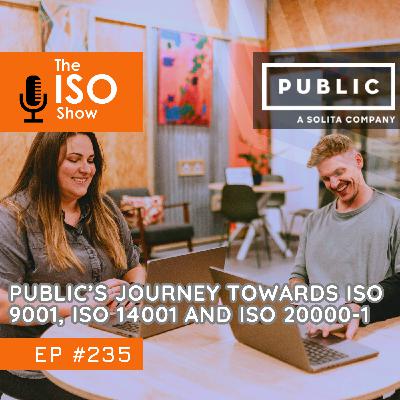
An ISO project can typically be completed within 6 – 12 months depending on an organisations size and complexity. Anyone who's been through the process of ISO Implementation knows that there is a lot of work involved in that time span, from coordinating teams, gathering and creating documentation to auditing your processes. Now imagine doing that for 3 ISO Standards simultaneously within 3 months! Which is exactly what today's guest, PUBLIC, have achieved. While it's not a timeframe we recommend, their efforts deserve to be celebrated, and displays what good project management with dedicated individuals can accomplish. In this episode, Ian Battersby is joined by Biba Gonzalez, Senior Associate of Business Operations at PUBLIC, to discuss their 3-month dash to implement ISO 9001, ISO 14001 and ISO 20000-1, and explore the challenges and benefits experienced during the process. You'll learn · Who is Biba Gonzalez? · Who are PUBLIC? · What was the main driver behind ISO 9001, ISO 14001 and ISO 20000-1 Implementation? · What was the biggest gap identified during the Gap Analysis? · What did Biba learn from the experience of implementing 3 standards at once? · What are the main benefits of ISO 9001, ISO 14001 and ISO 20000-1? · Biba's top tip Resources · PUBLIC · Isologyhub In this episode, we talk about: [02:05] Episode Summary – Ian is joined by Biba Gonzalez, Senior Associate of Business Operations at PUBLIC, to learn more about their 3-month whirlwind journey towards ISO 9001, ISO 14001 & ISO 20000-1 implementation. [02:30] Jumping in at the deep end: Biba was tasked with obtaining certification to 3 ISO Standard on returning from maternity leave in July 2025. PUBLIC already held ISO 27001 certification, but were looking to achieve ISO 9001 & ISO 14001 before Christmas of 2025. This was quite the task, especially since Biba had no previous experience with ISO Standards! [04:15] Who is Biba? Biba is the Senior Associate of Business Operations at PUBLIC. She has been the driving force behind PUBLIC's ISO 9001, ISO 14001 and ISO 20000-1 implementation. One fact that not many people might know about her is that she has had a private audience with the pope, by complete accident! Simply a case of wrong queue at the right time while on a family vacation. [06:50] Who are PUBLIC? PUBLIC are a digital transformation partner. They work within the private sector to help improve public services, by providing procurement services, online safety programmes and other digitally enabled services. [08:00] What were the main drivers behind achieving ISO 9001, ISO 14001 and ISO 20000-1?: PUBLIC work with a number of Government departments, and while bidding for various frameworks they noticed a trend in requests for bidding companies to have ISO 9001 and ISO 14001 certification. While not always a strict requirement, it was certainly a desirable trait that was preferred of bidding companies. There's also an increasing number of tenders asking for more environmental requirements, such as carbon emission reporting. What used to be a 'nice to have' is now becoming a requirement, and PUBLIC sought to have these requirements met via the relevant ISO Standards. [09:40] A tight timescale: When Biba had arrived back from maternity leave in July, PUBLIC has already booked in assessment dates with a Certification Body. This left quite a tight timeline of just 3-months to get all 3 Standards implemented to a level that could pass a Stage 1 Assessment. They already had an ISO 27001 system in place, but there was still a lot of work to do. A lot had been discussed about the implementation of additional standards in Biba's absence, but no practical steps had been taken aside from booking the audit dates. She certainly had her work cut out for her as most ISO project typically last between 6 – 12 months! Due to all her hard work, and some assistance from Blackmores, PUBLIC passed their Stage 1 assessment with flying colours and are in a good place to tackle their Stage 2 Assessment in late November 2025. [11:40] What was the biggest gap identified during the Gap Analysis? Thankfully PUBLIC didn't have any huge gaps to fill. Due to their previous work with Government departments, they had a lot of the pieces just not together in a cohesive system. They did identify early on that they wanted a system that worked for them in the long term and were conscious of creating something that fit their way of working. With so many ISO Standards, the upkeep alone would have been overwhelming so they aimed to combine as much as they could into one Business Management System rather than opting to silo each individual Management System. [13:00] What were the benefits of Implementing ISO 9001, ISO 14001 & ISO 20000-1? Biba states that the implementation of these ISO Standards took their business to the next level. Coming from a relatively small start-up, there was some of the micro business mentality that remained despite their growth in recent years. ISO Standards helped to keep everyone adhering to the same requirements. PUBLIC have taken a more hollistic approach to ISO implementation to both make it as simple as possible for everyone to work within, while also driving continual improvement within the business. Having established processes means that everyone is singing from the same song sheet, and provides traceable processes that can be questioned and amended if and when issues occur. [16:15] Additional benefits felt from ISO Implementation: There is greater accountability with the Management system in place. There is also the added benefits of being able to bid and win new business opportunities. [17:25] Biba's top tip for ISO Implementation: Don't try and implement an ISO Standard (or multiple!) in just 3 months. While PUBLIC managed to do so, it was a lot of hard work squeezed into a very tight timeframe, and Biba wouldn't recommend anyone try to match their level of ambition in this regard. Secondly she adds, make the Management System work for you and your business. ISO Standards by their nature read to be fairly generic, and that's by design, so that you have the freedom to implement them in a way that makes sense to you. There is no point implementing an obtuse system that no one wants to interact with, the key is to embed it into the way you already work, with a view to use it as a tool to drive continual improvement as the system matures. [19:00] Looking to the future: Biba is optimistic about the business, as they're looking to grow by 20% next year, supported by all the work done to Implement ISO 9001, ISO 14001 and ISO 20000-1. While they have had to change aspects of how they worked prior, due to being a small business the nature of approvals and ways of working were on a more individual basis, whereas now there is a team-based approach. It's been a learning curve, but ultimately one that will serve them well as they grow over the next few years. [21:30] Biba's book recommendation: Invisible Women: the Sunday Times number one bestseller exposing the gender bias women face every day by Caroline Criado Perez [24:05] Biba's favourite quote: "Not my circus, not my monkey" an idiom which Biba's sure a lot of Operations Directors can sympathise with If you'd like to learn more about PUBLIC, check out their website. We'd love to hear your views and comments about the ISO Show, here's how: ● Share the ISO Show on Twitter or Linkedin ● Leave an honest review on iTunes or Soundcloud. Your ratings and reviews really help and we read each one. Subscribe to keep up-to-date with our latest episodes: Stitcher | Spotify | YouTube |iTunes | Soundcloud | Mailing List
Continual Improvement is at the heart of ISO Management, a large part of which is dedicated to ensuring issues don't reoccur. This is more than just putting a plaster on it and calling it a day, it's about finding the root cause. This not only eliminates wasted time, effort and money with firefighting repeated mistakes, but also drives meaningful improvement. Over the years, many techniques have been developed to help with finding cause. In this episode, Ian Battersby explores the need to find the root cause of issues in ISO Management and explains some key techniques for root cause analysis that you can put into practice to help stop recurring issues. You'll learn · What is meant by 'finding cause'? · Why do you need to find the cause? · Where is finding cause specified in ISO Standards? · Finding cause in practice · What are the 5 Why's? · What is the fish bone / Ishikawa? · What is FMEA? · What is fault tree analysis? · How do these techniques work in practice? Resources · Isologyhub In this episode, we talk about: [02:05] Episode Summary – Ian dives into finding cause within ISO Management, explaining various techniques to help you prevent recurring issues. [03:15] What is meant by 'Finding cause'? When an output from a process is not what was expected, then it is classed as a non-conformity which will need to be addressed through corrective action. Before you can put that action into place, you need to identify the root cause for the issue. It's about putting right what went wrong. [04:00] Why do you need to find cause? Ian gives an example of a reactive response to resolving an issue, it didn't get to the root of why the mistake happened in the first place. Finding cause is necessary to stop issues from repeating, rather than simply firefighting issues as they occur. ISO terminology has updated to reflect this over the years. There used to be a term called 'Preventive action', but this has since been changed to 'Corrective action' following on from the 2015 Annex SL update to many ISO Standards. This reflects the new risk-based approach to ISO management. The terms are largely the same in nature, but preventive action was widely misunderstood and so this was renamed and clarified following 2015. [05:55] Where is finding cause specified in ISO Standards? As with many aspects of ISO, the need for finding cause can be found in a few places within a Standard, including: - Clause 6.1.1 Planning: It specifies the need to determine risks and opportunities that need to be addressed. This is because they will affect the desired outcome of your Management System. It's also a good place to start thinking about how to reduce those risks. Evaluating your strengths and weaknesses also gives you the chance to contemplate whether your existing processes are good at delivering what you want. Clause 10 Improvement: The Standard states something to the effect of 'the organisation shall determine and select opportunities for improvement and implement any necessary actions to address those opportunities' These opportunities will focus on improving products and services, which includes correcting, preventing or reducing undesired results. Also included under clause 10 is a subclause that directly addresses non-conformities and corrective action. These specify not only the need to resolve issues as they arise, but to evaluate the need for action to eliminate the root cause. Additional requirements include the need to review these actions and determine if they are actually effective. Ian goes into Clause 10 in more detail in a previous podcast specifically looking at opportunities for improvement. [14:20] Finding cause in practice – Why a methodology is necessary: Ian provides an example where an employee may lack confidence completing a certain activity. Their lack of competence could lead to a process being delivered incorrectly. That adverse quality outcome would then likely end up with the customer who would raise a complaint, in this instance that could be a damaged product. The damaged product is what needs correcting, from your perspective you would be looking at what caused that to prevent recurrence. Without knowing the initial cause, you would need to determine whether it's a production issue or a human error. These types of scenarios can branch out further than the initial quality issue. For example, if that damaged product causes harm, then it turns into a health & safety risk. If products need to be scrapped, then there's an environmental factor. Complaints related to product quality may also not be recorded in a standard non-conformity system, and could easily be missed for a full investigation to find root cause. This is why it's important to have a consistent approach, in both logging issues and evaluating them to determine cause. [18:10] What are the 5 Why's? This is one of the more popular methods that people use to determine cause. It's simply a case of asking why a scenario happened, usually 5 times, though you can ask more or less depending on how long it takes to reach the core issue. It doesn't require much training and all it requires is an open and honest response to the questions. This method can get answers quickly and is often utilised as an early problem solving technique. [19:30] What is the fish bone / Ishikawa? This is a more visual method to find cause. Depicting a fish skeleton that categorises possible causes and groups these accordingly. These causes are then discussed for a few minutes, typically with teams of people in order to gain different perspectives to help pull apart complex problems into their contributing factors. This method is particularly useful in cases where there isn't a single underlying cause. [20:30] What is FMEA? FMEA or Failure Modes and Effects Analysis is a more structured technique and acts like a risk assessment in reverse. It looks at what can go wrong, what the effect of failure is and then how critical that failure is to the outcome of what you're trying to do. It uses risk priorities to decide what's more important. [21:15] What is Fault Tree Analysis? This method utilises a top-down logical approach. It's a diagrammatic representation of what's going wrong. It asks, does this happen? Yes or no or both, and branches down paths that explore the issue. It allows for quantitative measures with a number output that can help determine how likely recurrence will be. It's a method that is often used in engineering and manufacturing processes. [22:55] Scatter Diagrams: Scatter diagrams are a good tool to find correlation. They help visualise the relationship between two variables. If you have data rich environments, these can really help you plot out those relationships and make those links that otherwise may have been missed. [23:40] The 5 Why's in more detail: The 5 Why's is a great starting technique as it requires little training. Ian provides an example of using the 5 Why's, with the scenario of a worker who has injured themselves while cutting some wood. Using the 5 Why's, he asks these questions: · Why did the workers hand slip while cutting the wood? – They were holding the material in one had without the use of any clamping device to keep it steady. · Why was the material being held by hand instead of using a clamp? Because there was no clamping device available. · Why was there no clamping device available on the table? The design of that workstation didn't take into consideration the need for a permanent clamping fixture. · Why wasn't that taken into consideration for the workstation? The risk assessment for that workstation was overlooked. From this exercise, you can see how you can get to the root of an issue by simply asking 'Why' a number of times. Again, it can be more or less than 5 times, the name is simply a guideline. [25:40] The Fishbone / Ishikawa method in more detail: Another favoured simple technique for finding cause is the fishbone method. It utilises 6 categories to get to the root of an issue, those being:- · Machine: Addressing the equipment or technology that you use to deliver products and services. · Method: The way in which you deliver products and services. · Material: The raw inputs into your processes. · Measurement: The data and metrics that you use to monitor the successful delivery of your products and services. · Mother Nature: The environment and conditions in which you're operating. · Man – Although this has now been updated to 'People', addresses the human element of product and service delivery. This is a great method for instances where there may be multiple root issues, so you can categorise and analyse each of them with multiple perspectives involved as this is considered a more collaborative method for root cause. [28:15] Record your findings: We dive more into this in a previous episode, but essentially, it's a requirement of every ISO Standard to address these non-conformities as they occur. Going through the process of root cause and rectifying the issue will need documentation to prove that you are actively addressing these issues, as well as doing as much as you can to prevent recurrence. There is no defined way to do this in the Standard, so it can be documented via forms, intranets, other digital systems etc. Documenting all the evidence of resolving issues may seem arduous at times, but it will ultimately lead to genuine continual improvement, and will lead to reduced overall error. If you'd like any assistance with ISO Implementation or support, get in touch with us, we'd be happy to help. We'd love to hear your views and comments about the ISO Show, here's how: ● Share the ISO Show on Twitter or Linkedin ● Leave an honest review on iTunes or Soundcloud. Your ratings and reviews really help and we read each one. Su
When thinking of sectors that need effective energy management, the ones that typically come to mind include the likes of transportation and manufacturing. However, energy management is something that any business can benefit from. Such is the case with today's feature, Clyde & Co, a global law firm who made the decision to Implement ISO 50001 energy management to tackle the largest part of their sustainability impact. In this episode, Ian Battersby is joined by Paul Barnacle, Head of Health, Safety, Security and Environment at Clyde & Co, to discuss their journey towards ISO 50001, including the challenges associated with implementation and benefits gained from certification. You'll learn · Who is Paul Barnacle? · Who is Clyde & Co? · What was the main driver behind obtaining ISO 50001? · How long did it take to achieve certification? · What was the biggest gap found during the Gap Analysis? · What has Paul learned as a result of ISO 50001 Implementation? · What are the benefits of gaining ISO 50001 certification? · Paul's top tip Resources · Clyde & Co · ISO 50001 · Isologyhub In this episode, we talk about: [00:25] Episode Summary – We invite guest Paul Barnacle, Head of Health, Safety, Security and Environment at Clyde & Co, onto the show to share his journey with implementing ISO 50001, including the associated challenges and benefits from gaining certification. [02:50] Who is Paul Barnacle? Paul is the Head of Health, Safety, Security and Environment at Clyde & Co , and was the lead for the ISO 50001 Implementation project. One thing that many may not know about Paul is that he's an avid angler, whether rain or shine, he's dedicated to getting the next big catch. [04:45] Who are Clyde & Co? Clyde & Co are a global law firm that helps organisations navigate risk and maximise opportunities across sectors such as insurance, professional services, aviation, marine, construction and energy. The firm has over 500 partners with a total headcount of 5,500 people operating across 70 offices around the world. [05:40] Who is included within the ISO 50001 scope for Clyde & Co? For those that aren't aware, an ISO scope can be against an entire business, a single department or even against a specific product / service. For Clyde & Co, their ISO 50001 scope extends across 9 offices in the UK and Republic or Ireland. [06:15] What were the main drivers behind ISO 50001 Implementation? – One of the main drivers links back to Clyde & Co's Net Zero Strategy, which included the need to identify which sustainability focused ISO Standard would help them the most. Following a lot of internal conversation with their Chief Sustainability Officer, they settled on ISO 50001 as they were seeking more visibility on their energy consumption and help with identifying opportunities for improvement. Ultimately taking the first steps to tackle their scope 1 and 2 emissions. [07:05] Why ISO 50001 over ISO 14001? ISO 14001 Environmental Management was considered, however they don't have any industrial processes, so other environmental factors outside of energy aren't very applicable to a business like Clyde & Co. Seeing as energy was their largest environmental expenditure, ISO 50001 naturally seemed like the best fit. [08:10] How long did it take to achieve ISO 50001? Paul started the Implementation journey back in early August of 2024, and completed the Stage 2 Assessment by April 11th 2025, so a total of nine months. [09:00] What was the biggest gap identified during the Gap Analysis? Paul highlights how key the Gap Analysis was to the whole process, as it gave them a clear picture of the amount of work involved with completing the implementation. One of the biggest gaps identified was the fact that they didn't have a structured management system in place. There was a lack of knowledge when it came to ISO implementation, so some of the terminology was a bit lost on Paul to start with! They also lacked key documentation such as continual improvement log and Register of Energy Saving Opportunities. [10:10] What were the benefits of ISO 50001 implementation? There are a number of benefits, including:- · ISO 50001 allows a business to have a lot more visibility on their energy consumption · ISO 50001 certification demonstrates a proactive approach for energy management to clients and prospects. · The data provided by ISO 50001 allows for more informed decisions on energy saving and reduction opportunities, allowing you to target your biggest emission sources and spot any anomalies. [11:45] Client influence: Clyde & Co were seeing an increase in requests from clients regarding their energy performance indicators and related KPI's. They were also being asked about what they were doing in relation to reducing their scope 1 and 2 emissions. This exercise allowed them to address both, in addition to setting up the infrastructure to continuously monitor this year on year. As a result of ISO 50001 implementation, Clyde & Co now plan to communicate the reduction in their energy consumption on a quarterly basis with staff across all regions. [13:50] Additional Improvement as a result of ISO 50001: Paul enjoys the renewed communication between teams that hadn't really interacted prior to ISO 50001 implementation. Previously the energy management team were fairly siloed in the business, but now they're getting tech champions involved and asking anyone to contribute to the energy performance indicators. It's created a connected culture that encourages new ideas from all corners of the business. They've helped to facilitate this through the use of their intranet with dedicated mailboxes where people can submit any questions or suggestions for improvement. They've also got QR codes set-up for easy access for mailbox submissions. [15:55] Paul's Top Tip: Get a copy of whichever Standard you intend to Implement and read it thoroughly. It's key that you understand what the Standard is asking for. If you're struggling with the ISO terminology, the Standards will include a glossary of terms and definitions to help you. You can also do what Clyde & Co did, which is hire ISO consultants that specialise in ISO implementation. They will help you interpret the Standard and help you establish a Management system that is both compliant with the Standard and also integrates with the way you work. For ISO 50001 specifically, Paul highlights the need for strong data. Energy monitoring will require some number crunching, so you need those figures to be as accurate as possible to get the best results. [15:55] Paul's book recommendation: Sustainable Energy - Without The Hot Air by David MacKay [15:55] Paul's favourite quote: "The best way to predict the future, is to create it." – Abraham Lincoln If you'd like to learn more about Clyde & Co, check out their website. We'd love to hear your views and comments about the ISO Show, here's how: ● Share the ISO Show on Twitter or Linkedin ● Leave an honest review on iTunes or Soundcloud. Your ratings and reviews really help and we read each one. Subscribe to keep up-to-date with our latest episodes: Stitcher | Spotify | YouTube |iTunes | Soundcloud | Mailing List
The topic of suicide is all too often a discussion avoided due to its tragic and uncomfortable nature. However, the reality is that there are 6,000 deaths by suicide in the UK each year, with in excess of 727,000 deaths annually worldwide. In recent years there has been more awareness about the topic, with a range of resources targeted to help with the prevention and support of those affected. For businesses seeking further guidance, a new Standard is on the horizon. In this episode, Ian Battersby is joined by Marcus Long, Chief Executive at IIOA, who shares his inspirational story of working through an unthinkable tragedy and creating a silver lining that aims to tackle the intervention, prevention and support for people affected by suicide. You'll learn · Who are IIOA? · Who is Marcus Long? · What was the catalyst behind BS 30480? · Who is involved with the development of BS 30480? · What does this Standard hope to achieve? · How does this Standard compare to other ISO Standards? · How will this Standard develop within the next year? · The cost of suicide · What are the benefits of BS 30480? · How can you get involved? Resources · Register your interest in BS 30480 · Contact Marcus Long · IIOA In this episode, we talk about: [00:25] Episode Summary – We invite guest Marcus Long, Chief Executive at IIOA, onto the show to talk about his involvement with the development of BS 30480, a Standard dedicated to the intervention, prevention and support for people affected by suicide. [01:30] Who are IIOA? The IIOA are the Independent International Organisation for Assurance, which is a trade association for global assurance bodies. Their members carry out certification to a wide range of ISO Standards, related Standard schemes, product certification and the provision of validation and verification training. [02:30] Who is Marcus Long? Before becoming the Chief Executive at IIOA, Marcus worked for the national Standards body side of BSI. There he was involved with ISO Standard development and later moved into certification. He's had 20 years' experience within the field of ISO Standards, and spent most of that time pushing the benefits and value of quality infrastructure. One thing many may not know about Marcus is that he spent 48 hours underwater! While not in one stint, Marcus is an avid scuba diver, and has been taking trips under the waves since 1990, with his cumulative underwater adventures reaching 48 hours total to date. [05:30] What was the catalyst behind BS 30480? Marcus experienced an unthinkable tragedy in October of 202, when his son Adam took his life at the age of 21. In the following three years, Marcus sought to find some sort of silver lining to give him some peace. After a while, he turned to look at the industry he worked within, Standards, which is focused on solving problems and finding solutions. Ultimately, it's aim is to make the world a better place, whether that's through sustainability, quality or Health & Safety. So why couldn't that principle be applied to something as difficult and heartbreaking as suicide. With that idea in mind, Marcus got talking to some national standards bodies in different countries around the globe, in addition to ISO, to see if the idea could spark some interest. These discussions reached BSI, who were currently also working on creating a Standards on the topic of menstrual health and menopause in the workplace. Marcus appreciated that they were willing to touch on topics that many shied away from. [08:50] The conception of BS 30480 – The first steps taken included hosting workshops at the Houses of Parliament in February of 2024. There Marcus brought together a wide range of people with different experiences, and asked them if they thought this Standard was a good idea and gather what how they would like to see something like this work in practice. With that encouragement and feedback, Marcus set to work on setting a scope and deciding who should be involved in the development process. [11:05] Who is involved with the development of BS 30480? As with many ISO's, the development team are made up of a wide range of people, including people from academia and business owners. Marcus ensured that healthcare specialists and those who've assisted in suicide prevention schemes were also included. All of these individuals had the same passion to help reduce the rate of suicide within the UK. [13:10] What does this Standard hope to achieve? The sad reality is that in many instances, it's a reactive response to suicide. What Marcus hope BS 30480 can achieve is to encourage the creation of suicide prevention strategies. This turns that reactive response into a proactive one in terms of preventing the worst from happening. As quoted from the Standard: " The aim is to make workplaces more suicide safe, more conducive to suicide prevention, more supportive of those who have been exposed to suicide and more knowledgeable and confident in talking about suicide and taking actions that prevent suicide." [15:30] How does this Standard compare to other ISO Standards? This Standard differs from ISO Standards such as ISO 9001 and ISO 45001 in the fact that it's a guidance Standard, so not one that can be certified to. It provides guidelines and guidance that businesses use, and select the parts that are most relevant to them. The Standard also includes a number of Appendix's that provide more practical guidance to help give businesses a clearer idea on how certain elements can be implemented, for example, the creation and deployment of a suicide prevention plan. So rather than a rigid set of requirements, think of it as a collection of practical ideas and solutions that can aid in the prevention of suicide. [18:20] How will this Standard develop within the next year? BS 30480 is expected to be published in November 2025, as they've just finished the consultation period in August 2025, which was met with a very positive response. Marcus would love to see this Standard move into the international stage by becoming an ISO, but for now it's being published as a British Standard. There are plans to create training and host webinars to spread awareness about the Standard, so keep an eye out on BSI's socials for more about that! The standard is set to enter a phased communication strategy: Phase 1: The launch of the Standard, which has already had some preparation as various other Standard bodies and those involved have been spreading awareness throughout the drafting process. Phase 2: Public awareness – Marcus and those involved in the creation of BS 30480 will be ramping up public dialogue on what the Standard is about and what it can achieve for people. Phase 3: Engagement – Actively getting business to engage with dialogue around suicide prevention, as this is a topic that some businesses are scared to even tough. But if we're to tackle it, it needs to be discussed. There is scope for this Standard to fit in with the likes of ISO 45001 (Occupational H&S) and ISO 45003 (Mental Health in the workplace). Marcus also discusses the opportunities for this to help less traditional workplaces such as educational institutions, sports clubs, charities & youth clubs. [23:30] The cost of suicide: As much as it seems inappropriate to put a price on suicide, there is more to it that the emotional and societal devastation. A report by The Samaritans suggested that each death by suicide resulted in a cost of £500,000. This is due to related costs for emergency healthcare systems and loss of productivity. Marcus emphasizes that if we are to get more businesses, Government and local Governments on board, all impacts of suicide need to be discussed in addition to the benefits of suicide prevention. While odd to approach it from a cost perspective, it's more often than not the language that businesses speak. They need to be informed of the investment required in people, time and cost just as much as they need to be aware of the many benefits of effective and proactive suicide prevention. [26:40] What are the benefits of BS 30480? The ultimate aim is to make workplaces a safer and better place. This Standard can also provide a means of effectively measuring social value, which is often times a rather nebulous metric to grasp. This Standard is here to save lives, and its practical guidance can help businesses create a clear path of actions to help those who may suspect that a colleague is in need of help. [28:25] How can you get involved? Marcus' biggest ambition is for BS 30480 to assist with saving lives, but if it's to achieve it's main aim, it needs advocates. Whether from trade associations, other Standards bodies or just from individuals, spread the word and encourage businesses to adopt the guidance provided. You can register your interest in BS 30480 through BSI's website, this ensures you get updates on the Standards progress and any training opportunities. If you'd like learn more about BS 30480, feel free to contact Marcus Long via LinkedIn. We'd love to hear your views and comments about the ISO Show, here's how: ● Share the ISO Show on Twitter or Linkedin ● Leave an honest review on iTunes or Soundcloud. Your ratings and reviews really help and we read each one. Subscribe to keep up-to-date with our latest episodes: Stitcher | Spotify | YouTube |iTunes | Soundcloud | Mailing List
When stating ISO Management System 'compliance', that in reality means the conformance to ISO Standard requirements, compliance in ISO terminology actually refers to compliance with legal and other statutory regulations. It may sound like semantics, but the difference is distinct for a reason, as you don't get a 'non-compliance' for not meeting requirements, rather you get a 'non-conformity'. When it comes to compliance with the law as required by ISO Standards, you need more than a Legal Register to prove compliance. In this episode, Ian Battersby dives into what is meant by compliance in ISO, how this relates to legal and statutory requirements, and how businesses can effectively evaluate compliance. You'll learn · What is the difference between 'Compliance' and 'Conformity'? · What are the different types of compliance requirements? · How do Acts and Regulations work in tandem? · Who enforces legal compliance requirements? · Where do these requirements sit in ISO Standards? · How do you prove compliance within ISO management? · How do you evaluate effective compliance? Resources · Isologyhub · From Silos to Synergy: The benefits of Implementing an Integrated ISO Management System Webinar registration In this episode, we talk about: [00:30] Upcoming webinar: If you'd like to learn more about the benefits of integrated management systems, feel free to register for our upcoming webinar here. [01:30] Episode Summary – Ian Battersby discusses the topic of compliance within ISO Standards, and how you can effectively evaluate it within your Management System. [02:30] What is the difference between 'Compliance' and 'Conformity'? It's a common misconception that you 'comply' with an ISO Standard, when in reality, you conform to an ISO Standard, hence why you can receive a 'non-conformity' in audits and not 'noncompliance'. When we talk about compliance within ISO Management, this refers to compliance with the law, regulations and other statutory requirements, as this is a requirement within all ISO Standards. [03:50] What are the different types of compliance requirements? There are many different types of law, Ian focuses on what is known as statute law legislation, as this is distinct from common law, case law and constitutional conventions. Statute law legislation is clearly written and can be cited in something like a Legal Register, or Register of Compliance Obligations. There are different types of legislation that you'll need to document, including: Primary Legislation: These are put in place by acts of UK Parliament and may have involvement from devolved administrations as well. Statutory compliance refers to compliance with primary legislation. An example of this type of legislation includes the Health & Safety at Work Act. Secondary or delegated legislation: Those primary Acts often require a lot more detail regarding the practicalities of applying them, which is delivered through Secondary or delegated legislation, otherwise more commonly known as regulations. These have more input from relevant public bodies to provide the requirements that can be applied. Both regulations are issues under Statutory Instruments (SI's), which are the formal legal vehicle that gives them effect. Put simply, regulations are the rules and Statutory Instruments are the legal mechanism which brings those rules into effect. [06:05] How Acts and Regulations work in tandem: Taking the Health & Safety at Work Act as an example, at the start this was quite a broad and generic act, it wasn't until years later that the workplace health, safety and welfare regulations came about to support the Act. This was further bolstered with the Management of Health & Safety at Work Regulations. Both regulations were developed through consultation between Government departments and other bodies such as the Health & Safety Executive. These regulations gave companies much more detail on what's actually required in order to comply with the Health & Safety at Work Act. [06:50] Who enforces legal requirements? – It's not just the police that enforce legal requirements, there are a number of other bodies independent of government and the judiciary that can enforce regulations and prosecute for breaches caused by organisations and individuals. This can include bodies such as The Health & Safety Executive, The Financial Conduct Authority, The Environment Agency and the Information Commissioners Office. There are more for other areas, and these are often the bodies involved in the development of specific regulations. [07:45] Where do these requirements sit in ISO Standards? As Is the case with ISO Standards, the requirement for compliance is sprinkled throughout the whole document. Starting with Clause 4 Context. Here 'Interested parties' are a focus, of which regulatory bodies can be considered an interested party, as they control the regulations that you are required to comply with by law. Even if you don't think you fall under specific legislation, there are still general applicable business laws that all businesses must comply with. So this exercise is not simply a case of running a Management System, it's also about running an effective business. Ian highlights clause 6.1.3 in ISO 45001, which states the need to determine legal requirements applicable to your business, whereas in ISO 14001 this clause talks about compliance obligations. Despite the difference in wording, they are essentially looking for the same thing, which is detailing what legal requirements you need to comply with. In ISO 9001 it also states that any products or services offered should meet customer and applicable statutory and regulatory requirements. This is then further strengthened in the Leadership clause as leaders are required to ensure that their commitments meet all customer requirements, but also any applicable regulatory and statutory requirements associated with the products and service. This is phrasing that is repeated throughout ISO 9001. Going back to ISO 45001 and ISO 14001, both also require an evaluation of compliance, both the part of monitoring and measuring and the results of them to be submitted through your management review process. The Standards are very clear in that they require you to determine the frequency and methods for evaluation of compliance. [12:00] How do you prove compliance within ISO management? In ISO 45001 there is an appendix that give examples of what you can monitor and measure for the fulfilment and evaluation of legal requirements. As mentioned, many organisations opt to use a Legal Register which states all applicable legislation for your business that will be evaluated in an Internal Audit, but proving genuine compliance is much more than just acknowledging the legislation itself. For larger organisations, this can be a very burdensome task, especially if you find yourself in a position where legal requirements aren't being met. Ian provides an example to illustrate how to prove effective compliance: Waste removal is something that every business has to do, whether they do so through a waste management contractor, or through a landlord, the law states that any waste you generate must be removed, transferred, processed, treated, etc. by licenced organisation in a very specifically regulated fashion. You as an organisation or your landlord may receive an annual season ticket which includes the required demonstration of compliance, which can be in the form of West Carrier license number, the types of waste, the classification codes under the European or waste catalogue, dates and signatures. Now if you run into an instance where something on that waste transfer note was incorrect, like a wrong address or waste type, how do you prove that you were still compliant in the actual activity of removing waste? An Audit will pick up on the note discrepancies and you may be faced with being non-compliant. A way to ensure that you have a record of compliance is to keep electronic copies of all your waste transfer notes, and keep them in a central location, or even possibly linked within your Legal Register if possible. Despite the discrepancy, you will be able to prove that you have a prior record of compliance. Ian gives another example, you may have air conditioning in your area of work that's due for a service. The contractor will need to verify the engineer before you engage with them, including a check to see if they're competent under F Gas Regulations and hold a valid REFCOM Registration Certificate. If you wait to check / validate their certificates of competence, you may run into a situation where they may have an expired certificate at the time that they serviced your aircon, and so that may render that service as inadequate under your legal requirements. To avoid this, you should reference that you've evaluated the contractor within your Legal Register, this would include a check on their registration number and dates of when their F Gas competency certificates are valid, ensuring your service falls within those dates. In short, to demonstrate compliance, you should be keeping on-going records in relation to your legal requirements. These should also be readily available and easily accessible. [20:35] How do you evaluate effective compliance: Legal requirements such as the Health & Safety at Work Act are much broader, and it can be difficult to know exactly what records you need to keep to prove compliance. This is where the supporting regulations can provide the required detail and provide a much clearer picture of what evidence is required. One example is the requirement to carry out sufficient risk assessments, which requires you to identify hazards, assess risks, determine control measures you know, communicate those to people, and review of those assessments regularly. You as the business will need to create a programm
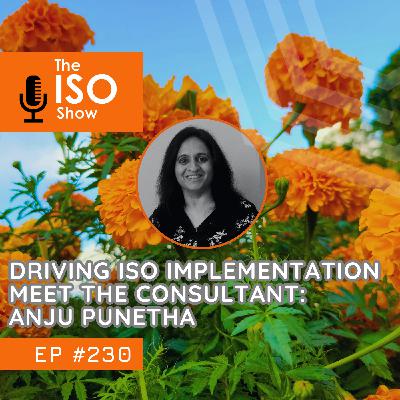
How often have you heard someone say they aspire to be an ISO consultant? Likely not at all! That's not surprising as it's quite a niche world to find yourself in, yet despite that, there are still thousands of ISO professionals worldwide. We're continuing with our latest mini-series where we introduce members of our team, to explore how they fell into the world of ISO and discuss the common challenges they face while helping clients achieve ISO certification. In this episode we introduce Anju Punetha, a QHSE Consultant at Blackmores, to share the journey of how she transitioned from special education in India, to ISO consultancy for international organisations. You'll learn · What is Anju's role at Blackmores? · What does Anju enjoy outside of consultancy? · What path did Anju take to become an ISO Consultant? · What is the biggest challenge she's faced when implementing ISO Standards? · What is Anju's biggest achievement? Resources · Isologyhub · From Silos to Synergy: The benefits of Implementing an Integrated ISO Management System Webinar registration In this episode, we talk about: [02:05] Episode Summary – We introduce Anju Punetha, a QHSE Consultant here at Blackmores, to discuss her journey towards becoming an ISO consultant who specialises in ISO 9001, ISO 14001, ISO 45001, ISO 27001, ISO 20121 and ISO 55001. [04:05] What is Anju's role at Blackmores? Her role primarily involves supporting clients in two key areas: maintaining and continually improving their existing ISO management systems and helping them establish and implement new standards. As part of that support, she: · Conduct internal audits · Reviews and updates management system documentation · Facilitate management reviews · Train internal teams and prepare them for certification audits. When implementing a new ISO standard, she'll start with a gap analysis – i.e comparing their current practices against the standard's requirements. Then break down those requirements into simple, easy-to-understand language and create a practical plan to bridge the gaps. Depending on the standard, she may also facilitate strategic business risk assessments, environmental aspects and impacts assessments, or information security risk assessments. Additionally, Anju helps clients develop and implement policies and procedures, create legal and compliance registers, and verify their readiness for certification body audits. [05:55] What does Anju enjoy doing outside of consultancy?: Anju loves spending time outdoors with long walks being her go-to, as they help her unwind both physically and mentally. She also enjoys cooking for her family and friends. Experimenting with different cuisines and blending spices is something Anju finds incredibly relaxing. [08:00] What was Anju's path towards becoming an ISO Consultant?: Like many of the Blackmores team, Anju never planned to become an ISO consultant. She began her career as a Special Educator, working with children with special needs in India. Later, she transitioned into the development sector as a Research Assistant, working on projects funded by The World Bank and the UN World Food Programme. These projects focused on microfinance, training and development, and women & child health. However, that role involved a lot of travel, which became challenging after the birth of her first son. So, Anju decided that would be a good time to take a career break. When Anju was ready to return to work, she looked for an office-based role which resulted in her joining Ericsson, a Swedish Networking and Telecommunication Company as support staff, and progressed upwards to become the Learning and Development Manager at their rapidly growing Global Service Centre in India. This involved managing training requirements of an employee base of around 4000+ employees, involvement in stakeholder management at all levels and vendor management. As part of the Operational Excellence initiatives, she also got involved in preparing different business teams for their internal and external audits. During that time, Anju became interested in Ericsson's Group Management System, which all legal entities had to comply with. She then moved into the newly formed Quality Department and helped them to gain various ISO certifications. She was the Project Leader for implementing Ericsson's Operational Maturity Model compliant to the requirements of ISO 9001, ISO 14001, ISO 27001 and OHSAS 18001 (ISO 45001's predecessor). Joining Blackmores as an ISO Consultant felt like a natural next step when she relocated to UK. She's now been a member of our team for over six years, and continues to inspire others with her level of dedication to her work and clients. [13:35] What is Anju's favourite aspect of being a Consultant? – The variation in daily activities is a big positive for Anju. One day she may be conducting a gap analysis for Environmental Management System for an IT company, and the next drafting policies and procedures for managing Events Sustainably for an Event Management company or auditing a client on their Information Security Management System. No two days are the same! She also enjoys being able to work with a wide range of clients across sectors like IT, construction, facilities, asset management, event management, and train operating companies, all ranging from small businesses to large, multi-site organisations. She particularly enjoys working on Integrated Management Systems, as they help clients save time and money by streamlining multiple standards into one cohesive system. It reduces duplication, improves efficiency, and encourages collaboration across teams—breaking down silos and building synergy. [15:50] Upcoming webinar: If you'd like to learn more about the benefits of integrated management systems, feel free to register for our upcoming webinar here. [17:30] What Standards does Anju specilaise in and why? Starting with: · ISO 9001 Quality Management: A core foundation that many businesses start with when diving into the world of ISO Standards. This is an essential one for any ISO consultant and is often the first Implementation experience for many who go on to become ISO consultants. · ISO 14001 Environmental Management: This Standard provides a solid base for any business looking to start taking sustainability seriously. · ISO 45001 Health and Safety Management: Anju helped one of her previous employers implement this Standards' predecessor, and has since implemented and supported ISO 45001 for a number of Blackmores clients. · ISO 27001 Information Security Management: An increasingly popular Standard as we see more and more business rely on technology to keep their services running smoothly. · ISO 55001 Asset Management: A popular Standard within the facilities and public transportation sectors. This Standard aims to create a framework to help organisations manage the life-cycle of their assets. ISO 20121 Sustainable Event Management: ISO 20121 focuses on governing principles of sustainable development, which are: · Stewardship · Inclusion · Integrity · Transparency ISO 20121 was revised in 2024. The revised standard explicitly requires considering climate change and its impact on the event and stakeholders. The new version also expands beyond environmental concerns to encompass human and child rights, social impact (including mental health and diversity), and digital responsibility and how organisations should start considering these areas at the early stages of planning an event through post event activities. Recently, Anju has been busy in putting together the toolkit for transition to ISO 20121:2024 and preparing her clients with the implementation of the revised and new requirements. [21:10] What is the biggest challenge Anju had faced during a project and how did she overcome it?: Anju offers one experience in particular: She was working with a company that was implementing its first ISO Standard. The project not only involved creating and implementing standardised policies and procedures but also working on the overall change management within the business. The teams were used to working in silos for many years and were not very forthcoming with the idea of establishing and implementing standardised ways of working. This was due to various reasons, such as lack of awareness, operational activities taking precedence over risk and process-based approach. As a result, project leads struggled in getting support from the project sponsor and the extended project team in terms of time and effort. They had to put the project on halt for few months and only proceeded with the project after getting the full commitment from the sponsor and other project team members. During this time, ISO related roles and responsibilities were built into the job descriptions of the various stakeholders, these were agreed as part of the internal review processes and required time and effort for the different stakeholders within the business was agreed with the Management Team. At the end, this project helped the company to embed the standardised processes within the business, rather than it being just a tick in the box exercise to achieve certification. [25:35] What is Anju's proudest achievement? Anju's proudest achievement in relation to work, is when she's able to see a marked difference in the confidence level of her clients, from the start of the ISO implementation project, which is the gap analysis stage, to confidently facing the certification audit and demonstrating to the external assessors that the implementation of the ISO project was not just a tick in the box exercise for them. One achievement in particular stands out in recent months as she supported a client in successfully transitioning to the revised ISO 20121 standard. If you'd like any assistance
One of the biggest challenges for those looking to achieve Net Zero is tackling scope 3 emissions, which are indirect emissions that typically reside in your supply chain. These can account for up to 70% of your total emissions and can be quite the undertaking to gather the necessary data to be able to complete your calculations needed for carbon verification. In the final episode of the Platform to Proof mini-series, we invite Jay Ruckelshaus, Co-Founder and Head of Policy and Partnerships at Gravity, back onto the podcast to explain how to tackle scope 3 emissions, how it works in practice and how carbon accounting software can streamline the process. You'll learn · What are scope 3 emissions? · What are the drivers for those tackling scope 3 emissions? · Where to start with scope 3 emissions · How does supply chain engagement work in practice? · What are the benefits for suppliers involved? · How can carbon accounting software help with scope 3 emissions? Resources · Gravity · Carbonology In this episode, we talk about: [02:05] Episode Summary – We introduce Jay Ruckelshaus, Co-Founder and Head of Policy and Partnerships at Gravity, who will accompany Mel on a 3-part mini-series diving into carbon accounting software and the value it can bring. In this final part, Mel and Jay dive into scope 3 emissions, the challenges associated with gathering them and how carbon accounting software can help streamline this process. [02:30] Catch-up on the first part – If you missed the first two parts of the series, catch-up with them here: · Part 1: From Platform To Proof – What Is The Business Driver For Carbon Accounting And Reporting? · Part 2: From Platform To Proof – How Carbon Accounting Software and Verification Combine for Carbon Compliance [03:50] What are scope 3 emissions?: The term 'scope 3' comes from a document and initiative called the GHG Protocol, which sets out the core methodology by which companies should measure account for their greenhouse gas emissions. It details 3 different scopes, scope 1 is your direct emissions (i.e. fuel for vehicle use ect), Scope 2 is grid emissions associated with purchased electricity or other forms of energy (i.e. energy for offices). Scope 3 is a very broad term and addresses the emissions created by your value / supply chain. This could include things like transportation of resources you require from a third-party. These emissions can count to upwards of 70% of a companies total emissions, depending on the nature of the business that can even go as high as 90%! [06:50] What are the drivers for those tackling scope 3 emissions? Jay summaries 3 of the main drivers: Biggest emission source: For those looking to truly hit Net Zero, they can't simply ignore their largest emission source. It poses the biggest risk to the company, so it's in their best interest to reduce them where possible. Of course, this isn't easy as it may involve swapping suppliers or working with existing ones to make their practices more sustainable. It's not as straight forward as addressing your scope 1 and 2 emissions. Regulation requirement: Scope 3 is increasingly being included within mandatory regulations, whereas in previous years, it may have been a voluntary part of those requirements. For example, the new regulations coming into effect for California in 2026 will see around 10,000 companies needing to report on their scope 3 emissions. In the EU, regulations such as CSRD also require reporting on these emissions. Though these haven't been made mandatory as of yet, we can see that changing in future. Stakeholder requirement changes: Customers and other stakeholders are asking for more evidence of meaningful sustainability action. Supply chain initiatives now are gearing more towards sustainable procurement, which coincides with the rise of CSR related activities. This drive to evaluate your supply chain is being pushed from all directions. [09:55] Where to start with scope 3 emissions: Likely stating the obvious, but ensure you have addressed your scope 1 and 2 emissions first. When looking to your scope 3 emissions, you'll first need to determine which of the 15 emission categories is going to be important for your business to get a handle on. The nature of your business will determine which of the categories are a priority, so if you're a digital service based business, then the raw materials category likely won't be very appliable to you so you'd only need to provide a very high-level summary of any related emissions. For those categories that are a priority, you should identify how in-depth you would need to get with the data analytics, and create a strategy for each of those categories. If you're struggling to start, there are some industry average statistics out there to help you with those initial calculations. It's key to set up a defined measurement cycle, that will need the ability to get more granular as you progress. This is so you can actively track your reduction efforts. Of course, the level of this will be determined by the resource you and your suppliers have to help facilitate the process. It's definitely worth investing in your supplier relationships to make this process run smoothly year on year. Some business that have say 100+ suppliers will often send out a survey to obtain this data, but the quality of the information returned (if any) can be lacking. So, a more direct approach will likely reap the results you're after. Mel highlights an instance where an organisation had an engagement programme, where they selected 100 of their suppliers and provided training and guidance on understanding and reporting on their emissions. The suppliers could then see how beneficial the process was not just for that organisations, but for their own company as well. It's more than just gathering data, it's about effecting your sphere of influence for meaningful change. [14:15] How does supply chain engagement work in practice? As mentioned, one of the ways many organisations have opted to gather data have been through supplier surveys, however, you need to supplement this with other supplier initiatives to get the best results. Gravity took a more empathetic approach, by looking at this process from the suppliers perspective. They highlighted that this should just be an extractive exercise, the supplier should also be getting something out of this. One such way to do so would be to give them training and / or tools in order to measure their emissions so they can give you the data you need, and also have that data to share with their other customers. You can work with them to identify potential emission reductions and energy saving schemes that could save them money down the line. There are also a number of AI tools that can comb the web and look for any public carbon disclosures or ESG reports that suppliers may have already made. So this saves on the initial outreach and results in less burden for both parties. [17:10] What are the benefits for suppliers involved? By adding further requirements to your supplier relationship, it offers the opportunity to evaluate and develop your supplier engagement strategy. The suppliers can benefit both from your experience with carbon reporting, in addition to gaining access to the same tools you use to manage this. By helping them get a jump start on their carbon disclosures, they can benefits from being ahead of the curve if certain regulations haven't effected them yet. We're seeing these sustainability regulations trickle down to new sectors and smaller companies, so them having the data ready puts them at a great advantage. They can also potentially optimise their own processes and save money from the experience by using their data to identify where further reductions can be made. Those supplier reductions then benefit your organisation as your scope 3 emissions improve, it's a win win situation. [20:35] How can carbon accounting software help with scope 3 emissions? Using Gravity as an example, they've built a lot of tools that can take raw inventory and gather a lot of data concerning purchasing, logistics ect. This is all collated into one area where it can be analysed and used for calculations. They also have an AI agent that can comb the web for specific information that your suppliers may have publicly disclosed. An AI agent can also reach out directly to suppliers for further information which will be collated within your centralised system, checked for accuracy and put into a format that's ready for reporting. This is all done with a full audit trail for transparency. If you'd like to learn more about Gravity and how their energy and carbon accounting software can help you, check out their website. If you'd like to ask Jay any questions directly, feel free to send him an email. If you'd like any assistance with Carbon Verification, get in touch with the Carbonology team, they'd be happy to help! We'd love to hear your views and comments about the ISO Show, here's how: ● Share the ISO Show on Twitter or Linkedin ● Leave an honest review on iTunes or Soundcloud. Your ratings and reviews really help and we read each one. Subscribe to keep up-to-date with our latest episodes: Stitcher | Spotify | YouTube |iTunes | Soundcloud | Mailing List
As the sustainability crisis grows more pressing each passing year, companies are increasingly being required to comply with various sustainability regulations and legislation, most of which include the need to monitor and verify your carbon emissions. Calculating these carbon emissions can be tricky, especially if you have a lot of sites or international locations that require conversions. This is where dedicated carbon accounting software can save you a lot of headache! In the second episode of the Platform to Proof mini-series, we invite Jay Ruckelshaus, Co-Founder and Head of Policy and Partnerships at Gravity, back onto the podcast to discuss how carbon accounting software can be utilised on your carbon verification journey, and explore the additional benefits provided by this technology. You'll learn · What is the role of carbon accounting platforms and how does carbon accounting software help to overcome the challenges that organisations are facing today? · How does carbon accounting software work? · What additional benefits are there from using carbon accounting software? · Why is carbon verification becoming increasingly important? · How can carbon accounting software encourage a culture shift? Resources · Gravity · Carbonology In this episode, we talk about: [02:05] Episode Summary – We introduce Jay Ruckelshaus, Co-Founder and Head of Policy and Partnerships at Gravity, who will accompany Mel on a 3-part mini-series diving into carbon accounting software and the value it can bring. In this second episode Mel and Jay explore how carbon accounting software and verification work together for carbon compliance, in addition to the other benefits companies can gain from utilising carbon software. [02:30] Catch-up on the first part – If you missed our first episode in the series, go back and listen to that before continuing. It gives a more in-depth introduction to Jay, Gravity and carbon accounting software in general. [04:05] What is the role of carbon accounting platforms and how does carbon accounting software help to overcome the challenges that organisations are facing today?: Jay has had many conversations with those that have had challenges historically with gathering the data needed for carbon calculation and verification. As we see more regulations and legislation, this challenge is passed down to those just starting on their journey. Carbon accounting software can help ease the burden involved with these tasks. This can come in the form of making it easy to aggregate the data and doing the necessary calculations while maintaining a trail of where all that information comes from. There's also an audit trail available for the calculations done, which can be monitored and dug down further into. There's scope in many dedicated carbon accounting platforms for you to be able to dig deeper into your data if needed. Lastly, this level of transparency in the data is often a requirement of going through full carbon verification in alignment with best practice standards (such as ISO 14064). Ultimately, carbon accounting software can make the verification process go a lot more smoothly. [09:05] How does carbon accounting software work? Jay breaks this down to help define the purpose of carbon accounting software, and the additional benefits it can bring, including: A centralised place for carbon data: Often times, businesses need to pull data from a wide variety of places, and collating that data is always a challenge. Dedicated software allows for easier collection and storage of data from all of the necessary sources, such as utilities, logistics and finance. Carbon accounting software will often allow for integrations that allow for existing systems to feed data into the software without any extra burden. With the addition of AI tools, they can even allow for automatic document processing that can interpret the meaning of utility bills, fuel invoices, waste receipts ect to save on manual data entry. Carbon calculation: Another headache associated with carbon reporting is the calculation utilising all that data you've painstakingly collected. There're often additional layers such as conversion or emission factors that need to be considered when making these calculations. Carbon Accounting Software can do all of this for you, saving you the trouble and potential of making mistakes. This in addition to the transparency offered as the software will provide an audit trail to show how it arrived at the final numbers. Carbon Reporting: This isn't a feature in all carbon related software, but it can be another time saver if you find one that does. The raw calculations data will only get you so far, and that alone may not be enough to meet the requirements of whichever framework you need to comply with. Carbon software can assist with putting those calculations into a usable reporting format. This report and data can then be analysed and used for meaningful action, in addition to complying with a number of different frameworks. Carbon reduction: Some carbon accounting software will also have the additional bonus of being able to help you source potential solutions and vendors to help reduce your carbon emissions. This more proactive stance on taking your findings and making improvements is voluntary in a lot of schemes currently, but we are seeing a rise in a mandatory requirements to show evidence of carbon reduction, so it's better to get your head around this sooner rather than later. [15:20] Why is carbon verification becoming increasingly important? Sustainability is no longer isolated to one person or department in an organisation, there's an increasing overlap of sustainability with other functions such as financial reporting. It also coincides with those working towards ESG compliance, as the data collection, calculations and reporting infrastructure for sustainability information can have a very big practical effect. The need for transparency regarding sustainability is also becoming a bigger concern for customers and stakeholders, so naturally, companies are taking it more seriously as more questions are being asked of them in that regard. Having the data and paper trails (or software trails if you prefer) to back up their claims is vital. [19:20] How can carbon accounting software encourage a culture shift? Carbon accounting software is the glue that pulls all the elements of carbon compliance together. It's often the case that the person responsible for the software in a company is crucial for the full verifications process as well. Though the gathering of data is a team process, and if embedded correctly, then it can act as a catalyst for a cultural shift towards sustainability. Not everyone has to have knowledge of all the inner workings of carbon collection, calculation and reporting, but by being involved in the process they can feel a sense of accomplishment when milestones are reached. By spreading the burden companies can also afford to spend a lot more time working on this than they would have otherwise. Carbon accounting software can help this along by ensuring the data gets where it needs to go, and to make the process simpler for all those involved. The use of both a team-based approach in tandem with dedicated software can also help in regard to risk mitigation by removing single points of failure. Carbon reporting and verification is an annual task, so when people come and go from the business, it's key that you have the necessary skills, people and tools to help facilitate that process through those organisational changes. If you'd like to learn more about Gravity and how their energy and carbon accounting software can help you, check out their website. If you'd like to ask Jay any questions directly, feel free to send him an email. If you'd like any assistance with Carbon Verification, get in touch with the Carbonology team, they'd be happy to help! We'd love to hear your views and comments about the ISO Show, here's how: ● Share the ISO Show on Twitter or Linkedin ● Leave an honest review on iTunes or Soundcloud. Your ratings and reviews really help and we read each one. Subscribe to keep up-to-date with our latest episodes: Stitcher | Spotify | YouTube |iTunes | Soundcloud | Mailing List
One of the biggest hurdles for businesses when embarking on their journey to net zero is the calculation required for carbon verification. Depending on the nature and size of a business, it can be quite the undertaking! Those looking to tackle this challenge have various options available to them, including the use of dedicated carbon accounting software, which we'll explore in our latest mini-series: From Platform to Proof. In the first episode of this series, we introduce Jay Ruckelshaus, Co-Founder and Head of Policy and Partnerships at Gravity, to explore the key drivers behind carbon accounting and reporting and how you can maximise value from going through the process. You'll learn · Who is Jay Ruckelshaus? · Who are Gravity? · Why do businesses measure their carbon footprint? · Why is the language of business value becoming more important for sustainability professionals? · What are the key drivers for carbon accounting? · How has GHG emissions reporting helped to drive business value? · What should businesses be thinking about to maximise business value? · How can businesses keep up with ever changing sustainability legislation? · The importance of data quality · How can carbon accounting software help? Resources · Gravity · Carbonology In this episode, we talk about: [02:05] Episode Summary – We introduce Jay Ruckelshaus, Co-Founder and Head of Policy and Partnerships at Gravity, who will accompany Mel on a 3-part mini-series diving into carbon accounting software and the value it can bring. In this first episode, they explore the key drivers behind carbon accounting and reporting, and how businesses can maximise the value from the process. [03:10] Who is Jay Ruckelshaus? Jay's involvement in sustainability was almost an inevitability, coming from a family of environmental lawyers. Energy, climate and sustainability were topics that often came up at the dinner table, and so it remained a subject near and dear to his heart. Initially, Jay thought he would remain in the academic world, studying polarisation and exploring how energy intensive industries think about sustainability. He found his enthusiasm spiked when working directly with companies and individuals on these topics. As a result, he broke out of the academic world to join forces with a few technology leaders to develop a solution to help businesses measure and reduce their emissions. [04:45] Who are Gravity?: Jay founded Gravity 4 years ago (2021). It provides a carbon and energy management platform, which assists businesses with compliance to the alphabet soup of sustainability legislation currently in effect, such as CSRD and TCFD. This platform also uses the data collected to help businesses find and invest in projects to help reduce their emissions, which ultimately saves on energy, costs and utilities. Their aim was to make it easier for businesses to report their emissions, by streamlining the collection process, and using the data to pre-qualify potential vendors that would fit the businesses needs when it comes to the reduction phase. Jay initially started with emissions heavy industries such as construction, manufacturing logistics, utilities, metals, mining, energy ect. These are industries where data collection can be very challenging, so it provided a very solid base for their software so that it could tackle these challenges first and provide a way for them to work with various e-commerce, software companies and financial institutions, all within one system. [09:05] Why do businesses measure their carbon footprint? Historically, back in the 70's, 80's and 90's, sustainability was often wrapped up in the wider corporate social responsibility movement. We've seen a lot of change in the last decade, where we used to have strictly voluntary schemes such as CSR, that are now transitioning into a requirement. Whether that be by stakeholders or legislation. We've also seen a greater interest in ESG metrics, which require solid figures to back up your claims. This trend follows from the introduction of mandatory legislation from the European Union's CSRD, which is trickling into California law as around 10,000 companies of a certain size that operate in California must now disclose their carbon emissions. [11:40] Why is the language of business value becoming more important for sustainability professionals? It wasn't too long ago that sustainability professionals were lumped in with groups that managed general social responsibility. We're seeing more dedicated and senior roles in relation to sustainability, such as 'Chief Sustainability Officer'. These roles now integrate with most every branch of an organisation, from the financial reporting to the general strategy for the business. It becomes a central part of the business. Its role can reap many benefits for businesses that embed it effectively, including cost cutting, energy reduction, creation or use of innovative products, opening doors to new markets and investment opportunities. [14:15] What are the key business drivers for carbon accounting? There are many benefits for carbon accounting, such as: - Saving energy: Energy prices are volatile, and often on the rise. Carbon accounting allows you to have a full view on what you're consuming and where you can reduce or look to more efficient options. Building in sustainability from the top down: With increasing scrutiny from stakeholder and consumers regarding sustainability, it's in leaderships interest to ensure that sustainability is embedded in your business strategy. This alignment sets you up well for the future, In addition to creating an avenue to reap other benefits from meaningful sustainability action. New opportunities: Embarking on your sustainability journey will open many new doors. Whether this be for innovative new technology, new partners and suppliers that better align with your values, or access to new investment opportunities. [18:05] How has GHG emissions reporting helped to drive business value? Businesses that get their emissions verified against ISO 14064 can benefit from improved insurance rates and access to green finance. It's also a necessary step towards energy and cost savings. You can't reduce what you can't measure. Doing this correctly will require time and resources, thankfully we're at a time where there are a lot of tools to help businesses with data collection for reporting purposes. The key is to understand where you currently stand, and where you can make improvements. From there you can look at vendors to assist and what financing is available to help facilitate the required changes. Jay states an example of where Gravity managed to save a US based aluminum foundry over $400,000 in energy costs from their initial assessment. This was achieved through identifying energy hotspots and finding vendors and initiatives to help reduce the energy use and costs. [21:15] What should businesses be thinking about to maximise business value?: The biggest challenge for carbon accounting is typically gathering the data. There are a lot of things to consider, facility energy usage, travel, home workers ect. To make this easier, you should ideally have a centralised location to report and track your emissions data. You also need to ensure that this is as accurate as possible. In order to make sure this doesn't turn into an annual tick-box exercise, you need to embed proactive processes for monitoring and measuring this data. This way, when you have anomalies in energy usage, you can identify these quickly and put plans in place to address it. [24:25] How can businesses keep up with ever changing sustainability legislation? In recent years, the goal posts for specific sustainability regulation and legislation has changed a lot. This is in part due to convergence that is happening between the frameworks, countries and Governments adopting the best bits out of other requirements to make theirs more robust. So, while a lot of the information they're asking for is largely the same, it can still be very confusing to navigate. Jay advises that businesses focus on getting a core system for reporting, monitoring and measuring energy usage and carbon emissions in place. Depending on the requirements that you need to adhere to, you can slice and dice that data up however it's needed, but setting up a unified approach that's embedded throughout your business to get the data needed is they key. [28:40] The Importance of data quality: Your first attempt at this process will likely be rough and ready. Gathering the basics of what's available such as utility bills and general energy usage. Presenting this estimation can make for a great business case to put in place measures to get more granular data. The more granular the data, the more insightful it can be, offering you more opportunities to save money and implement reduction initiatives. This data will reveal trends, form benchmarks and present opportunities for meaningful action that benefits both the business and the environment, all while satisfying your legal and regulatory requirements. [30:50] How can carbon accounting software help?: Data collection is hard, getting the data where you need it to be can be nightmare, especially when multiple departments are involved. Having a centralised location makes this task a lot easier. Calculating this data into something usable is also tricky, and would likely require a skillset that you won't have readily available. This may also involve knowledge of conversion factors if you have multiple international locations. Having a system that can manage all of this, while using methodologies that are in alignment with best practice standards is crucial. Lastly, technology such as carbon accounting software, can really help with creating a proactive approach to the measurement and reporting process. It can reveal

Becoming an ISO consultant isn't a career path many aspire to, rather it's one often stumbled on after being tasked with either implementing or maintaining a Standard for a business. We're continuing with our latest mini-series where we introduce members of our team, to explore how they fell into the world of ISO and discuss the common challenges they face while helping clients achieve ISO certification. In this episode we introduce Minoo Agarwal, a QHSE Consultant at Blackmores, to learn about her journey of following in her father's footsteps towards ISO Standards Management, and what drives her to help clients on their ISO journey. You'll learn · What is Minoo's role at Blackmores? · What does Minoo enjoy outside of consultancy? · What path did Minoo take to become an ISO Consultant? · What is the biggest challenge she's faced when implementing ISO Standards? · What is Minoo's biggest achievement? Resources · Isologyhub In this episode, we talk about: [02:05] Episode Summary – We introduce Minoo Agarwal, a QHSE Consultant here at Blackmores, to discuss her journey towards becoming an ISO consultant who specialises in ISO 14001, ISO 9001, ISO 45001 and ISO 27001. [03:50] What is Minoo's role at Blackmores? Minno's official job title is QHSE Consultant. She is the ISO14001:2015 standard champion and a Mental Health First Aider for Blackmores. Ultimately, Minoo supports clients with embedding Management System into the heart of their companies. Her work with them typically consists of: · Conducting internal audits · Management review · Consultancy days or document review days Essentially doing whatever it takes to getting the management system to be at a suitable level to pass external audits. [05:05] What does Minoo enjoy doing outside of consultancy?: Minoo's free time is mostly taken up by her dear son, Aarav. He's very young at the moment; and so Minoo makes sure that any of her input into his life is to ensure that he is successful in whatever career he chooses. In addition, Aarav has a very busy social life! So, she's makes sure her gets plenty of time to play with his friends. Minoo is also a bit of a foodie, enjoying eating out when possible. She also enjoys reading books by authors such as Jay Shetty and the Sad Guru. [07:10] What was Minoo's path towards becoming an ISO Consultant?: Minoo, like many of our consultants, didn't know that she would become a consultant. The opportunity was presented by Mel Blackmore via LinkedIn in 2019, on April 1st of all dates! Minoo's passion for this field arose from her father, Mr Hardial Agarwal, who is very well known in the industry. He worked as a consultant for Crayola for many years, travelling abroad to meet with various suppliers and international branches of the company. His work always held an air of mystery to Minoo as a child, and she become more curious about his role in later years, even attending CQI meetings with her father to learn more. She started her career in 2006 as a Quality, Environmental, Health & Safety Administrator and since then really never looked back, progressing from role to role from roles like Quality Associate, to a Business Quality Control Officer, to a QESH Auditor, to HSQE Compliance Manager and then as a Head of Quality. Each role gave her a different experience of life. As a result, she has worked in many industries ranging from electronics to logistics to pharma and even automotive and IT. She feels very fortunate to gain experience and knowledge from a range of industries from her previous roles, and now more so from Blackmores where this knowledge develops further. [12:35] What is Minoo's favourite aspect of being a Consultant? – Minoo genuinely loves her role as a consultant at Blackmores, it was hard to narrow down a specific aspect. That being said, Minoo loves to hear when a client of hers has passed their surveillance and re-certification audits, especially if it was with no findings. It's a return on their combined effort as a team to get recognition of that fact from a certification body. She also enjoys the teamwork involved, often being seen as a real member of the client's team. As a consultant, a bid part of your role is building strong working relationships, which makes the whole process run a lot more smoothly. She also takes a bit of joy in being able to be a bit bossy, though all the guidance is with the best intentions. [15:40] What Standards does Minoo specilaise in and why? Starting with: · ISO 9001 Quality Management: A core foundation that many businesses start with when diving into the world of ISO Standards. This is an essential one for any ISO consultant and is often the first Implementation experience for many who go on to become ISO consultants. · ISO 14001 Environmental Management: Minoo is our Standards champion for this Standard. This involves keeping on-top of any changes to the Standard and creating internal training material for the team. · ISO 45001 Health and Safety Management: A few of Minoo's previous roles involved health and safety compliance, so she learned a lot about ISO 45001 and general risk management along the way. · ISO 27001 Information Security Management: This one was a necessity to learn when joining Blackmores. Many of our clients have integrated management systems with multiple ISO certifications, most of which include ISO 27001. Minoo also has some experience with MHRA regulations and TS 16949. [18:20] What is the biggest challenge Minoo had faced during a project and how did she overcome it?: Minoo stresses that it's fundamental to fully understand the requirements of the client from the very onset of the project, if that is understood then there will be no challenges during a project. She provides two incidents in particular that stood out: Scope creep: There was an incident when there was a misunderstanding of the work agreed, and the client had anticipated much more than what was agreed. As a result, Minoo had to complete the work in her own time to meet their expectations. Personal bias: There have been incidents not related to projects but external audits when external assessors start to audit the client by providing what they believe their interpretations is of the standard is the only way that it can be implemented. Forgetting the fact that Standards are built to be flexible in the way they are implemented. They can get very fussy about the exact way documentation should be laid out and worded, which is obviously not a specific stipulation within a Standard. Minoo has overcome this by confronting the assessor at the time and asking them to explain where in the standard it say that – basically keeping them in check. [21:30] What is Minoo's proudest achievement? On the work side, Minoo is always proud to hear when a client has passed their Surveillance and Recertification Audits with no or few findings. On the personal side, it's her son who she lovingly dubs as her masterpiece. She's already instilling the values of health and safety into him, and he's always looking out for others. She couldn't be prouder to watch him grow up into his own person. If you'd like any assistance with implementing ISO standards, get in touch with us, we'd be happy to help! We'd love to hear your views and comments about the ISO Show, here's how: ● Share the ISO Show on Twitter or Linkedin ● Leave an honest review on iTunes or Soundcloud. Your ratings and reviews really help and we read each one. Subscribe to keep up-to-date with our latest episodes: Stitcher | Spotify | YouTube |iTunes | Soundcloud | Mailing List
The process of verifying your carbon emissions requires a lot of data gathering, number crunching and in some cases conversion if you're international. It's certainly no small task! However, it's worth the effort. With it completed you will have a much better idea of your current impact and be able to make better informed decisions on how to reduce it. When starting out on your verification journey you'll need to start with calculating your scope 1 & 2 emissions, these are the direct and indirect greenhouse gas (GHG) emissions that your business is responsible for. That alone can be quite a mammoth task, especially if you have a lot of locations worldwide, such is the case as today's guest: Culligan. In this episode, Mel is joined by Martin Murden, ESG Manager at Culligan International, to discuss why Culligan started their verification journey, the key insights uncovered, and the challenges involved with calculating emissions for a large international organisation. You'll learn · Who is Martin Murden? · Who are Culligan International? · Why are Culligan seeking third-party verification for scope 1 & 2? · Key insights uncovered as a result of verification · What changes have they made to their data collection processes? · How did internal teams find the experience? · How have Culligan utilised verified data? · What is the biggest misconception about the verification process? Resources · Culligan International · Carbonology · Culligan 2024 ESG Report In this episode, we talk about: [02:05] Episode Summary – Mel Blackmore is joined by Martin Murden, ESG Manager at Culligan, to discuss their carbon verification journey and explore the challenges associated with calculating scope 1 & 2 emissions for a large international organisation. [03:25] Who is Martin Murden? Martin is an ESG Manager at Culligan, his role focuses more on the environmental aspect of ESG compliance. His main role involves looking after Culligan's carbon emissions, carbon reduction plan, evaluating use of resources and exploring initiatives to reduce their current impact. One fun fact that not many people know about Martin, one of his ancestors was involved in the creation of Turkish delight! [06:25] Who are Culligan International? Culligan International are a global leader in water services. Their solutions provide cleaner, safer, better tasting water. While not a household name here in the UK, chances are if you're refilling a bottle from a cooler, it's likely derived from one of Culligan's brands. They own over 100 businesses in over 40 countries, with more than 600 sites ranging from warehouses and offices to production and water bottling plants. They also manage 7000 vehicles which help with delivering, installing and maintaining their equipment. With over 15,000 people working at Culligan, it's clear to say that it's a large organisation with a lot of moving parts. They keep sustainability at the heart of their business, working to discourage the use of single use plastic, and looking at other ways to reduce their impact via their supply chain. [08:45] Why did Culligan seek third-party carbon verification? – There were a few reasons, including: - Regulatory requirements: Being a global business, there are a number of mandatory reporting requirements coming down the pipeline in certain countries they operate in, such as Australia and Mexico, Canada, California. Accuracy: Part of these requirements is assuring the transparency and accuracy of the data. Third-party assurance is essential to meet mandatory reporting requirements, in addition to being an added level of assurance for stakeholders. From an internal point of view, it also gives the ESG team more confidence in the gathered data, allowing them to form a more robust baseline for their decarbonisation strategy. [10:15] Culligan's decarbonisation strategy – In 2024, Culligan published a number of commitments, one of those was to reduce its scope 1 and 2 carbon emissions by 40% by 2035. They built a decarbonisation plan based on information that they had available internally. This consisted of looking at vehicle fleet use and facilities use, how large they are and what kind of energy sources they use. They also spoke to individual business units to understand where it may be possible to switch to renewable energy sources, how initial energy use could be reduced and making use of lower carbon vehicles. They were confident in their ability to reduce their impact, but they needed that third-party assurance that their initial baseline was as accurate as possible. [11:35] Is this the first time Culligan has gone through a formal verification process? – While they have measured their carbon emissions since 2022, they have never formally gone through the full verification process before. [11:55] How did they prepare for the formal verification process? – The first step was selecting a reputable carbon verification body to verify their calculations. They opted to go ahead with Carbonology, spending a lot of time with their assigned auditor to: · Understand what the requirements were · Ascertain what the priorities were · Understand what evidence was required They also needed to clearly communicate internally so that all their stakeholders and data owners were aware of what was required from them and when they needed to provide it by. Martin has found that over the past 3 years of collating data required for carbon emission calculations, they have greatly improved their level of accuracy and accountability. With the goal of carbon verification providing a much-needed focus, they've been able to identify potential gaps in their evidence received from local data owners. [14:10] How did Culligan find the experience of working with Carbonology?:- They were pleasantly surprised! ISO Standard audits can be daunting at the best of times as you're not really sure what to expect, however, Carbobology were great at guiding the process so it all ran smoothly. This included a process of daily review meetings and establishing a daily agenda and priorities. Martin found himself looking forward to those meetings as they opened up the opportunity to discuss how to improve the accuracy of data in addition to the collection methods. [16:05] What were the key insights Culligan found when going through the carbon verification process? – They certainly had a few surprises along the way, mostly positive, including: - Exposing inaccuracies: There were cases of inaccuracies in their original data, where data owners accidentally added an extra 0, or accidentally selected gigawatt hours instead of kilowatt hours when uploading submissions. Going through this process allowed them to tidy up their data. Identifying high energy usage: Using this updated accurate data, they could then identify what sites had a higher-than-average rate of energy consumption. Holistic approach: The data provided a fuller picture of where their emissions were over or understated. They could then interrogate any irregularities and look at where improvements could be made, in addition to updating their data collection methods where necessary. [18:35] What changes have Culligan made to their data collection and reporting process as a result of verification? – They're now looking at other options for collecting data. Ideally, they'd like to connect their data to a centralised sources, rather than having to approach each business individually. With over 100 businesses owned, you can appreciate that this is quite a time consuming task! There are other opportunities such as getting API links in place directly with their back office systems and utility providers, so that manual intervention isn't required. Technology related to carbon data collection is advancing each year, there are a number of platforms that can make this process more efficient. For example, Culligan are looking into OCR software that can read PDF supplier invoices so that this no longer has to be a manual activity. Looking forward, they would like to capture evidence needed for the audit process at the point of data entry, rather than having to ask data owners a second time to provide copies of invoices they'd already populated in a different database. [20:55] Were there any unexpected challenges or collaboration as a result of the carbon verification process? – Martin was expecting some pushback, however he was pleasantly surprised with the amount of buy-in they had from local business units. It seemed they really understood the benefits to the business on their level and for Culligan as a whole. As they'd been collating data for a few years now, a process was already in place meaning there was minimal work to do on their end. Many of their local businesses have found it a real benefit to have this information available, as many clients and prospective clients are asking about their sustainability credentials. Also, having credible third-party verification validating their claims gives them a step up from competitors, in addition to providing those clients assurance that Culligan followed due diligence. [23:05] What additional value has third-party verification provided? –The main benefits were strengthening stakeholder trust and improved reporting confidence internally. The initial reactions that Culligan had from colleagues once they'd shared the news that they'd passed the accreditation was an extremely positive one. Shortly after they were inundated with requests from their global business units for copies of the ISO certificate provided by Carbonology, so that they could share it with their clients and customers. It's also provided some much-needed confidence to the ESG team in terms of combatting claims of greenwashing. With verification against the internally recognised standard ISO 14064, they know they won't have anyone chall
Asset Management can be explained as a systematic process of planning, operating, maintaining, upgrading and replacing assets cost-effectively with minimum risk and at the expected levels of service over the assets' life cycle. One sector where effective asset management can make a huge difference is public transportation, with organisations having to keep track of an exhaustive list of costly vehicles and infrastructure. Long time listeners may recall a previous episode where we interviewed the train operator, Greater Anglia, after they successfully achieved ISO 55001, the best practice standard for asset management. Now 3 years on, they've been recently recertified and have learned a lot since their initial certification. In this episode, Andrew Barnes, Head of Asset Management at Greater Anglia, joins Ian Battersby to discuss how they currently manage their ISO 55001 certification, what they've learned in the past 3 years since certification and the benefits of effective asset management. You'll learn · Who is Andrew Barnes? · Who are Greater Anglia? · How do Greater Anglia manage their ISO 55001 certification? · What lessons have been learned since their initial certification? · What are the main benefits of ISO 55001? · Andrew's top tip for ISO Implementation Resources · Isologyhub · Greater Anglia · ISO Support Plan In this episode, we talk about: [02:05] Episode Summary – Ian Battersby is joined by Andrew Barnes, Head of Asset Management at Greater Anglia, to discuss their experience with being certified to ISO 55001 for the past 3 years, explaining the lessons learned and benefits gained. [03:25] Who is Andrew Barnes? Andy is currently the Head of Asset Management at Greater Anglia. A fun fact that not many people know about him is that he was part of the Lord Mayor's Show in the 80's, though he had a bit of a wardrobe malfunction that ended with him getting a stern talking to! Andy has been working in the railways since 1985, starting as an apprentice with British Rail. [05:15] Who are Greater Anglia? Greater Anglia are a train operator who took over from National Express, East Anglia back in 2012. They serve the Anglia region from Liverpool Street Station, and are unusual among railway companies in that they are under a full repairing and insuring lease. This differs from most who have station access conditions, where the responsibility for maintenance and repair is split between Network Rail and the train operator. They currently operate 134 stations, with 2 more under construction which are Burley Park (due to open in October 2025) and Cambridge South (opening in early 2026). In addition to the stations, they also own 7 depots for train stabling and maintenance. So in short, a lot of assets to keep track of! [07:40] Extra asset requirements – They are also now challenged on cleanliness at train stations. This involves mystery shoppers visiting stations and marking them against certain criteria to give a score, which Greater Anglia tend to score quite highly. They also have to inspect all of their assets on a conditioned surveying scheme, the scores of which need to be communicated to Network Rail. [09:00] Andy's role as Head of Asset Management – Andy is relatively new to this role, becoming the Head of Asset Management in April 2025. He has a team of asset inspectors that conduct the condition surveys internally. He's also responsible for the Engineer Insurance Team, part of their role is to determine the technical aspects of large schemes that require focused designs. [10:05] How do Greater Anglia manage their ISO certifications? – In addition to ISO 55001, Greater Anglia also hold ISO 9001 and a number of standards specific to engineering. They have benefitted from 3rd party support in the form of utilising Blackmores consultancy to help gain certification and aid with on-going support for internal audits. Their processes and procedures are all managed by their Project Management Team, who conduct regular reviews against ISO requirements to ensure they stay relevant and in alignment with best practice. They also have a strategic asset management plan, risk register and continuous improvement plans in place to address various elements of both asset management and general quality management. Like with most ISO Standards, there's a lot of crossover in the requirements, so elements of each certification can easily be integrated and used to bolster an existing management system. [11:15] The benefit of a maturing management system – Andy is quite keen on learning from their maturing management system. Through effective implementation, you can look back and see what's working well and where improvements can be made. Having a certain level of management system maturity enables you to make more informed continual improvement decisions. [13:20] A structured approach – Prior to ISO 55001 certification, they were still doing everything that was required of them to maintain assets simply because that was the right thing to do. What they lacked was the structured processes and procedures to support that hard work. It wasn't as planned and more of a reactionary approach to asset management. Andy appreciates the clearly defined lines, processes and ability to learn from their mistakes as a result of ISO 55001 implementation. It simply helped provide a more consistent and collaborative base for effective asset management. [14:25] Other benefits from ISO 55001 certification:- Improved efficiency: New and improved processes helped to manage both their time and internal resource. They eliminated unnecessary meetings, and consolidated key discussion points for their regular meet-ups to ensure important updates were prioritised. Risk Mitigation: They now have a structured approach to learning from past mistakes. This is managed via a Lessons Learned Database, which collates the answers to specific questions that get asked after project completion. They make sure to include contractor input so all parties involved feel the benefits. Recently, they've also been granted access to Network Rail's Lesson's Learned database, so they will benefit from an even wider knowledge base for future projects. Consistent approach: Their current management system ensures that everyone is following the same policies, processes and procedures. People know what their responsibilities are, who to communicate what to and how they can help contribute to improvement efforts. Continual Improvement culture shift: The management system doesn't require everyone to know everything from the get-go. It encourages a culture of learning with the goal of continual improvement, so people aren't afraid of suggesting actions for innovation. [19:45] Lessons learned: Not just from mistakes – Ultimately, from an asset management point of view, Greater Anglia want to maintain or renew an asset as functional and preserve it for as long as possible. They need to intervene as quickly and as efficiently as possible to minimise the impact to people using it. Minimising the time on site with things like modular construction and hauling large equipment are things we've done due to lessons learned from other projects. These were positive changes that we've taken on not due to mistakes but simply from trying different things. A lesson learned doesn't have to result from a mistake. It's about learning from both risks and opportunities. [21:20] Top ISO Implementation tips from Andy – Do your homework: Have a good understanding of your Management System and take your time to weave it into your day-to-day activities. A helping hand: Make use of an ISO champion, whether that's someone internal with ISO knowledge or a 3rd party dedicated ISO consultancy (such as Blackmores) to help you break down an ISO Standard into something you can understand and apply to your way of working. Recording evidence: Don't just talk the talk, walk the walk! Once a process or procedure is documented, follow it, and record evidence of this. Same goes for any actions for improvement that are raised, don't just let it sit there, action it. [23:45] Andy's take away from ISO 55001 management – Andy is surprised by how attuned their business is to the Standard. The Standard speak may seem obtuse or vague, but its adaptability is it's greatest strength. You have the flexibility to apply it in a way that works for your business. [25:15] Andy's book recommendations – 1984 by George Orwell and Adolf Hitler: My part in his downfall by Spike Milligan. [26:35] Andy's favorite quote – 'By Failing to prepare, you're preparing to fail' – Benjamin Franklin If you'd like to learn more about Greater Anglia, check out their Website and Linkedin. If you'd like any assistance with ISO 55001 Asset Management, feel free to get in touch with us, we'd be happy to help. We'd love to hear your views and comments about the ISO Show, here's how: ● Share the ISO Show on Twitter or Linkedin ● Leave an honest review on iTunes or Soundcloud. Your ratings and reviews really help and we read each one. Subscribe to keep up-to-date with our latest episodes: Stitcher | Spotify | YouTube |iTunes | Soundcloud | Mailing List
ISO certification is more than just earning a certificate, and it requires continuous maintenance to both retain certification and drive effective improvements. Over the course of your 3-year certification cycle, you will need to ensure your Management System is regularly updated and reviewed so that it remains relevant to the way you're currently working. That in addition to annual tasks such as internal auditing and management review, it can be a lot to keep on top of. Which is why some turn to external ISO Support. In this episode, Steph Churchman explains what ISO Support is, the challenges of managing ISO internally and the benefits of external support. You'll learn · What is ISO Support? · What tasks can you outsource · Challenges of managing ISO internally · What are the benefits of ISO Support? Resources · Isologyhub · ISO Support Plan In this episode, we talk about: [02:05] Episode Summary – Steph explains what is meant by ISO Support, explains the challenges with managing ISO internally and the benefits of engaging in external support. [02:20] What is ISO Support? ISO certification involves a 3-year cycle, where you will be subjected to an annual Surveillance audit by your certification body. On year 3, you will need to undertake a recertification audit, which will determine if you can keep your ISO certification. During that cycle, you will be required to complete annual tasks such as internal auditing, documentation updates and management review to ensure that your management system is effective in driving continual improvement. ISO Support is a service provided by an external party to help facilitate the management of these annual tasks, usually undertaken by a dedicated ISO consultancy. [03:40] What tasks can be outsourced? To learn about what tasks can be outsourced, check out a previous episode. [03:55] ISO Management Challenge #1: Internal auditors not being comfortable about auditing their peers - It may be the case that certain individuals do no get on, however if someone manages a key process or area of the business, they still need to be audited. There's also the chance for auditors to be misunderstood, or have trouble getting the answers they need from auditees. Auditing requires the ability to effectively communicate and make yourself understood. It's quite common for auditees to ask for further clarification on questions asked, so you need to be able to work with them so that they understand what you're really asking. [04:45] ISO Management Challenge #2: Internal auditors not being particularly objective or impartial when auditing leadership – It can be hard to be impartial towards leadership, even if it is ultimately in their best interest! These dynamics can be habitual, but by not pointing out genuine issues or opportunities for improvement, you dimmish the purpose of the exercise. This also involves any leadership being receptive to feedback given. If this hasn't been taken well in the past, it's understandable for individuals to be hesitant doing so again, even if it's a necessary part of the process. [05:35] ISO Management Challenge #3: Fed up with paying for training for a high turnover of internal auditors - Internal Auditing will require a qualification, which will cost money. It's not a tremendous amount for these courses, but it would be an extra thing to budget for, and then there's factoring the time to complete the course which takes away from that individuals other responsibilities. It can also be frustrating when your only Internal Auditor moves on and so you have to train another. Depending on the business, this could happen quite frequently and so ends up being a repetitive expense. You will also need to ensure any current auditors are competent to audit against any new ISO Standards that you may add along the way. [06:35] ISO Management Challenge #4: Managers not having time to update processes - Your Management system is likely owned by either just 1 individual or by a small team within the business. Those involved will already have their plates full with day-to-day operations, and anything ISO related is just another task to add onto that pile. In the eyes of many, they may seem unimportant in comparison, and will continually get shuffled down the priority list until it's time for a Surveillance Audit. There will also be a certain amount of documentation to review and update on a regular basis. Even those with mature systems can experience trouble with duplicated processes, or confusion with old versions, and finding the time to sit and refresh all of that is often hard to accomplish. [07:30] ISO Management Challenge #5: Managers not aware of their legal, regulatory or ISO Standards requirements - As ISO Standards lay out best practice, they do require businesses to be aware of and adhere to relevant legislation and regulations. Managers will likely not be an expert in ISO Standards or legislation, so it can be easy for things to get missed if they've not had sufficient training beforehand. It will take time for relevant individuals within a business to be trained, or complete CPD to be fully competent to ensure full ISO and legal compliance. [08:25] ISO Management Challenge #6: Not updating key information i.e. Risk Register, BCP's, environmental/energy metrics - Monitoring and measuring is a big part of ISO Management. You need to document certain metrics if you want to track them effectively. You will also need to update key documentation, as nothing stays the same forever. Major business changes may prompt updates to key policies and procedures. You may have opportunities to improve that fall out of audits that require certain documentation to be updated. Or correcting things where non-conformities have been raised. These updates are necessary to keep the momentum of a management system going. It needs to grow with you, which it will fail to do if everything documented is only applicable to how your business operated a few years ago. [09:15] ISO Management Challenge #7: Not reviewing key information i.e. Objectives, Environmental/H & S/Data Security trends - Objectives is another key metric that should be reviewed on a regular basis. To not only establish if you are making progress with them, but also to possibly adjust if the original plans were too lofty. They should still be a challenge to obtain, but we're all only human and sometimes our first estimates about what's achievable might be a tad too ambitious. There is also a need to review audit results to see if there's any trends in areas such as info sec, sustainability and risk. This could be opportunities for improvement or some reoccurring issues that need to be addressed. All of this monitoring is going to require dedicated time from relevant personal, including feeding back results and following through with further actions. [10:55] ISO Support Benefit #1: Expertise and Specialisation - Dedicated ISO consultants will keep you up-to-date with the latest standard revisions, interpretations, and best practices. This includes their experience with helping businesses to plan and conduct annual maintenance. They are there as a guiding hand and can be a great sounding board for you if you have questions surrounding ideas or actions that you're unsure about. Their help ensures your system is maintained effectively and most importantly, compliantly. [11:40] ISO Support Benefit #2: Cost Savings - While there's a fee for outsourcing, it's often more cost-effective than maintaining an in-house team or dedicating significant internal resources. As mentioned earlier, you would need qualified internal auditors at the very least, this will require training costs. You also need to consider the time taken out of individual's typical working schedule to be able to conduct annual ISO maintenance, this will take away from their day-to-day tasks. We took this into consideration when creating our ISO Support Plan option, which is a 3-year contract that allows you to stay at a fixed rate for those 3-years. It's a set it and forget it approach to ISO Support, which is flexible on both the number of days required annually in addition to the tasks you'd like support with. [12:35] ISO Support Benefit #3: Reduced Workload for Internal Staff - It's often the case that Individuals, especially in SMEs, often wear many hats. Adding ISO maintenance onto that will impact on their day-to-day activities. Outsourcing frees up their time and resources, allowing them to focus on core business activities rather than the complexities of ISO maintenance. A lot of people don't take training into consideration for people who get handed the task of maintaining a management system. It's a lot of unnecessary stress when they've likely already got enough on their plate. Outsourcing will take a lot of that burden away, and give them a chance to lean on consultant guidance and be able to learn how to manage the tasks without fear of jeopardising the company's certification. [13:30] ISO Support Benefit #4: Impartiality and Objectivity - An external consultant can offer an unbiased perspective on your management system's performance, identifying areas for improvement that might be overlooked by internal staff due to familiarity, bias or ingrained practices. A fresh pair of eyes can provide a lot of valuable insight, in addition to their lessons learned from other clients. It also helps to have another unbiased voice on your side if you have suggestions for improvement that need presenting to leadership. It should also be noted that impartial audits are a requirement of ISO Standards, this is so you're not marking your own homework all the time. It's another level of assurance that you are doing what you say you're doing. [14:20] ISO Support Benefit #5: Continuity and Risk Mitigation - Employee turnover can disrupt internal ISO maintenance. Outsourcing provides conti
ISO Standards are often a must have due to stakeholder requirements, whether that's from your customers, investors or regulators. The need for multiple ISO certifications is also becoming more common, which can become a tricky task to juggle if you're managing these as separate systems. The solution? An Integrated Management System. In this episode, Steph Churchman explains what an integrated management system is, how the Annex SL format facilitates integration and the benefits and challenges involved with an IMS. You'll learn · What is an Integrated Management System? · Why consider an IMS? · What is the Annex SL format? · What are the benefits of an IMS? · What are the challenges of implementing an IMS? Resources · Isologyhub In this episode, we talk about: [02:05] Episode Summary – Steph explains what an Integrated Management System is, how the Annex SL format makes this possible and dives into the benefits and challenges associated with an IMS. [02:20] What is an Integrated Management System? Often abbreviated to 'IMS', it simply refers to a management system based off certification to or alignment with multiple ISO Standards. For example, a company may be certified to ISO 9001, ISO 14001 and ISO 45001 but will only have 1 Management system rather than 3 sperate systems. [03:30] What is the Annex SL format? The Annex SL format was applied to most ISO Standards back in 2015. This format helped to create a consistent 10 clause structure which makes it simple to integrate multiple ISO Standards. Before this was introduced, not all Standard clauses aligned, making it difficult to audit against and combine with other Standards, even if they had similar requirements. [04:00] The Annex SL 10 Clause Structure explained:– · The first 3 clauses are explanatory clauses. These give you more context for the purpose of the standards, as well as providing a helpful glossary of terms and definitions that you'll come across in the Standard. These clauses aren't audited against · Clause 4 - Context of the Organisation: This is where you'll be establishing your scope, your interested parties and looking at where your risks and opportunities are. It's setting the foundation for your Management system. · Clause 5 Leadership: This is where you'll need commitment from top management. They will need to be involved with tasks such as establishing key policies, assigning roles & responsibilities and communicating the Management System once you're ready to launch it. · Clause 6 Planning: This is where you will look at the risks and opportunities raised during the context phase and plan what actions you'll take to address them. This is in addition to setting your business objectives. · Clause 7 Support: This is where you will establish the resources you have available to create and facilitate the running of the Management system. This clause gives you guidance for considerations such as people, infrastructure, monitoring and measurement needs, competence of staff and key communication requirements. · Clause 8 Operation: This clause is where the main differences can be found between ISO Standards. It provides guidance on considerations for key processes and procedures relating to the Standard focus. ISO 9001 for example contains a rather chunky clause 8 as it details requirements for products and services, including the development and provision of them. While ISO 27001's clause 8 focuses more on information security risk assessments and risk treatment plans. · Clause 9 Performance Evaluation: This is where you establish the who, what and when involved in the monitoring, measurement and evaluation of your management system. This is also where Internal Auditing requirements are detailed. · Clause 10 Continual Improvement: This is the driving force of all ISO Standards. In this last clause you'll find requirements for Management review and non-conformity and corrective action. That's simply about reviewing the effectiveness of the Management system and putting plans in place to correct any non-conformities raised, or act on any of those opportunities for improvement. [08:00] IMS Benefit #1: Cost Saving – ISO Implementation can get costly, especially if you're investing in a consultancy to help you in addition to the certification body costs involved in the actual assessment. You can save money by implementing multiple standards at the same time. At Blackmores, we're happy to help you implement multiple ISO's at the same time. This saves on the time spent if you were to do them separately, as we typically combine elements of the selected standards in project days such as during a Gap analysis, document creation and internal audits. On the certification body side, you can save on assessment days by assessing against an integrated management system, rather than assessing against 2 separate management systems. Many will do their best to accommodate integrated assessment and surveillance audits. [09:05] IMS Benefit #2: Reduced Duplication and Increased Efficiency - There are elements of a Management system that you can combine to not only save money but also reduce document and process duplication, which leads to a more efficient system. We've seen companies trying to manage separate systems over the years, and often times they end up just causing confusion, or only being adhered to by specific departments within a business. This results in duplicated work as shared elements of compliance are being managed in two different ways, often with slightly different styles of documents. Save yourself the trouble and headache by integrating all relevant management system documentation into 1 system. It makes it so much easier to update and keep on top of, and to enable it to act as a real tool for continual improvement rather than being thought of as a chore to upkeep. [10:10] IMS Benefit #3: Improved Communication and Collaboration - An integrated system encourages communication between all elements of your business. This holistic approach is often broken down into silos for select departments to focus on select objectives, which in turn encourages invested teamwork which will contribute to the business's success as a whole. Internal Audits will also allow employees from every level to feedback to the system, highlighting key areas for improvement that could be rolled out. We see a lot of companies leveraging integrated management systems in various ways, often using them as a springboard to launch company wide initiatives that encourage further collaboration. These are then tracked, monitored and reported on in a similar way to other company objectives, all guided by the processes put in place by the Management system. [11:20] IMS Benefit #4: Enhanced Risk Management - Integrating multiple Standards will mean you have greater comprehension and risk assessment of multiple different aspects across your business, such as quality, environmental and Health & Safety. Many start with ISO 9001, as that's a fantastic solid foundation for a Management system, it builds in all the core policies and procedures needed to run a business smoothly, but it doesn't touch on the specifics of environmental management or information security. For that, you'd need to integrate other standards to ensure you have robust measures to tackle those other elements. [12:15] IMS Benefit #5: Streamlined Auditing Processes - Internal Audits act as a good measure of where things are going right and wrong, in addition to being a dummy run for your certification assessment if it's your first time going through the process. Internal Audits are also an element which can be combined, this allows you to save time for the auditees, which reduces the amount of disruption they may cause overall. It also reduces the overall amount of audit reports for review, saving a duplication of effort on auditing similar elements across multiple standards. [13:00] IMS Benefit #6: Better Decision-Making - By having a more unified view of all processes and performance across different management areas, leadership can make more informed decisions. ISO Standards require a Management Review, which is where you can review audit findings and put plans in place to resolve any non-conformities and address any opportunities for improvement. Don't forget to highlight any achievements and lessons learned too! As these can be applied elsewhere in the business. [14:00] IMS Benefit #7: Increased Stakeholder Confidence - ISO Standards are a mark of best practice, they are an internationally recognised seal of approval that proves your commitment to either quality, safety and sustainability. This competitive advantage will also serve you when going for funding or to tender. [14:40] IMS Benefit #8: Improved Organizational Performance and Culture - An integrated Management system ensures that everyone is unified in their way of working. It also fosters a culture of continual improvement, that encourages participation from all levels within the business. Having a central integrated system makes things simple for everyone to understand. No one has to search out different processes for a separate quality and environmental management system, when they could all be combined and stored in 1 location. An integrated management system approach also allows for you to collaborate across multiple different focus areas such as quality, safety and sustainability. Objectives for each can be siloed and focused on by select departments, but can still be contributed to from any part of the business. Be open about the results in different areas of the business and encourage suggestions for improvement, this is how you'll foster a culture of continuous Improvement. [16:05] IMS Challenge #1: Initial set-up and resourcing - Implementing ISO Standards aren't a small task. If you're implementing multiple ISO Standards
The process approach is recommended by all Management System Standards, and effective implementation is key to drive continual improvement. Processes outline the basic steps needed to complete a task or achieve a certain outcome, and serve to keep things running smoothly and consistently. For those new to ISO Standards, it can be quite daunting to understand what this means in practice. In this episode Ian Battersby explains what a process is in the context of Management systems, how to map processes and the different ways you can visualise a process for communications. You'll learn · What is a Process? · Why are processes needed in Management Systems? · Why should you document your processes? · How do you map a process? · How can you display a process? Resources · Isologyhub · ISO 9004 In this episode, we talk about: [02:05] Episode Summary – Ian explains the importance of processes in Management systems, how you can effectively map processes and how you can visualise them for further communication. [03:00] Why are processes so important for Management Systems? As ISO 9004 (Quality management - Quality of an organization - Guidance to achieve sustained success) states:- "Organisations deliver value through activities connected within a network of processes. Processes often cross boundaries of functions within the organisation. Consistent and predictable results are achieved more effectively and efficiently when the network of It processes functions as a coherent system." It doesn't propose a type of process. All organisations are different. But what it does say is that they should be viewed as a system rather than in isolation. It's a key principle of Quality Management and of business, allowing an organisation to manage and control the way it delivers its activities, with predictable results. [05:30] What is a process? Put simply, a process is a set of activities which achieve a specific outcome. Or, to put it another way, it's a series of detailed steps describing how to do a job. [05:40] We should you document your processes?: · To show how to repeat tasks consistently, getting the same result every time · It guides people in how to do their jobs · To allow you to measure that outcomes are as expected · To provide for a structured approach to improvement · To help mobilise new contracts, products services of a similar type which supports business growth. [08:15] How to map a process – There are many different ways you could do this, but a popular method is with process map or process flow. A process map is a series of boxes on a page or screen. Each box represents an activity. The activities are then linked in a sequential order, using arrows. As an example, let's say you have a process which repeats a task until you get the right outcome. The first box would be 'Start job', this then points to the next box called 'Perform task'. In turn this points to a third box, which is a question, 'Did it achieve the desired outcome?'. This would lead to two options: yes and no. So. there are two arrows out this time. If no, we need to learn from it (another box). When we learn from it, we point back to 'Perform task'. If yes we end the job, which would be another box. Using a diagram such as this, it makes it a lot easier to visualise and follow a process. Many processes will likely be more complicated than this example, but the principle remains the same. [11:40] Keep things simple – Ian's had experiences of companies that insist on bloated process maps that contains hundreds of boxes and arrows that end up making the whole diagram very difficult to follow. This defeats the purpose of process mapping. If you have a lot of complicated processes, it's better to break these down into manageable chunks. [12:30] Process overview: If you're struggling to start, you may want to consider a process overview. This focuses on the main steps on how you run your organisation, so this could be marketing, sales, production and delivery services. From there you can look at each area and focus on the more detailed activities which can be mapped and linked to each other. The ones dealing with the process overview include subject matter experts, departmental heads, functional leads, Senior Management ect… They will help shape the process mapping to ensure the overall delivery is in-line with the organisations' direction. [14:00] A collaborative task: Process mapping shouldn't be done by one person. One person is hardly going to know how each and every aspect of your organisation works. Don't just leave it to your Quality Manager. Leaving this task to someone who's not fully involved in the part of the organisation where the process originates will only end in disaster. They will likely not be aware of small yet vital steps, such as key communication and authorisations. So make sure you involve multiple parties, and key people involved in the areas you're mapping process for. [17:05] Process mapping across departments: Think practically about how you deliver products or services. How people actually do their jobs. This is a very important aspect of processes. Then visualise how each process works: draw it with pencil and paper; throw some Post It notes on a flipchart; put it on a whiteboard and take a photo; even write it out in a Word document. Make it clear. Make it documented: This is essential. This unleashes the power to measure and improve. Documenting something allows you to compare the way things are done to what you expect and to establish whether the outcome is as you expect. [12:30] How processes link with other areas of ISO Standards: Processes are very useful in helping people do their job, but they can also assist with:- Assigning roles and responsibilities. Each box (activity) can be measured for success, performance indicators can be established at individual activity level, or for a process overall. You can see if the process is successful in delivering its intended outcome. The results can then form part of your monitoring and measuring regime as required by Management System standards (clause 9 is all about evaluating performance). You can use them as a basis for audit, which is all about assessing whether you get what you expect. They are also useful in explaining how you deliver to external parties; or demanding how others should do things. Standards also specify that process performance be included in Management Review (9001 9.3.2 c) 3)) – so it really is an unavoidable step towards ISO certification! Lastly, it can also help with clause 10, which is all about improvement. What-if scenarios can be performed by moving activities, lines, adding new ones deleting and predicting the outcome of the overall process. Whichever way you wish to document your processes, by documenting them you have the power to improve them If you'd like any assistance with ISO Implementation, feel free to get in touch with us, we'd be happy to help. We'd love to hear your views and comments about the ISO Show, here's how: ● Share the ISO Show on Twitter or Linkedin ● Leave an honest review on iTunes or Soundcloud. Your ratings and reviews really help and we read each one. Subscribe to keep up-to-date with our latest episodes: Stitcher | Spotify | YouTube |iTunes | Soundcloud | Mailing List
We're past the point of simply saying you're committed to sustainability, it's time for tangible and verified action. This is what many are calling for in response to the recent rise in Greenwashing and subsequent erosion of trust from consumers and other stakeholders regarding any green claims. As a result, a number of voluntary disclosure schemes have been created to help benchmark and verify organisation's claims, should they choose to participate. One example being the focus of today's episode: EcoVadis. In this episode Mel Blackmore continues with our voluntary disclosure's series, discussing the ESG rating scheme EcoVadis, what is required to earn a Platinum rating and provides some tips on how to get that Platinum rating. You'll learn · What is EcoVadis? · What are the requirements to achieve a Platinum rating? · Top tips for earning an Platinum rating for EcoVadis · What are the advantages of earning a Platinum rating? · What are the disadvantages of getting involved with EcoVadis? Resources · EcoVadis · Carbonology · Contribute to Mel's carbon verification commitment research by taking her Survey In this episode, we talk about: [02:05] Episode Summary – Mel discusses the voluntary disclosure scheme: EcoVadis, including what's involved with taking part, how to achieve a Platinum rating and the pros and cons of being benchmarked. [03:00] Why is there a need for EcoVadis? An increased number of investors and financial institutions, in addition to clients are demanding more than just financial reports. They want to know what a company's environmental footprint is, and at this point, it's time to move on beyond simply making pledges. This extends to other elements of governance as EcoVadis doubles as a crucial ESG rating scheme. [04:30] What is EcoVadis? EcoVadis is a globally recognised provider of business sustainability ratings. They assess companies' environmental, social, and ethical performance across 21 indicators and four main themes: Environment, Labor & Human Rights, Ethics, and Sustainable Procurement. EcoVadis aims to help organisations manage their supply chain sustainability risks and opportunities. If you're a supplier, you've likely received a request from a customer to complete an EcoVadis assessment. The assessment process involves completing a detailed questionnaire, submitting supporting documentation, and then EcoVadis analysts review your submission and assign a scorecard. This scorecard provides a detailed breakdown of your performance across the four themes and assigns an overall score and a medal status: Bronze, Silver, Gold, or Platinum. It's this medal status that's crucial, especially those coveted Gold and Platinum badges, which signal to your customers that you are a top-tier performer in sustainability. [05:40] We want to hear from you: Mel is currently running some research around CDP and the key drivers behind carbon emission verification, and would appreciate your feedback if you have a few minutes to spare. The results are completely anonymous, and it should only take 5 – 10 minutes. You can take the survey here. Thank you in advance to any contributors! [06:05] What is required to achieve an Platinum Rating? – While EcoVadis assesses across four themes, the 'Environment' theme often carries significant weight, and within that, greenhouse gas (GHG) emissions management is paramount for the higher ratings. To earn an EcoVadis Platinum rating, you'll generally need to achieve an overall score between 78-100 out of 100. Key areas that you need to excel in include:- 1) Comprehensive Environmental Management System: This includes policies, actions, and reporting on a wide range of environmental issues. For Platinum, EcoVadis expects to see highly structured and systematic approaches to environmental management. 2) Robust GHG Emissions Management: For this you need to: · Measure your GHG Emissions: Accurately calculate your Scope 1, Scope 2, and significant Scope 3 emissions. EcoVadis places increasing emphasis on Scope 3, as it often represents the largest portion of a company's footprint. · Set Ambitious Targets: Have clear, quantitative targets for GHG emission reduction. Aligning these with a science-based target (SBTi) is highly advantageous and often a de facto requirement for Platinum. · Implement Reduction Initiatives: Demonstrate concrete actions you are taking to reduce emissions, such as investing in renewable energy, improving energy efficiency, optimizing logistics, or engaging your supply chain. 3) Independent Verification of GHG Emissions Data: This is a non-negotiable for Platinum and often for Gold. EcoVadis awards significant points for having your Scope 1 and Scope 2 GHG emissions (and increasingly, relevant Scope 3 categories) independently verified by a third-party accredited body. This provides assurance that your reported data is accurate and reliable. As a CDP accredited verification body, we routinely help companies through this process, and it makes a profound difference in their EcoVadis and overall ESG scores. 4) Strong Policies and Actions Across All Themes: While we're focusing on environment, remember Platinum requires excellence across all four EcoVadis themes: · Labor & Human Rights · Ethics · Sustainable Procurement Implementing Standards such as ISO 37001 (Anti-Bribery and Corruption), ISO 27001 (Information Security), ISO 20400 (Sustainable Procurement) can help put some of these in place. 5) Effective Reporting and Transparency: You need to clearly articulate your policies, actions, and performance data within the EcoVadis questionnaire. This includes providing high-quality, relevant supporting documentation. To get the best result, don't just tick boxes; provide evidence! 6) Continuous Improvement: EcoVadis looks for evidence of ongoing improvement. It's not a one-off assessment; it's about demonstrating a commitment to continually raising your standards. [14:20] How to get an EcoVadis Platinum Rating with verified data? – Here's a few tips: · Start Early and Plan Strategically: Don't wait until the last minute. The EcoVadis assessment requires significant time and effort. Plan your data collection, policy development, and verification process well in advance. · Understand the EcoVadis Methodology: Download the EcoVadis methodology and scoring criteria. These double as guidance documents that explain what they're looking for in each section. Tailor your responses and documentation accordingly. · Invest in carbon accounting software: Accurate and consistent data is paramount. Implement systems (whether software or well-organized spreadsheets) to track your energy consumption, waste, water use, and especially your GHG emissions. · Prioritize GHG Emissions Verification: Engage a reputable, accredited third-party verification body (like Carbonology 😉) to audit your Scope 1 and Scope 2 GHG emissions. Ensure the verification covers the reporting period relevant to your EcoVadis assessment. This provides the external assurance EcoVadis demands. · Address All Four Themes: While environmental performance is crucial, don't neglect Labor & Human Rights, Ethics, and Sustainable Procurement. A weak score in one area can pull down your overall rating. · Leverage External Expertise: If you're new to EcoVadis or aiming for a significant jump in your score, consider consulting with experts. They can help you identify gaps, optimize your strategy, and ensure your documentation meets EcoVadis's requirements. Blackmores consultants are able to provide support if you're seeking an EcoVadis rating. · Continuous Improvement: Use the EcoVadis scorecard feedback to identify areas for improvement. Implement corrective actions and integrate them into your ongoing sustainability strategy. This commitment to continuous improvement is a strong indicator of a Platinum-level company. [16:40] The pros and cons of EcoVadis: Many of these share similarities with the Carbon Disclosure Project, which we covered in a previous episode. To summarise: Pros: · Enhanced Reputation and Brand Value · Risk Management and Resilience · Cost Savings and Operational Efficiency · Competitive Advantage · Innovation and Strategic Planning · Benchmarking and Peer Learning Cons: · Resource Intensive · Potential for Negative Public Scrutiny If you'd like any assistance with carbon verification, get in touch with Carbonology, they'd be happy to help! We'd love to hear your views and comments about the ISO Show, here's how: ● Share the ISO Show on Twitter or Linkedin ● Leave an honest review on iTunes or Soundcloud. Your ratings and reviews really help and we read each one. Subscribe to keep up-to-date with our latest episodes: Stitcher | Spotify | YouTube |iTunes | Soundcloud | Mailing List
In recent years there has been a growing need for transparency within sustainable action taken by businesses. This is due to the rampant increase in greenwashing, which only serves to diminish the focus on genuine efforts, in addition to creating a culture of mistrust within stakeholders and consumers. To combat this, certain organisations have taken on the task of encouraging and supporting the accurate public disclosure of environmental data. Such is the case with today's focus, the Carbon Disclosure Project (CDP). In this episode Mel Blackmore discusses what the Carbon Disclosure Project is, what is required to earn an A rating, provides some tips on how to get that A rating and explains the pros and cons with getting involved with the project. You'll learn · What is the Carbon Disclosure Project? · What are the requirements to achieve an A rating? · Top tips for earning an A rating in the CDP · What are the advantages of earning a CDP rating? · What are the disadvantages of getting involved with the CDP? Resources · Carbon Disclosure Project · Carbonology · Contribute to Mel's carbon verification commitment research by taking her Survey In this episode, we talk about: [02:05] Episode Summary – Mel discusses the Carbon Disclosure project, including what's involved with taking part, how to achieve an A rating and the pros and cons of the project. [03:00] Why is there a need for the CDP? An increased number of investors and financial institutions, in addition to clients are demanding more than just financial reports. They want to know what a company's environmental footprint is, and at this point, it's time to move on beyond simply making pledges. Ultimately, key stakeholders are looking for a commitment to sustainability and for accessible information to help them understand how an organisation is managing its climate risks and opportunities. This is where CDP comes in. A key component of getting the coveted A rating within CDP involves independent verification of greenhouse gas emissions. [04:45] What is the Carbon Disclosure Project? CDP is a global non-profit that runs the world's leading environmental disclosure system. For over two decades, it has revolutionized how companies, cities, states, and regions report their environmental impacts. They ask thousands of organizations to disclose data on climate change, water security, and deforestation. This data is then used by investors, purchasers, and policymakers to make informed decisions. The CDP questionnaire covers a wide range of topics, from governance and strategy to risk management, targets, and of course, greenhouse gas emissions. Companies receive a score from D- to A based on the completeness of their reporting, their level of awareness of environmental issues, their management of those issues, and ultimately, their leadership in addressing them. [05:40] We want to hear from you: Mel is currently running some research around CDP and the key drivers behind carbon emission verification, and would appreciate your feedback if you have a few minutes to spare. The results are completely anonymous, and it should only take 5 – 10 minutes. You can take the survey here. Thank you in advance to any contributors! [09:10] What is required to achieve an A Rating? – There are a number of key requirements, including:- 1. Comprehensive Disclosure and Data Quality: This is foundational. You need to provide accurate and complete data across all relevant sections of the CDP questionnaire. This includes detailed information on your Scope 1, Scope 2, and increasingly, your Scope 3 GHG emissions. 2. Strong Governance and Strategy: CDP looks for clear evidence that environmental issues are integrated into your company's core business strategy and that there's robust board and management oversight of climate-related matters. This means having a defined climate strategy, understanding your climate-related risks and opportunities, and demonstrating how you're incorporating these into your financial planning. 3. Verified Data: To truly hit that "A" list, your Scope 1 and Scope 2 GHG emissions, and a significant portion of your Scope 3, must be independently verified. This isn't just a suggestion; it's an essential criterion for the leadership level. Independent verification provides crucial assurance to stakeholders that your reported emissions data is accurate, reliable, and trustworthy. It also minimises the risk of "Greenwashing". 4. Science-Based Targets and a Robust Climate Transition Plan: CDP is increasingly emphasizing the need for companies to set ambitious, science-based targets for emissions reductions, aligned with a 1.5°C global warming scenario. In addition, having a publicly available, credible climate transition plan that outlines how you will achieve these targets, including specific actions, metrics, and progress tracking mechanisms, is now a must for "A" list companies. 5. Value Chain Engagement: For many companies, the most significant emissions lie within their supply chain. To achieve an "A" rating, you'll need to demonstrate robust engagement with your suppliers to measure and reduce their emissions, and address environmental impacts across your entire value chain. 6. Continuous Improvement and Transparency: The "A" rating isn't a one-off achievement. It reflects a commitment to continuous improvement in your environmental performance and a willingness to be transparent about your journey, including challenges and successes. [15:05] Top tips for achieving a CDP A Rating:- Tip 1: Plan Ahead and Start Early. CDP reporting is an annual cycle, and it's complex. Don't wait until the last minute! Start gathering your data, assessing your internal processes, and identifying any gaps well in advance. This includes planning for your verification process. Tip 2: Invest in Robust Data Management Systems. Accurate and comprehensive data collection is paramount. Consider leveraging sustainability software that can help you track, calculate, and manage your GHG emissions data efficiently. This reduces manual errors and streamlines the reporting process. Tip 3: Understand the Verification Process. This is where an accredited verification body, like Carbonology, becomes invaluable. Verification Bodies work to an internationally recognized standard, typically ISO 14064-3, to ensure the accuracy and reliability of your GHG emissions data. The process involves: · Defining the scope: What emissions are being verified? · Data review: Examining your underlying data, methodologies, and calculations. · Site visits (where applicable): Physically verifying operational data. · Report generation: Providing an assurance statement on the accuracy of your emissions. Tip 4: Engage with a CDP-Accredited Verification Body. CDP specifically requires third-party verification from an independent external organization that is accredited and competent. Look for bodies with proven experience and accreditation to international standards like ISO 14064. They can guide you through the process, identify areas for improvement, and ensure your data meets the stringent requirements for leadership points. Tip 5: Conduct a Gap Analysis. Before you even begin your disclosure, perform a thorough gap assessment against the latest CDP questionnaire and essential criteria. This will highlight areas where your current disclosures fall short and allow you to address them proactively. Tip 6: Focus on Quality over Quantity. While comprehensive disclosure is important, ensure the quality and accuracy of your data. It's better to provide high-quality, verified data for a focused set of emissions than to report broadly with unverified or unreliable numbers. Tip 7: Train Your Team. Ensure your internal team understands the CDP requirements and best practices for sustainability reporting and data collection. Building internal capacity is essential for maintaining high-quality disclosures year after year. [20:35] The pros of voluntary disclosures: Enhanced Reputation and Brand Value: Disclosing and performing well on platforms like CDP showcases your commitment to environmental responsibility. This can significantly boost your reputation among customers, employees, and the wider public, attracting conscious consumers and talent. Risk Management and Resilience: The disclosure process forces companies to identify and assess their environmental risks – from climate change impacts to resource scarcity. This proactive approach allows for better risk mitigation strategies, building greater business resilience. Cost Savings and Operational Efficiency: The process of measuring and managing environmental impacts often reveals opportunities for greater efficiency, such as reduced energy consumption, waste reduction, and optimized resource use, leading to tangible cost savings. Competitive Advantage: Being a leader in environmental transparency can differentiate your company in the marketplace, especially as sustainability becomes a key consideration for clients and supply chain partners. Competitive Advantage: Being a leader in environmental transparency can differentiate your company in the marketplace, especially as sustainability becomes a key consideration for clients and supply chain partners. Preparation for Future Regulation: Voluntary disclosure puts you ahead of the curve. As environmental regulations become increasingly stringent globally, companies with established reporting mechanisms will be better prepared to meet mandatory requirements. Innovation and Strategic Planning: The disclosure process encourages long-term strategic planning around environmental impact, driving innovation in products, services, and processes. Benchmarking and Peer Learning: CDP provides a framework for measuring and tracking your performance over time and allows you to benchmark yourself against
The world of ISO is often stumbled into as a result of being tasked with either Implementing or maintaining a Standard for a business. It is rarely a desired career path, and yet there are thousands of ISO professionals from all corners of the globe. We're continuing with our latest mini-series where we introduce members of our team, to explore how they fell into the world of ISO and discuss the common challenges they face while helping clients achieve ISO certification. In this episode we introduce Derek Hall, a Senior Isologist® and Sustainability Lead at Blackmores, to learn about his journey from spending 40 years in the printing industry to becoming an ISO Consultant, and what drives him to help clients on their ISO journey. You'll learn · What is Derek's role at Blackmores? · What does Derek enjoy outside of consultancy? · What path did Derek take to become an ISO Consultant? · What is the biggest challenge he's faced when implementing ISO Standards? · What is Derek's biggest achievement? Resources · Isologyhub · Climate Change Amendment Workshop In this episode, we talk about: [02:05] Episode Summary – We introduce Derek Hall, a Senior Isologist® here at Blackmores, to discuss his journey towards becoming an ISO consultant who specialises in ISO 9001, ISO 14001 and ISO 22716. [03:45] What is Derek's role at Blackmores? Derek is a Senior Isologist® with Blackmores, supporting companies with maintaining systems, undertaking internal audits, and supporting with implementing new systems to gain certification utilising our Isology methodology. His passion lies in the realm of sustainability, embedding it within the management systems of many of our clients regardless of any certification to any dedicated sustainability Standard. Derek was worked with a number of sectors, including:- · Media · Printing · Constructions · Cosmetics · Recycling · Electrical · Public Sector & NHS Derek enjoys the learning aspect of working with new industries, and values the input from all personnel involved, from top management to those on the shop floor. He well and truly immerses himself within each company he works with to learn about their values and how ISO can best support their vision. [08:30] What does Derek enjoy doing outside of consultancy?: Derek has a few varied hobbies, including oil painting born out of his other passion, photography. He often uses his own photos as subject matter for his paintings. He also trains 4-5 times a week at his local karate club, which caters for all ages and skill sets. Derek has diligently worked his way up to black belt over the 17 years he's been attending, and offers his skills to teach sessions. He appreciates the respect that karate teaches, in addition to gaining more knowledge on other points of view. With such a varied class, there's always something new to learn. The Australian based club he attends is called GKR Karate. [12:20] What was Derek's path towards becoming an ISO Consultant?: Derek's journey starts back in the 60's, where he worked in commercial photography, taking pictures on the progress of various building works, and products for furniture stores. He used to work with plate photography, which was a rather old school method even back then! This was coupled with more modern methods such as 35 millimeter film. He recalls witnessing the building of the Thames barrier, taking pictures to help monitor the amount of water coming through the barrier. After that he moved onto work for a printing company in Barnet (Hertfordshire), which specialized in advertisements and signage for furniture stores. From the shop floor Derek worked his way up to becoming a printer operative. This company evolved to include screen printing, which allowed for more versatile applications such as clothing or certain plastics. After spending 3 and a half years there he moved on with a friend to start their own printing company in Watford, which continued until the 70's. In the 70's Derek joined a much larger printing company based in Southgate London. Here he was involved in the printing of cinema posters for theatres, and musical groups. Derek remained there for 40 years, watching it evolve to larger scale printing for retail markets such as HMV Records and curry's, in addition to bus advertisements. During the 90's, there was a larger push for quality Standards, their clients wanted more assurance that they were following established guidelines and could produce the quality they were after. So, Derek was tasked with Implementing BS 5750, ISO 9001's precursor, and BS 7750, ISO 14001's precursor. The company then got involved in an eco management audit scheme called EMAS, which required the reporting of environmental impacts. It was similar to ISO 14001, but it's regulatory reporting requirements more closely align with modern schemes such as ESOS. They also introduced other schools of thinking such as Kaizen, for the purpose of continual improvement. At this point, Derek became very involved with sustainability standards, and developed a concept called 'The Tree of Sustainability', which included 9 branches for improvement. This was introduced due to the fact that their industry by its current nature, wasn't very sustainable. There was a lot that could be done to reduce their impact. Through developing that project Derek got involved with the DTR project called 'The Sigma Guidelines', a backed scheme run by the BSI forum and The Accountability Institute. These guidelines outlined a 3-year project to identify what sustainability meant to them and how it could apply to their industry. The result of their work on this project was then submitted to various awards, netting them a number of sustainability awards and The Accountability Institute Awards. That company continued its operations until 2007, leading to Derek joining Blackmores first year of operation in 2008. Derek is leading us down a similar sustainability path by encouraging us to become a signatory of the Terra Carta, an initiative including 100 different actions for nature, people and planet. [26:40] What is Derek's favourite aspect of being a Consultant? – Derek has a few, including: Building relationships with clients – Many of Dereks clients have been working with him for over 10 years. He's as much friends with them as he is a work colleague. Flexible approach – Consultancy can be delivered in many different ways, allowing for hybrid working. This flexible approach also applies to the way we achieve internal targets, with each member of the team being given specific goals with the freedom to choose how they reach them. Everyone has their own way of working, and we encourage all members of the team to work how they like with the opportunity to learn from each other. [28:35] What Standards does Derek specilaise in and why? Starting with: · ISO 9001 Quality Management: A core foundation that many businesses start with when diving into the world of ISO Standards. Derek started with it's predecessor, and has watched it develop over the years. He appreciates the value it can bring, especially to SME's who are looking for a scalable model for success. · ISO 14001 Environmental Management: Derek is a fan of sustainability in general, and encourages everyone to implement some of it's requirements as part of any project. · ISO 22716 Good Manufacturing Practices for the Cosmetics Industry: A rather niche quality standard for the cosmetic industry, this Standards works well in collaboration with ISO 9001 for a more holistic approach. · ISO 45001 Health and Safety Management: Derek picked up this Standard as a result of his work with the construction industry. It's importance as a tool to prevent harm to humans cannot be understated. · ESG: Derek has been working closely with his colleague, Ali Henshaw, to develop an ISO based framework to tackle ESG requirements. This includes inputs and requirements from guidance standards such as ISO 20400 (Sustainable Procurement) and ISO 26000 (Social Responsibility) · ISO 22301 Business Continuity: A lot of organisations are looking to implement aspects of business continuity as a result of the ever-changing resilience landscape. [32:20] The link between business continuity and climate change: We have seen client requirements evolve to include various elements of business continuity in response to the increasing threats of cyber incidents and climate change related issues. This is reflected in the recently introduced Climate Change Amendment to many commonly implemented ISO Standards. This requirement ensures that businesses consider their impact on climate change in addition to, how and if they would be affected in turn. If you would like to learn more about this, listen to a previous episode or watch our Workshop playback. [34:20] What is the biggest challenge Derek had faced during a project and how did he overcome it?: Derek took on the challenge of implementing ISO 22716, when he knew very little about the Standard and the cosmetics industry as a whole. Though there were a few stumbles on his first attempt, they managed to get certified without issue. That same company then wanted his help to implement ISO 14001, which is a tough ask for the cosmetics industry. There are a lot of factors to consider, such as: · What is their environmental impact? · Where are you sourcing materials? · Are the ingredients shipped from across the globe or sourced locally? · Is there any animal testing involved? · How sustainable was their supply chain? There was a lot to get through, but it was a beneficial choice to get a full picture of their environmental cost. Later, the company opted to implement ISO 9001 in addition to their existing Iso 22716 and ISO 14001 certifications. This fit nicely as both ISO 22716 and

Comments

Download from Google Play

Download from App Store
 United States