


Women Who Work From Home
Subscribed: 1Played: 4
Subscribe

© 2024
Description
Welcome to a podcast designed for ambitious women who refuse to choose between family and career success. Join Michelle Rivera as she interviews successful entrepreneurs who have mastered the art of building thriving businesses while prioritizing their homes, health, marriages, and children. Through candid conversations, Michelle uncovers the strategies, decisions, and daily routines that enable these inspiring women to have it all. From practical tips to heartfelt discussions, each episode blends meaningful insights with lighthearted moments, showing you how to create your own version of success—both at home and in business.
5 Episodes
Reverse
This one has no guest. Michelle Rivera talks through her own diagnosis with PCOS, perimenopause and thyroid problems, and what it took to manage all three while homeschooling and running a podcast. Brought to you by Upper Cumberland Notary.
Key takeaways
Health is not the thing you get to after everything else. Stated plainly, by someone who tried the other order first.
PCOS can travel with autoimmune issues. Which is part of why it takes so long to get a straight answer.
Energy is a dietary problem before it is a discipline problem. The adjustments came before the willpower did.
The morning routine is the lever. Get the first hour right and the rest of the day stops fighting you.
Boundaries and delegation are health interventions. Not productivity tips.
Rest has to be scheduled into the week. Recovery does not happen in the gaps.
On this page
Getting to a diagnosis
Managing energy rather than managing time
The morning routine
Boundaries, delegation and rest
Why community is part of the treatment
People, ideas and sources mentioned
Questions this episode answers
Go deeper
Getting to a diagnosis
PCOS, perimenopause and thyroid dysfunction overlap enough that each one can mask the others. Michelle walks through how she got to an answer and what she wishes she had asked for sooner. She also notes the link between PCOS and autoimmune issues, which is one of the reasons the picture stays muddy for so long.
If you are reading this while waiting on your own answers, the useful part is the sequencing. She stopped treating symptoms as separate problems and started treating them as one system.
Her own account of that journey, and the reading that helped, is linked in her notes on living with these conditions.
Managing energy rather than managing time
The shift she describes is from time management to energy management. When your body has a hard ceiling on what it can do in a day, an optimised calendar just schedules you into a wall faster.
Dietary adjustment did more for her energy than any productivity change. That is a boring answer and it is the honest one.
The morning routine
She is direct about how much the first hour sets. A morning that starts on somebody else’s terms tends to stay that way all day, and with a homeschool schedule there is no natural point later on to take it back.
Boundaries, delegation and rest
Boundaries, framed as a mental-health requirement rather than an assertiveness exercise.
Delegation, including inside the household. The list does not have to be hers.
Rest periods, deliberately scheduled, because recovery does not fit in the leftovers.
Adaptation in homeschooling, where changing the plan to fit the week produced better outcomes than defending the plan.
She also makes the case for actually going somewhere. For her that is Dale Hollow Lake, close enough to be realistic and far enough to count.
Why community is part of the treatment
The last point in the episode is the one people skip. Health journeys run on community. The isolation that comes with working from home, homeschooling and managing chronic conditions compounds all three.
People...
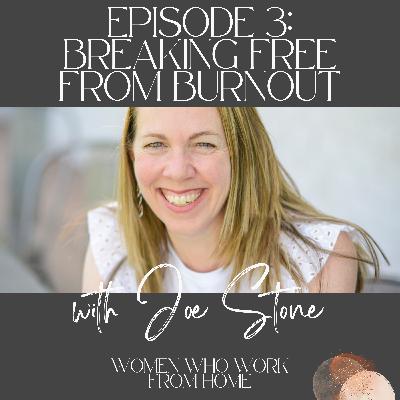
Jo Stone had the executive role, the beautiful home and the family. She also ended up in a hospital bed, convinced she had an autoimmune disease. It was burnout. Host Michelle Rivera talks to her about what happens after you tick every box on the list and the list turns out to be the problem.
Key takeaways
Burnout impersonates illness. Jo went looking for a diagnosis before she was willing to consider that the job was doing it.
The Triple P Trifecta. Perfectionism, procrastination and people-pleasing, which she treats as three faces of the same self-sabotage rather than three separate habits.
Diffuse awareness is not a productivity flaw. Women tend to track everything at once, which is why advice built around single-threaded focus keeps failing them at home.
Working from home removes the boundary the commute used to enforce. Nobody replaces it unless you do it deliberately.
Rest gets scheduled or it does not happen. Jo puts it on the same footing as achievement instead of treating it as the reward for achievement.
On this page
The hospital bed that was not an autoimmune disease
The Triple P Trifecta
Why standard productivity advice misses women
Boundaries when the office is the house
Redefining success on your own terms
People, ideas and sources mentioned
Questions this episode answers
Go deeper
The hospital bed that was not an autoimmune disease
Jo had checked the traditional boxes. Executive title. The house. The family. Then her body stopped cooperating and she went hunting for a medical explanation, because a medical explanation is easier to accept than the idea that the life you built is the thing making you ill.
The detail that matters is the order of events. The collapse came first. The reframe came after. Very few people get to do it the other way round.
The Triple P Trifecta
Her name for the self-sabotage pattern she sees most often in high-achieving women:
Perfectionism, which sets a bar nobody asked for and then punishes you for not clearing it.
Procrastination, which is usually perfectionism wearing a different coat. If it cannot be done perfectly, it does not get started.
People-pleasing, which quietly hands your calendar to everybody else.
Treating them as one system rather than three bad habits is the useful move. Fix the standard you are holding yourself to and the other two lose most of their fuel.
Why standard productivity advice misses women
Jo talks about diffuse awareness: the tendency to hold the whole environment in view at once rather than narrowing onto one task. It is not a deficiency, but it does mean advice written around deep single-threaded focus tends to land badly.
If you work from home, the environment you are diffusely aware of includes the laundry, the school run and the fridge. The advice does not fail because you lack discipline. It fails because it assumes an environment you do not have.
Boundaries when the office is the house
The commute used to do the boundary work for you. Remove it and the workday quietly expands to fill every hour that is not actively defended.
What she actually recommends
Decide when work ends before the day starts, not while you are in it.
Give rest a slot on the calendar the same way a meeting gets one.
Say no to th...
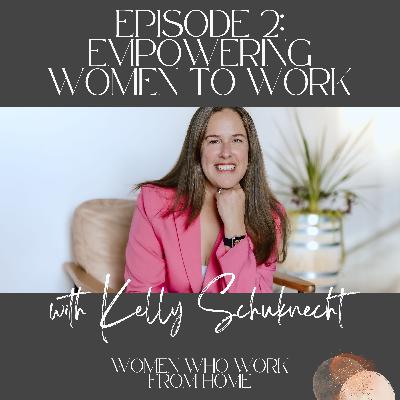
Kelly Schuknecht has worked from home for eighteen years, through three children and a full career in publishing and marketing. That is long enough to have run the experiment properly. She talks to Michelle Rivera about the systems that survived, the ones that did not, and what building a career and a business from home actually looked like.
Mentioned in this episode: oxygen and CO2 monitors from PureAire Monitoring Systems — the sealed-room air quality problem behind the mid-afternoon fog.
Key takeaways
Eighteen years is the useful part. Most work-from-home advice comes from people two years in. Kelly has watched the whole arc, from toddlers underfoot to a grown practice.
Block scheduling plus a colour-coded calendar. Unglamorous, and the thing she actually still uses.
Childcare gets solved creatively or not at all. Gym daycare as a focused work block is the example that sticks.
Todoist run on Getting Things Done. The tool matters less than having one trusted place where everything lands.
A dedicated workspace is a boundary, not a luxury. It tells the household and it tells you.
Delegation is what makes professional growth possible from home. Otherwise the ceiling is your own hours.
On this page
Eighteen years of evidence
Block scheduling and the colour-coded calendar
Working with small children in the house
The tool stack that survived
Growing professionally without an office
People, ideas and sources mentioned
Questions this episode answers
Go deeper
Eighteen years of evidence
Kelly started working from home when it was still something you had to explain to people. Over eighteen years she moved through publishing and marketing while raising three children, which means her advice has been tested against several different family stages rather than one.
The landscape changed underneath her too. Remote work went from an oddity to a default and back to a negotiation. She is one of the few people who can describe that shift from the inside without it being a pandemic story.
Block scheduling and the colour-coded calendar
Her core system is boring on purpose. Work goes in blocks. The calendar is colour-coded so family commitments and work deadlines are visible against each other rather than competing invisibly.
The point is not the colours. It is that a conflict shows up as a conflict before it becomes a crisis. She uses Google Calendar for it.
Working with small children in the house
The early years are the hard ones and Kelly does not pretend otherwise. Her answer was to find real, defended blocks wherever they existed. The example listeners remember is gym daycare: two hours of childcare that came with the membership, used for focused work rather than a workout.
The expectation problem
She is blunt that realistic expectations do more for you than any app. If you plan a full workday around a napping toddler, the system did not fail. The plan did.
The tool stack that survived
Todoist, run on the Getting Things Done method. Kelly wrote up how she does it in her GTD with Todoist post.
A col...

In the inaugural episode of the Women Who Work From Home podcast, host Michelle Rivera introduces the concept of balancing work and family life for women. She discusses the societal pressures women face regarding career and motherhood, emphasizing the importance of pursuing both. Michelle shares her personal journey of navigating motherhood while maintaining a career, and sets the stage for future conversations with women who successfully balance these aspects of their lives.
Takeaways
Women are increasingly questioning traditional roles and expectations.
The podcast aims to support women who want to balance work and family.
Michelle emphasizes the importance of authenticity in these conversations.
There is a growing trend of women opting out of hustle culture.
Motherhood and career can coexist without sacrificing one for the other.
The podcast will feature interviews with women who are successfully managing both.
Michelle's personal journey reflects the struggles many women face.
The conversation is not about which choice is better, but about exploring options.
Listeners are encouraged to share their stories and suggestions for guests.
The podcast aims to create a supportive community for women working from home.
Creating a home environment that supports both work and family life is essential, and brands like Willow Creek Outdoors offer great options for enhancing family-friendly spaces.
Loved this episode? There’s so much more here for you, sweet friend. Mish Rivera is where heaven invades the everyday — real encouragement for women building a faith-filled life, family, and work that all fit under one roof.
Hear every conversation and meet our guests on the Women Who Work From Home podcast. For weekly encouragement on faith, family, and working from home, settle in with the Mish Rivera blog. And if you’re new around here, I’d love for you to get to know the heart behind Mish Rivera.
In this debut episode, host Michelle Rivera shares her personal journey from a beauty professional in Orange County, California, to a work-from-home mom in Tennessee. She introduces her new podcast dedicated to featuring women who successfully balance career and family life from home. Michelle discusses her transition through various roles—from beauty professional to social media manager to homeschool mom—and outlines what listeners can expect: authentic conversations, practical advice, and inspiring stories from women who are building careers without sacrificing family time. Future episodes will showcase entrepreneurs, side-hustlers, and business owners who are redefining work-life balance from their home offices.
Loved this episode? There’s so much more here for you, sweet friend. Mish Rivera is where heaven invades the everyday — real encouragement for women building a faith-filled life, family, and work that all fit under one roof.
Hear every conversation and meet our guests on the Women Who Work From Home podcast. For weekly encouragement on faith, family, and working from home, settle in with the Mish Rivera blog. And if you’re new around here, I’d love for you to get to know the heart behind Mish Rivera.
Comments

Download from Google Play

Download from App Store
 United States