


44 Describing Words in German: Small, Big, etc.
Update: 2025-09-18
Description
🚀 Pre-Sale Open – Get Talking: German for Beginners & Restarters
Learn German without unnecessary complications – with a method you won’t find anywhere else.
🎯 Real results, not just rules.
💸 One-time 50% discount – only 10 spots!
🗓 Course starts February 9, 2026
👉Want to make steady German progress?📚
Our live courses are starting soon — check them out here.
Our live courses are starting soon — check them out here.
Summary
📥Get the free PDF guide for this episode at bettergerman.info/adjectives. It helps you follow along and practice the words step by step.🤓
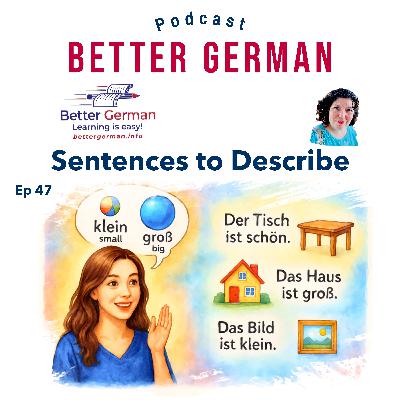
Episode 44 of the Better German is a good step forward if you want to go beyond nouns and verbs and start expanding your German vocabulary. Susi shows you how to use German adjectives — words that tell you what something is like. You’ll hear 16 common examples, such as warm, cold, cheap, expensive, and more. She also explains the German names for these words, gives simple tips for saying them correctly, and helps you practice with short sentences.
Introduction
Welcome back to Better German! In today’s episode, Susi takes you into the world of adjectives—words that describe things, people, and experiences. Imagine being able to say not just “a table” but “a big table” or “a new table.” These small words change how you express yourself and make your sentences come alive. Susi also explains why Germans sometimes refer to them as Eigenschaftswörter and why mastering them is an important step in your German-learning journey. And when you are ready to go further, join the free Better German Community for extra practice and support.🫂
🔎Key Topics: Adjectives in German
- What adjectives are, and their role in both English and German
- German terms: Adjektiv and Eigenschaftswort
- Why are adjectives introduced across multiple episodes
- 16 essential adjectives with examples, including:
▫️ groß / klein (big/small)
▫️ alt / jung (old/young)
▫️ kalt / warm (cold/warm)
▫️ schlecht / gut (bad/good)
▫️ schön (beautiful/nice)
▫️ neu (new)
▫️ teuer / billig (expensive/cheap)
▫️ stark / schwach (strong/weak)
▫️ laut / leise (loud/quiet) - Pronunciation tips: how to approach the German r
- Regional variations and why not to worry about perfect R sounds
Related Episodes🎧
Episode 1: Introduction to Better German
Episode 4: How to Learn German
Episode 5: Introduction to Articles
Episode 7: Sentence Patterns in German
Episode 12: Learn German Words about an Office or Classroom
Episode 27: Introduction to Parts of Speech for Learning German
Other Resources📚
Episode 1: Introduction to Better German
Episode 4: How to Learn German
Episode 5: Introduction to Articles
Episode 7: Sentence Patterns in German
Episode 12: Learn German Words about an Office or Classroom
Episode 27: Introduction to Parts of Speech for Learning German
Other Resources📚
- 📥Download the free PDF guide for this episode at bettergerman.info/adjectives. Grab it, listen along, and start practicing!
- You might find this helpful: our Verbs Practice PDF with simple examples and exercises. It walks you through the most important present-tense verbs.
- Listen to All The Episodes Published So Far!
✨ Join The Better German Community
Think you’re “bad at languages”? You’re not—the method was just wrong. Join the Better German Community and learn German in a way that finally makes sense.
Think you’re “bad at languages”? You’re not—the method was just wrong. Join the Better German Community and learn German in a way that finally makes sense.
📰 Sign Up for Our Newsletter
Get Tips & Updates Straight To Your Inbox!
🌍 Explore Our Podcast Episodes
New to the podcast? Head over to our podcast homepage to find other episodes you’ll love.
💬 Come See Our Approach For Yourself
We believe in real understanding, not just memorizing grammar rules—come see how we do in this YouTube Video.
Get Tips & Updates Straight To Your Inbox!
🌍 Explore Our Podcast Episodes
New to the podcast? Head over to our podcast homepage to find other episodes you’ll love.
💬 Come See Our Approach For Yourself
We believe in real understanding, not just memorizing grammar rules—come see how we do in this YouTube Video.
📲 Stay Connected and Follow Us On:
- Instagram: https://www.instagram.com/susi_blumel/
- Facebook: https://www.facebook.com/61580057243680
- YouTube: https://www.youtube.com/@Better-German
- TikTok: https://www.tiktok.com/@susibettergerman
- Pinterest: https://de.pinterest.com/susibettergerman/
⭐ Enjoyed this episode?
If you liked what you heard, give us a review on Apple Podcasts or Spotify or share it with a fellow learner!

Comments

In Channel











Download from Google Play

Download from App Store
 United States
00:00
00:00
1.0x

