


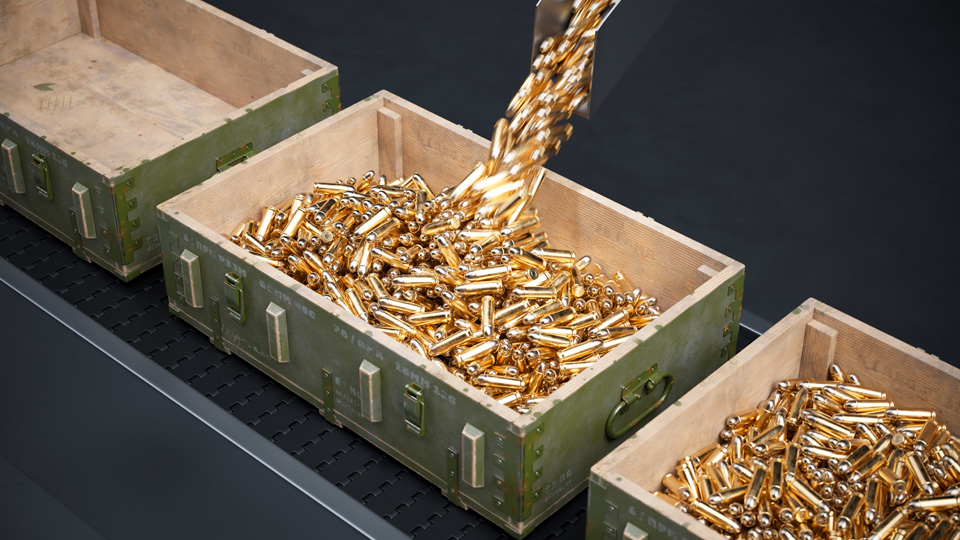
A new era of European rearmament
Description
Following the Commission’s unveiling, in October, of its defence readiness roadmap, it is now full steam ahead for Europe’s defence industry.
EDIP, the European Defence Industry Programme, formally received the go-ahead from MEPs in Strasbourg last week (25 November). This pioneering programme, which has already been informally agreed with the European Council, aims to strengthen the defence industry throughout the EU, promote joint procurement, accelerate arms production and step up support for Ukraine.
Debate over EDIP
There are many European tools dedicated to the defence industry: the European Defence Fund, the SAFE instrument… The list goes on. With this latest addition to the portfolio, it is clear that the era of European rearmament has really begun.
The new programme took additional contributions from the Security Action for Europe (SAFE) instrument. In addition, unspent Recovery and Resilience Facility funds can be diverted and reallocated to support EDIP projects.
Of EDIP’s 1.5-billion-euro budget, 300 million is earmarked for the Ukraine Support Instrument. In addition, 65 per cent of defence supplies must come from European companies.
This latter point has provoked sharp debate, with France, for example, pushing to make the scheme as eurocentric as possible and limit the use of third-country materials, and the Baltic states and Poland throwing their weight behind more flexible procurement rules.
Julie Rechagneux, an MEP representing France’s far-right National Rally party, tells euRadio why the European Parliament’s Patriots for Europe group attempted to block the regulation.
Julie Rechagneux, Member of the European Parliament – Patriots for Europe, France (in French):
“The initial intention behind this text was very good, namely to give preference to European products in the purchase of armaments. The reality is that the final text that emerged from the negotiations is not sufficient. Why is it not sufficient? Because we are [only] going to require 65 per cent of components to be European. Initially, our group advocated for an 80-per-cent share, and even Parliament asked for 70 per cent. So this 65-per-cent share is not enough. Why? Because it means that a third of the equipment will ultimately be made elsewhere but will be financed by European money. That is why we voted against this text.”
She goes on to say that her group is also against the increasingly prominent role the European Commission is taking in defence, which in their view should remain a national matter. And her criticisms do not stop there.
Julie Rechagneux, Member of the European Parliament – Patriots for Europe, France (in French):
“The amount allocated to this fund, 1.5 billion, will obviously not be sufficient to rearm Europe and promote European industries […] This is a text that, in reality, serves no purpose and will only serve to continue our dependence on the Americans, on the US, for the purchase of arms.”
Yet in an interview with Kuku Raadio, Estonian EPP member Riho Terras, who is vice-chair of the Parliament’s security and defence committee, stresses that Europe would have been shooting itself in the foot to turn its back on the US and other non-European partners at this stage. And he adds that, while the budget of 1.5 billion euros clearly falls short, this is a positive – and significant – first step.
Riho Terras, Member of the European Parliament – EPP, Estonia (in Estonian):
„First of all, it is a very big step that the EU created such a format. All the previous instruments have been based on the use of loan money. But this one is specifically aimed at industrial development. Unfortunately, this has come at the end of this financial period, and there was no money originally set aside for it. So there were no real sums to put into it. 1.5 billion is certainly not enough for this kind of project. But it is a start.”
And where would he like to see the money go?
Riho Terras, Member of the European Parliament – EPP, Estonia (in Estonian):
“Of this, 300 million will be used specifically to support Ukraine and the Ukrainian defence industry. The rest must be made available to the defence industries of European countries by way of various projects. It has not yet been decided exactly how it will be divided. But my hope and suggestion is that it be invested in modern technologies, and in small and medium-sized enterprises.“
https://kuku.pleier.ee/uudised/euroopa-kaitsetoostuse-programm
Eroding neutrality
In a recent interview with our Austrian partner station Agora, political scientist, author and peace researcher Josef Mühlbauer comments that this move towards rearmament, based on a perception of threats to Europe and the goal of strategic autonomy, is being mirrored in Austria.
Josef Mühlbauer, Political Scientist and Author (in German):
“The defence budget has been increased. Austria has made plans to acquire long-range and air defence missiles […] And Austria has also confirmed its participation in the European Sky Shield, a joint ground-based air defence missile project in Europe. Austria naturally wants to be part of this.”
But this is somewhat remarkable, isn’t it, given the longstanding and legally enshrined policy of Austrian ‘neutrality’?
Josef Mühlbauer, Political Scientist and Author (in German):
“It is a fine line, a balancing act between perpetual neutrality, which is enshrined in the constitution, and a willingness to integrate more militarily into NATO and European structures. Politicians are also manoeuvring in this balancing act. They seem to be moving towards questioning neutrality. The same cannot be said for the population. The polls are clear on this. Two-thirds of the Austrian population is in favour of perpetual neutrality. But at the political level, we are seeing a shift towards higher defence and military spending and, of course, closer integration into European and NATO military structures.”
https://www.agora.at/news/detail/abruestung-oder-wiederaufruestung-europas-wo-stehen-wir-derzeit
Already seeing results
According to an announcement by the Aerospace, Security and Defence Industries Association in Europe on Tuesday, the bloc’s defence sector turnover shot up by 13.8 per cent in 2024, reaching some 183 billion euros. So it’s clear that we are already seeing results.
Radio România reports on one such boost to the European defence industry – namely that the world’s most modern ammunition powder factory is to be built in Romania, after the Romanian government signed an agreement with major German defence equipment manufacturer Rheinmetall.
The factory will be based in the city of Victoria and involve a half-a-billion-euro investment. 400 million of this will come from the German company itself, and 120 million euros from Romania. The company is to receive 47 million euros in aid under a Brussels-approved programme, while the Romanian government will be able to access money through the SAFE instrument.
Romanian prime minister Ilie Bolojan believes that this partnership will make Romania a key player in the region’s defence industry.
Ilie Bolojan, Prime Minister of Romania (in Romanian):
“The future powder factory in Victoria means an investment of half a billion euros, approximately 700 new jobs, and above all the advantage of producing powder in Romania. I welcome Rheinmetall’s willingness to renegotiate the partnership agreement, ensuring that part of the new factory’s supply chain will be local.”
Construction is set to begin in 2026, with a view to the plant being operational within two years.
https://www.rri.ro/actualitate/in-actualitate/investitie-rheinmetall-in-romania-id947532.html
Meanwhile, a total of 19 member states have submitted national plans to the Commission in a bid to get their hands on a portion of the SAFE instrument, which will mobilise up to 150 billion euros in loans for use on defence. Most of these countries – 15 of them, to be precise – have set aside funds to support Ukraine.
With a plan worth more than 43 billion, Poland will be the largest SAFE beneficiary by far, followed by Romania, France and Hungary, each of which are requesting loans exceeding 16 billion.
The Commission will now evaluate the plans, before seeking sign-off from the Council.
NGOs under attack
I’d now like to extend a warm ‘welcome back’ to Linda Givetash from the Euranet Plus fact-checking team for a look at a totally different topic.
Linda Givetash, Euranet Plus Fact-Checker (in English) 1:
“Hi,










 United States
