


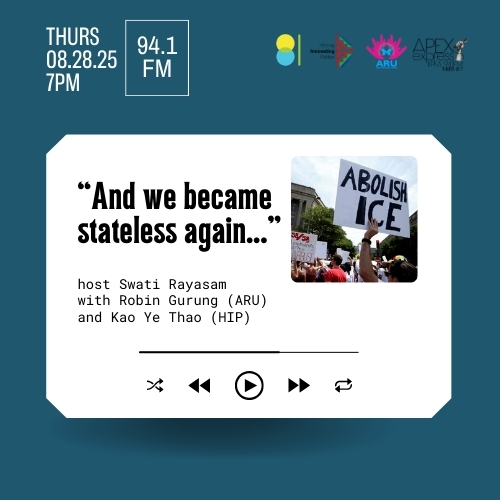
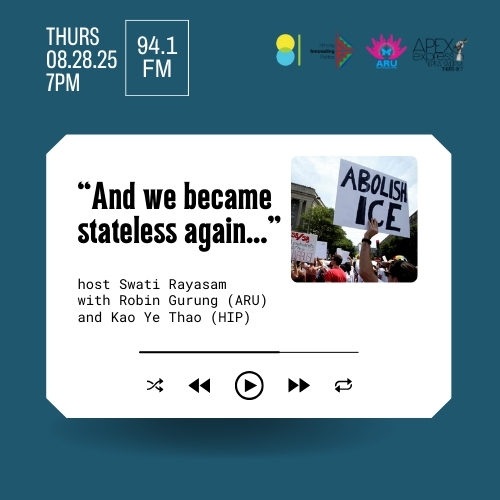
APEX Express – 10.23.25 -And We Become Stateless Again
Description
 A weekly magazine-style radio show featuring the voices and stories of Asians and Pacific Islanders from all corners of our community. The show is produced by a collective of media makers, deejays, and activists.
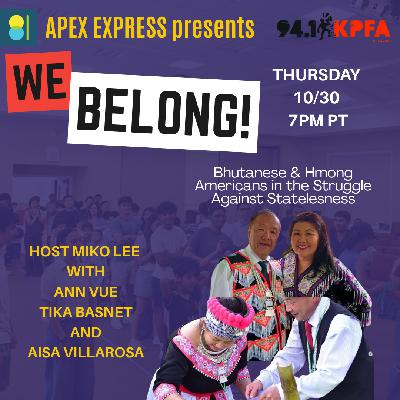
On tonight’s episode, we’re focusing on a particular segment of our immigrant and refugee community, Hmong and Bhutanese refugees.
Both of these targeted communities are stateless with no land to call their own, and their deportation carries the very real danger of disappearance and death. Robin Gurung from Asian Refugees United and Kao Ye Thao from Hmong innovating Politics, discuss their community and personal refugee stories, and talk about the intersection of the US’ deeply broken immigration and criminal legal systems, otherwise known as crimmigration.
We also get to hear from the wives of two detained refugees, one Bhutanese and one Hmong, who are currently fighting to keep their families together and to protect their loved ones from the dangers of deportation as stateless people.
Important Links:
Hmong Innovating Politics: Website | Instagram
Asian Refugees United: Website | Instagram
Bhutanese American Refugee Rights website
Transcript
Swati Rayasam: You are tuned in to Apex Express on KPFA. My name is Swati Rayasam.
Since the onset of the Trump administration, immigrant and refugee communities have been under increased attack, being kidnapped in broad daylight, detained in unsanitary and unsafe conditions, and deported to countries many of them barely know. All without due process or communication to their loved ones and communities.
On tonight’s episode, we’re focusing on a particular segment of our immigrant and refugee community, Hmong and Bhutanese refugees.
Both of these targeted communities are stateless with no land to call their own, and their deportation carries the very real danger of disappearance and death. Robin Gurung from Asian Refugees United and Kao Ye Thao from Hmong innovating Politics, discuss their community and personal refugee stories, and talk about the intersection of the US’ deeply broken immigration and criminal legal systems, otherwise known as crimmigration.
We also get to hear from the wives of two detained refugees, one Bhutanese and one Hmong, who are currently fighting to keep their families together and to protect their loved ones from the dangers of deportation as stateless people.
I also want to note because this is a rapidly developing situation, that this episode was recorded on August 13th, 2025, and is being released on August 28th, 2025.
For the most recent updates, please go to bhutaneserefugeerights.org or check out the Pardon Refugees campaign. Now, here’s Miko.
Miko: Welcome to Apex Express. Thank you so much for being here today. I’m so glad to bring you all together in this time. I’m wondering if I could ask you each to introduce yourselves and tell us a little bit about the community your organization serves and what you do, and let’s start with Kao Ye.
Kao Ye: Hello everyone, and thank you for making space- my name is Kao Ye Tao. I use she her pronouns, and I work as the director of policy and partnerships with an organization called Hmong Innovating Politics. We are an organization that serves Hmong youth and families in Sacramento and Fresno, which holds two of our largest Hmong American communities in California. And our work with Hmong youth and families is really about developing their leadership to organize towards social justice and to get the resources that their communities deserve.
Miko: Thank you, Kao Ye and Robin, could you please introduce yourself?
Robin: Sure. My name is Robin Gurung. I use he, him, his, I’m from the Nepali speaking Bhutanese community. I live in Harrisburg, Pennsylvania. my role at Asian Refugees United is the co-founder and the co-executive director. We have our program in California and Pennsylvania. California programs are, are serving Asian diaspora and then, Pennsylvania programs are focused serving the Nepal speaking Bhutanese community. We work in the intersection of arts and healing, storytelling, civic engagement, leadership development. Thank you.
Miko: Thanks Robin and I am your host Miko Lee, lead producer at Apex Express. And all of us are part of a network called AACRE Asian Americans for Civil Rights and Equality, which is a network of progressive Asian American groups.
So you all work with refugee populations. I’m wondering if you could tell a little bit more about the backstory of your community, and also if you feel comfortable about how you personally came to be a refugee in the United States. And, Robin, I’d love to start with you on that one.
Robin: Sure. My community is Nepali speaking, Bhutanese refugee community. And we are ethnically Nepali, which means culture wise and language wise we speak Nepali and follow the Nepali culture tradition. Our ancestors like maybe in 18 hundreds, 19 hundreds migrated from Nepal to Bhutan and became the citizen of that country.
And most people don’t know about Bhutan, it’s a very tiny country between China and India. And, if people know about Bhutan, then people know it through the cross national happiness concept, Bhutan is considered the happiest country in the world.
So our ancestors were in mostly in the southern area of Bhutan for generations, they became the citizen. They had their own home, their own land. And then later, 1980s, early nineties, there was a policy by the government of Bhutan, which is the monarchy government system- king rules the country. They brought a policy called One Nation, One People Policy. Which means all different groups of people would have to follow the same culture, same religion, kind of follow the same dress code and because of that policy all people were forced to stay away from following our own culture or our own religion, which, most of our folks were Hindu. Our people protested against it and because of that, the government expelled over a hundred thousand of our community members.
And, they expelled to India and then from like India wouldn’t allow us to stay and we had to resettle in Nepal in seven different refugee camps under different international agencies like U-N-H-C-R and other agencies.
Miko: And then Robin, can you tell a little bit about your personal story and how you came here?
Robin: Yeah. Yeah. So 1992 is when my family had to leave Bhutan. And at that time I was three years old. I remember growing up in a refugee camp in Nepal, from three years until I was 23 years. So 20 years of my life I was in a refugee camp in Nepal. And in 2012, I came to US through the refugee resettlement program introduced to our camps in 2008, and through it US agreed to resettle 60,000 of our committee members. By 2017, I think US has resettled about 70 to 80,000 of our Bhutanese community members.
Miko: Thank you so much for sharing. Kao Ye I wonder if you could talk about your community and the refugee resettlement program that your community was a part of.
Kao Ye: The Hmong American community, or just the Hmong community overall, is a group that’s indigenous to East and Southeast Asia. And through our ancient history, we’ve always been a stateless, people fighting for our autonomy to live to practice our customs and our culture. And particularly where we come into this history of refugee is during the Vietnam War where many Hmong people, alongside other ethnic groups in Laos, were caught in the crossfire of the United States conflict in Southeast Asia.
And so with the Vietnam War. The Hmong as well as many other ethnic communities that lived, in the hills and the mountains were recruited in covert operations by the CIA to fight back against the Vietnamese, the Northern Vietnamese communist forces, as well as the Putet Lao. And so once the US withdrew from Southeast Asia, it created a vacuum of conflict and violence that our people had to escape from in order to survive. And so after the Vietnam War in 1975, we saw the mass displacement of many Southeast Asian ethnic communities, including Hmong families. And that is where my history starts because my parents were born in Laos and because of this war, they fled to Thailand refugee camps and lived there for a few years until they were able to come to the United States in 1992. And I’m actually I’m a child of refugees and so what I know about this part of my history comes from the stories of my grandparents who raised me as well as what little I could learn in the textbooks of public education.
And so it wasn’t actually until going to college and. Being able to access more of this literature, this history that I really learned about what the United States had done in Southeast Asia and the ramifications of that for myself and my family and so many others, refugees that. Have to have had to resettle in the United States.
And so it’s definitely a history that runs very close, because we have relatives that live through that refugee experience. And so it is very well and alive. And so as we now approach this conversation around ICE and deportations, it really is a reminder of the trauma that our people face, but are still facing as a people that have been seen as disposa









 United States
