


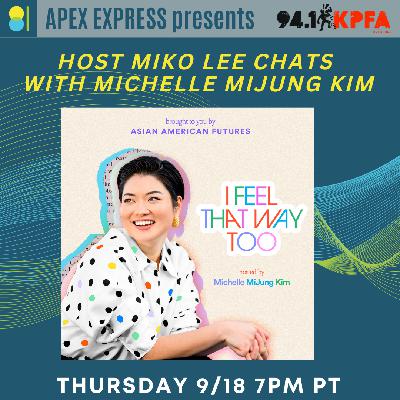
APEX Express – 9.18.25 – I Feel That Way Too
Description
 A weekly magazine-style radio show featuring the voices and stories of Asians and Pacific Islanders from all corners of our community. The show is produced by a collective of media makers, deejays, and activists.
Host Miko Lee speaks with author, activist Michelle MiJung Kim about her new Podcast, I Feel That Way Too. Then we listen to the first episode.
I FEEL THAT WAY TOO show Transcript
Miko Lee: Welcome to APEX Express. I’m your host, Miko Lee, and tonight I’ll be talking with author, speaker, and activist, Michelle MiJung Kim, about the new podcast. So we get to listen after the interview to the very first episode, and you get a little behind the scenes with activist Michelle MiJung. Kim, stay tuned. welcome, Michelle MiJung Kim to Apex Express. I’m so excited to chat with you. You are an award-winning author, activist, and now a podcast host. Hello girl. Welcome. Yay.
Michelle MiJung Kim: Hello. Thank you so much for having me, Miko. I’m so excited.
Miko Lee: I wanna start with my big question, who are your people and what legacy do you carry with you?
Michelle MiJung Kim: Hmm. What a deep question that I can go on forever about. My people are, first and foremost people who are in my life, who have supported me throughout. Everything that I’ve gone through in my life, including my friends and family who have different lineages, people, most of the people that I hold near and dear carry with them, a deep understanding of their historical trauma, their familial trauma, and people who are courageous enough to share them [00:02:00 ] with me. So that really creates this bond that I have with my people. A lot of my people are in the queer and trans community and in the physical space of the Ohlone land, also known as Oakland, California. A lot of my community rooted in my Asian American identity.
Miko Lee: Love this. My follow up, what is the legacy you carry with you from your people?
Michelle MiJung Kim: The legacy that I carry from my people that jumps out to me right now is the legacy of my grandparents. My grandparents were both born in Korea. My grandpa from the north, my grandma from the south, and I am always thinking about how my grandpa was fighting for the Korea’s liberation from Japanese occupation, and he was a writer himself. I always saw him writing and he had [00:03:00 ] stacks of paper ready to be published, but he ended up not being able to publish before he passed.
So my book dedication starts with my gratitude to my grandparents and my grandpa specifically. The legacy of his work, his spirit, his love for philosophy, social justice language I carry with me. My grandmother, who was part of the first class of women in her generation to go to a university she was a badass matriarch of our family and her energy, her audacity, her courage, her confidence in her herself and her community is what I try to channel. I think about them every day.
Miko Lee: Ugh. I love that. I’m wondering if you could share a little bit about your book.
Michelle MiJung Kim: My book is called The Wake Up Closing The Gap Between Good Intentions and Real Change and really it’s part memoir, part [00:04:00 ] principles of Social justice that I hold near to my heart. I really wanted to write a book that could be timeless and that could put into accessible ways how we can embody these values that are important for our collective liberation.
So much of the social justice work that I encountered throughout my education journey had been highly intellectualized and theoretical and sometimes not unpacked in ways that feel human. I wanna see how people are struggling to hold social justice values while living their daily lives.
How sometimes it gets challenging to embody the values that we say are important to us because it asks us to trade off our comfort and safety sometimes. I wanted to be really honest about my experience trying to live in alignment with my values, including the parts of my own contradictions and struggles and paradoxes that I’ve had to navigate.
Miko Lee: Such a powerful [00:05:00 ] book for the time of now in that it does have the personal story, but then also recognizing what’s happening in our world. It’s really action forward. Tell me how you got from this book to creating a podcast series called. I feel that way too. Tell me what inspired this whole series?
Michelle MiJung Kim: I think it is an extension of the work that I’ve been doing, which really marries personal storytelling and social justice values. I Feel that way too, exploring these tricky life questions like, can we be friends if we politically disagree? What if I’m not above revenge, even though I am a self-proclaimed abolitionist? Why do I have this urge to, be vengeful and why do I feel gleeful when people that have done harm get punished, right? Am I supposed to sleep with one person for the rest of my life? Am I a bad daughter? These are all the questions that I’ve struggled [00:06:00 ] with. I wanted to have an opportunity to unpack them with raw honesty and with guests that could really help guide me in thinking about these things while trying to stay tethered to my values around social justice.
I’ve always been a fan of audio storytelling. So this was the perfect opportunity to explore that, especially in an era where the world is constantly insisting we solve these issues in isolation and we deal with our traumas in shame and without each other’s witnessing. This is my way of hopefully making people feel a little bit less alone in their struggles and also in a way that, helps us to build more courage and community through stories.
Miko Lee: I binge the entire season. Super fun, super personal., I was wondering how did you decide on these topics? Did they come naturally [00:07:00 ] or did you create an arc? Tell me about your process.
Michelle MiJung Kim: I had probably two, three pages long list of topics that I wanted to explore and we had to pick and narrow it down. I wanted to tackle questions that felt existential in the collective psyche. I look at and feel into the zeitgeist of what is happening in the world . These are the questions that I wanted to explore because of my own life, but also some of these questions bring up a lot of shame and tension. when I looked at other podcasts that were exploring similar topics, I just felt as though a lot of these issues were being talked about in a very intellectualized way, in a very theoretical way without the raw sort of personal storytelling aspect that I was craving.
So this was my attempt at being, courageous and practicing what I preach and being able to share some of the more vulnerable [00:08:00 ] tensions that aren’t typically explored in the public arena.
Miko Lee: Oh wow. So two whole more pages for future seasons of shows to do. I was, struck by how vulnerable the episodes are, how they’re so personal. The first one being around, supporting your single mom and around financial and really emotional stability that really struck me as being so very personal and deep. I just wonder, has your mom and dad listened to the series or particularly that episode and what has been any response?
Michelle MiJung Kim: Yeah. Um, my dad, no, but my mom, yes. I wanted my mom to listen to it before it aired. ’cause I thought that was the only fair thing to do. I gave her the option also to not have this air if she didn’t want it to go live.
And I was. So [00:09:00 ] scared about how she was gonna receive it. And for the listeners, the story really goes deep into my struggle around prioritizing her needs over my desires, and constantly living in this. Feeling of guilt for not doing more to support my mom. And also our definition of love and sacrifice being entangled in ways that feel sometimes impossible to navigate.
I had attempted to have this conversation years ago with my mom that like completely backfire that I talk about on the podcast and, since then, I just never broached the subject because I was so nervous about how she was gonna take it. , And my biggest fear was her feeling less loved and feeling, hurt by my honesty.
And so when it came time for me to present this podcast to her, I was incredibly nervous. What ended up happening was we ended up listening to the episode together. She was sitting [00:10:00 ] right there on the couch behind me and the, I played the episode and I just couldn’t look at her face. So instead of looking directly at her, I had my camera on , so I could look at her through my phone.
And I had my back toward her, and within the first five minutes she started crying. So I would pause the episode, talk to her about what was coming up for her. We would cry, we would fight, we would argue, we would apologize and we would cry again. So the entire episode that’s 30 minutes long, took us three hours to get through.
Miko Lee: Wow.
Michelle MiJung Kim: It was incredibly difficult emotionally. And it was probably one of the most pivotal interactions I’ve ever had with my mom. I’ve been able to be more honest than ever with her. [00:11:00 ] She got to also be honest in her reaction and response, and we were able to be really brave with our vulnerability, which we had never don




 United States
