


APEX Express – August 14, 2025
Description
A weekly magazine-style radio show featuring the voices and stories of Asians and Pacific Islanders from all corners of our community. The show is produced by a collective of media makers, deejays, and activists.
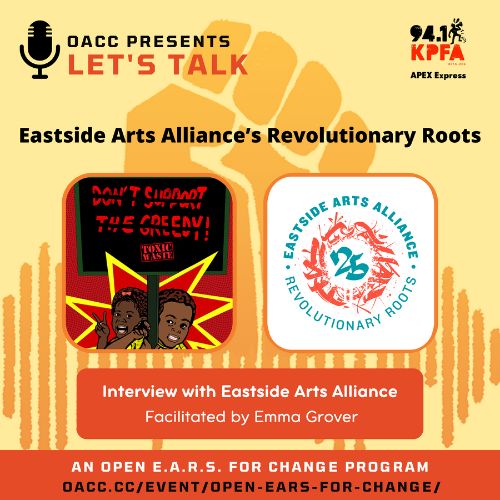
In this two-part series of Oakland Asian Cultural Center’s “Let’s Talk” podcast Eastside Arts Alliance is featured. Elena Serrano and Susanne Takehara, two of the founders of Eastside Arts Alliance, and staff member Aubrey Pandori will discuss the history that led to the formation of Eastside and their deep work around multi-racial solidarity.
Transcript:
Let’s Talk podcast episode 9
[00:00:00 ] Emma: My name is Emma Grover, and I am the program and communications coordinator at the Oakland Asian Cultural Center, known also as OACC. Today we are sharing the ninth episode of our Let’s Talk Audio Series. Let’s Talk is part of OACC’S Open Ears for Change Initiative, which was established in 2020. With this series, our goals are to address anti-Blackness in the APIA communities, discuss the effects of colorism and racism in a safe space, and highlight Black and Asian solidarity and community efforts specifically in the Oakland Chinatown area. Today’s episode is a round table discussion with Elena Serrano, Susanne Takahara, and Aubrey Pandori of Eastside Arts Alliance.
[00:00:53 ] Aubrey: Hello everybody. This is Aubrey from Eastside Arts Alliance, and I am back here for the second part of our Let’s Talk with Suzanne and Elena. We’re gonna be talking about what else Eastside is doing right now in the community. The importance of art in activism, and the importance of Black and Asian solidarity in Oakland and beyond.
So I am the community archivist here at Eastside Arts Alliances. I run CARP, which stands for Community Archival Resource Project. It is a project brought on by one of our co-founders, Greg Morozumi. And it is primarily a large chunk of his own collection from over the years, but it is a Third World archive with many artifacts, journals, pens, newspapers from social movements in the Bay Area and beyond, international social movements from the 1960s forward. We do a few different programs through CARP. I sometimes have archival exhibitions. We do public engagement through panels, community archiving days. We collaborate with other community archives like the Bay Area Lesbian Archives and Freedom Archives here in Oakland and the Bay Area. And we are also working on opening up our Greg Morozumi Reading Room in May. So that is an opportunity for people to come in and relax, read books, host reading groups, or discussions with their community. We’re also gonna be opening a lending system so people are able to check out books to take home and read. There’ll be library cards coming soon for that and other fun things to come.
[00:02:44 ] So Suzanne, what are you working on at Eastside right now?
[00:02:48 ] Susanne: Well, for the past like eight or nine years I’ve been working with Jose Ome Navarrete and Debbie Kajiyama of NAKA Dance Theater to produce Live Arts and Resistance (LAIR), which is a Dance Theater Performance series. We’ve included many artists who, some of them started out here at Eastside and then grew to international fame, such as Dohee Lee, and then Amara Tabor-Smith has graced our stages for several years with House Full of Black Women. This year we’re working with Joti Singh on Ghadar Geet: Blood and Ink, a piece she choreographed, and shot in film and it’s a multimedia kind of experience. We’ve worked with Cat Brooks and many emerging other artists who are emerging or from all over, mostly Oakland, but beyond. It’s a place where people can just experiment and not worry about a lot of the regulations that bigger theaters have. Using the outside, the inside, the walls, the ceiling sometimes. It’s been an exciting experience to work with so many different artists in our space.
[00:04:03 ] Elena: And I have been trying to just get the word out to as many different folks who can help sustain the organization as possible about the importance of the work we do here. So my main job with Eastside has been raising money. But what we’re doing now is looking at cultural centers like Eastside, like Oakland Asian Cultural Center, like the Malonga Casquelord Center, like Black Cultural Zone, like the Fruitvale Plaza and CURJ’s work. These really integral cultural hubs. In neighborhoods and how important those spaces are.
[00:04:42 ] So looking at, you know, what we bring to the table with the archives, which serve the artistic community, the organizing community. There’s a big emphasis, and we had mentioned some of this in the first episode around knowing the history and context of how we got here so we can kind of maneuver our way out. And that’s where books and movies and posters and artists who have been doing this work for so long before us come into play in the archives and then having it all manifest on the stage through programs like LAIR, where theater artists and dancers and musicians, and it’s totally multimedia, and there’s so much information like how to keep those types of places going is really critical.
[00:05:28 ] And especially now when public dollars have mostly been cut, like the City of Oakland hardly gave money to the arts anyway, and they tried to eliminate the entire thing. Then they’re coming back with tiny bits of money. But we’re trying
to take the approach like, please, let’s look at where our tax dollars go. What’s important in a neighborhood? What has to stay and how can we all work together to make that happen?
[00:05:52 ] Susanne: And I want to say that our Cultural Center theater is a space that is rented out very affordably to not just artists, but also many organizations that are doing Movement work, such as Palestinian Youth Movement, Bala, Mujeres Unidas Y Activas, QT at Cafe Duo Refugees, United Haiti Action Committee, Freedom Archives, Oakland Sin Fronteras, Center for CPE, and many artists connected groups.
[00:06:22 ] Aubrey: Yeah, I mean, we do so much more than what’s in the theater and Archive too, we do a lot of different youth programs such as Girl Project, Neighborhood Arts, where we do public murals. One of our collective members, Angie and Leslie, worked on Paint the Town this past year. We also have our gallery in between the Cultural Center and Bandung Books, our bookstore, which houses our archive. We are celebrating our 25th anniversary exhibition.
[00:06:54 ] Susanne: And one of the other exhibits we just wrapped up was Style Messengers, an exhibit of graffiti work from Dime, Spy and Surge, Bay Area artists and Surge is from New York City, kind of illustrating the history of graffiti and social commentary.
[00:07:30 ] Elena: We are in this studio here recording and this is the studio of our youth music program Beats Flows, and I love we’re sitting here with this portrait of Amiri Baraka, who had a lot to say to us all the time. So it’s so appropriate that when the young people are in the studio, they have this elder, magician, poet activist looking at him, and then when you look out the window, you see Sister Souljah, Public Enemy, and then a poster we did during, when Black Lives Matter came out, we produced these posters that said Black Power Matters, and we sent them all over the country to different sister cultural centers and I see them pop up somewhere sometimes and people’s zooms when they’re home all over the country. It’s really amazing and it just really shows when you have a bunch of artists and poets and radical imagination, people sitting around, you know, what kind of things come out of it.
[00:08:31 ] Aubrey: I had one of those Black Power Matters posters in my kitchen window when I lived in Chinatown before I worked here, or visited here actually. I don’t even know how I acquired it, but it just ended up in my house somehow.
[00:08:45 ] Elena: That’s perfect. I remember when we did, I mean we still do, Malcolm X Jazz Festival and it was a young Chicana student who put the Jazz Festival poster up and she was like, her parents were like, why is Malcolm X? What has that got to do with anything? And she was able to just tell the whole story about Malcolm believing that people, communities of color coming together
is a good thing. It’s a powerful thing. And it was amazing how the festival and the youth and the posters can start those kind of conversations.
[00:09:15 ] Aubrey: Malcolm X has his famous quote that says “Culture is an indispensable weapon in the freedom struggle.” And Elena, we think a




 United States
