


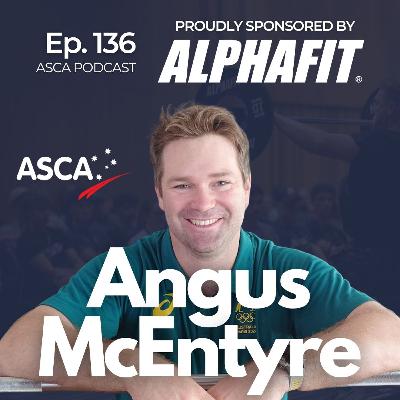
ASCA Podcast #136 - Angus McEntrye
Update: 2025-12-16
Description
Angus McEntrye is a Chiropractor, Athletics coach and Strength & Conditioning Coach. He works out of his practice AM Health & Performance in Sydney and specialises in injury diagnosis, management, and rehabilitation. Angus has worked with several different athletes and teams and has coached athletes competing at World Championships, Commonwealth Games, and the Olympic Games in athletics. Angus is also an accredited Level 4 Athletics Coach and ASCA Elite L3 Strength & Conditioning Coach.
QUOTES
"So what is VBT to me? It's all about speed output. So moving the bar or the body as fast as we can."
"The most important part about the competitive season is that they're competing. We're not trying to be Olympic lifters. We're not trying to be power lifters. We want to make sure that their transfer to the sport is as high as possible. That's submaximal loading, accelerative strengthening, power on the force velocity curve. 60-70 % 1RM comes in as the heavy and then we muck around with 50-30 %; lighter, faster, ballistic tosses, jumping, loud noises, trying to get things moving as fast as we can..."
"How many sports generate force up and down like a squat? There aren't too many. In track and field, it's the hammer throw, skiing, rowing, a couple of examples there, but most of what we do is we're generating force in a split based position"
"So then, you know, going into those lighter loads, and doing it with a snatch, Cameron can lift up to four meters per second with 30% 1RM on the bar"
“I've always been somebody that likes to be creative and just think outside of the box and how might this work? How might this better the output that we're trying to achieve? And then in the gym, it just bolsters that as well. So, you know, as long as you're not being stupid, think being creative in your environment … especially with VBT”
SHOWNOTES
1) Angus’ journey in strength and conditioning, athletics coaching and chiropractic influences
2) Velocity based training (VBT) basics and split snatches in Tokyo
3) Periodizing VBT across general prep, specific prep and competition phases
4) Different exercises, including Olympic lifting variations, that Angus will use in his coaching
5) How VBT metrics and speeds can be adapted for power development, including lifts above 3-4 meters per second
6) The benefits of different coaching cues combined with VBT feedback
7) Being creative in your environment as a coach and the use of different exercises to influence technique
PEOPLE MENTIONED
Cam McEntrye
John Mitchell
Nick Winkelman
John Manenti
QUOTES
"So what is VBT to me? It's all about speed output. So moving the bar or the body as fast as we can."
"The most important part about the competitive season is that they're competing. We're not trying to be Olympic lifters. We're not trying to be power lifters. We want to make sure that their transfer to the sport is as high as possible. That's submaximal loading, accelerative strengthening, power on the force velocity curve. 60-70 % 1RM comes in as the heavy and then we muck around with 50-30 %; lighter, faster, ballistic tosses, jumping, loud noises, trying to get things moving as fast as we can..."
"How many sports generate force up and down like a squat? There aren't too many. In track and field, it's the hammer throw, skiing, rowing, a couple of examples there, but most of what we do is we're generating force in a split based position"
"So then, you know, going into those lighter loads, and doing it with a snatch, Cameron can lift up to four meters per second with 30% 1RM on the bar"
“I've always been somebody that likes to be creative and just think outside of the box and how might this work? How might this better the output that we're trying to achieve? And then in the gym, it just bolsters that as well. So, you know, as long as you're not being stupid, think being creative in your environment … especially with VBT”
SHOWNOTES
1) Angus’ journey in strength and conditioning, athletics coaching and chiropractic influences
2) Velocity based training (VBT) basics and split snatches in Tokyo
3) Periodizing VBT across general prep, specific prep and competition phases
4) Different exercises, including Olympic lifting variations, that Angus will use in his coaching
5) How VBT metrics and speeds can be adapted for power development, including lifts above 3-4 meters per second
6) The benefits of different coaching cues combined with VBT feedback
7) Being creative in your environment as a coach and the use of different exercises to influence technique
PEOPLE MENTIONED
Cam McEntrye
John Mitchell
Nick Winkelman
John Manenti

Comments
In Channel




Download from Google Play

Download from App Store
 United States
00:00
00:00
x

