


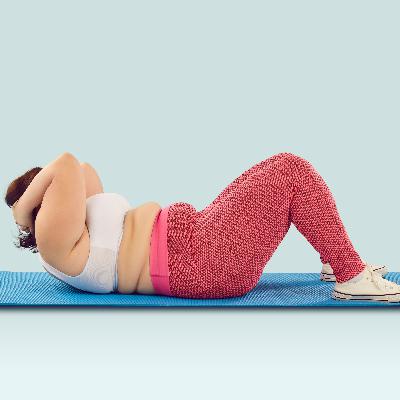
All Fat People Are Strong
Description
You're listening to Burnt Toast! We are Virginia Sole-Smith and Corinne Fay.
Happy 2026!!! To celebrate—and kick off the most diet-y month of the year!—we are here with a roundup of the very best anti-diet fitness advice in the Burnt Toast archives.
If you find this useful, consider a paid Burnt Toast subscription! We're way cheaper than a gym or a diet app membership, and arguably better for your health too.
And in addition to getting behind paywalled episodes and essays, Burnt Toasties get to join our awesome chat rooms like Team CPAP, Anti-Diet Ozempic Life and Fat Fashion! You'll find so much practical support, inspiration, and fat joy. Join us here!
Don't diet, come hang with us!🧈🧈🧈🧈🧈🧈🧈🧈🧈🧈🧈🧈🧈🧈
This episode contains affiliate links. Thank you for supporting Burnt Toast when you shop our links!
Episode 226 Transcript
Virginia
Happy 2026! We made it. It's a whole new year.
Corinne
Thank God, honestly.
Virginia
See you later, 2025. Excited to be here in a new in a new chapter.
Corinne
To celebrate, we're bringing you a helpful episode to kick off the most diet-y month of the year: A roundup of our favorite anti-diet fitness advice.
Virginia
I'm excited for this. I hope this is grounding to people and helps prevent you spiraling off into some new thing that doesn't serve you.
We're also holding space for the fact that a lot of people do like fresh start culture. We will be coming to you next week with our annual Ins and Outs episode. So don't think we are immune from resolution culture! That's the Burnt Toast version of it. It's coming.
All right. First up, we have an excerpt from an episode called “We Have Only Recently Acknowledged That Female Athletes Need to Eat.” This episode aired October 19, 2023. It's an oldie, but a goldie. And the guest was Christine Yu, author of Up to Speed: The Groundbreaking Science of Women Athletes.
And one of the main things Christine wanted us to understand was carbs are good for you.
Virginia
I also want to spend some time on your very excellent chapter about diet and sports. This was so well done. It feels like nutritional science, athletic research— all of this research—has only just recently given women permission to eat as athletes, and to eat enough to support their sports. This feels really staggering to me, that there has been this underfeeding of women athletes for so long.
Christine
Consistently. All the time. And I think it’s in part because of just general diet culture in our culture and society and these ridiculous expectations that we have or we place on girls and women in terms of what their bodies need to look like. And then you have the sports performance side, you have this idea that certain body types are the ideal athletic body types.
It’s almost no wonder that we create this perfect storm and a way for disordered eating and eating disorders and all these other problematic behaviors to take root. Especially because bodies are so central, obviously, in sports and performance. And we focus so much on bodies and how they look, what their body composition is, and all of these different things, the shape of you, all of that.
It’s wild to me that it’s only been recently that we do acknowledge the fact you just need to eat. We talked so much about nutrition and sports as this idea of fueling your body, which I think was at first kind of helpful in the way of reframing food within this context. Your body needs fuel to be able to do all this stuff, in order to start to give folks a little bit more permission to eat or feel like they could eat what they needed. But that, I think, even still creates this idea that there’s a certain kind of fuel that you need to be eating in order to be an athlete, in order to fuel your body correctly, if that makes sense.
Virginia
It’s, again, mind blowing, but makes sense that we had to first embrace the idea of eating, period, as opposed to eating being the enemy. You have so many heartbreaking stories from athletes in this chapter talking about feeling like they were so tapped out at the end of a practice that they couldn’t function and that when they started eating enough, they were like, wow.
Christine
Turns out!
Virginia
“I can do a 90 minute workout without a problem!” The fact that they were performing at all when they were being asked to do it while starving is ridiculous. It’s ridiculous what they were being asked to do. Then seeing that immediate and logical shift that if you feed yourself, you can perform better. But then from there, this idea of food as fuel can also become very limiting because, of course, athletes are human beings, as well. And food is more than fuel for all of us.
Christine
It’s really easy within sports and athletics to look at food as almost a hack, in a way. Like, as a way to like fine tune your performance. Oh, I need more iron, or whatever other very specific thing that you need. And again, I think it dissociates food from what it actually is. I think that also just makes it really ripe to encourage a lot of these behaviors that aren’t always helpful or healthy.
Virginia
You also do some amazing work in this chapter dissecting a couple of the modern big diet trends: Intermittent fasting, keto, and you even look at some of the less extreme ones like the Mediterranean diet, and show how they underserve athletes and especially women athletes. I wondered if we could just spend a little time talking about your findings there, because that felt super important to me.
Christine
In the last several years, we’ve seen things like intermittent fasting and keto pop up within athletic communities as this way to make your body a better machine. Especially, I think, within endurance sports, it’s this idea that your body can run longer or you can somehow create these these efficiencies, if you will.
But the body likes to be in homeostasis, it likes to be in balance. So anytime energy levels start to dip, your body starts to send out these flares that are like, “Wait a second, hold on. Are we going to be starving real soon?” Because if so, I need to make some adjustments, physiologically. So with a lot of these diets, you’re actually ended up with these long periods of under-fueling your body. With intermittent fasting, you’re not eating for anywhere between eight to many, many hours. So you’re leaving your body in this huge deficit of energy so it starts to freak out and starts to shut down these non essential systems.
And the thing with women is that our bodies are much more sensitive to these downturns in nutrition. It starts to send up those flares a lot earlier, it starts to make those those physiological changes a lot earlier. That can have repercussions on things like your menstrual cycle and all the hormonal things that your body does.
Similarly, with keto, this whole idea of eating a lot of fat and very few carbs might seem like, Oh, I’m really full, I don’t need to eat as much. But it’s the same idea that you end up inadvertently underfueling your body. But more importantly, especially for women, by not eating carbs, it sends up those same flares to the body. Women’s bodies, in particular, need carbohydrates in order to function well, in order to do all the things it does. And when we don’t have carbs, the body starts to send all these warning signs.
We tend to see intermittent fasting or keto “work” in men because it seems like male bodies can get away with that under-fueling a little bit more than female bodies. But when women tend to try these diets they end up feeling, unsurprisingly, really flat, really fatigued, a lot of brain fog. They don’t see this performance boost and then they wonder what they’re doing wrong because all the podcasts, all the influencers, say I should be intermittent fasting. This is going to be how I’m going to lose weight. This is how I’m going to cut time on my race. This is how I’m going to improve performance, improve body composition, all the stuff. But I’m not seeing that. I’m feeling flat. I’m not seeing all these other positive benefits. It’s because your body is essentially saying, ah, this isn’t working for me.
Virginia
Just because it works for Peter Attia does not mean—and question mark on if it even works for these guys? Thats the other thing I just want to interject. It might improve athletic performance, it doesn’t mean it’s not having other consequences on their mental health or their relationships with food and body. But that’s fascinating to realize specifically, if your goal is improving athletic performanc


![[PREVIEW] The Year in Butters: 2025](https://s3.castbox.fm/97/0e/ee/44e1a0b26f934e73cb55f46ed899d75a91_scaled_v1_400.jpg "[PREVIEW] The Year in Butters: 2025")
![[PREVIEW] Hot People Problems](https://s3.castbox.fm/10/0c/c3/2c4186bb3ffaa958c5a4ee4d3888ceb6df_scaled_v1_400.jpg "[PREVIEW] Hot People Problems")
![[PREVIEW] Are Standing Pants Different from Sitting Pants?](https://s3.castbox.fm/be/2c/0c/f737b964d5f27610acbbd373a16c29a78e_scaled_v1_400.jpg "[PREVIEW] Are Standing Pants Different from Sitting Pants?")
![[PREVIEW] How Much Did You Pay Your Pumpkin Stylist?](https://s3.castbox.fm/fe/3d/c0/dd8784a5450c5e085b6336501f2ac0f261_scaled_v1_400.jpg "[PREVIEW] How Much Did You Pay Your Pumpkin Stylist?")

![[PREVIEW] Can A Body Acceptance Advocate Work for Weight Watchers?](https://s3.castbox.fm/ce/6e/f2/62fdccc162b0b6bc777b5875f2c6d64cfa_scaled_v1_400.jpg "[PREVIEW] Can A Body Acceptance Advocate Work for Weight Watchers?")

![[PREVIEW] Not Trying to Be Hot 25-Year-Olds](https://s3.castbox.fm/1c/8e/70/adb41c046a3fe07dc045af139e24fdcf89_scaled_v1_400.jpg "[PREVIEW] Not Trying to Be Hot 25-Year-Olds")


![[PREVIEW] Is Back To School A Diet?](https://s3.castbox.fm/29/4e/50/fbf3f4de138a90fdd48db11f2d64935074_scaled_v1_400.jpg "[PREVIEW] Is Back To School A Diet?")

![[PREVIEW] The Mel Robbins Cult of High Fives](https://c10.patreonusercontent.com/4/patreon-media/p/post/140044903/63d8db77f7bf4ae6adc056b196ba3c37/eyJkIjo3MiwiaCI6MzAwMCwic3RyaXBfYWxwaGEiOjEsInciOjMwMDAsIndlYnAiOjB9/1.jpg?token-hash=_lgawLhrnuO4p0kAmMk8Wmg8kk1uHDzmHglZCAmOM1I%3D "[PREVIEW] The Mel Robbins Cult of High Fives")


 United States
