


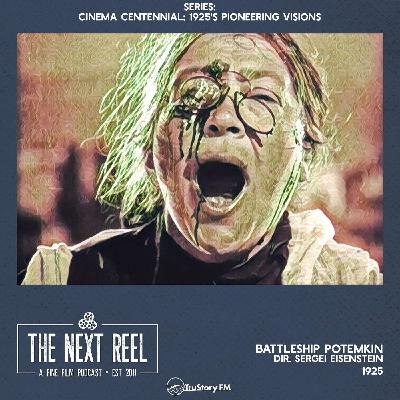
Battleship Potemkin
Update: 2025-11-27
Description
“The land is ours. Tomorrow is ours!”
Revolutionary Cinema: Battleship Potemkin Turns 100
Sergei Eisenstein's landmark 1925 Soviet silent film Battleship Potemkin revolutionized cinema through its innovative use of montage and dramatic storytelling. Commissioned to commemorate the 20th anniversary of the 1905 Russian Revolution, Eisenstein focused on a single episode—the mutiny aboard the Potemkin—rather than attempting to capture the entire revolutionary period. This decision allowed him to create an intimate yet universal story about the power of collective action against oppression. Join us—Pete Wright and Andy Nelson—as we kick off the Cinema Centennial: 1925's Pioneering Visions series with a conversation about Battleship Potemkin.
Mastering Montage
Pete and Andy explore how Eisenstein's groundbreaking editing techniques created meaning through the juxtaposition of images. They discuss the evolution of the term "montage" from its origins in Soviet cinema theory to its modern usage, highlighting how Battleship Potemkin established foundational principles of film editing that continue to influence filmmakers today.
Propaganda vs. Authenticity
The hosts debate whether the film's revolutionary message feels propagandistic or authentic, with both agreeing that Eisenstein's sincere belief in the story's themes elevates it beyond mere propaganda. They note how the director's decision to focus on collective protagonists rather than individual heroes creates a unique narrative perspective.
The Odessa Steps Sequence
Andy and Pete analyze the famous Odessa Steps sequence, discussing how its shocking violence and masterful editing create an unforgettable statement about state oppression. They explore how this sequence has influenced countless films while noting that its full impact can only be appreciated within the context of the complete film.
Key discussion points:
Both hosts emphasize how Battleship Potemkin remains remarkably fresh and energetic despite its age, praising its technical innovation and emotional power. Pete, watching it for the first time, expresses surprise at how engaging and modern the film feels, while Andy notes how effectively it maintains its revolutionary spirit across multiple viewings.
We have a great time talking about it, so check it out then tune in. The Next Reel—when the movie ends, our conversation begins!
🎬 Watch & Discover
Revolutionary Cinema: Battleship Potemkin Turns 100
Sergei Eisenstein's landmark 1925 Soviet silent film Battleship Potemkin revolutionized cinema through its innovative use of montage and dramatic storytelling. Commissioned to commemorate the 20th anniversary of the 1905 Russian Revolution, Eisenstein focused on a single episode—the mutiny aboard the Potemkin—rather than attempting to capture the entire revolutionary period. This decision allowed him to create an intimate yet universal story about the power of collective action against oppression. Join us—Pete Wright and Andy Nelson—as we kick off the Cinema Centennial: 1925's Pioneering Visions series with a conversation about Battleship Potemkin.
Mastering Montage
Pete and Andy explore how Eisenstein's groundbreaking editing techniques created meaning through the juxtaposition of images. They discuss the evolution of the term "montage" from its origins in Soviet cinema theory to its modern usage, highlighting how Battleship Potemkin established foundational principles of film editing that continue to influence filmmakers today.
Propaganda vs. Authenticity
The hosts debate whether the film's revolutionary message feels propagandistic or authentic, with both agreeing that Eisenstein's sincere belief in the story's themes elevates it beyond mere propaganda. They note how the director's decision to focus on collective protagonists rather than individual heroes creates a unique narrative perspective.
The Odessa Steps Sequence
Andy and Pete analyze the famous Odessa Steps sequence, discussing how its shocking violence and masterful editing create an unforgettable statement about state oppression. They explore how this sequence has influenced countless films while noting that its full impact can only be appreciated within the context of the complete film.
Key discussion points:
- The significance of the film's various musical scores over the decades
- How the film's depiction of religious figures reflected Soviet attitudes
- The lasting influence of Eisenstein's editing techniques
- The film's historical accuracy versus its emotional truth
- Visual symbolism, particularly the hand-painted red flag
- The movie's enduring presence in critics' and filmmakers' all-time greatest films lists
Both hosts emphasize how Battleship Potemkin remains remarkably fresh and energetic despite its age, praising its technical innovation and emotional power. Pete, watching it for the first time, expresses surprise at how engaging and modern the film feels, while Andy notes how effectively it maintains its revolutionary spirit across multiple viewings.
We have a great time talking about it, so check it out then tune in. The Next Reel—when the movie ends, our conversation begins!
🎬 Watch & Discover
- 🎥 See Our Full Conversation on YouTube
- 🍿 Watch the Film: Apple TV | Amazon | Letterboxd
- 📽️ Theatrical Trailer (featuring the Tennant/Lowe score)
- Become a member for just $5/month or $55/year
- Join our Discord community of movie lovers
- Cinema Scope: Bridging Genres, Subgenres, and Movements
- The Film Board
- Movies We Like
- The Next Reel Film Podcast
- Sitting in the Dark
- Main Site: Web
- Movie Platforms: Letterboxd | Flickchart
- Social Media: Facebook | Instagram | Threads | Bluesky | YouTube | Pinterest
- Your Hosts: Andy | Pete
- Merch Store: Apparel, stickers, mugs & more
- Watch Page: Buy/rent films we've discussed
- Originals: Source material from our episodes
- Special offers: Letterboxd Pro/Patron discount | Audible

Comments
In Channel







Download from Google Play

Download from App Store
 United States
00:00
00:00
x

