


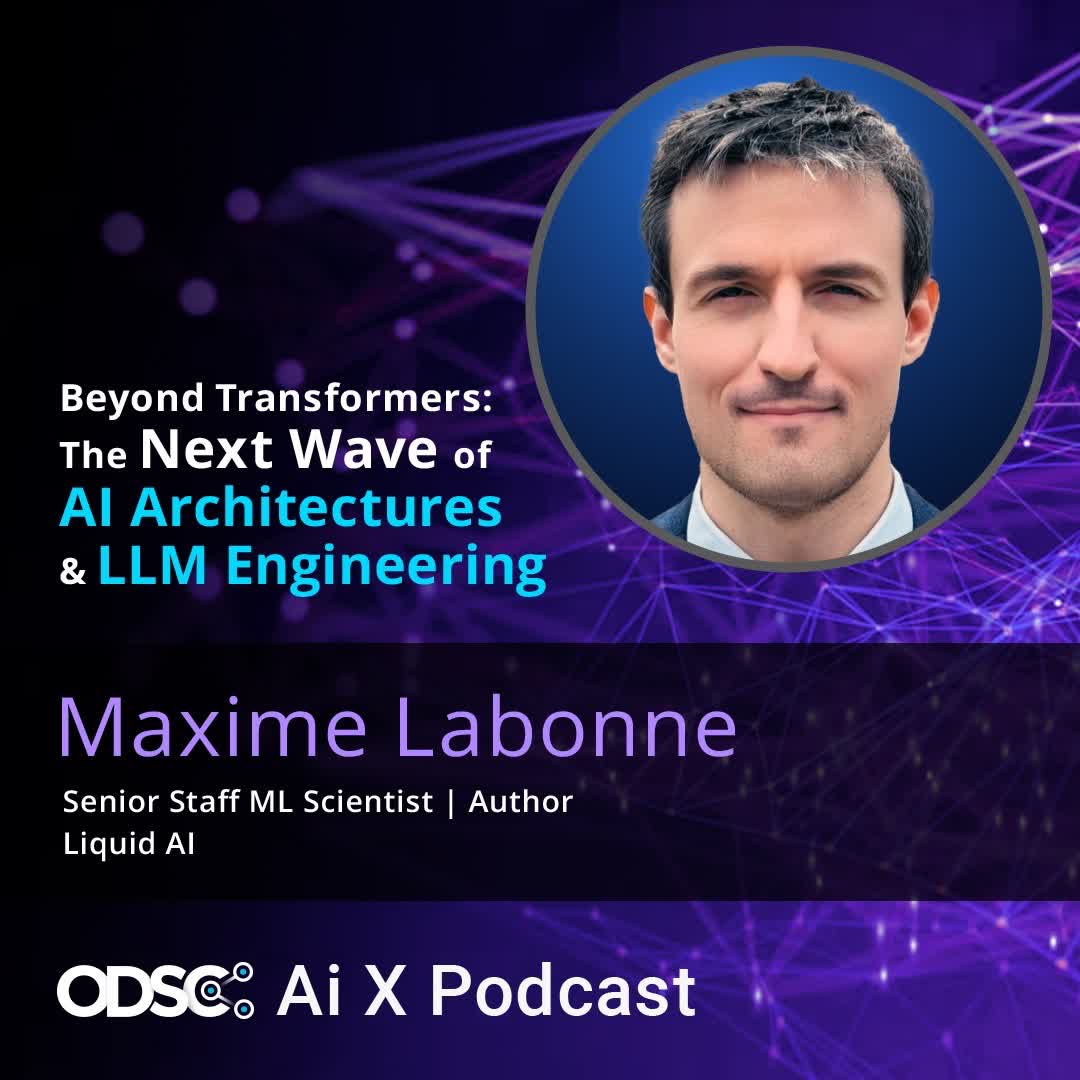
Beyond Transformers: The Next Wave of AI Architectures and LLM Engineering with Maxime Labonne
Description
In this episode, we sit down with Maxime Labonne, Head of Post-Training and Senior Staff Machine Learning Scientist at Liquid AI, to explore the evolving landscape of LLM engineering, Liquid AI, next-generation foundation models, automated benchmarking, model optimization and the shift beyond Transformer architectures.
Key Takeaways
LLM Engineering is Evolving Rapidly
- Success in LLM engineering requires strong software engineering skills, expertise in fine-tuning, inference optimization, and deployment knowledge.
- As AI systems grow more complex, LLM Ops is becoming just as critical as MLOps in ensuring scalable, production-ready AI pipelines.
- The field is increasingly specialized, with roles focusing on inference, optimization, deployment, and fine-tuning techniques.
Transformer Architectures are Being Replaced
- State-space models (SSMs) and hybrid architectures are emerging as powerful alternatives, offering improved memory efficiency, inference speed, and scalability.
- Leading AI labs—including OpenAI, DeepSeek, and Bytedance—are moving away from the traditional Transformer model
- Merging multiple fine-tuned models can combine specialized capabilities (e.g., math + coding) while reducing compute costs.
Agentic AI Workflows are Promising But Still Immature
- Current Agentic AI frameworks lack standardization, leading to inconsistent performance in real-world applications.
Fine-tuning Should be Used Selectively
- Many organizations fine-tune unnecessarily, when RAG or preference alignment would be a better, lower-cost alternative.
- Distilled models are gaining traction for being faster, cheaper, and easier to integrate while preserving reasoning capabilities.
LLM Engineering Careers are Rapidly Expanding
- The demand for specialists in inference optimization, fine-tuning, and model deployment is growing, with new roles emerging in model evaluation and LLM Ops.
- Future-proofing AI systems means designing architectures that can easily swap models and adapt to new AI innovations.
References and Resources Mentioned:
- Maxime Labonne's LLM Course on GitHub https://github.com/mlabonne/llm-course
- Maxime Labonne's Published Articles on His Blog https://mlabonne.github.io/blog/
- The LLM Engineer's Handbook by Maxime Labonne https://www.amazon.com/LLM-Engineers-Handbook-engineering-production/dp/1836200072
- Quantizing Deep Neural Networks https://arxiv.org/abs/1609.07061
- Unsloth AI https://unsloth.ai/
- Open LLM Leaderboard https://huggingface.co/spaces/HuggingFaceH4/open_llm_leaderboard
- Chatbot Arena by LMSys https://chat.lmsys.org/
- OpenHands GitHub Repository https://github.com/All-Hands-AI/OpenHands
- Speculative Decoding by OpenAI https://arxiv.org/abs/2211.17192
- Hugging Face's Implementation of Speculative Decoding https://huggingface.co/blog/whisper-speculative-decoding
- Graph Neural Networks Using Python on GitHub https://github.com/mlabonne/graph-neural-networks
- Liquid AI Benchmarks https://www.liquid.ai/benchmarks
- MergeKit GitHub Repository https://github.com/arcee-ai/mergekit
- Liquid AI Playground https://www.liquid.ai/playground
- Bytedance's Emory Architecture Paper https://arxiv.org/abs/2201.10005
- Understanding the Key-Value Cache in Transformers https://arxiv.org/abs/2006.14939
- Hugging Face Transformers Library https://github.com/huggingface/transformers
- OpenRouter https://openrouter.ai/
- Maxime Labonne's Twitter https://twitter.com/maximelabonne
- Maxime Labonne's LinkedIn https://www.linkedin.com/in/maximelabonne






 United States
