


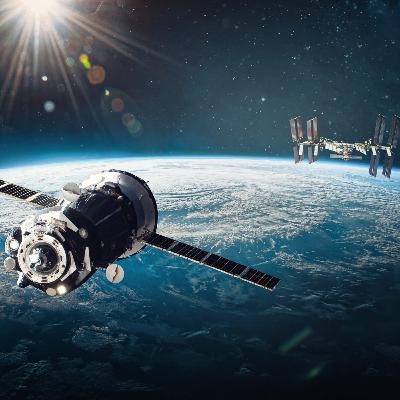
Dynamic Space: The Fight for Orbital Supremacy Has Already Begun
Description
Dynamic Space: The Fight for Orbital Supremacy Has Already Begun
In this episode of The War Lab, we take you inside the most important strategic transformation underway in modern warfare: the shift from a static, predictable space architecture to a fully maneuverable, combat-ready orbital force. What the U.S. built for peaceful dominance in the late 20th century is now a glaring vulnerability—and China is exploiting that gap faster than many policymakers realize.
We explore why Dynamic Space Operations (DSO) are no longer an abstract concept but a hard requirement for preserving space superiority. That means sustained maneuver, refueling and repair in orbit, modular payload swaps, rapid launch, and a logistics network that turns space into a fluid operational domain rather than a graveyard of satellites locked into Keplerian orbits.
You’ll hear how China’s Shijian satellites are already demonstrating refueling, proximity operations, coordinated multi-vehicle maneuvers, and robotic arms capable of grabbing or disabling U.S. assets—evidence of a real, ongoing campaign to master orbital warfare. And you’ll learn why U.S. systems, despite their sophistication, behave like predictable blimps in space—easily tracked, easily targeted, and unable to maneuver without exhausting precious fuel.
From here, we walk through the pillars required to flip the script:
• On-orbit refueling, servicing, and modular upgrades that radically extend satellite life and utility.
• Nuclear thermal and nuclear electric propulsion, the key to escaping the tyranny of the rocket equation and achieving real maneuver warfare in space.
• Distributed, mobile command-and-control, optical cross-links, and spectrum agility that eliminate single points of failure.
• Responsive launch, including allied “Starlift” concepts, that allow the U.S. and NATO to replace or augment constellations within hours—not years.
• In-space assembly and deception, creating unpredictable spacecraft, surprise payload deployments, decoys, and mission ambiguity that force adversaries to spend enormous resources tracking shadows.
But DSO comes with its own challenges: the complexity of continuous maneuver, authority to expend fuel in wartime, gaps in ISR during service windows, and a legal and regulatory vacuum that has allowed commercial mega-constellations to accelerate an orbital debris crisis approaching Kessler-syndrome levels.
We close by examining what may be the most controversial shift of all: the potential need for a future human guardian in space. As repair, troubleshooting, and combat interaction grow more complex, the U.S. may face a strategic cost if it cedes human spaceflight experience to a competitor already gaining operational reps.
This is one of our most comprehensive deep dives yet—an essential briefing for anyone trying to understand the future character of war and why space, more than any other domain, will define who holds strategic advantage in the decades ahead.
Tune in to The War Lab and step into the frontier where orbital mechanics meet military necessity, and where the race for competitive endurance in space is already underway.













 United States
