


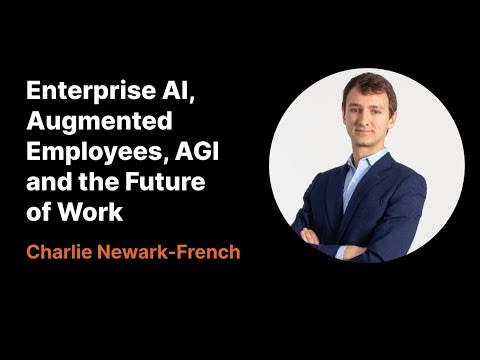
Enterprise AI, Augmented Employees, AGI and the Future of Work with Charlie Newark-French, CEO of Hyperscience
Description
Hi Hitchhikers!
I’m excited to share this latest podcast episode, where I interview Charlie Newark-French, CEO of Hyperscience, which provides AI-powered automation solutions for enterprise customers. This is a must-listen if you are either a founder considering starting an AI startup for Enterprise or an Enterprise leader thinking about investing in AI.
Charlie has a background in economics, management, and investing. Prior to Hyperscience, he was a late-stage venture investor and management consultant, so he also has some really interesting views on how AI will impact industry, employment, and society in the future.
In this podcast, Charlie and I talk about how Hyperscience uses machine learning to automate document collection and data extraction in legacy industries like banking and insurance. We discuss how the latest large-scale language models like GTP-4 can be leveraged in enterprise and he shares his thoughts on the future of work where every employee is augmented by AI. We also touch on how AI startups should approach solving problems in the enterprise space and how enterprise buyers think about investing in AI and measuring ROI.
Finally, I get Charlie’s perspective on Artificial General Intelligence or AGI, how it might change our future, and the responsibility of governments to prepare us for this future.
I hope you enjoy the episode!
Please don’t forget to subscribe @ http://hitchhikersguidetoai.com
Thanks for reading The Hitchhiker's Guide to AI! Subscribe for free to receive new posts and support my work.
Episode Notes
Links:
* Charlie on Linkedin: https://www.linkedin.com/in/charlienewarkfrench/
* Hyperscience: http://hyperscience.com
* New York Times article on automation: https://www.nytimes.com/2022/10/07/opinion/machines-ai-employment.html?smid=nytcore-ios-share
Episode Contents:
00:00 Intro
01:56 Hyperscience
04:52 GPT-4
09:41 Legacy businesses
11:13 Augmenting employees with AI
15:48 Tips for founders thinking about AI for enterprise
20:34 Tips enterprise execs considering AI
23:49 Artificial General Intelligence
29:41 AI Agents Everywhere
32:12 The future of society with AI
37:44 Closing remarks
Transcript:
HGAI: Charlie Newark French
Intro
AJ Asver: Hey everyone, and welcome to the Hitchhiker Guide to ai. I am so happy for you to join me for this episode. The Hitchhiker Guide to AI is a podcast where I explore the world of artificial intelligence and help you understand how it's gonna change the way we live, work, and play. Now for today's episode, I'm really excited to be joined by a friend of mine, Charlie Newark, French.
AJ Asver: Charlie is the CEO of hyper science, a company that is working to bring AI into the enterprise. Now, Charlie's gonna talk a lot about what hyper science is and what they do, but what I'm really excited to hear Charlie's opinions on is how he sees automation impacting our future.
AJ Asver: Both economically, but as a society, as you've seen with recent launch of G P T four and all the progress that's happening in AI, there's a lot of questions around what this means for everyday knowledge workers and what it means for jobs in the future. And Charlie, has some really interesting ideas about this, and he's been sharing a lot of them on his LinkedIn and I've been really excited to finally get him on the show so we can talk. Charlie also has a background in economics and management. He studied an MBA at Harvard and previously was at McKinsey, and so he has a ton of experience thinking about industry as a whole, enterprise and economics and how these kind of technology waves can impact us as a society.
AJ Asver: If you are excited to hear about how AI is gonna impact our economy, our society, and how automation is gonna change the way we work, then you are gonna love this episode of The hitchhiker Guide to ai.
AJ Asver: Hey Charlie, so great to have you on the podcast. Thank you so much for joining me.
Charlie: Aj, thank you for having me. I'm excited to discuss everything you just talked about
AJ Asver: maybe to start off, one of the things I'm really excited to understand is how did you end up at Hyper Science and what exactly do they do?
Hyperscience
Charlie: Yeah, hyper Science was founded in 2014. It was founded by three machine learning engineers. so We've been an ML company for a long time. My background before hyper science was in late stage investing. Had sort of the full spectrum of outcomes there.
Charlie: Some why successful IPOs, some strategic acquisitions, and then a lot of miserable, sleepless nights on some of the other areas. I found, hyper science, incredibly impressed with, their ability to take cutting edge technology and apply it to real well problems. We use machine vision, we use large language models, and we use natural language processing, and we use that those technologies to speed up back office process.
Charlie: The best examples here are a loan origination, insurance claims processing, customer onboarding. These are sort of miserable long processes, a lot of manual steps, and we speed those up. With some partners taking it down from about 15 days to four hours.
Charlie: So all of that data that's flowing in of this is who I am, this is what's happened, this is the supporting evidence. We ingest that. It might be an email, it might be a document. It's some human readable data. We ingest that, we process it, and then ultimately the claims administrator can say, yes, pay out this claim, or no, there's something.
AJ Asver: Yeah, so what, what you guys are doing essentially is you had folks that were previously looking at these documents, assessing these documents, maybe extracting the data out of these forms, maybe it was emails, and entering those into some database, right? And then decision was made, and now your technology's basically automating that. It's kind of sucking up all these documents and basically extracting all that information, helping make those decisions. My understanding is that with machine learning, what you're really doing is you've kind of trained on this data set, right, in a supervised way, which means you've said like, this is what good looks like.
AJ Asver: This is what, you know, extracting a, a, a data from this form looks like now we're gonna teach this machine learning algorithm how to do it itself. Now what what I found really interesting is that, That was kind of where we made the most advancements, really in kind of AI over the last decade, I would say.
AJ Asver: Right? It's like these deeper and deeper neural networks. They could do machine learning in very supervised ways, but what's recently happened with large language models especially, is that we've now got this like general purpose AI that, you know, GPT-4, for example, just launched this. and there was an amazing demo where I think the CTO of OpenAI basically sketched on like the back of a napkin, a mockup for a website, and then he put in in GPT and it was able to like, make the code for it.
AJ Asver: Right. So when you think about a general purpose, let large language model like that, compared to the machine learning, y'all are using do you consider that to be a tool that you'll eventually use? Do you think it's kind of a, a threat to like the companies that have spent the last, you know, 5, 6, 7 years, decades, maybe kind of perfecting these ma machine learning tools or, you know, I, is it something that's gonna be more like different use cases that won't be used you know, by your customers?
GPT-4
Charlie: Open ai ChatGPT, GPT-4. Anything that's been, the technology you're speaking about has really had two fundamental impacts. There's been the technology. It's just very, very cutting edge, advanced technology. And then you've got the adoption side of it. And I think both sides are as interesting as each other.
Charlie: On the adoption side, I sort of like to compare it to the iPhone that there was a lot of cutting edge technology, but what they did is they made that technology incredibly easy to use. There's a few things that Open AI has done here that's been insanely impressive. First, , they use human language. Um, humans will always assign a higher level of intelligence to something that speaks in its language.
Charlie: The other thing, it's a very small thing, but I love the way that it streams answers so it doesn't have a little loading sign that goes around and dumps an answer on you. It's like, it's almost like it's communicating with you. Allow you to read in real time and it feels more like a conversation.
Charlie: Obviously the APIs have been a huge addition. It's just super easy to use, so that's been one big step forward. But it's a large language model. It's a chat bot. I don't wanna underestimate the impact of that technology, but my thoughts are AI will be everywhere. It's gonna be pervasive in every single thing we do.
Charlie: And I hope that chatbots and large language models aren't the limitation of ai. I'd sort of like to compare chatbots and large language. To search the internet is this huge thing, one giant use case





 United States
