


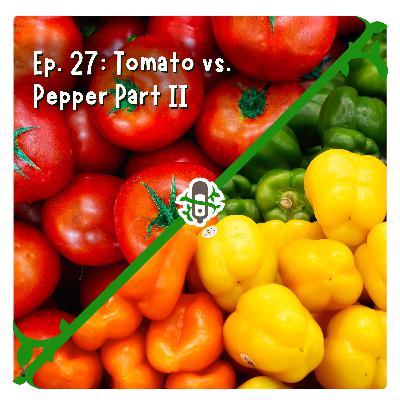
Ep. 27 Tomato vs. Pepper Part II
Description
It’s Part II of the nightshade party!
Sean and Erin plunge back in with tomatoes and peppers, covering cultural history, culinary and medical uses, and fun facts about these garden staples of the nightshade family. If you could look back thousands of years to see gardens in the Andes mountains, you would find both of them growing there. Find out how peppers once acted both as a trade good and a discipline tool, where tomatoes have spread most around the world, and the truth about the fantastical-sounding tomato-potato.
If you want to know more about growing tomatoes and peppers or to explore their botany and etymology, be sure to check out Part I of this plant face-off.
Who brought the most fascinating facts about their plant this week? Vote for borage or cosmos by tagging us on social media and using the hashtag #PAWFaceOff.
Comments? Feedback? Want your garden question to be featured in a future Q&A segment? Email us, reach out over social media, or get Q&A priority by supporting us on Patreon.
Discord: https://discord.gg/K6wF9dY4Ja
Bluesky: @plantsalwayswin.com
TikTok: @plantsalwayswinpodcast
YouTube: @plantsalwayswinpodcast
Website: www.plantsalwayswin.com
Credits
Website Design and Illustration by Sophia Alladin
Intro and Outro Music from #Uppbeat (free for Creators!): https://uppbeat.io/t/soundroll/when-my-ukulele-plays
License code: GWOIMMBAS15FG6PH
Citations
The biggest global tomato-growing nations today
Solanum lycopersicum (Tomato, Tomatoes). (n.d.). North Carolina Extension Gardener Plant Toolbox. https://plants.ces.ncsu.edu/plants/solanum-lycopersicum/#:~:text=The%20genus%20name%2C%20Solanum%2C%20is,when%20they%20came%20to%20Europe
Tomato varieties, history, and misconceptions of toxicity
The University of Vermont. (n.d.). A History of Tomatoes. University of Vermont Extension. https://www.uvm.edu/extension/news/history-tomatoes#:~:text=Tomatoes%20have%20undergone%20centuries%20of,Andes%20of%20 western%20South%20africa
Heirloom vegetables
Heirloom vegetables. (n.d.). Wisconsin Horticulture. https://hort.extension.wisc.edu/articles/heirloom-vegetables/
Carnivorous tomatoes!
Chase, M. W., Christenhusz, M. J. M., Sanders, D., & Fay, M. F. (2009). Murderous plants: Victorian Gothic, Darwin and modern insights into vegetable carnivory. Botanical Journal of the Linnean Society, 161(4), 329–356. https://doi.org/10.1111/j.1095-8339.2009.01014.x
Toxicity of capsaicin
Rohrig, B. (2013). Hot peppers: Muy caliente! In Chemmatters. American Chemical Society. https://www.acs.org/chemmatters
The debate about weaponizing capsaicin
Peppers as non-lethal weapons. (2022). In The Royal Society of Chemistry eBooks (pp. 145–155). https://doi.org/10.1039/9781839160646-00145
Chili peppers in cultural history
Kelly, V. a. P. B. C. P. (2021, March 5). The Trail of Fire: The Story of the Chili Pepper. Synaptic Space. https://synapticspace.wordpress.com/2019/05/02/the-long-journey-of-the-chili-pepper/
The capsaicin isn’t in the pepper seeds
Cronin, J. R. (2002). The chili pepper’s pungent principle: capsaicin delivers diverse health benefits. Alternative and Complementary Therapies, 8(2), 110–113. https://doi.org/10.1089/10762800252909865
Timestamps
<span style="background-color: transpare











 United States
