


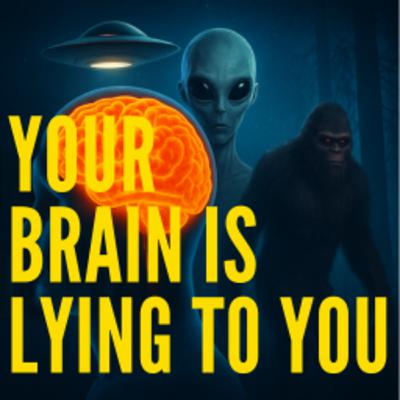
Episode 258: I KNOW What I Saw!!
Description
In this episode I talk about how confirmation bias, memory and brain chemistry shape our experiences.
Thanks to the TIN FOIL MULISHA
Exclusive episodes on Patreon https://www.patreon.com/c/ufonopodcast
Join the Tin Foil Mulisha Discord: https://discord.gg/PQyaJzkt4Y
Paypal Donation https://www.paypal.com/ncp/payment/Y6WRSW9F2JBSC
Stripe Donation https://buy.stripe.com/aFa6oGeiXamjdlW39HgUM00
Buy Merch https://ufono.dashery.com/ | https://ufono-podcast.creator-spring.com/
Buy Mushrooms https://www.schedule35.co/us/ (Code: U1173687US240607)
Email: Iwant2believe115@gmail.com
French, C. C., & Wilson, K. (2006). Cognitive factors in anomalous experiences. frontiersin.orgfrontiersin.org
Wiseman, R., & Morris, R. (1995). Recall of pseudo-psychic events by believers vs. disbelievers. frontiersin.org
Wiseman, R. et al. (2003). Suggestion and false memory in séance settings. frontiersin.orgfrontiersin.org
Wiseman, R. & Greening, E. (2005). Verbal suggestion and paranormal key-bending reports. frontiersin.orgfrontiersin.org
van Elk, M. (2015). “Perceptual Biases in Relation to Paranormal and Conspiracy Beliefs.” PLOS One, 10(6): e0130422. Findings: prior beliefs modulate perception; believers detect illusory patterns pmc.ncbi.nlm.nih.govpmc.ncbi.nlm.nih.gov.
Müller, P., & Hartmann, M. (2023). “Linking paranormal and conspiracy beliefs to illusory pattern perception.” Scientific Reports, 13:97 39. Demonstrated believers’ low sensitivity and high false alarms in noisy visual tasks nature.comnature.com.
Clancy, S. et al. (2002). “Memory Distortion in People Reporting Abduction by Aliens.” J. Abnormal Psych., 111(3), 455–461. Showed recovered-alien-abduction claimants have elevated false recall/recognition on laboratory tests researchgate.netresearchgate.net.
Wilson, K., & French, C. (2014). “Magic and Memory.” Frontiers in Psychology, 5:12 89. Used a fake psychic video to show believers vs. nonbelievers differ in memory accuracy under suggestionfrontiersin.orgfrontiersin.org.
CORDIS Project EXPECT_CONSCIOUS (2013–2015). Findings summarized: expected stimuli enter awareness faster; memory bias increases as time passes cordis.europa.eucordis.europa.eu.
Paulpope.co.uk – “The Psychology of Paranormal Belief: Cognitive Bias” (2021). Overview of biases (confirmation bias, pareidolia, etc.) that foster supernatural interpretation paulpope.co.ukpaulpope.co.uk.
Additional References: Loftus, E. (1997). “Creating False Memories.” Scientific American; French, C. (2001). “Belief in the paranormal: a cautionary note on making assumptions.”; Jahn, G. et al. (2024). “False memory propensity and pseudoscientific belief.” Cognitive Research: Principles and Implications, 9(5) link.springer.com. (This 2024 study found that individuals who more readily formed misinformation-induced false memories were more likely to endorse pseudoscientific and paranormal claims link.springer.com.)




 United States
