


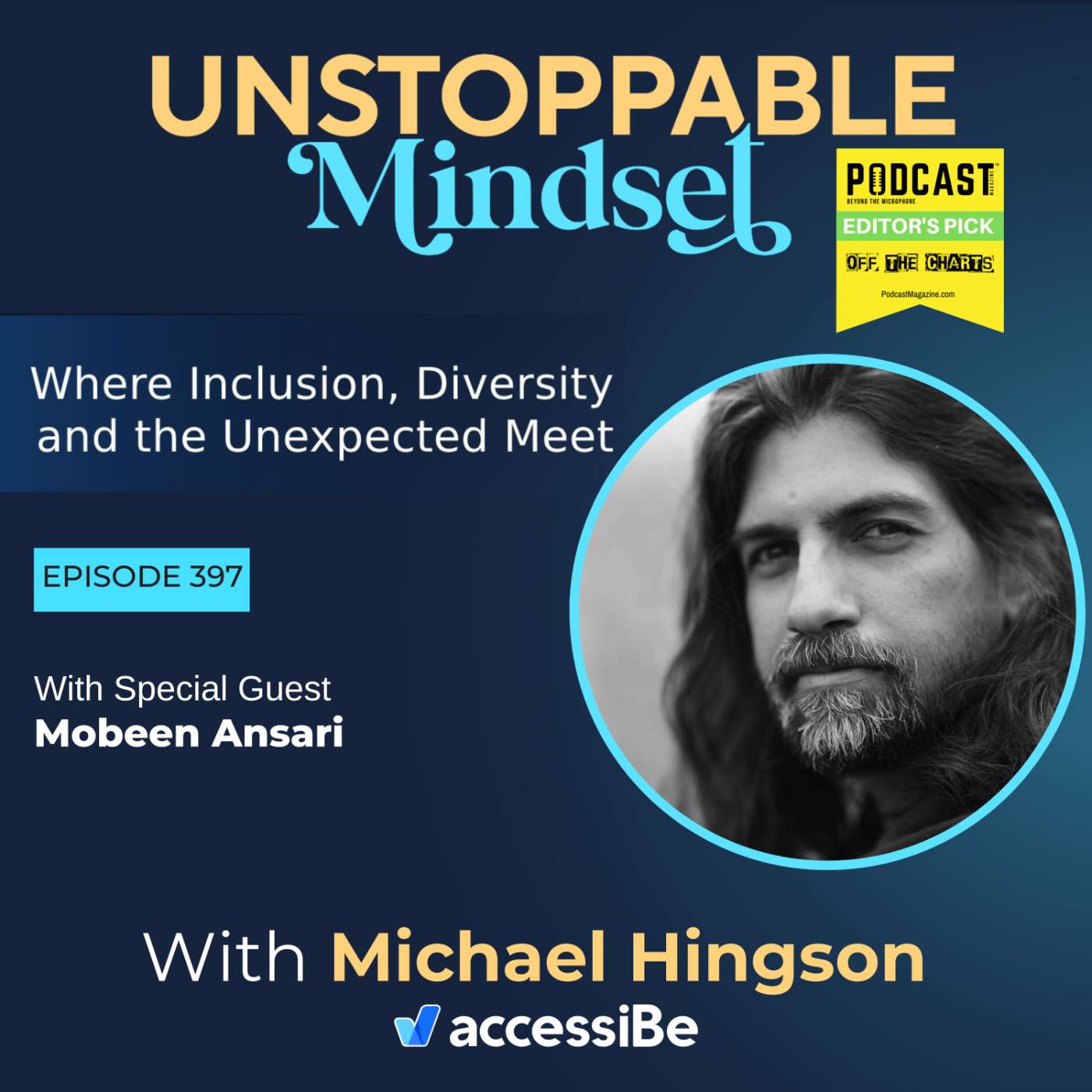
Episode 397 – Unstoppable Purpose Found Through Photography with Mobeen Ansari
Description
What happens when your voice is built through visuals, not volume? In this Unstoppable Mindset episode, I talk with photographer and storyteller Mobeen Ansari about growing up with hearing loss, learning speech with support from his family and the John Tracy Center, and using technology to stay connected in real time.
We also explore how his art became a bridge across culture and faith, from documenting religious minorities in Pakistan to chronicling everyday heroes, and why he feels urgency to photograph climate change before more communities, heritage sites, and ways of life are lost.
You’ll hear how purpose grows when you share your story in a way that helps others feel less alone, and why Mobeen believes one story can become a blueprint for someone else to navigate their own challenge.
Highlights:
00:03:54 - Learn how early family support can shape confidence, communication, and independence for life.
00:08:31 - Discover how deciding when to capture a moment can define your values as a storyteller.
00:15:14 - Learn practical ways to stay fully present in conversations when hearing is a daily challenge.
00:23:24 - See how unexpected role models can redefine what living fully looks like at any stage of life.
00:39:15 - Understand how visual storytelling can cross cultural and faith boundaries without words.
00:46:38 - Learn why documenting climate change now matters before stories, places, and communities disappear.
About the Guest:
Mobeen Ansari is a photographer, filmmaker and artist from Islamabad, Pakistan. Having a background in fine arts, he picked up the camera during high school and photographed his surroundings and friends- a path that motivated him to be a pictorial historian. His journey as a photographer and artist is deeply linked to a challenge that he had faced since after his birth.
Three weeks after he was born, Mobeen was diagnosed with hearing loss due to meningitis, and this challenge has inspired him to observe people more visually, which eventually led him to being an artist. He does advocacy for people with hearing loss.
Mobeen's work focuses on his home country of Pakistan and its people, promoting a diverse & poetic image of his country through his photos & films. As a photojournalist he focuses on human interest stories and has extensively worked on topics of climate change, global health and migration.
Mobeen has published three photography books. His first one, ‘Dharkan: The Heartbeat of a Nation’, features portraits of iconic people of Pakistan from all walks of life. His second book, called ‘White in the Flag’ is based on the lives & festivities of religious minorities in Pakistan. Both these books have had two volumes published over the years. His third book is called ‘Miraas’ which is also about iconic people of Pakistan and follows ‘Dharkan’ as a sequel.
Mobeen has also made two silent movies; ’Hellhole’ is a black and white short film, based on the life of a sanitation worker, and ‘Lady of the Emerald Scarf’ is based on the life of Aziza, a carpet maker in Guilmit in Northern Pakistan.
He has exhibited in Pakistan & around the world, namely in UK, Italy, China Iraq, & across the US and UAE. His photographs have been displayed in many famous places as well, including Times Square in New York City. Mobeen is also a recipient of the Swedish Red Cross Journalism prize for his photography on the story of FIFA World Cup football manufacture in Sialkot.
Ways to connect with Mobeen**:**
Facebook: www.facebook.com/mobeenart
Linkedin: https://www.linkedin.com/in/mobeenansari/
Instagram: @mobeenansariphoto
X: @Mobeen_Ansari
About the Host:
Michael Hingson is a New York Times best-selling author, international lecturer, and Chief Vision Officer for accessiBe. Michael, blind since birth, survived the 9/11 attacks with the help of his guide dog Roselle. This story is the subject of his best-selling book, Thunder Dog.
Michael gives over 100 presentations around the world each year speaking to influential groups such as Exxon Mobile, AT\&T, Federal Express, Scripps College, Rutgers University, Children’s Hospital, and the American Red Cross just to name a few. He is Ambassador for the National Braille Literacy Campaign for the National Federation of the Blind and also serves as Ambassador for the American Humane Association’s 2012 Hero Dog Awards.
https://www.facebook.com/michael.hingson.author.speaker/
https://www.youtube.com/user/mhingson
https://www.linkedin.com/in/michaelhingson/
accessiBe Links
https://www.youtube.com/c/accessiBe
https://www.linkedin.com/company/accessibe/mycompany/
https://www.facebook.com/accessibe/
Thanks for listening!
Thanks so much for listening to our podcast! If you enjoyed this episode and think that others could benefit from listening, please share it using the social media buttons on this page. Do you have some feedback or questions about this episode? Leave a comment in the section below!
Subscribe to the podcast
If you would like to get automatic updates of new podcast episodes, you can subscribe to the podcast on Apple Podcasts or Stitcher. You can subscribe in your favorite podcast app. You can also support our podcast through our tip jar https://tips.pinecast.com/jar/unstoppable-mindset .
Leave us an Apple Podcasts review
Ratings and reviews from our listeners are extremely valuable to us and greatly appreciated. They help our podcast rank higher on Apple Podcasts, which exposes our show to more awesome listeners like you. If you have a minute, please leave an honest review on Apple Podcasts.
Transcription Notes:
Michael Hingson 00:00
Access Cast and accessiBe Initiative presents Unstoppable Mindset. The podcast where inclusion, diversity and the unexpected meet. Hi, I'm Michael Hingson, Chief Vision Officer for accessiBe and the author of the number one New York Times bestselling book, Thunder dog, the story of a blind man, his guide dog and the triumph of trust. Thanks for joining me on my podcast as we explore our own blinding fears of inclusion unacceptance and our resistance to change. We will discover the idea that no matter the situation, or the people we encounter, our own fears, and prejudices often are our strongest barriers to moving forward. The unstoppable mindset podcast is sponsored by accessiBe, that's a c c e s s i capital B e. Visit www.accessibe.com to learn how you can make your website accessible for persons with disabilities. And to help make the internet fully inclusive by the year 2025. Glad you dropped by we're happy to meet you and to have you here with us.
Michael Hingson 01:20
Well, hi everyone, and welcome to another episode of unstoppable mindset. I am your host. Michael Hingson, we're really glad that you are here, and today we are going to talk to Mobeen Ansari, and Mobeen is in Islamabad. I believe you're still in Islamabad, aren't you? There we go. I am, yeah. And so, so he is 12 hours ahead of where we are. So it is four in the afternoon here, and I can't believe it, but he's up at four in the morning where he is actually I get up around the same time most mornings, but I go to bed earlier than he does. Anyway. We're really glad that he is here. He is a photographer, he speaks he's a journalist in so many ways, and we're going to talk about all of that as we go forward. Mobin also is profoundly hard of hearing. Uses hearing aids. He was diagnosed as being hard of hearing when he was three weeks old. So I'm sure we're going to talk about that a little bit near the beginning, so we'll go ahead and start. So mo bean, I want to welcome you to unstoppable mindset. We're really glad that you're here.
Mobeen Ansari 02:32
It's a pleasure to be here, and I'm honored to plan your show. Thank you so much.
Michael Hingson 02:37
Well, thank you very much, and I'm glad that we're able to make this work, and I should explain that he is able to read what is going on the screen. I use a program called otter to transcribe when necessary, whatever I and other people in a meeting, or in this case, in a podcast, are saying, and well being is able to read all of that. So that's one of the ways, and one of the reasons that we get to do this in real time. So it's really kind of cool, and I'm really excited by that. Well, let's go ahead and move forward. Why don't you tell us a little about the early Beau beam growing up? And obviously that starts, that's where




















 United States
