


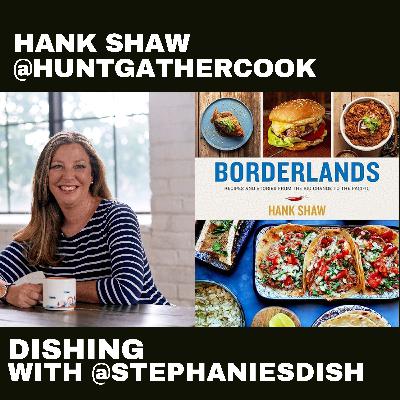
Hank Shaw @huntgathercook is a James Beard Award-winning author of 5 cookbooks, a chef, a forager and a hunter.
Description
If you enjoy this podcast and look forward to it in your inbox, consider supporting it by becoming a paid yearly subscriber for $60 or you can buy me a cup of coffee for $8
Welcome to another episode of "Dishing with Stephanie's Dish." Today, I interview acclaimed food writer, wild foods expert, and self-described hunter-gatherer Hank Shaw. Hank is the author of the brand new cookbook, "Borderlands: Recipes and Stories from the Rio Grande to the Pacific," an exploration of the flavors, cultures, and stories that define the borderlands between the United States and Mexico. He also has a Substack that’s wonderful, called Hank Shaw “To The Bone” and a website full of recipes.
In this episode, Hank and I dive into everything from his early days as a restaurant cook and investigative journalist to his passion for foraging, preserving, and hunting wild foods. Hank discusses the vibrant mix of culinary traditions that thrive along the border, debunks myths about iconic ingredients (like acorns!), and shares the fascinating histories behind beloved dishes such as chimichangas and parisa.
They also touch on practical advice—like the art of drying herbs, the joys and challenges of single-person food preservation, and the ins and outs of self-publishing cookbooks at a high level.
Get ready for an episode filled with storytelling, culinary wisdom, and inspiration for your next adventure in the kitchen or the great outdoors. Whether you're a curious home cook, an aspiring cookbook author, or simply a lover of good food, there’s something here for everyone. Let’s get started!
Original Episode Transcript Follows:
Stephanie:
Hello, everybody, and welcome to Dishing with Stephanie's Dish, the podcast, where we talk to fun people in the food space and sometimes they have cookbooks. And today's author is an author. He's an author of great magnitude, Hank Shaw. His new book is Borderlands Recipes and Stories from the Rio Grande to the Pacific. And Hank, you are such a prolific, beautiful writer. This book, I feel like, is just so you. Do you love it?
Hank Shaw:
It's been a long journey to make this book, and I'm pretty proud of it. And it's. It's been probably the biggest project of my adult life in terms of time, commitment, travel, really unlocking understanding of things that I thought I knew but didn't necessarily know until I got there. And it's just been this. This crazy, fantastic journey and a journey that you can eat.
Stephanie:
Can you talk a little bit about your history? Like, I think many people know you as the hunter, forager, gatherer, type, and Borderlands obviously has a lot of those elements to it. But can you just walk readers that are listeners that might be new to your journey kind of through how you got here?
Hank Shaw:
Sure. Many, many years ago, when I was still fairly young, I was a restaurant cook. So I worked first as a dishwasher and then as a line cook and then as a sous chef in a series of restaurants, mostly in Madison, Wisconsin. And I left that job to be a newspaper reporter. And I ended up being a newspaper reporter for 18 years. And I cooked all throughout that and traveled and learned more about food and did fishing and hunting and foraging and such. And then I left the News Business in 2010 to do my website, which is hunter, angler, gardener, cook. And I've been doing that full time since 2010.
So, yeah, my entire kind of current incarnation is wild foods. But Borderlands is kind of an outgrowth of that for two reasons. The first is I've been basically written all of the fishing game books you can possibly write already. I've got one for every kind of quarry you can imagine. And then the other thing was, oh, well, you know, a lot of that travel for those other books was on the border on both sides, on the American side and on the Mexican side. And that kind of grew into this. Wow, you know, God, the food is so great and God, this area is just so neglected, I think, by most, you know, the. The food, or radio, for lack of a better term.
Yeah, because all of the, like, everybody seems to love to hate Tex Mex without really fully knowing what Tex Mex actually is. And people say that the Southwestern cooking is so very 1987. And. And, you know, the people who know Mexico are like, oh, all the good foods in Oaxaca or Michoacan or Mexico City or Yucatan. And really that's not the case, as over and over and over again, I was discovering these amazing just finds. And a lot of them had to do with wild foods, but not all of them. And so that borderlands became my diary of that journey.
Stephanie:
And quite a diary it is. What's interesting to me is I didn't actually ever know that you were in the newspaper business.
Hank Shaw:
And that makes a Pioneer Press graduate.
Stephanie:
Oh, you work for them. How did I not know this?
Hank Shaw:
Yeah, I was a St. Paul Pioneer Press investigative reporter from 2002 to 2004. And if you're of a certain age and you remember there was a big story about some Republican operatives getting involved with a telecommunications boondoggle. And yeah, that was probably. That was us. That was our story.
Stephanie:
Well, and it makes sense because the book is so like. It's the storytelling that's so good. And, you know, cookbooks are cookbooks with beautiful recipes and different people's point of view on recipes. But what I love about your book, too, is it really goes into ingredients a little more in depth. It tells the story of the terroir, of where the recipe's from and why it's the way it is. And it makes sense now to me that you're a journalist because it's so beautifully written.
Hank Shaw:
I really appreciate that. I mean, I tried in this particular book. There are essays in all of my books, but in this particular one, I really, really wanted people from the rest of the country to get a flavor of what it's like to was really honest to God, like on the border. Everybody has thoughts and opinions about immigration and about the border and about blah, blah, blah. And it's like, well, how much time have you actually spent on the border? Do you actually know what it feels like, what it smells like, what it tastes like? Chances are you probably don't. And I really wanted this book to shine a light on that in ways that go well beyond food.
Stephanie:
When we talk about the borderlands, can you talk about it without talking about immigration and the close connection between the United States and Mexico? I mean, we share this border. People have this idea that it's like this gated, fenced situation, and really there's tons of the border that's just. You'd only know it was a border if someone told you you were crossing it.
Hank Shaw:
It's very true. In Fact, one of my favorite moments to that was in south southwest Texas there's a beautiful national park called Big Bend. It's one of the biggest national parks in the country. It's fa. It's famous, it's amazing. But you're going to drive and hike and hike and drive and hike and drive a gigantic park. So one place that you can go to. And it's actually, if you open up a copy of Borderlands and you see this huge vista right at the beginning of the book, there's this huge vista and it's on a cliff. That is exactly it. That is. That is Big Bend National Park. And if you're looking right in the back end of that back center, a little to the left, you'll see a canyon in the background. In that canyon is St. Helena Canyon. And St.
Helena Canyon is created by the Rio Grande. So you can go to that park and you can walk across the border literally to Mexico and not have the Rio Grande come up over your ankles. And there's Mexicans on their side, there's Americans on our side, and everybody's crossing back and forth until their families are there and having a fun time, blah, blah, blah. And it's just, it's one of these great moments where it shows you that, yeah, that border is really just sort of a fiction.
Stephanie:
Yeah. Yes, in many ways. Right. Figuratively. And also, I don't know, we seem to be in a global food economy whether we want to or not. When you look at the individual ingredients that you're using here in Borderlands, obviously there's very different things because of temperature in Mexico than you might have here in the Midwest. But is it really different from like say, Texas to Mexico in.
Hank Shaw:
Yes, there, there are definitely different. So the food you'll get in Nueva Leon or Coahuila or Tamaulipas, which are the three Mexican states, that border Texas is going to be different from what you would think about as Texas food. However, on the Borderlands, that. That change really is minimal. And I talk about in the book the idea of Fronteraisos, people who are neither fully Mexican nor full. They're. They're border people and they can slide between English and Spanish in mid clause. And it's really the, you know, the, the pocho or Spanglish or whatever you want to call it that you'll hear there is very different from what you'll hear from a bilingual person from, say, Mexico City, where typically those people will speak in full sentences or paragraphs in one language and then maybe switch to another language in the next sentence or paragraph.
Hank Shaw:</stro














 United States
