


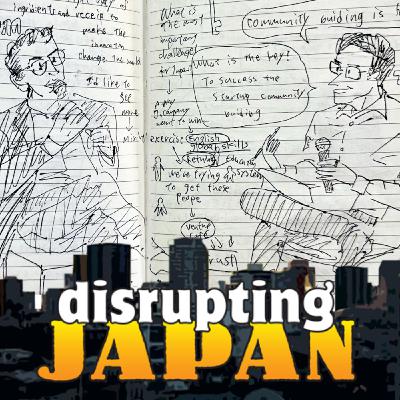
How to build a successful startup community
Update: 2025-04-14
Description
(sketch by Kaori Rei)Today we are going to sit down with an old friend.
It was over seven years ago when I first had Tim Rowe on the podcast, and we mapped out what we saw as the future of startup innovation in Japan. In today's short episode, we talk about what we got right. what surprised us, and what we think is next for Japanese startup innovation.
It's a great conversation, and I think you'll enjoy it.
Leave a comment
Transcript
Welcome to Disrupting Japan, straight talk from Japan's most innovative founders and VCs.
I'm Tim Romero, and thanks for joining me.
I'd like to share a special short in between episode with you.
Last month I had a fireside chat with Tim Rowe, the founder and CEO of the Cambridge Innovation Center at the Global Venture Cafe's anniversary celebration in Tokyo. And I thought I would share it with you just as it happened. I first had Tim on the show about eight years ago, just before CIC opened their Big Tokyo collaboration space.
This time Tim and I talk about the changes to the Japanese startup ecosystem since then, what we are likely to see in the future, and we also discuss what might be a new model for startup ecosystems. As startups have become more and more accepted and more and more common. The old community playbook may not be as effective as it once was.
But Tim tells that story much better than I can. So, let's get right to the interview.
Interview
Romero: All right, Tim, it is great to be sitting down with you again. And as a bit of background for the audience. You and I back in 2017, we were sitting down over coffee in Tokyo and you were telling me about your plans to open Venture Cafe and CIC and I remember asking you like, how the hell are you going to fill 6,000 square meters of co-working space in Tokyo? And here we are. Venture Cafe is one of the driving forces in the startup ecosystem. CIC is over capacity. I have never been so delighted to have my doubts proven wrong, so congratulations on that.
Rowe: Thank you, Tim. Glad to be here.
Romero: Before we dig in, you've got ties to Japan. You've been working with Japan for a long time, so can you tell us a little bit about what was your involvement in Japan in the 90s and forward?
Rowe: Okay, so a bit of background. I'm from Cambridge, Massachusetts. My father was a professor at Harvard. My mother was a professor at MIT, so I'm one of those kids. And I was fortunate to be exposed a bit to the world. My grandmother had spent about a decade in Asia in the 1920s. And she used to teach me kanji when I was little. And so I didn't know much about Asia, but I thought this was really interesting. And I learned later that my great-grandfather arrived in Yokohama in 1919. He was then acting Surgeon General for the United States. And he was on a world trip to kind of build connections and relationships. So, we go back a little ways in Asia. My father, when I was in high school, did something that I think all the parents in the room should do. He said, look you should learn a little bit about the rest of the world. And he said, if you learn Japanese, I'll give you an opportunity to work in my company's Tokyo office for the summer. And I said, okay, deal. And I started studying Japanese. I didn't know the language at all, but it seemed like a cool opportunity. By the way, a generation later, I made the same offer to my oldest child. Actually, I made the offer to all my children, but my oldest child took me up and he came and worked in Tokyo also when he was 16.
Kihara-san, I understand that you did something similar. You were in school in Chicago and in Amsterdam when you were young. And clearly your English reflects that experience. I think all of us should have this opportunity to go out of our usual comfort zone and work in another country and learn about other cultures. But that's my background. So, I did a year at Dosha University later as an exchange student from Amherst College. And then I was fortunate to get a job at Mitsubishi Research Institute Mitsubishi Soko for about four years after college. So, I've had time now and then in Japan.
Romero: Alright, well, things have changed a lot, both from the 90s when you were first here and in the past seven years or so with the Venture Cafe and CIC experience. So, before we get into the future of Japan, what sticks out as some of the most significant changes you've seen in the startup ecosystem over the last, say seven years?
Rowe: Japan as a country, and many of Japanese institutions have really gotten serious about startups I would say the last decade. I think the first wave was a lot of the Japanese corporations starting to really embrace working with startups. Before that it was almost impossible to work with a Japanese company as a startup. If you remember back 15, 20 years doing business in Japan is typically about your experience, your reputation as a business. And startups kind of by definition have none. And there was an awakening to the fact that, well, that's true. Startups are new and don't have this experience. They can also move faster and be agile and sometimes introduce new technologies that the larger companies have trouble introducing. We see this story in the automotive industry where Honda and General Motors and others could make an electric car, but they could never quite figure out how to make a market for electric cars. And then it took a startup Tesla to come in and say, okay, we're going to really seriously make a market. And that happened and later others followed. So, there's this recognition that I think emerged that startups can do things that companies, 10,000 times their size can't. And that's exciting. And so the doors started to open.
More recently, I think the Japanese government started to really lean in and say, how can we support? What can we do? How can we support this part of the economy? Hey Michael, how are you? We have an expert in the room. Michael Cusumano, professor at MIT who has been writing and teaching about this for decades longer than I have. So, later you should get a chance to hear from him on this. But, so that started to happen, but I really need to say here, Tim, that there's a history before all this that I don't want us to forget. If you go back to Japan in the post-war era, Japan was one of the most productive startup economies in the world. And if you look at the results of that today, all you need to do is look at the percentage of the Russell 2000, most successful companies in the world that are from Japan. And you'll see that that percentage is roughly tied with the United States when you adjust for population. And all of those successful big companies were startups. These were companies like Sony and Honda and so forth. So, I just need to baseline this. There isn't some difference really, in terms of Japan's potential or capability to build world-leading startups than the United States. Yes, there's a difference in where we are today. Yes, there's a difference today in the amount of venture capital that's flowing. Those are all true, but there isn't some sort of fundamental reason why Japan shouldn't be producing startups of the same size and impact as the ones coming out of the United States or the UK or other leading innovation countries.
So, the importance of this is that sometimes people think, well, maybe this is cultural. Maybe there's something about the Japanese culture where it doesn't produce as many startups. No, that's BS I won't say the full word because I'm in a public venue here. But that's BS, there's absolutely no cultural barrier here. There are structural barriers, there are differences. And I was pleased that Kihara-san talked about tax policy. We have policies in the United States, for instance, that make it very attractive to invest in startups. We have policies for our pension funds that make it very attractive for them to invest in venture funds. These policies are not necessarily followed equally everywhere. I know the UK, for instance, doesn't have that same policy, which has made it harder to get venture capital funds out of the pension and similar kinds of institutions. Those are policy changes, the policies, and they can be changed. And so I think what we're seeing now in Japan is this sort of openness to really rethink the structural drivers of innovation and how to move things forward.
Romero: I agree. I think probably one of the most significant changes is the willingness of large enterprises to interact with startups. In the dotcom era, it was next to impossible. You get pushed down through four layers of subcontractors, and now almost every large organization to Japan has a team that's dedicated to working with startups. But looking back, and I agree, cultural explanations are kind of hand wavy. So structurally, I mean, is there anything you can particular that you point to and say, ah, that was the triggering event, this was the most important policy, social change, anything that set the wheels in motion? Or do you think it was more of a gradual change of people realizing the opportunities that working with startups presented?
Rowe: Japan has a history of embracing things that have high level support. There's a little bit of follow the leader kind of behavior. People say Japan is not a risk taking country, but that's not true at all. Again, if you go back to World War II and look at Japan, there were a lot of risks taken. And if you look at modern, say, extreme sports, you have Japanese contestants that are just as capable as others, and they're taking extreme risks. But what Japan culture, this is a cultural piece. There tends to be a sort of a need for kind of a stamp of approval from someone that it's cool to take these risks. So when the Prime Minister's office launched its startup awards when METI and the cabinet office backed the J startup initiative, which you're probably familiar with that said,
It was over seven years ago when I first had Tim Rowe on the podcast, and we mapped out what we saw as the future of startup innovation in Japan. In today's short episode, we talk about what we got right. what surprised us, and what we think is next for Japanese startup innovation.
It's a great conversation, and I think you'll enjoy it.
Leave a comment
Transcript
Welcome to Disrupting Japan, straight talk from Japan's most innovative founders and VCs.
I'm Tim Romero, and thanks for joining me.
I'd like to share a special short in between episode with you.
Last month I had a fireside chat with Tim Rowe, the founder and CEO of the Cambridge Innovation Center at the Global Venture Cafe's anniversary celebration in Tokyo. And I thought I would share it with you just as it happened. I first had Tim on the show about eight years ago, just before CIC opened their Big Tokyo collaboration space.
This time Tim and I talk about the changes to the Japanese startup ecosystem since then, what we are likely to see in the future, and we also discuss what might be a new model for startup ecosystems. As startups have become more and more accepted and more and more common. The old community playbook may not be as effective as it once was.
But Tim tells that story much better than I can. So, let's get right to the interview.
Interview
Romero: All right, Tim, it is great to be sitting down with you again. And as a bit of background for the audience. You and I back in 2017, we were sitting down over coffee in Tokyo and you were telling me about your plans to open Venture Cafe and CIC and I remember asking you like, how the hell are you going to fill 6,000 square meters of co-working space in Tokyo? And here we are. Venture Cafe is one of the driving forces in the startup ecosystem. CIC is over capacity. I have never been so delighted to have my doubts proven wrong, so congratulations on that.
Rowe: Thank you, Tim. Glad to be here.
Romero: Before we dig in, you've got ties to Japan. You've been working with Japan for a long time, so can you tell us a little bit about what was your involvement in Japan in the 90s and forward?
Rowe: Okay, so a bit of background. I'm from Cambridge, Massachusetts. My father was a professor at Harvard. My mother was a professor at MIT, so I'm one of those kids. And I was fortunate to be exposed a bit to the world. My grandmother had spent about a decade in Asia in the 1920s. And she used to teach me kanji when I was little. And so I didn't know much about Asia, but I thought this was really interesting. And I learned later that my great-grandfather arrived in Yokohama in 1919. He was then acting Surgeon General for the United States. And he was on a world trip to kind of build connections and relationships. So, we go back a little ways in Asia. My father, when I was in high school, did something that I think all the parents in the room should do. He said, look you should learn a little bit about the rest of the world. And he said, if you learn Japanese, I'll give you an opportunity to work in my company's Tokyo office for the summer. And I said, okay, deal. And I started studying Japanese. I didn't know the language at all, but it seemed like a cool opportunity. By the way, a generation later, I made the same offer to my oldest child. Actually, I made the offer to all my children, but my oldest child took me up and he came and worked in Tokyo also when he was 16.
Kihara-san, I understand that you did something similar. You were in school in Chicago and in Amsterdam when you were young. And clearly your English reflects that experience. I think all of us should have this opportunity to go out of our usual comfort zone and work in another country and learn about other cultures. But that's my background. So, I did a year at Dosha University later as an exchange student from Amherst College. And then I was fortunate to get a job at Mitsubishi Research Institute Mitsubishi Soko for about four years after college. So, I've had time now and then in Japan.
Romero: Alright, well, things have changed a lot, both from the 90s when you were first here and in the past seven years or so with the Venture Cafe and CIC experience. So, before we get into the future of Japan, what sticks out as some of the most significant changes you've seen in the startup ecosystem over the last, say seven years?
Rowe: Japan as a country, and many of Japanese institutions have really gotten serious about startups I would say the last decade. I think the first wave was a lot of the Japanese corporations starting to really embrace working with startups. Before that it was almost impossible to work with a Japanese company as a startup. If you remember back 15, 20 years doing business in Japan is typically about your experience, your reputation as a business. And startups kind of by definition have none. And there was an awakening to the fact that, well, that's true. Startups are new and don't have this experience. They can also move faster and be agile and sometimes introduce new technologies that the larger companies have trouble introducing. We see this story in the automotive industry where Honda and General Motors and others could make an electric car, but they could never quite figure out how to make a market for electric cars. And then it took a startup Tesla to come in and say, okay, we're going to really seriously make a market. And that happened and later others followed. So, there's this recognition that I think emerged that startups can do things that companies, 10,000 times their size can't. And that's exciting. And so the doors started to open.
More recently, I think the Japanese government started to really lean in and say, how can we support? What can we do? How can we support this part of the economy? Hey Michael, how are you? We have an expert in the room. Michael Cusumano, professor at MIT who has been writing and teaching about this for decades longer than I have. So, later you should get a chance to hear from him on this. But, so that started to happen, but I really need to say here, Tim, that there's a history before all this that I don't want us to forget. If you go back to Japan in the post-war era, Japan was one of the most productive startup economies in the world. And if you look at the results of that today, all you need to do is look at the percentage of the Russell 2000, most successful companies in the world that are from Japan. And you'll see that that percentage is roughly tied with the United States when you adjust for population. And all of those successful big companies were startups. These were companies like Sony and Honda and so forth. So, I just need to baseline this. There isn't some difference really, in terms of Japan's potential or capability to build world-leading startups than the United States. Yes, there's a difference in where we are today. Yes, there's a difference today in the amount of venture capital that's flowing. Those are all true, but there isn't some sort of fundamental reason why Japan shouldn't be producing startups of the same size and impact as the ones coming out of the United States or the UK or other leading innovation countries.
So, the importance of this is that sometimes people think, well, maybe this is cultural. Maybe there's something about the Japanese culture where it doesn't produce as many startups. No, that's BS I won't say the full word because I'm in a public venue here. But that's BS, there's absolutely no cultural barrier here. There are structural barriers, there are differences. And I was pleased that Kihara-san talked about tax policy. We have policies in the United States, for instance, that make it very attractive to invest in startups. We have policies for our pension funds that make it very attractive for them to invest in venture funds. These policies are not necessarily followed equally everywhere. I know the UK, for instance, doesn't have that same policy, which has made it harder to get venture capital funds out of the pension and similar kinds of institutions. Those are policy changes, the policies, and they can be changed. And so I think what we're seeing now in Japan is this sort of openness to really rethink the structural drivers of innovation and how to move things forward.
Romero: I agree. I think probably one of the most significant changes is the willingness of large enterprises to interact with startups. In the dotcom era, it was next to impossible. You get pushed down through four layers of subcontractors, and now almost every large organization to Japan has a team that's dedicated to working with startups. But looking back, and I agree, cultural explanations are kind of hand wavy. So structurally, I mean, is there anything you can particular that you point to and say, ah, that was the triggering event, this was the most important policy, social change, anything that set the wheels in motion? Or do you think it was more of a gradual change of people realizing the opportunities that working with startups presented?
Rowe: Japan has a history of embracing things that have high level support. There's a little bit of follow the leader kind of behavior. People say Japan is not a risk taking country, but that's not true at all. Again, if you go back to World War II and look at Japan, there were a lot of risks taken. And if you look at modern, say, extreme sports, you have Japanese contestants that are just as capable as others, and they're taking extreme risks. But what Japan culture, this is a cultural piece. There tends to be a sort of a need for kind of a stamp of approval from someone that it's cool to take these risks. So when the Prime Minister's office launched its startup awards when METI and the cabinet office backed the J startup initiative, which you're probably familiar with that said,

Comments
In Channel






Download from Google Play

Download from App Store
 United States
00:00
00:00
x

