


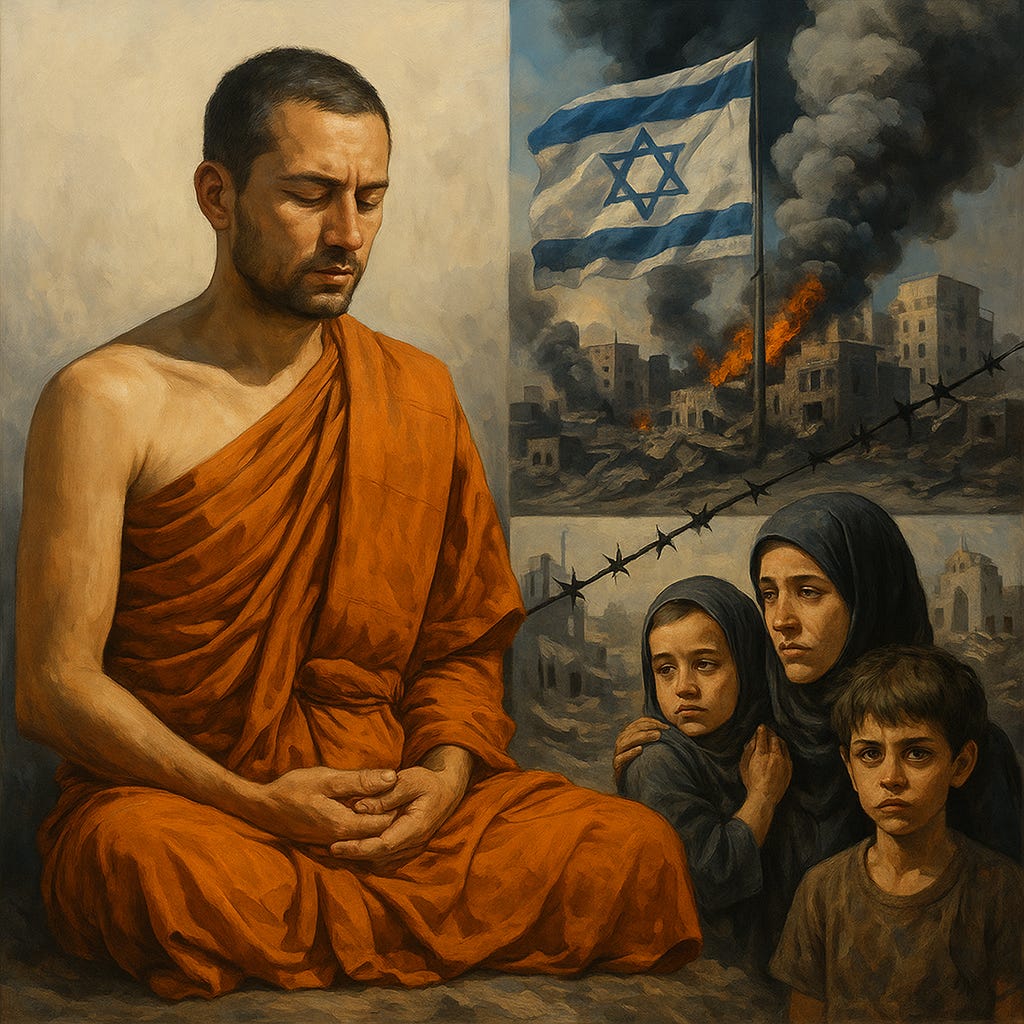
Is the Insight Tradition Complicit in Genocide?
Description
Vince Fakhoury Horn reflects on his experiences within the Insight meditation tradition, as an authorized teacher in the lineage, arguing that its senior leaders have remained complicit, through their silence, on the genocide of Palestinians in Gaza.
💬 Transcript
Vince: Today I want to speak to you as an authorized representative of the Insight meditation tradition. I was authorized to teach—empowered to teach—by Trudy Goodman and Jack Kornfield in a public ceremony in Los Angeles several years ago.
This is largely going to be a story about my experience with the Insight meditation tradition and a kind of out-loud contemplation and meditation on how this tradition, from my point of view, has ended up two-plus years into what I saw, and see still, as a genocide in Israel with the Gazans—the Palestinians in Gaza—and how the Insight tradition has remained silent, largely silent, on such an important issue, one of the moral issues of our time, I think.
And of course, I have to acknowledge as a Palestinian American, my view is informed by my own history. But I also want to say most Americans have no clue what the history is here. And I run into this every single day as I talk to people, as I try to share my honest experience—not hide—to be courageous and open about what it’s like to be a Palestinian living in America today, watching people that I care about be murdered, watching my family in the West Bank be terrified as they live in conditions which I could only describe as concentration-camp-like conditions.
Two of my close family members here in Western North Carolina—two members who married into the larger clan of Fakhourys that live here. The last name of my grandfather was Fakhoury—Latif Fakhoury. He raised me; he was my father basically; I called him Pops. A number of family members live here in this area who immigrated here so they could get support from each other.
Two of them have shared that they’ve both lost over 200 family members in Gaza. I want that to land with you for a second.
Two hundred. That’s a whole family tree. People are losing family trees.
So to me, as a Buddhist practitioner and as a Palestinian American—as someone who cares about things like this—I’m just completely, utterly fucking heartbroken, and I have been for the last two years. And I feel like during that time I’ve waited, I’ve waited, I’ve waited for the leaders of my own lineage—for my own teachers—to take a courageous moral stand. And the reality is they have not. And I don’t think they will.
And so how in the world did we get here? I’ve been thinking about this a lot, and I’ve been looking at my own disappointment and disillusionment around it. And I’ve been disillusioned and disappointed before by teachers—you know, I’m not new to this game. I’ve been a teacher for 15 years. I’ve seen people get disillusioned and disappointed with me. That’s, in part, normal.
But this is not. I want to claim that this is not normal. This is an abdication of moral responsibility at the deepest level.
And I guess it’s not that surprising to me as I reflect back on my own experience with this tradition. When I first started engaging in the Insight tradition, around 2003, I went up for my first retreat at the Insight Meditation Society in Barre, Massachusetts. It was with Joseph Goldstein and a number of other teachers, who themselves had just exited a six-week retreat with Sayadaw U Pandita, a famous Burmese meditation master who was christening the new Forest Refuge long-term retreat facility with a retreat for the teachers of the Insight tradition.
And for me, this was like falling in love. It was exactly what I was looking for—the hardcore retreat experience. I had been reading Daniel Ingram’s work prior to this—my first teacher—and he advocated for this hardcore contemplative approach. So it was great. I fell in love. I loved the Buddhist tradition. I loved the teachings. I loved the opportunity to go deep and be hardcore in my practice.
But I noticed even then—me, a millennial practicing in an almost completely Boomer culture—that the politics of the place were weird. I remember complaining about this many times to my partner and other friends: how we would go on these retreats and the teachers would act apolitical, but then they would proceed to share reams of political opinions in their Dharma talks—some of which I agreed with and many of which I did not.
And I found their political views to be quite homogeneous and quite apparent, and yet somehow being couched in apolitical terms. That was the first thing I found odd.
So now when I look at it, this is a modernist movement. This is a modern movement. And part of what one does in the modern world, especially in the marketplace, is you depoliticize things. It’s not smart business to bring politics into your product or your offering.
Right—but this isn’t exactly a product, and this is, I think, one of the challenges of bringing Buddhism into the modern world, especially into America, the hyper-capitalist capital of the world. How do you not lose the spirit and essence of the Dharma when adapting to a new environment? How do you not leave something transformative and powerful on the table by not being willing to adapt to the new environment?
I want to hold this tension here between conserve and adapt throughout this monologue if I can, because I think it’s a really important generative tension.
But in my experience with the Insight tradition, when I first started engaging with it in the early aughts, they were caught in a kind of paradox around their own obvious political views—which were liberal, maybe progressive-leaning, leftish. Very Boomer-centric in terms of a particular kind of generational politics.
And I found it very awkward and weird practicing in those environments. But it was okay. I could deal with it. I could handle it.
Some ten years later, as the times changed and as the traditions changed, I noticed that increasingly the Insight tradition—starting with Spirit Rock, the more liberal of the two major centers in California, and then following that, the Insight Meditation Society—began making the politics more explicit. They started to own the values of inclusion and wanting to make this available not just to young people (which was kind of their initial politics of attracting the next generation), but also to people of color and the LGBTQI community and all of these different historically marginalized groups they wanted to explicitly include and make space for.
They began to examine some of the cultural conditions they have around the practice, to see the impact and influence of American WASP culture—White Anglo-Saxon Protestant culture. And they started to realize, “Oh, even though we went to Asia and did all this stuff, of course we still have this conditioning. And it’s fine for us, and it’s fine for anyone like us, but it’s potentially problematic for other people.”
An example of this: many people who are non-white come to meditation retreat centers and then are told to be silent. They hear that from a different point of view. They don’t hear it from the perspective of members of the dominant culture, who can just be quiet and be okay. Rather, they’re coming from a point of view of having felt like they were silenced—often systematically silenced—and then they’re entering into an environment where they’re told to be quiet again.
This is an example where the Insight tradition, I think—and I want to praise the Insight tradition here—has done a good job of wrestling with these very challenging questions of how to teach Dharma in a multicultural, postmodern world. And this is a transition, I think, from modern to postmodern: when you start to actually include voices that have been historically marginalized; when you start to become aware of those power differentials and the history there; that is a kind of awakening to a new level of understanding.
In the developmental psychology world, they would call that Pluralism or Postmodernity. And I think it’s really important, because you can take a view on the modern meta-narrative, on the grand story of what modernity is. It’s about progress and it’s for all people, etc., etc. It’s like, “Oh yeah, that’s beautiful, but in reality, how does it actually work? Where did all this wealth come from that we’ve accrued as modern people? Who’s left out?”
These are the questions I think you have to start asking if you want to move past the modern mode.
And my teachers did that, and I learned a lot from them in the process. Not just from them— from others as well— but I went through that journey with them as I was training very seriously. I watched their initiatives at their own retreat centers, and that informed how I taught. That informed my views. And I began to believe that, in fact, they were integrating this pluralistic wave of development—this inclusive mindset that can include people regardless of their backgrounds and regardless of their histories: include them financially, include them culturally, etc.
Now, of course, in practice this has been a painful implementation. I’ve seen behind the scenes of that quite a bit, having been married to someone who has worked both inside the Insight tradition as a teacher—teaching at places like Spirit Rock—and who also trained for eight years as a mindfulness meditation mentor in Jack Kornfield and Tara Brach’s Mindfulness Meditation Teacher Certification Program. We just called it at home the “MMTCP,” because you couldn’t repeat that many times.
So I very much got to see, from their point of view and my own, that the tradition has done a lot in its attempt to include these areas and topics which have historically bee

















 United States
