


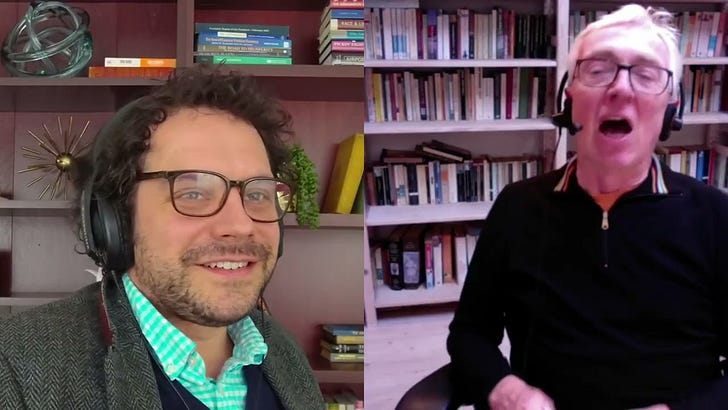
John Mullan. What makes Jane Austen great?
Description
Tuesday is the 250th anniversary of Jane Austen’s birth, so today I spoke to John Mullan, professor of English Literature at UCL, author of What Matters in Jane Austen. John and I talked about how Austen’s fiction would have developed if she had not died young, the innovations of Persuasion, wealth inequality in Austen, slavery and theatricals in Mansfield Park, as well as Iris Murdoch, A.S. Byatt, Patricia Beer, the Dunciad, and the Booker Prize. This was an excellent episode. My thanks to John!
Transcript
Henry Oliver (00:00 )
Today, I am talking to John Mullen. John is a professor of English literature at University College London, and he is the author of many splendid books, including How Novels Work and the Artful Dickens. I recommend the Artful Dickens to you all. But today we are talking about Jane Austen because it’s going to be her birthday in a couple of days. And John wrote What Matters in Jane Austen, which is another book I recommend to you all. John, welcome.
John Mullan (00:51 )
It’s great to be here.
Henry Oliver (00:53 )
What do you think would have happened to Austin’s fiction if she had not died young?
John Mullan (00:58 )
Ha ha! I’ve been waiting all this year to be asked that question from somebody truly perspicacious. ⁓ Because it’s a question I often answer even though I’m not asked it, because it’s a very interesting one, I think. And also, I think it’s a bit, it’s answerable a little bit because there was a certain trajectory to her career. I think it’s very difficult to imagine what she would have written.
John Mullan (01:28 )
But I think there are two things which are almost certain. The first is that she would have gone on writing and that she would have written a deal more novels. And then even the possibility that there has been in the past of her being overlooked or neglected would have been closed. ⁓ And secondly, and perhaps more significantly for her, I think she would have become well known.
in her own lifetime. you know, partly that’s because she was already being outed, as it were, you know, of course, as ⁓ you’ll know, Henry, you know, she published all the novels that were published in her lifetime were published anonymously. So even people who were who were following her career and who bought a novel like Mansfield Park, which said on the title page by the author of Sense and Sensibility and Pride and Prejudice, they knew they knew.
John Mullan (02:26 )
were getting something by the same author, they wouldn’t necessarily have known the author’s name and I think that would have become, as it did with other authors who began anonymously, that would have disappeared and she would have become something of a literary celebrity I would suggest and then she would have met other authors and she’d have been invited to some London literary parties in effect and I think that would have been very interesting how that might have changed her writing.
John Mullan (02:54 )
if it would have changed her writing as well as her life. She, like everybody else, would have met Coleridge. ⁓ I think that would have happened. She would have become a name in her own lifetime and that would have meant that her partial disappearance, I think, from sort of public consciousness in the 19th century wouldn’t have happened.
Henry Oliver (03:17 )
It’s interesting to think, you know, if she had been, depending on how old she would have been, could she have read the Pickwick papers? How would she have reacted to that? Yes. Yeah. Nope.
John Mullan (03:24 )
Ha ha ha ha ha!
Yes, she would have been in her 60s, but that’s not so old, speaking of somebody in their 60s. ⁓ Yes, it’s a very interesting notion, isn’t it? I mean, there would have been other things which happened after her premature demise, which she might have responded to. I think particularly there was a terrific fashion for before Dickens came along in the 1830s, there was a terrific fashion in the 1820s for what were called silver fork novels, which were novels of sort of high life of kind of the kind of people who knew Byron, but I mean as fictional characters. And we don’t read them anymore, but they were they were quite sort of high quality, glossy products and people loved them. And I’m I like to think she might have reacted to that with her sort of with her disdain, think, her witty disdain for all aristocrats. know, nobody with a title is really any good in her novels, are they? And, you know, the nearest you get is Mr. Darcy, who is an Earl’s nephew. And that’s more of a problem for him than almost anything else. ⁓ She would surely have responded satirically to that fashion.
Henry Oliver (04:28 )
Hahaha.
Yes, and then we might have had a Hazlitt essay about her as well, which would have been all these lost gems. Yes. Are there ways in which persuasion was innovative that Emma was not?
John Mullan (04:58 )
Yes, yes, yes, yes. I know, I know.
⁓ gosh, all right, you’re homing in on the real tricky ones. Okay, okay. ⁓ That Emma was not. Yes, I think so. I think it took, in its method, it took further what she had done in Emma.
Henry Oliver (05:14 )
Ha ha.
This is your exam today,
John Mullan (05:36 )
which is that method of kind of we inhabit the consciousness of a character. And I I think of Jane Austen as a writer who is always reacting to her own last novel, as it were. And I think, you know, probably the Beatles were like that or Mozart was like that. think, you know, great artists often are like that, that at a certain stage, if what they’re doing is so different from what everybody else has done before,
they stop being influenced by anybody else. They just influence themselves. And so I think after Emma, Jane Austen had this extraordinary ⁓ method she perfected in that novel, this free indirect style of a third-person narration, which is filtered through the consciousness of a character who in Emma’s case is self-deludedly wrong about almost everything. And it’s...
brilliantly tricksy and mischievous and elaborate use of that device which tricks even the reader quite often, certainly the first time reader. And then she got to persuasion and I think she is at least doing something new and different with that method which is there’s Anne Elliot. Anne Elliot’s a good person. Anne Elliot’s judgment is very good. She’s the most cultured and cultivated of Jane Austen’s heroines. She is, as Jane Austen herself said about Anne Elliot, almost too good for me. And so what she does is she gives her a whole new vein of self-deception, which is the self-deception in the way of a good person who always wants to think things are worse than they are and who always, who, because suspicious of their own desires and motives sort of tamps them down and suppresses them. And we live in this extraordinary mind of this character who’s often ignored, she’s always overhearing conversations. Almost every dialogue in the novel seems to be something Anne overhears rather than takes part in. And the consciousness of a character who
doesn’t want to acknowledge things in themselves which you and I might think were quite natural and reasonable and indeed in our psychotherapeutic age to be expressed from the rooftops. You still fancy this guy? Fine! Admit it to yourself. ⁓ No. So it’s not repression actually, exactly. It’s a sort of virtuous self-control somehow which I think lots of readers find rather masochistic about her.
Henry Oliver (08:38 )
I find that book interesting because in Sense and Sensibility she’s sort of opposed self-command with self-expression, but she doesn’t do that in Persuasion. She says, no, no, I’m just going to be the courage of, no, self-command. know, Eleanor becomes the heroine.
John Mullan (08:48 )
Yes. Yes, yes, yes, yes, yes, yes. But with the odd with the odd burst of Mariannes, I was watching the I thought execrable Netflix ⁓ persuasion done about two or three years ago ⁓ with the luminous Dakota Johnson as as you know, as Anne Elliot. You could not believe her bloom had faded one little bit, I think.
John Mullan (09:23 )
And ⁓ I don’t know if you saw it, but the modus operandi rather following the lead set by that film, The Favourite, which was set in Queen Anne’s reign, but adopted the Demotic English of the 21st century. similarly, this adaptation, much influenced by Fleabag, decided to deal with the challenge of Jane Austen’s dialogue by simply not using it, you know, and having her speak in a completely contemporary idiom. But there were just one or two lines, very, very few from the novel, that appeared. And when they appeared, they sort of cried through the screen at you. And one of them, slightly to qualify what you’ve just said, was a line I’d hardly noticed before. as it was one of the few Austin lines in the programme, in the film, I really noticed it.
And it was much more Marianne than Eleanor. And that’s when, I don’t know if you remember, and Captain Wentworth, they’re in Bath. So now they are sort of used to talking to each other. And Louisa Musgrove’s done her recovering from injury and gone off and got engaged to Captain Benwick, Captain Benwick. So Wentworth’s a free man. And Anne is aware, becoming aware that he may be still interested in her. And there’s
















 United States
