


John Walton’s Wisdom for Faithfully Reading the Old Testament
 2
2Description
<figure class="aligncenter size-large is-resized">
 </figure>
John H. Walton is a professor of Old Testament at Wheaton College and Graduate School. Previously he was a professor of Old Testament at Moody Bible Institute in Chicago for twenty years.
Some of Walton’s books include The Lost World of Adam and Eve, The Lost World of Scripture, The Lost World of Genesis One, Ancient Near Eastern Thought and the Old Testament, The Essential Bible Companion, The NIV Application Commentary: Genesis, and The IVP Bible Background Commentary: Old Testament (with Victor Matthews and Mark Chavalas).
Walton’s ministry experience includes church classes for all age groups, high school Bible studies, and adult Sunday school classes, as well as serving as a teacher for “The Bible in 90 Days.” John and his wife, Kim, live in Wheaton, Illinois, and have three adult children.
<figure class="aligncenter size-large">
 </figure>
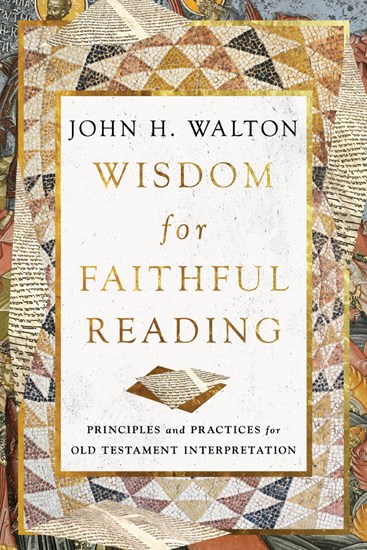
The church has too often lost its way in reading the Old Testament for lack of sound principles of interpretation. When careless habits get us off track, we can lose sight of what the Bible is really saying, derailing our own spiritual growth and even risking discredit to God’s word.
We need a consistent approach to give us confidence as faithful interpreters. In Wisdom for Faithful Reading, the trusted Old Testament scholar John Walton lays out his tried-and-true best practices developed over four decades in the classroom. His principles are memorable, practical, and enlightening, including:
- The Bible is written for us, but not to us.
- Reading the Bible instinctively is not reliable and risks imposing a foreign perspective on the text.
- More important than what the characters do is what the narrator does with the characters and what God is doing through the characters.
- Not everything has a “biblical view.”
Along with identifying common missteps, Walton’s insights point the way to stay focused on what the Old Testament text communicated to its original audience—and what it has to say for us today. When we submit ourselves to be accountable to the authors’ intentions we experience the true authority of Scripture, and faithful reading fuels a faithful life.
Using numerous examples across the breadth of the Old Testament and its genres, Walton equips thoughtful Christians to read more knowledgeably, to pay attention to God’s plans and purposes, to recognize good interpretations, and to truly live in light of Scripture. You may never read the Old Testament the same way again.
From the Publisher
Subscribe/Rate/Review Seminary Dropout on Apple Podcasts
Get 40% off Shane’s book Go and Do: Nine Axioms on Peacemaking and Transformation From the Life of John Perkins.


 United States

I Peter 3 18 For Christ also died for sins once for all, the just for the unjust, so that He might bring us to God, having been put to death in the flesh, but made alive in the spirit; 19 in which also He went and made proclamation to the spirits now in prison, 20 who once were disobedient, when the patience of God kept waiting in the days of Noah, during the construction of the ark, in which a few, that is, eight persons, were brought safely through the water. 21 Corresponding to that, baptism now saves you—not the removal of dirt from the flesh, but an appeal to God for a good conscience—through the resurrection of Jesus Christ, 22 who is at the right hand of God, having gone into heaven, after angels and authorities and powers had been subjected to Him. So the flood was a type somehow involved with of an appeal to God for a good conscience. As far as this typology goes, are all the people that died in the flood representative of the aspects within one's conscience which normally wou