


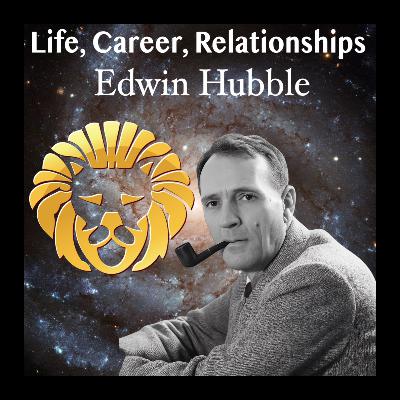
Life, Career And Relationships of Edwin Hubble - A Vedic Astrology Case Study
Description
His ascendant lord, the Sun in Scorpio in Anuradha (Pada 2), introduces a deep, investigative, emotionally intense, and research-driven interior world. The Sun here loses all superficiality and becomes a surgeon of cosmic truth—intellectual, philosophical, and relentlessly focused. Scorpio gives penetrating insight; Anuradha gives discipline, devotion, and the capacity to structure knowledge with loyalty to truth. This is the placement of someone who must uncover what lies beneath existence. The Leo–Scorpio axis is legendary for producing individuals who radiate outward confidence yet live inwardly in profound inquiry and intensity.
The Moon in Libra in Swati (Pada 2) sharpens the intellect with independence, conceptual clarity, and an ability to think in abstract patterns. Swati is the wind: fluid, flexible, curious, exploratory, restless, innovative. It added scientific openness, mathematical abstraction, and the ability to let ideas flow without being restricted by dogma. This was crucial for someone who would later redefine the cosmic scale itself.
Mars in Virgo in Hasta (Pada 2) fused razor-sharp technical skill with manual and mental dexterity. Hasta is the nakshatra of precision and mastery through the hands. Virgo is analytical refinement. Mars here builds a logical mind with surgical problem-solving, scientific rigor, and the ability to execute complex sequences flawlessly. This is the planetary architecture of someone who works with meticulous method.
Mercury exalted in Libra in Vishakha (Pada 3) brought goal-driven intellectual focus, elegance of reasoning, scientific balance, mathematical clarity, and a competitive mind that refuses mediocrity. Vishakha is the nakshatra of achieving milestones, conquering intellectual targets, and persevering until the objective is reached. Mercury here explains the sophistication of Hubble’s scientific reasoning—the ability to integrate observation with theory, logic with imagination.
Jupiter in Sagittarius in Purva Ashadha (Pada 1) became the philosophical engine of his life. Jupiter in its own sign expands horizons, constructs worldviews, asks questions about origins, direction, and purpose. Purva Ashadha adds victory, clarity, and intellectual conquest. This Jupiter was the force behind Hubble’s urge to understand the architecture of the universe itself. His entire career sits on the shoulders of this placement.
Venus in Libra in Swati (Pada 3) supported mathematical elegance, conceptual beauty, the aesthetic interpretation of science, the harmony of intellectual structures, and the uncanny ability to communicate abstract truths in a manner that felt poetic. Swati Venus produces individuals whose creativity is fueled by independence and original thinking.
Saturn in Leo in Magha (Pada 4) introduced ancestral responsibility, discipline, tradition, and the karmic weight of carrying a lineage of knowledge forward. Saturn in Magha is the one who honors ancestors through achievement. This fits perfectly: Hubble extended the intellectual lineage of astronomy itself.
Rahu in Gemini in Ardra (Pada 2) gave revolutionary thinking, unconventional insight, intellectual intensity, and the ability to break apart old models. Ardra is transformation through destruction of illusions. It is the nakshatra of scientific storm-bringers—the ones who tear the veil of ignorance.
Ketu in Sagittarius in Moola (Pada 4) anchored him in existential truth-seeking, philosophical detachment, and the urge to find the root (Moola literally means “root”). This Ketu dissolves boundaries in pursuit of the deepest, most foundational knowledge. It perfectly aligns with a man who uncovered the true structure of the universe.
#VedicAstrology
#AstroPsychology
#edwinhubble
#AstrologyCommunity









 United States
