


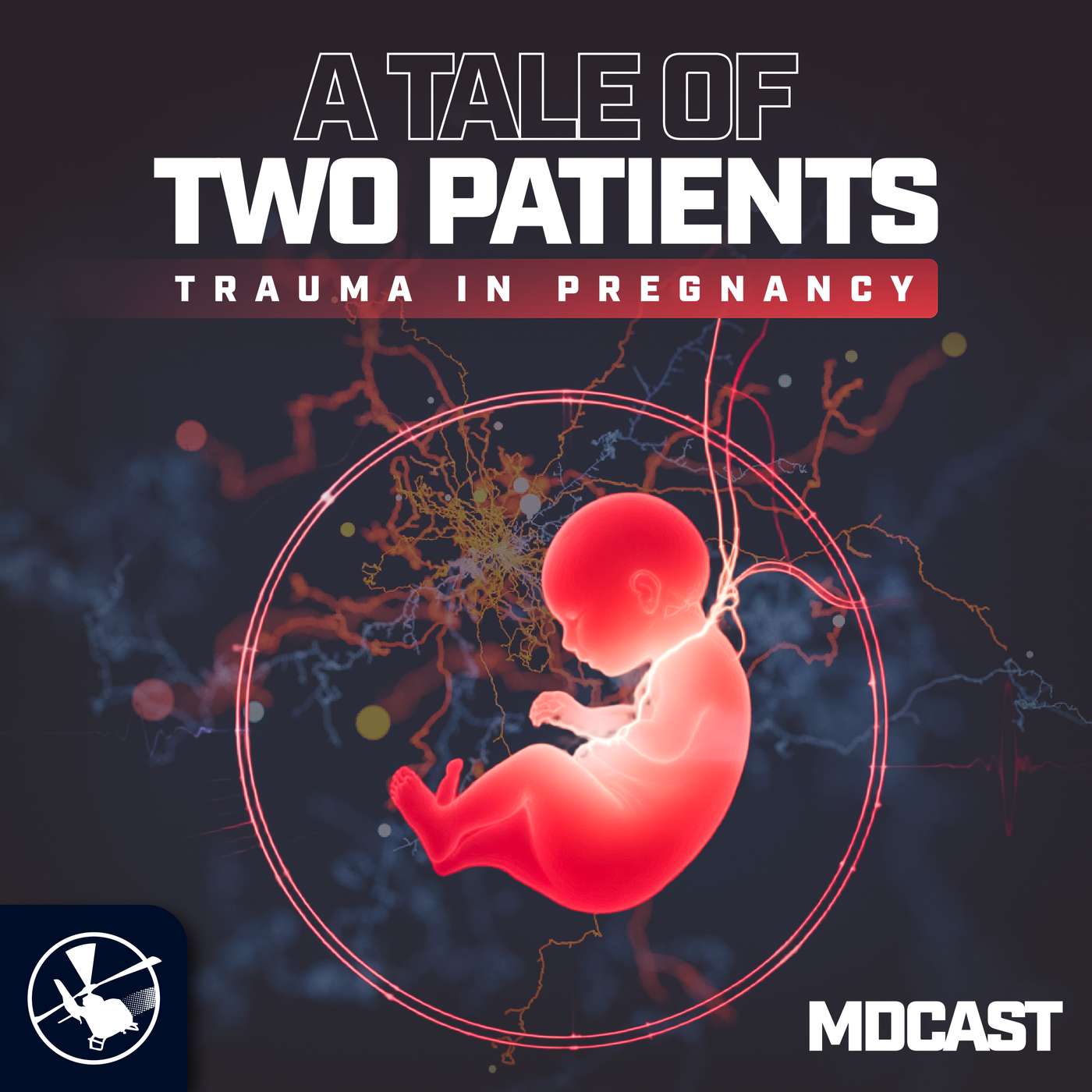
MDCast: A Tale of Two Patients - Trauma in Pregnancy
Description
In this episode of FlightBridgeED, Dr. Mike Lauria is joined by maternal-fetal medicine specialists Dr. Alex Pfeiffer and Dr. Liz Gartner for a practical, transport-focused deep dive into trauma in pregnancy. With maternal morbidity and mortality rising in the U.S. and more obstetric patients requiring transfer from smaller facilities, the team breaks down what changes when you’re managing trauma with two patients sharing one circulation—and how pregnancy can mask shock until both mom and fetus suddenly decompensate.
They walk through the pregnancy-specific physiology that matters most in the field: increased blood volume and cardiac output, decreased SVR, and why hypotension is a late sign. You’ll hear why “normal blood pressure doesn’t equal normal perfusion,” how to recognize early compensated shock (including subtle mental-status changes and agitation), and the key resuscitation tweaks that make a major difference—especially oxygenation and ventilation targets that are tighter than what you might accept in non-pregnant trauma patients.
The conversation also covers the highest-yield operational pieces for EMS and critical care transport crews: aortocaval compression after ~20 weeks and how to relieve it with left tilt/uterine displacement (even on a backboard), what to do about chest trauma (tube placement one to two interspaces higher), why placental abruption is a clinical diagnosis (and often not seen on imaging), fetal heart tones as a “vital sign,” and how viability changes transport destination decisions. They also address Rh considerations, RhoGAM timing, intimate partner violence screening opportunities during transport, and what crews should understand about perimortem C-section even if it’s not in their scope.
Key takeaways
- Mom first = baby best: Maternal stabilization is fetal resuscitation. Prioritize ABCDs before fetus.
- After 20 weeks: relieve aortocaval compression with 15–30° left tilt, hip bump, or manual uterine displacement—don’t skip this during resuscitation/transport.
- Shock can hide: Pregnant patients may lose ~30–40% blood volume before hypotension—watch trends and early signs like tachycardia and altered/anxious behavior.
- Oxygen/ventilation goals are tighter: Aim SpO₂ ≥ 95%; pregnancy has a lower baseline CO₂—an EtCO₂ around 40 may represent hypoventilation in pregnancy.
- Placental abruption is clinical: Uterine tenderness + contractions + vaginal bleeding = high suspicion, even with “normal” ultrasound/CT.
- Chest tubes go higher: Due to diaphragmatic elevation, place chest tubes 1–2 intercostal spaces higher than usual.
- Think destination + monitoring: Viability (~23–24 weeks) drives need for OB capability and fetal monitoring; minimum observation discussed as ~4 hours post-trauma for viable gestations.
- Rh matters, but perfusion matters more: Use O-negative if available for known Rh-negative patients; don’t withhold lifesaving blood when it’s the only option.
- Transport is a screening opportunity: Consider intimate partner violence and create safe moments to ask when separated from partners.
References –
· American Academy of Family Physicians. Trauma in Pregnancy: Assessment, Management, and Prevention. Am Fam Physician. 2014;90(10):717–722.
· Appelbaum RD, Yorkgitis B, Rosen J, Butts CA, To J, Knight AW, Zhang J, Kirsch JM, Levin JH, Riera KM, Kelley KM, Carter KT, Sawhney JS, Mukherjee K, Metz TD, Fiorentino MN, Cantrell S, Sapp A, Potgieter CJ, Kasotakis G, Como JJ, Freeman J. Trauma in pregnancy: A systematic review, meta-analysis, and practice management guideline from the Eastern Association for the Surgery of Trauma. J Trauma Acute Care Surg. 2025 Aug 1;99(2):298-309.
· SOGC Clinical Practice Guideline. Guidelines for the Management of a Pregnant Trauma Patient. J Obstet Gynaecol Can. 2015;37(6):553–571.
· Muench MV et al. Physiologic changes of pregnancy relevant to trauma management. Clin Obstet Gynecol. 2007;50(3):601–610.
· Larson, Nicholas J. et al.Prehospital Management of the Pregnant Trauma Patient. Air Medical Journal, Volume 44, Issue 4, 236 - 241
· Mendez-Figueroa, Hector et al. Trauma in pregnancy: an updated systematic review. American Journal of Obstetrics & Gynecology, Volume 209, Issue 1, 1 - 10
· Jain V et al. Trauma in pregnancy. Clin Obstet Gynecol. 2015;58(3):613–624.
· Clark SL et al. Amniotic Fluid Embolism: Diagnosis and Management Update. Am J Obstet Gynecol. 2016;215(2):B16–B24.
· Lipman S, Cohen S, Einav S, Jeejeebhoy F, Mhyre JM, Morrison LJ, Katz V, Tsen LC, Daniels K, Halamek LP, Suresh MS, Arafeh J, Gauthier D, Carvalho JC, Druzin M, Carvalho B, Society for Obstetric Anesthesia and Perinatology The Society for Obstetric Anesthesia and Perinatology consensus statement on the management of cardiac arrest in pregnancy. Anesth Analg. 2014 May;118(5):1003-16.
· Strong TH, Lowe RA. Perimortem cesarean section. Am J Emerg Med. 1989 Sep;7(5):489-94.
· Liggett MR, Amro A, Son M, Schwulst S. Management of the Pregnant Trauma Patient: A Systematic Literature Review. J Surg Res. 2023 May;285:18 7-196.
· Greco PS, Day LJ, Pearlman MD. Guidance for Evaluation and Management of Blunt Abdominal Trauma in Pregnancy. Obstet Gynecol. 2019 Dec;134(6):1343-1357.
· April MD, Long B. Trauma in pregnancy: A narrative review of the current literature. Am J Emerg Med. 2024 Jul;81:53-61.














 United States
