


New Narratives on the Late Ming Military: An Interview with Professor Kenneth Swope
Description
For a long time, Ray Huang's influential book 1587: A Year of No Significance has colored our imagination of the Late Ming, painting the Ming as a state that was stagnant and in decline. Traditional historiography usually focuses on the poor finances of the Ming state, its inability to pay troops, its poor military performance against the peasant rebels and the Manchus, and its factionalism. While all these are true to an extent, more recent scholarships have also uncovered another side to the late Ming - one of military success and military innovation. Professor Kenneth Swope, an expert on Ming military history and author of numerous monographs and articles on the topic, joins us to talk about these new narratives of the late Ming's successes and failures.
Contributors
Professor Kenneth Swope
Professor Kenneth Swope is a Professor of History & Senior Fellow of the Dale Center for the Study of War & Society at the University of Southern Mississippi. He is an expert on Chinese military history, particularly Ming military history and has published numerous monographs, articles, and book chapters on the topic. His major publications include A Dragon’s Head and a Serpent’s Tail: Ming China and the First Great East Asian War, 1592-1598, The Military Collapse of China’s Ming Dynasty, 1618-1644, and On the Trail of the Yellow Tiger: War, Trauma, and Social Dislocation in Southwest China During the Ming-Qing Transition. In addition, he serves as the book review editor for The Journal of Chinese Military History and is a member of the Board of Directors for the Chinese Military History Society.
Yiming Ha
Yiming Ha is a Ph.D. candidate in the Department of History at the University of California, Los Angeles. His current research is on military mobilization and state-building in China between the thirteenth and seventeenth centuries, focusing on how military institutions changed over time, how the state responded to these changes, the disconnect between the center and localities, and the broader implications that the military had on the state. His project highlights in particular the role of the Mongol Yuan in introducing an alternative form of military mobilization that radically transformed the Chinese state. He is also interested in military history, nomadic history, comparative Eurasian state-building, and the history of maritime interactions in early modern East Asia. He received his BA from UCLA and his MPhil from the Hong Kong University of Science and Technology.
Credits
Episode no. 7
Release date: January 29, 2022
Recording location: Hattiesburg, MS/ Los Angeles, CA
Bibliography courtesy of Professor Swope
Images:
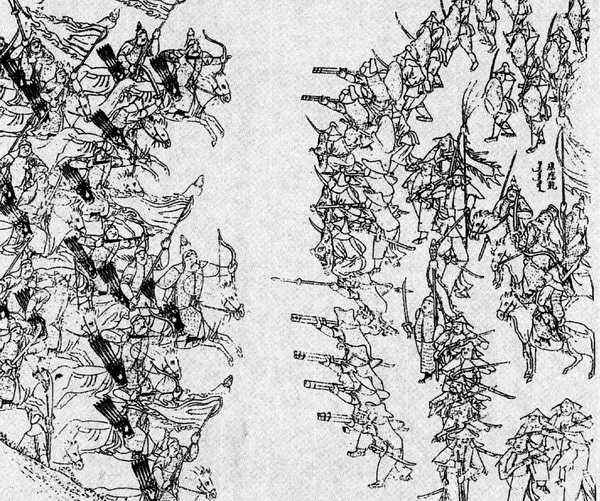
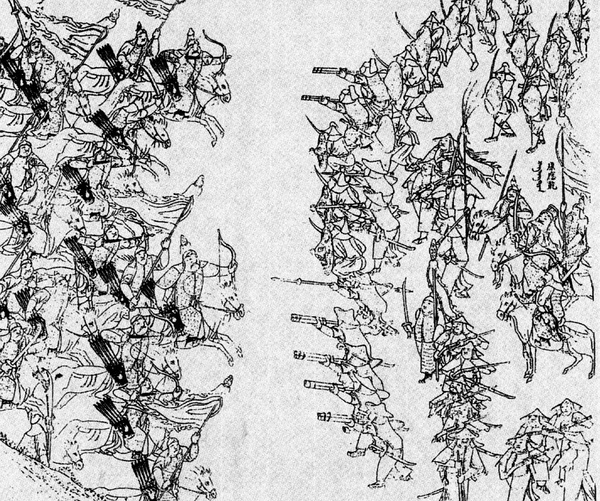
Cover Image: Battle of Sarhu, 1619. Note the use of gunpowder weapons. (Image Source)
Battle of Liaoyang, 1621. Note the use of gunpowder weapons. (Image Provided by Professor Swope)
Gate at Shanhai Pass (Photograph by Professor Swope)
Ming rocket-propelled arrows and launching tube and cart, from the Wubei zhi (for more images of Ming gunpowder weapons, see here)
A type of Ming warship from the Chouhai tubian, note the gunner operating a cannon on the lower deck.
References
Andrade, Tonio. Lost Colony: The Untold Story of China’s First Great Victory over the West. Princeton: Princeton University Press, 2011.
Fan Shuzhi 樊樹志. Wan Ming shi 晚明史 2 vols. Shanghai: Fudan daxue chubanshe, 2015.
-----. Wanli zhuan 萬歷傳. Beijing: Zhonghua shuju, 2020.
Parsons, James B. Peasant Rebellions of the Late Ming Dynasty. Ann Arbor: Association for Asian Studies, 1993.
Struve, Lynn A. The Southern Ming, 1644-1662. New Haven: Yale University Press, 1984.
Swope, Kenneth M. On the Trail of the Yellow Tiger: War, Trauma, and Social Dislocation in Southwest China during the Ming-Qing Transition. Lincoln: University of Nebraska Press, 2018.
-----. The Military Collapse of China’s Ming Dynasty. London: Routledge, 2014.
-----. A Dragon’s Head & a Serpent’s Tail: Ming China and the First Great East Asian War, 1592-1598. Norman: University of Oklahoma Press, 2009.
Wakeman, Jr., Frederic W. The Great Enterprise. 2 Vols. Berkeley: University of California Press, 1985.











 United States
