


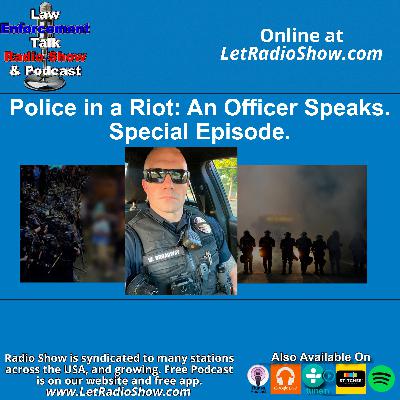
Police in a Riot: An Officer Speaks. Special Episode.
Description
Police in a Riot: An Officer Speaks. Special Episode. Riots are something most people only see through the lens of a television screen or a viral clip on social media. Flames in the background. Police lines in riot gear. Shouting crowds. What rarely makes it into the headlines is what it feels like to stand in the middle of that chaos, especially when you’re a young police officer with only weeks of experience on the street. This special episode is streaming for free on the Law Enforcement Talk Radio Show and Podcast website, on Apple Podcasts, Spotify, YouTube, and most every major Podcast platform
In this special episode, former Charlotte, North Carolina police officer Bill Broadway takes listeners inside the harsh realities of policing during violent riots. His account is raw, detailed, and deeply unsettling, not because it’s political, but because it’s personal. Look for The Law Enforcement Talk Radio Show and Podcast on social media like their Facebook , Instagram , LinkedIn , Medium and other social media platforms.
Thrown Into the Fire
Bill Broadway was just weeks out of field training when he was suddenly called into action to help control violent riots in Charlotte. Like many young officers, he expected to learn policing step by step, traffic stops, calls for service, building rapport with the community. Instead, he found himself facing crowds that were no longer protesting, but actively engaging in violence. Police in a Riot: An Officer Speaks. Special Episode. Supporting articles about this and much more from Law Enforcement Talk Radio Show and Podcast in platforms like Medium , Blogspot and Linkedin .
“These weren’t peaceful demonstrations,” Bill explains. “This was chaos.”
From the moment he arrived, it was clear this was something different. Police vehicles were targeted and removed. Officers were surrounded. Projectiles were thrown. Every decision carried the risk of serious injury, or worse. Police in a Riot: An Officer Speaks. Special Episode.
Protest vs. Riot: A Critical Distinction
Much of the public conversation blurs the line between protest and riot, but legally and practically, the difference matters.
Generally speaking, a protest is an organized public demonstration of disapproval, often protected under the First Amendment. A riot, by contrast, is defined as a violent disturbance of the peace involving multiple people acting together in a way that threatens public safety. Police in a Riot: An Officer Speaks. Special Episode. Available for free on their website and streaming on Apple Podcasts, Spotify, Youtube and other podcast platforms.
Federal law, under the Anti-Riot Act of 1968, defines a riot as a public disturbance involving acts of violence by an assemblage of three or more people that create a clear and present danger to people or property. Many states, including North Carolina, enforce similar statutes through laws addressing arson, looting, assault, unlawful assembly, and destruction of property.
As Bill describes it, the moment objects started flying and officers became targets, the situation crossed that line.
“When violence starts, it’s no longer a protest,” he says. “It’s something else entirely.”
Injuries, Fear, and Constant Threats
Bill walks listeners through every phase of the riot, from his initial arrival, to the loss of police vehicles, to the injuries sustained by officers on the line. What stands out most is the constant psychological pressure. Police in a Riot: An Officer Speaks. Special Episode. The Law Enforcement Talk Radio Show and Podcast episode is available for free on their website , Apple Podcasts , Spotify and most major podcast platforms.
“You don’t just worry about what’s in front of you,” Bill explains. “You’re watching rooftops, alleys, shadows. You’re wondering if the next hit is coming from behind.”
The stress didn’t end when the shift was over. Officers went home bruised, exhausted, and emotionally drained, knowing they could be called back at any moment. For many, sleep was elusive. The adrenaline lingered. The fear stayed close.
Optics vs. Officer Safety
One of the most controversial topics addressed is the allegation that department leadership and city officials were more concerned with optics and public opinion than with the truth, or the safety of their officers.
This is not a new accusation in American policing, and it remains a deeply divisive issue.
Critics argue that police departments often prioritize public relations to manage perception, reduce backlash, and limit legal exposure. The use of Public Information Officers and carefully worded statements can sometimes feel, to officers on the ground, like a disconnect from reality. Police in a Riot: An Officer Speaks. Special Episode. The special episode can be found on The Law Enforcement Talk Radio Show and Podcast website, on Apple podcasts, Spotify, Youtube and on LinkedIn, Facebook, Instagram, and across most podcast platforms where listeners will find authentic law enforcement stories.
On the other hand, law enforcement leaders emphasize the importance of public trust. Studies consistently show that effective policing depends on community cooperation. Transparency, communication, and accountability are essential, but difficult to balance during fast-moving, volatile events.
“The people making decisions weren’t the ones standing there,” Bill says. “That’s what made it hard.”
A Divided Public
Public opinion on policing during riots is sharply divided, often along political, racial, and ideological lines. Some see restraint as weakness. Others see enforcement as oppression. Officers in the middle are left navigating not just physical danger, but a cultural battlefield.
Bill doesn’t claim to have all the answers. What he offers instead is perspective, what it’s like to be young, inexperienced, and suddenly responsible for holding a line while the world watches.
You Decide
Today, Bill Broadway works for a different agency, carrying with him the lessons and scars of those nights in Charlotte. His story raises difficult questions about leadership, accountability, public safety, and the human cost of civil unrest. Police in a Riot: An Officer Speaks. Special Episode. The full podcast episode is streaming now on their website, on Apple Podcasts, Spotify, Youtube and across Facebook, Instagram, and LinkedIn.
Were the riots handled correctly by department leadership and city officials?
Was the balance between optics and officer safety struck appropriately?
Bill shares his experience from the front lines.
You decide.
Listen to this special episode on the Law Enforcement Talk Radio Show and Podcast website on Apple Podcasts, Spotify, Youtube, Facebook, Instagram, LinkedIn, and most major podcast platforms.
Find a wide variety of great podcasts online at The Podcast Zone Facebook Page , look for the one with the bright green logo.
Be sure to check out our website .
Be sure to follow us on X , Instagram , Facebook, Pinterest, Linkedin and other social media platforms for the latest episodes and news.
Listeners can tune in on the Law Enforcement Talk Radio Show website, on Apple Podcasts, Spotify, YouTube, and most every major Podcast platform and follow updates on Facebook, Instagram, and other major News outlets. You can find the show on Facebook, Instagram, Pinterest, X (formerly Twitter), and LinkedIn, as well as read companion articles and updates on Medium, Blogspot, YouTube, and even IMDB.
Background song Hurricane is used with permission from the band Dark Horse Flyer.
You can contact John J. “Jay” Wiley by email at Jay@letradio.com , or learn more about him on their website .
Stay connected with updates and future episodes by following the show on Facebook, Instagram, LinkedIn, their website and other Social Media Platforms.
Police in a Riot: An Officer Speaks. Special Episode.
Attributions:
Hosted by Simplecast, an AdsWizz company. See pcm.adswizz.com for information about our collection





 United States
