


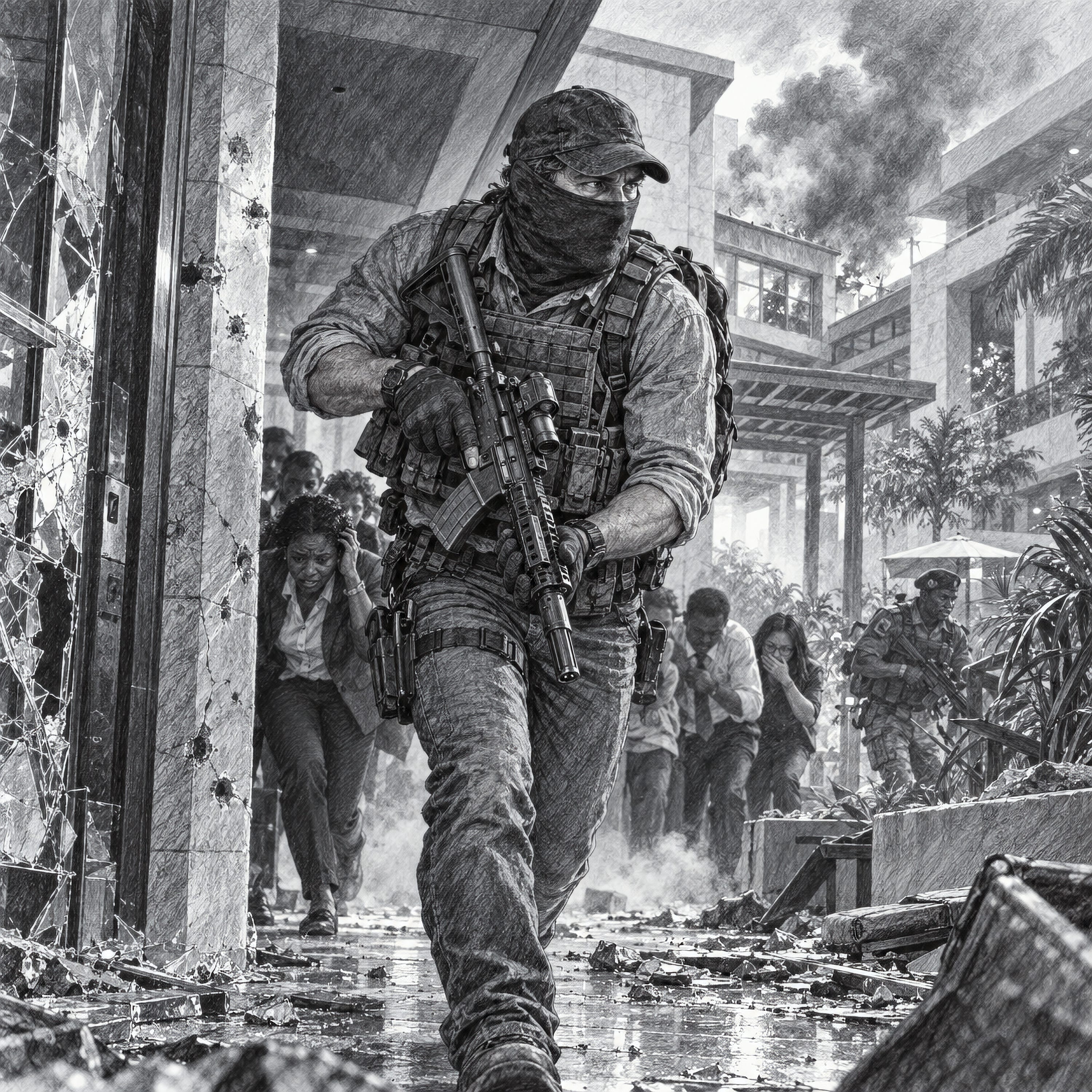
The Man Who Went In
Description
On this podcast, we tell stories about courage, service, sacrifice, resilience, and the people who step forward when circumstances demand more from them than anyone had a right to expect. Sometimes those stories come from battlefields. Sometimes they come from rescue operations, humanitarian missions, disasters, or ordinary moments that suddenly become extraordinary. What connects them is not simply danger. It is what people choose to do when someone else needs them.
This is one of those stories.
Sometimes courage is loud. Everyone sees it coming. There is time to prepare, assemble the team, receive the orders, study the mission, and understand what is expected. But other moments bring courage without warning. No briefing, no ceremony, and no one standing beside you telling you what comes next. Sometimes it arrives as a telephone call on an otherwise ordinary afternoon.
January 15, 2019, began that way for a British soldier living in Nairobi, Kenya.
His name, at least the name by which the world would come to know him, was Christian Craighead. He had spent virtually his entire adult life preparing for dangerous places. He joined the British Army as a teenager, served in the Parachute Regiment, moved into the Pathfinder Platoon, and eventually earned a place in 22 Special Air Service, the SAS. By 2019, he had accumulated decades of military experience, including operational service in Iraq and Afghanistan and years devoted to counterterrorism, hostage rescue, reconnaissance, and direct action. His published biography describes a twenty-eight-year military career, with nearly fifteen of those years associated with 22 SAS.
But the titles and unit designations are not the most important part of this story.
What interests me is what happened when there was no ceremony, no time to assemble the perfect team, and no guarantee anyone would accompany him. Training has value. Selection has purpose. Equipment and experience can change what a person can do. But eventually everything someone has learned comes down to a moment when the question is no longer, What do you know?
The question becomes, What are you going to do?
Craighead joined the British Army at sixteen, and that alone tells us something about the direction of his life. He has spoken publicly about wanting the Parachute Regiment from the beginning. He did not accidentally drift into an elite military career. He deliberately chose a difficult road and continued moving toward increasingly demanding standards. After the Parachute Regiment came the Pathfinder Platoon, a reconnaissance element associated with Britain’s airborne forces. Eventually came United Kingdom Special Forces selection.
A later British High Court case confirms an especially revealing part of that journey: Craighead was selected for 22 SAS on his third attempt.
His third attempt.
When people look at the photographs from Nairobi, they see the finished product. They see the balaclava, body armor, rifle, and the calm figure moving toward a terrorist attack while hundreds of other people were desperately trying to escape it. They see an SAS operator.
What they do not see are the failures that preceded the qualification. They do not see an unsuccessful first attempt or another unsuccessful attempt after that. They do not see the years of conditioning, field experience, repetition, disappointment, correction, exhaustion, and starting over that existed behind the photograph.
We tend to look at extraordinary performance and assume the person performing it must have been born different. Sometimes that assumption becomes an excuse. We tell ourselves, Well, he was an SAS soldier. That is what those guys do.
Yes, Christian Craighead was an SAS soldier.
But he was not born one.
There is an important difference.
Elite military selection isn't simply about finding who is physically strong. Strength helps. Fitness is important. Skill is essential. But selection also exposes people. Remove comfort. Introduce uncertainty. Keep pressure on them. Strip away excuses and force them to continue making decisions when both body and mind would prefer to stop. Eventually, you begin discovering something about who a person is when the plan disappears.
Craighead had spent years living inside that process.
He passed selection, joined 22 SAS, accumulated combat experience, and trained extensively for counterterrorism and hostage rescue. He became more than someone who had simply encountered difficult operations. His professional life revolved around solving problems in environments where violence, uncertainty, and innocent lives occupied the same space. His publicly released biography says that his career ultimately involved more than a thousand high-risk missions across several theaters.
None of that makes a man fearless.
I think we misunderstand courage whenever we make it synonymous with fearlessness. Fear is information. It tells you that something carries consequence. Courage is what you decide to do with that information.
Anyone who has spent much time around genuine danger eventually discovers that courage is usually far less theatrical than movies make it out to be. Often it is procedural. You control what you can control. You perform the next task. You solve the next problem. You keep moving and refuse to spend precious mental energy rehearsing every catastrophe that might happen.
Training gives the mind somewhere to go when chaos arrives. That is why repetition is so valuable. Under severe stress, human beings do not suddenly rise to some entirely new level of capability simply because the moment has become important. More often, we reach for patterns that have already been built. We search for something familiar inside something terrifying.
On the afternoon of January 15, 2019, Craighead was forty-three years old and in Kenya on a British military training assignment. According to the account later published in his memoir, One Man In, he was at home after training when a local friend called him from the DusitD2 complex. In the background, Craighead could hear the unmistakable sounds of an attack: gunfire and explosions. His friend told him what was happening.
The DusitD2 was much more than a hotel. The compound in Nairobi’s Westlands district contained a luxury hotel, restaurants, and office buildings filled with workers and visitors. On a normal business day, hundreds of people could be inside.
At approximately 3:28 that afternoon, according to a later United Nations investigation, an al-Shabaab terrorist detonated a suicide device and four gunmen entered the complex carrying rifles and grenades. Twenty-one civilians would ultimately be killed. The attackers had deliberately entered a crowded civilian environment where people were working, eating, meeting friends, conducting business, and simply living their lives.
Think about how quickly ordinary life can divide into before and after. One moment, someone is sitting at a desk. Someone else is ordering lunch. Another person is checking a phone or walking through a hotel lobby. Seconds later, the same environment has become broken glass, smoke, screaming, explosions, and gunfire.
That was the environment Craighead decided to enter.
His friend was somewhere inside. Other people were trapped. Gunfire was continuing. And Craighead possessed something most people at that scene did not.
He had the capability to help.
Capability creates its own burden.
Through military training, combatives, personal protection work, rescue, and years spent around people preparing for emergencies, I have come to believe something very strongly: the more capable you become, the harder it becomes to pretend a problem automatically belongs to somebody else.
Skill creates responsibility.
Craighead could have remained where he was. He was not part of the hotel security force. This had not begun as his assigned mission. He had not received a carefully prepared operational briefing, and he was not standing beside a fully assembled assault team waiting for a commander's signal. He had plenty of rational reasons to stay out of it.
Instead, he prepared himself and drove toward it.
That decision sits at the heart of this story.
The courage was not limited to entering the building.
The first act of courage was deciding to go.
Craighead has said he initially expected to assist, advise, or link up with Kenyan security forces already responding to the attack. But when he reached the complex, the situation remained confused and rapidly developing. People were trying to escape. Others were still trapped. Gunfire continued. The clean command structure people sometimes imagine when looking back at a crisis wasn't there waiting for him.
So he began doing what experienced people often do when no perfect solution exists.
He dealt with the problem directly in front of him.
Photographs from that afternoon eventually traveled around the world. They showed a man wearing jeans, a shirt, body armor, and a face covering. He moved alongside Kenyan personnel. He escorted civilians. He repeatedly went back toward the danger. The British Ministry of Defense would not publicly discuss special-forces operations at the time, but multiple news organizations identified the mysterious soldier as an SAS member who had been in Kenya training local forces.
There is something almost jarring about those photographs. He is wearing jeans. This is not a carefully staged uniform, a polished recruiting photograph, or a parade ground. It is a man dressed for an ordinary day who suddenly finds himself operating inside an extraordinary one.
Real courage rarely waits for everything to look right.
The clothing was irrelevant.
The preparation underneath it was not.


 United States
