


The Myth of "Full Recovery"
Description
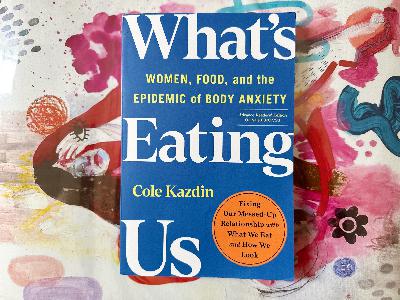
Today Virginia is chatting with Cole Kazdin, author of What's Eating Us: Women, Food, and the Epidemic of Body Anxiety, which explodes a lot of the problems with our current eating disorder treatment system.
Remember, if you order Cole's book (or any books we mention on the pod!) from the Burnt Toast Bookshop, you can get 10 percent off that purchase if you also order (or have already ordered!) Fat Talk! (Just use the code FATTALK at checkout.)
If you want more conversations like this one, please rate and review us in your podcast player! And become a paid Burnt Toast subscriber to get all of Virginia's reporting and bonus subscriber-only episodes.
Disclaimer: Virginia is a journalist and human with a lot of informed opinions. Virginia is not a nutritionist, therapist, doctor, or any kind of health care provider. The conversation you're about to hear and all of the advice and opinions she gives are just for entertainment, information, and education purposes only. None of this is a substitute for individual medical or mental health advice.
BUTTER & OTHER LINKS
For anyone who needs to recover into a fat body, you’re asking them to sacrifice the safety of their eating disorder in the sense that it’s harder to exist in this world in a fat body than in a thinner one.
just journal or do a crossword puzzle
backlash against the diagnosis of atypical anorexia
a very good piece about atypical anorexia
Virginia's story on Kurbo
Cole on Instagram
FAT TALK is out! Order your signed copy from Virginia's favorite independent bookstore, Split Rock Books (they ship anywhere in the US!). Or order it from your independent bookstore, or from Barnes & Noble, Amazon, Target, or Kobo or anywhere else you like to buy books. You can also order the audio book from Libro.fm or Audible.
CREDITS
The Burnt Toast Podcast is produced and hosted by Virginia Sole-Smith. Follow Virginia on Instagram or Twitter. Burnt Toast transcripts and essays are edited and formatted by Corinne Fay, who runs @SellTradePlus, an Instagram account where you can buy and sell plus size clothing. The Burnt Toast logo is by Deanna Lowe. Our theme music is by Jeff Bailey and Chris Maxwell. Tommy Harron is our audio engineer. Thanks for listening and for supporting anti-diet, body liberation journalism!
Episode 95 Transcript
Cole
I’m a journalist and now author. I worked in television news for many, many years and then left that work about 10 years ago to return to print journalism. If you’re a freelance journalist, you end up reporting about everything, right? Crime and the environment and breaking news. But I found myself focusing more and more on mental health reporting and in part that was because I was in a very unsatisfying moment of eating disorder recovery myself. And when I started reporting on mental health, specifically mental health around eating disorder recovery and the eating disorder epidemic, it really shifted the focus of my work to the point where it was all I wanted to really write about and thus the book.
Virginia
It’s called What's Eating Us: Women, Food, and the Epidemic of Body Anxiety. It’s incredible, Cole. Your reporting is top notch and then you also put your own story into this which I know can be difficult to do—to really go there—and you weave in other people’s stories. It’s just a beautiful mix of memoir and reporting.
Cole
Thank you.
Virginia
What made you decide this needed to be a book and this kind of book?
Cole
I had an eating disorder on and off through most of college and into my adult life. When I finally got treatment, I was very prepared for that treatment to be excellent and I’m done and now we don’t have an eating disorder anymore. It was so unsatisfying to me that it wasn’t remotely like that. It was more than the residue of the eating disorder. I was not very healed.
So, I started approaching it as a journalist, with the idea of seeing if I was the only one that felt this way. Is this in my own head? Am I crazy? Am I not able to recover because it’s just me? And also, as you know, as a journalist you can access people that would never talk to you if you are a patient.
Virginia
Oh yes. It’s a definite perk.
Cole
So I was writing short pieces about why doesn’t eating disorder recovery feel better? And what are the inequities in eating disorder care and in diagnosis? And the more I started reporting this, and the more people I spoke with both everyday people like myself who were suffering, and the clinicians, the researchers, the more I started to understand that not only was this not just in my head, this is the way it is. And understanding the scope of that, I felt an urgency to write a longer piece about this, to write a full book where I could reach all those points.
I use a lot of memoir because I think the transparency piece is very important. Eating disorders are very lonely and you really feel like you’re the only one suffering even though you know on paper that you’re not. So, I just wanted people to know how messy and difficult it is, to normalize that. And that no one is alone if they’re suffering from this.
Virginia
I mean, this whole concept of “full recovery” is so interesting. I feel like I’m beginning to see some pushback about that in the eating disorder therapist community. My good friend Shira Rosenbluth has talked a lot about her own eating disorder journey and this idea of full recovery being frankly unrealistic for so many people, given the current reality of treatments. Who currently gets to be fully recovered from an eating disorder?
Cole
What is so tricky about this is that no one can agree fully on what it means to be recovered from an eating disorder.
Virginia
I mean, that’s mind blowing right there.
Cole
Right. So, some organizations and clinic


![[PREVIEW] The Year in Butters: 2025](https://s3.castbox.fm/97/0e/ee/44e1a0b26f934e73cb55f46ed899d75a91_scaled_v1_400.jpg "[PREVIEW] The Year in Butters: 2025")
![[PREVIEW] Hot People Problems](https://s3.castbox.fm/10/0c/c3/2c4186bb3ffaa958c5a4ee4d3888ceb6df_scaled_v1_400.jpg "[PREVIEW] Hot People Problems")
![[PREVIEW] Are Standing Pants Different from Sitting Pants?](https://s3.castbox.fm/be/2c/0c/f737b964d5f27610acbbd373a16c29a78e_scaled_v1_400.jpg "[PREVIEW] Are Standing Pants Different from Sitting Pants?")
![[PREVIEW] How Much Did You Pay Your Pumpkin Stylist?](https://s3.castbox.fm/fe/3d/c0/dd8784a5450c5e085b6336501f2ac0f261_scaled_v1_400.jpg "[PREVIEW] How Much Did You Pay Your Pumpkin Stylist?")

![[PREVIEW] Can A Body Acceptance Advocate Work for Weight Watchers?](https://s3.castbox.fm/ce/6e/f2/62fdccc162b0b6bc777b5875f2c6d64cfa_scaled_v1_400.jpg "[PREVIEW] Can A Body Acceptance Advocate Work for Weight Watchers?")
![[PREVIEW] Not Trying to Be Hot 25-Year-Olds](https://s3.castbox.fm/1c/8e/70/adb41c046a3fe07dc045af139e24fdcf89_scaled_v1_400.jpg "[PREVIEW] Not Trying to Be Hot 25-Year-Olds")
![[PREVIEW] Is Back To School A Diet?](https://s3.castbox.fm/29/4e/50/fbf3f4de138a90fdd48db11f2d64935074_scaled_v1_400.jpg "[PREVIEW] Is Back To School A Diet?")

![[PREVIEW] The Mel Robbins Cult of High Fives](https://c10.patreonusercontent.com/4/patreon-media/p/post/140044903/63d8db77f7bf4ae6adc056b196ba3c37/eyJkIjo3MiwiaCI6MzAwMCwic3RyaXBfYWxwaGEiOjEsInciOjMwMDAsIndlYnAiOjB9/1.jpg?token-hash=_lgawLhrnuO4p0kAmMk8Wmg8kk1uHDzmHglZCAmOM1I%3D "[PREVIEW] The Mel Robbins Cult of High Fives")


 United States
