


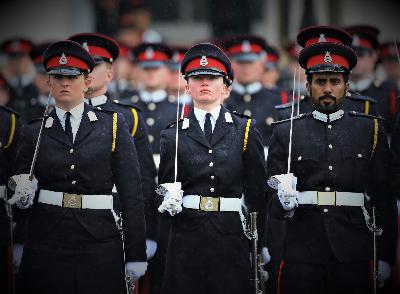
The UK's Shrinking Army Is Conducting Secretive Deployments in 51 Countries
Update: 2025-12-09
Description
Read our Digital & Print Editions
And support our mission to provide fearless stories about and outside the media system
SUBSCRIBE TODAY
Britain's Army is shrinking to its smallest size since the Napoleonic wars, struggling to recruit and unable to modernise at the pace its own commanders say is required. Yet despite this contraction, new Ministry of Defence (MoD) figures obtained by Byline Times suggest that the UK is quietly extending its global reach by sending military reservists into more countries than at any point in recent history.
The FOI disclosure reveals that 612 reservists were deployed overseas last year, entering what the MoD classifies as a "deployment theatre" for more than 24 hours in 51 countries and territories. It is an unusually broad global footprint for the modern Army Reserve - particularly for a force shrinking to its smallest size in two centuries - and one the Government has offered no public explanation for.
The MoD will not say what these part-time soldiers were doing, under whose authority they were sent, or why some missions took place in states that have no publicly declared UK military interest. When asked whether reservists had also been deployed to other, undisclosed countries, the department issued a "neither confirm nor deny" response - the phrasing normally reserved for sensitive or clandestine operations.
In a previous FOI disclosure, the MoD listed Iran as a deployment location before withdrawing the claim once Byline Times asked for clarification.
EXCLUSIVE
How Epstein Channelled Race Science and 'Climate Culling' Into Silicon Valley's AI Elite
The Epstein files expose how racial hierarchy, genetic "optimisation" and even climate-driven population culling circulated inside Big Tech circles
Nafeez Ahmed
It leaves a striking contradiction at the heart of British defence: as the Army contracts, its overseas activity appears to be quietly expanding, pushed into opaque theatres with little democratic scrutiny and few safeguards for accountability.
These revelations come at a moment when the military is facing scrutiny over a murder-rape case in Kenya and allegations that UK Special Forces carried out unlawful killings in Afghanistan - abuses senior officers stand accused of concealing.
This month, Kenya's parliament delivered a very clear warning of what happens when overseas deployments drift beyond scrutiny. A sweeping year-long inquiry into the British Army Training Unit Kenya (BATUK) has accused troops of decades of abuses, from sexual violence and fatal accidents to environmental damage and the negligent handling of unexploded ordnance. All of this seems to be shielded by a veil of diplomatic and military immunity that allowed grievances to fester for generations.
Kenyan lawmakers described BATUK's refusal to give evidence as showing an entrenched culture of impunity. This echoes patterns seen elsewhere in Britain's military footprint from Iraq to Afghanistan: allegations initially dismissed, investigations obstructed, civilian harm minimised, and accountability delayed and denied until the political cost becomes impossible to ignore.
Where They Went
The MoD's list spans NATO allies, conflict zones and several states where the UK has no obvious strategic interest. A handful of deployments follow familiar patterns of deterrence or alliance maintenance. Others sit far less comfortably, resembling the routines of a vanished Empire that persist more through inertia than declared strategy. The Gulf features prominently - unsurprising given long-standing security partnerships and the region's role as a major purchaser of British defence equipment. Eastern Europe also appears heavily on the list, consistent with the UK's efforts to signal resolve against Russia following the invasion of Ukraine.
Yet interspersed among these are countries where the UK's interests feel, at best, opaque.
Cape Verde, Djibouti, Lebanon, the Maldives: each appears on the MoD's ledger with no accompanying explana...
And support our mission to provide fearless stories about and outside the media system
SUBSCRIBE TODAY
Britain's Army is shrinking to its smallest size since the Napoleonic wars, struggling to recruit and unable to modernise at the pace its own commanders say is required. Yet despite this contraction, new Ministry of Defence (MoD) figures obtained by Byline Times suggest that the UK is quietly extending its global reach by sending military reservists into more countries than at any point in recent history.
The FOI disclosure reveals that 612 reservists were deployed overseas last year, entering what the MoD classifies as a "deployment theatre" for more than 24 hours in 51 countries and territories. It is an unusually broad global footprint for the modern Army Reserve - particularly for a force shrinking to its smallest size in two centuries - and one the Government has offered no public explanation for.
The MoD will not say what these part-time soldiers were doing, under whose authority they were sent, or why some missions took place in states that have no publicly declared UK military interest. When asked whether reservists had also been deployed to other, undisclosed countries, the department issued a "neither confirm nor deny" response - the phrasing normally reserved for sensitive or clandestine operations.
In a previous FOI disclosure, the MoD listed Iran as a deployment location before withdrawing the claim once Byline Times asked for clarification.
EXCLUSIVE
How Epstein Channelled Race Science and 'Climate Culling' Into Silicon Valley's AI Elite
The Epstein files expose how racial hierarchy, genetic "optimisation" and even climate-driven population culling circulated inside Big Tech circles
Nafeez Ahmed
It leaves a striking contradiction at the heart of British defence: as the Army contracts, its overseas activity appears to be quietly expanding, pushed into opaque theatres with little democratic scrutiny and few safeguards for accountability.
These revelations come at a moment when the military is facing scrutiny over a murder-rape case in Kenya and allegations that UK Special Forces carried out unlawful killings in Afghanistan - abuses senior officers stand accused of concealing.
This month, Kenya's parliament delivered a very clear warning of what happens when overseas deployments drift beyond scrutiny. A sweeping year-long inquiry into the British Army Training Unit Kenya (BATUK) has accused troops of decades of abuses, from sexual violence and fatal accidents to environmental damage and the negligent handling of unexploded ordnance. All of this seems to be shielded by a veil of diplomatic and military immunity that allowed grievances to fester for generations.
Kenyan lawmakers described BATUK's refusal to give evidence as showing an entrenched culture of impunity. This echoes patterns seen elsewhere in Britain's military footprint from Iraq to Afghanistan: allegations initially dismissed, investigations obstructed, civilian harm minimised, and accountability delayed and denied until the political cost becomes impossible to ignore.
Where They Went
The MoD's list spans NATO allies, conflict zones and several states where the UK has no obvious strategic interest. A handful of deployments follow familiar patterns of deterrence or alliance maintenance. Others sit far less comfortably, resembling the routines of a vanished Empire that persist more through inertia than declared strategy. The Gulf features prominently - unsurprising given long-standing security partnerships and the region's role as a major purchaser of British defence equipment. Eastern Europe also appears heavily on the list, consistent with the UK's efforts to signal resolve against Russia following the invasion of Ukraine.
Yet interspersed among these are countries where the UK's interests feel, at best, opaque.
Cape Verde, Djibouti, Lebanon, the Maldives: each appears on the MoD's ledger with no accompanying explana...

Comments
In Channel














Download from Google Play

Download from App Store
 United States
00:00
00:00
x

