


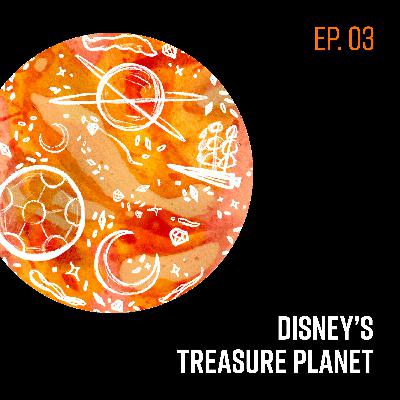
Treasure Planet
Description
Bio/ Background (intro)
- Directors: Ron Clements and John Musker
- Intro (below)
Topic 1 Introduction
To my surprise, a number of people have never seen or heard of the movie “Treasure Planet.” In this classic retelling of “Treasure Island” by Robert Louis Stevenson, the narrative was turned into an intergalactic adventure complete with cyborgs, space travel, and, of course, treasure. Disney’s “Treasure Planet” was one of two experimental movies in the year 2002. “Treasure Planet,” however, is notorious for its box office failure. The other experimental film, from a different in-house studio was “Lilo and Stitch,” which got way more attention and was well received by audiences. Now, this podcast is not a compare and contrast of the two experimental films of 2002, but I can’t help but take into consideration the alleged reasons why “Lilo and Stitch” swam but “Treasure Planet” sank. Both movies included obvious CGI, a wide variety of alien species, action-packed space travel, and family problems. I say this because a noticeable amount of articles claim the reason “Treasure Planet” bombed at the box office was because of the “high tech” CGI scenes. Amazingly after being scorned six feet into the grave of Disney’s backyard, 20 years later it gets dug up like a prized fossil.
Treasure Planet is based on the legendary novel “Treasure Island,” written by Robert Louis Stevenson. Instead of taking place in the Caribbean, it is set in outer space. The story begins with Jim Hawkins receiving a treasure map from a wounded alien by the name of Billy Bones in his mother’s inn. Rebellious Hawkins and passionate Dr. Delbert Doppler join a crew to find this elusive treasure hidden by the notorious pirate, Captain Nathaniel Flint. The crew of this ship seems to be of questionable authenticity as Hawkins meets the cook, Mr. Silver. Silver’s cyborg body with a robot arm reminds Hawkins of Billy Bones' warning about a cyborg. Eventually, the crew reveal themselves as pirates and launch a mutiny with Silver as their leader. The film carries multiple layers of character arcs journeys as the characters set out for Treasure Planet. This retelling of “Treasure Island” was, of course, given a sprinkle of “Disney magic” complete with striking animation, and memorable characters with flamboyant personalities.
Topic 2 Who Made the Film?
The striking film was directed by Ron Clements and John Musker. These guys directed “The Little Mermaid,” “Aladdin,” and “Hercules.” According to the reflections on the Walt Disney Family Museum Website, Ron Clements was born and raised in Indiana. He was inspired to learn animation at the age of 9 after seeing “Pinocchio.” He worked his way from the scraping bottom of Disney to the director’s chair. John Musker was also an animator, storyboard artist, writer, director, and producer for 40 years for Disney Animation Studios. He studied under icons like Elmer Plummer and Bill Moore at CalArts in the 1970s. “He also studied alongside classmates who would become distinguished directors such as Brad Bird, Chris Buck, Tim Burton, John Lasseter, and Henry Selick.” His partnered credits with Clements are as follows, “The Great Mouse Detective” (1986), “The Little Mermaid” (1989), “Aladdin” (1992), “Hercules” (1997), “Treasure Planet” (2002), “The Princess and the Frog” (2009), and lastly, “Moana” (2016).
Gladstein writes in “The Bizarre Story of How Treasure Planet Got Made” that the two directors pitched “Treasure Planet” the same time as “The Little Mermaid” in Disney’s Renaissance Era (1989-1999). The studio was extremely reluctant to green light “Treasure Planet” until the dynamic duo, Clements and Musker, shoveled out genius big time money makers like “The Little Mermaid” and “Aladdin.” Gladstein notes that the studio was so impressed with the consistency of success from these dudes that they finally said yes to “Treasure Planet.” As an observer, I’m reading that basically “The Little Mermaid” and other MAJORLY lucrative films were just incredible proofs of concept to convince the big guys of letting “Treasure Planet” fly.
According to Jocelyn Buhlman on The Official Disney Fan Club Website, this was Clements and Musker's first sci-fi film, despite their love for science fiction. Buhlman quotes Clements explaining, “John and I are both sci-fi fans. The idea of making our pirate and taking his eye patch and turning it into a cyborg eye and taking his peg leg and making it mechanical—not only was it a science fiction thing, but it was an animation thing.” Buhlman also mentions how the two directors utilized the 3D technology used in “Tarzan” to create a camera effect on the action scenes and moving parts, “Beyond the wonders of Deep Canvas, Clements and Musker achieved the dynamic directorial style they desired by creating a whole new technology—virtual sets. A scene in “Tarzan” that most viewers can recognize that used a mix of hand drawn and computer animation is when Tarzan “slides” down mossy trees to get around in the jungle like sliding on wood floors with socks. The hand drawn element was added to Tarzan’s body as he moved around and the passing trees and jungle was the computer animation portion.
Buhlman speaks on how Clements explains the logistics of making “Treasure Planet’s” backgrounds, “‘They were actually dimensional sets made to look like 2-D backgrounds, but in truth they were 3-D, and we could move the camera around.’” This was a huge deal for animation. Let’s take another well known “classic” Disney hand drawn film for an example: “The Little Mermaid.” As previously mentioned, this enormously successful animated film was also directed by Clements and Musker. In this film, everything was hand drawn. And I do mean everything. Before understanding how and why animators turned to computer animation, we have to dive into the meaning of hand drawn animation and how much a labor of love it was.
Hand drawn animation is formally known as cel animation. This process of animation and film making is labor intensive and requires massive numbers of animators to complete an ambitious film such as “The Little Mermaid.” Just like any other film, animation requires storyboarding, pitches, screenwriting, actors, directors, etc. The only difference is instead of using a camera to capture the movement of the story, artists have to draw it frame by frame. A frame is a single drawing. An animation is a collection of frames in a row that, ideally, “move” when viewed quickly. Ever heard of a flipbook? It’s the same concept: a stack of drawings just tiny changes from each other to make a seamless movement before the eye. According to Adobe, “Cel animation is one of the most traditional forms of animation and involves objects - usually characters - being hand-drawn on clear celluloid sheets and placed over painted backgrounds. These are known as animated cels or animation cels.”
These celluloid sheets are drawn and painted on for all of the characters that moved in a scene. That is why the backgrounds in cel animated films seem set in place, because they quite literally are. This style of animation was completely hands on and traditional with paint, pencils, and more. These artists would create a pencil test (an animation drawn roughly in pencil) to test how the character moves and interacts with the other characters. Disney was known for using live, moving models in the studio to help artists understand the realistic movement of the body. Animators would take a day to grab a paper pad, some pencils, and an easel to complete quick drawings of the model called gesture drawings. They would do this to understand how anatomy works and better their animation skills. If you’re interested in seeing records of these, Disney’s “Sleeping Beauty” and “Alice and Wonderland” have great films of the animators figure drawing in action. In “The Little Mermaid,” they also used models to understand how the main character, Ariel’s, hair moved underwater. According to Untitled Art Gallery, “The effect of Ariel's hair underwater was based on footage of Sally Ride when she was in space; and scenes of Sherri Lynn Stoner in a swimming pool were used in animating Ariel's swimming.” After the pencil tests were completed, they polished the frames by using clean line work.
You might be wondering, “How did they color the drawn animations?” They had a whole team dedicated to painting, yes, painting each and every single frame. This was also why hand drawn animation’s characters appeared less rendered. Rendering takes time, and time was something these studios certainly were scarce of. Untitled Art Gallery also made an excellent point on the difficulties of backgrounds in cel animation: “A challenge in animating Ariel were the colors required to show her in various changing environments, both under the sea and on land. By the end of the film, the animators required a total of 32-color models; not including costume changes. The sea-green color of her fin was a hue specially mixed by the Disney paint lab, and the color was named "Ariel" after the character.” In hand drawn animation, every single scene you see that moves or has a number of moving parts is drawn and painted by hand, unlike computer animation. This was why the use of computer graphics was a huge leg up for animation. When Musker and Clements mentioned how monumental computer animation was to making “Treasure Planet’s” moving backgrounds, they meant it. Computer graphics in a hand drawn appearance saved months of work for these animators. Buhlman claims that Clements and Musker were successful and known for mixing 2D and 3D animation techniques.
The process of mixing 2D (hand drawn) and 3D (computer animated) techniques was very tricky to pull off. As I mentioned before, the characters from “Treasure Planet” were either









 United States
