



Why Your English Doesn’t Sound Like You (And Why That’s Normal)
 5
5Description
This podcast is narrated using advanced AI voice technology (powered by ElevenLabs) to ensure consistent clarity, natural pacing, and an easy-to-follow listening experience — especially helpful for language learners.
All scripts are written and carefully edited by real humans, combining expert content creation with voice technology to bring you the best of both worlds:
✅ Human intelligence and creativity
✅ AI precision and clarity
PATREON GENERAL LINK
https://www.patreon.com/posts/slow-listening-145816780?utm_medium=clipboard_copy&utm_source=copyLink&utm_campaign=postshare_creator&utm_content=join_link
EPISODE TRANSCRIPT HERE
https://www.patreon.com/posts/why-your-voice-146212780?utm_medium=clipboard_copy&utm_source=copyLink&utm_campaign=postshare_creator&utm_content=join_link
CHECK THE ADITTIONAL FILES, STUDY GUIDE AND INFOGRAFIC SUMMARY
We use slow, natural pronunciation and carefully chosen vocabulary to support learners at every level.
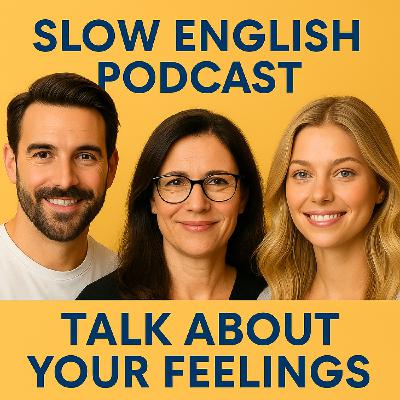
In this episode of Slow English Podcast · Your English Toolbox, Martin and Julia explore a question many English learners feel but rarely say out loud: Why does my voice feel different when I speak English?
This episode goes far beyond grammar and pronunciation.
We talk about identity, emotions, accent insecurity, and the inner voice that appears when you speak a second language. You’ll discover why your English voice may feel smaller, more controlled, or less natural — and why this has nothing to do with intelligence or ability.
In this episode, you will learn:
- Why your body and nervous system affect your English voice
- How emotional memory in your native language changes the way you speak
- Why accent insecurity is really about belonging, not pronunciation
- How monitoring yourself steals spontaneity and confidence
- How to build an authentic English voice without “acting” or forcing fluency
🎓 Exam-oriented focus:
This episode supports learners preparing for IELTS Speaking (Parts 1–3), TOEFL Speaking tasks, and Cambridge B1, B2, and C1 exams, with exam-relevant vocabulary, functional language for expressing feelings, identity, opinions, and self-reflection, as well as listening comprehension strategies for real spoken English.
We finish with practical, human strategies to help you speak English with more warmth, confidence, and presence — even with simple vocabulary.
💬 Call to action:
If this episode resonated with you, please leave a short comment.
Tell us how your English voice feels compared to your voice in your own language.
Your comments help platforms recommend our podcast and allow us to keep building this project slowly, with quality and care.
⏱️ TIME STAMPS
00:00 – Welcome & Introduction
01:05 – Why Your English Voice Feels Different
02:30 – Identity vs Grammar
04:00 – The Body, the Nervous System, and Your Voice
05:40 – Emotional Memory and Language
07:30 – The Inner Listener and Self-Monitoring
09:10 – Accent Insecurity and Belonging
11:10 – Authenticity and Feeling “Fake” in English
13:00 – Practical Strategies to Sound More Natural
15:10 – Building Confidence Over Time
16:40 – Final Reflection & Call to Action
🔎 KEYWORDS (Single Paragraph)
slow english podcast, english listening practice, learn english naturally, your english toolbox, english fluency mindset, english pronunciation confidence, english accent insecurity, emotional english vocabulary, identity and language, english speaking confidence, real spoken english, english comprehension skills, IELTS speaking practice, IELTS vocabulary, TOEFL speaking tasks, Cambridge B1 speaking, Cambridge B2 First, C1 Advanced speaking, exam english listening, academic english listening, exam strategies for speaking
#️⃣ HASHTAGS (Single Paragraph)
#SlowEnglishPodcast #YourEnglishToolbox #LearnEnglish #EnglishListeningPractice #EnglishSpeaking #EnglishConfidence #AccentInsecurity #IELTS #TOEFL #CambridgeEnglish #EnglishFluency #EnglishMindset #SpokenEnglish
💬 We’d love to hear from you!
If you enjoyed this episode, leave a comment, share your thoughts, or tell us how you’re using these tips to improve your English. Your feedback helps us grow and create even better content for you.
Hosted on Acast. See acast.com/privacy for more information.















 United States

yes,it is great true,exactly same with what my teacher told me years ago
😁 yeah, I'm not fake, but I'm still fake in English 🤭🤭
💐💐💐💐👌👌👌
❤️❤️❤️❤️❤️❤️
It was truly an interesting topic. I found it really fascinating that a native English speaker explained the problems and challenges that we face.
I really loved this part. I’ve experienced everything you mentioned. Every single sentence you said felt real. I also don’t like my voice or my accent when I start speaking English.
That's great 👍👍