


gpt-oss: OpenAI validates the open ecosystem (finally)
Description
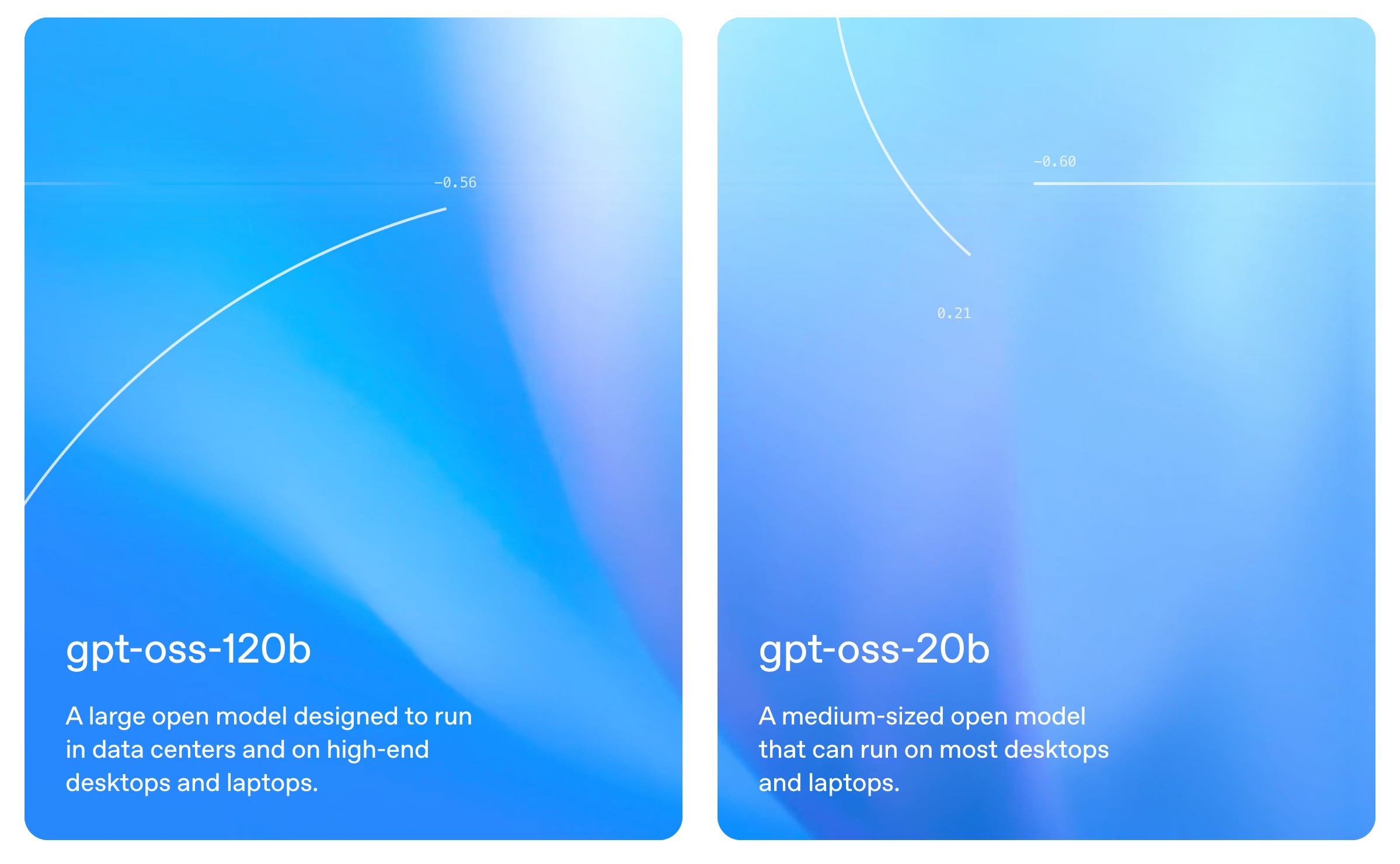
OpenAI released two open-weight, text-only reasoning models today, both mixture of experts (MoE) sized to run efficiently on a range of hardware from consumer GPUs to the cloud. These models have the Apache 2.0 license, so they’re available for distillation into other reasoning models, deployment into commercial products, and are free of downstream restrictions. These two models, the smaller gpt-oss-20B with 3.6B active parameters and 21B total and the larger gpt-oss-120B with 5.1B active parameters, follow the trends we’ve seen with the other leading open models in architecture choices.
Where this release shines is in the dramatic change in open model performance and strategy that comes with the leading name in AI releasing an open model that undercuts some of their own API products.
We’ll get to the technical details on the model later, but the main point of this post is how much OpenAI has changed by releasing their first open language model since GPT-2. The larger 120B model “achieves near-parity with OpenAI o4 mini on core reasoning benchmarks” and is a major moment for the ecosystem:
* OpenAI has released an open model at the frontier of current open model performance — highlighting how major concerns over open models that OpenAI leadership mentioned in 2023 were overblown. The marginal risks of open models have been shown to not be as extreme as many people thought (at least for text only — multimodal is far riskier). Once other organizations, particularly Meta and China showed OpenAI that there was no risk here, the path was opened to release a model.
* OpenAI has revealed far more of their technical stack than any release to date. This blog post has light details on many things in the model, but community tinkering will begin to better understand what is going on here. This includes basic things like our first time seeing a raw chain of thought (CoT) for an OpenAI reasoning model, but also more interesting things like how this model is trained to use tools in the CoT like their o3 model. Other details include researchers being able to play with OpenAI’s instruction hierarchy in raw weights (where pieces of it are untouchable in the API), a new “harmony” prompt format, the same “reasoning efforts” of low, medium & high from the API, a huge proof of concept on how far basic, community standard architectures with MoEs can be pushed, and other small details for the AI community to unpack.
* OpenAI has initiated a scorched earth policy on the API market, undercutting their own offerings and unleashing an extremely strong, trusted model brand with a permissive license. While adoption of any open model is much slower than an API due to testing, additional configuration, etc., this is set up to go about as fast as it can. Any API model that competes with current models like OpenAI o4 mini, Claude Haiku, Gemini Flash, DeepSeek R1 etc. are all going to have to compete with this model. OpenAI’s o4 mini model is currently served at $1.1 per million input tokens and $4.4 per million output. Serving this open model will likely cost at least 10x less. There are many potential strategic reasons for this, all of which paint OpenAI as having a clearer vision of what makes it valuable. What OpenAI hasn’t touched with this model is interesting too — “For those seeking multimodal support, built-in tools, and seamless integration with our platform, models available through our API platform remain the best option.” These are dropped for reasons above, and “headaches” discussed later in the post.
Together, these paint a much clearer vision by OpenAI on how they’ll control the AI ecosystem. The top potential reasons on my mind are:
* OpenAI could be trying to make all API models potentially obsolete on cost ahead of the GPT-5 release, which they hope to capture the top end of the market on. Or,
* OpenAI could be realizing that models are no longer their differentiation, as ChatGPT users continue to steadily climb — and they’ll soon pass 1 billion weekly actives.
There are plenty of other reasons, such as the politics alluded to at the end of the blog post, but OpenAI tends to only act when it serves them directly — they’ve always been a focused company on their goals.
There’s also a long list of head scratchers or in-between the lines points that illuminate OpenAI’s strategy a bit more. OpenAI of course didn’t release training data, code, or a technical report, as expected. OpenAI is trying to make a big splash with the name that captures more of the enterprise market, but in doing so takes some collateral damage in the research and true “open source” AI communities. These future questions include:
* The naming is bad — a mixture of cringe, confusion-inducing, and still useful for their marketing goals. For anyone following open-source AI for a long time it won’t be new that a major company is blurring the association of the term open-source with the community accepted definitions. I understand why OpenAI did this, but the naming conflict further enforces that the true open source AI community isn’t the target of this release — it’s people that want to try an “open source AI model” for their business, and OpenAI has made the target too big to miss for enterprises.
* OpenAI did not release the base models. Anyone following the space would’ve expected this, but it matters substantially for researchers. These two sparse, low numerical precision MoE models won’t be easy for researchers to use. The best model for researchers and tinkerers are dense, base models from 1 to 7 billion parameters. These are much “longer term” artifacts in the open community that will still be using almost only Qwen.
I need to take a second before the “unknowns” section and comment on the architecture. These models are reinforcing trends we’re seeing in modeling across the industry. Recent frontier open models are all very sparse MoEs inspired by the DeepSeek architecture. DeepSeek V3 had 37B active and 671B total parameters. Kimi K2 had 32B active and 1T total parameters. With 5B active and 121B total, the sparsity factor fits right in with normal. Sparsity in MoEs is totally king right now. The smaller gpt-oss is a bit less sparse than Qwen’s 3B active, 30B total smaller MoE, but expect the sparsity of these models to continue to increase.
Some things we need more testing to know the impact of include:
* The model has been quantized for release to MXFP4 (4 bit floating point). It’s not clear exactly who will be impacted here, but this could make it benefit people most with the newest hardware, cause minor issues across Torch/Cuda versions, or even make some of the behaviors weird relative to the trained version internal to OpenAI. This could also be a plus, depending on performance, as the bigger model is quantized to 4 bit precision to enable it to be run on GPUs with 80GB of memory, such as the A/H100 line from NVIDIA.
* Safety measures have been taken to change how finetunable the model is. With, or soon after, this release OpenAI is releasing a research paper on new methods to make it so you can’t “finetune the safety away” from a released instruct model. This is a very long-standing issue that people have concerns with over releasing open models. The main question here is if the models OpenAI releases are still able to be finetuned or not for productive use-cases. OpenAI claims they can be in their blog post, but this will be left up to the community to decide. Is finetuning the safety away actually a feature of an easy to use model?For example, Gemma has been tougher for people to finetune historically because it uses a different attention implementation and has a different parameter space from being distilled. Open finetuning stacks are still tuned for Llama and Qwen — this takes a long time to change.Many people will take the “we made it impossible to un-censor this model” as a challenge, which will be interesting to follow in the jailbreaking research community. There is a substantial market for modifiable models.
* The model was trained to expect tools, but open model tool use is a mess. One of the biggest problems I worry about in designing an OLMo model with native o3-style tool use is that I need to make it seamless for users to use the same tools from training time at inference time. An early tester in my network mentioned that the model would hallucinate tool calls from training (sort of like what was mentioned around o3’s full release). I don’t expect this to be an unsolvable issue, but it could slow adoption. It could also allow people to reverse engineer the tools that OpenAI uses during training, we’ll see!
* We need to re-benchmark the model on open infrastructure. OpenAI did a good job for this release integrating it everywhere, but we need to confirm that the community can easily replicate their evaluation scores.







 United States
