


 Claim Ownership
Business Talk
Subscribed: 30Played: 86
Subscribe

© All rights reserved
Description
Welcome to Business Talk, your go-to podcast for the latest trends, insights, and thought-provoking discussions in the business world. Whether you're a business professional, entrepreneur, researcher, or academic, our episodes will challenge you to rethink conventional wisdom and inspire actionable ideas.
Brought to you by Global Management Consultancy, we are committed to driving innovation and excellence in the business community. All content Copyrighted 2024 by Global Management Consultancy.
For more information about our past and upcoming podcasts, please click here:https://www.deepakbbhatt.com/businesstalk
Brought to you by Global Management Consultancy, we are committed to driving innovation and excellence in the business community. All content Copyrighted 2024 by Global Management Consultancy.
For more information about our past and upcoming podcasts, please click here:https://www.deepakbbhatt.com/businesstalk
276 Episodes
Reverse
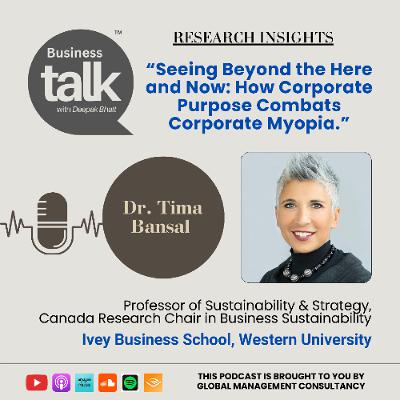
Dr. Tima Bansal, Professor of Sustainability and Strategy and Tier 1 Canada Research Chair in Business Sustainability at the Ivey Business School, Western University, joins us on the Business Talk podcast to discuss her groundbreaking research, “Seeing Beyond the Here and Now: How Corporate Purpose Combats Corporate Myopia.”
Corporate purpose emerges as a powerful antidote to organizational myopia in an increasingly uncertain, interconnected world. When uncertainty rises, firms tend to narrow their attention, prioritize immediate gains, and discount future rewards, leading to short-term decisions that undermine long-term value. Dr. Tima Bansal’s research shows that a clear, authentic purpose acts as a cognitive tool that guides strategic trade-offs, helps leaders balance three-month sprints with a long-term destination, and keeps the whole organization aligned on what truly matters. Purpose-driven companies not only navigate crises more effectively but also outperform their peers financially, with studies indicating up to 400 percent better performance over a decade.
By shifting from inside-out thinking, focused on what the organization wants, to outside-in thinking, oriented toward the needs of customers, communities, and the planet, corporate purpose connects individual, organizational, and societal goals, enabling innovation, resilience, and sustainable success.
This podcast is brought to you by Global Management Consultancy. For more information, please visit www.globalmanagementconsultancy.com.
Disclaimer:
A. The background music used in this video is the property of its respective developer and is protected by Copyright. Although it is a free version, Business Talk, Global Management Consultancy and Deepak Bhatt do not hold the rights to this music.
B. Dr. Tima Bansal shared thought-provoking insights from her research, “Seeing Beyond the Here and Now: How Corporate Purpose Combats Corporate Myopia,” in her engaging conversation on the Business Talk podcast. The uploaded video contains copyrighted material; therefore, any modifications to graphics, music, or the presence of the author or host are strictly prohibited.
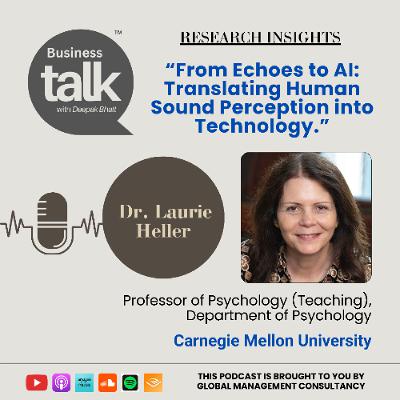
Dr. Laurie Heller, Professor of Psychology in the Department of Psychology at the Dietrich College of Humanities and Social Sciences, Carnegie Mellon University, explores her groundbreaking research, “From Echoes to AI: Translating Human Sound Perception into Technology,” and discusses how insights from human listening are reshaping intelligent audio systems.
The episode explores how humans perceive, interpret, and harness sound, from echolocation to intelligent audio systems. Dr. Laurie Heller explains how people can be trained to use echoes for navigation, highlighting the acoustic cues and brain networks involved in localizing sound in space. She discusses how vision and hearing interact, how sounds link to gestures and actions, and why understanding these connections matters for interface and assistive technology design. The conversation moves into applications, including hearing aids that better represent environmental sounds, machine learning models for sound classification, and echolocation-based tools for visually impaired users.
Dr. Heller also reflects on immersive audio in VR/AR, the cognitive and emotional impacts of noise pollution, and emerging insights into misophonia, where everyday sounds trigger intense reactions. Throughout, she emphasizes aligning technology with human perception to create safer, more intuitive and humane sound environments.
This podcast is brought to you by Global Management Consultancy. For more information, please visit www.globalmanagementconsultancy.com.
Disclaimer:
A. The background music used in this video is the property of its respective developer and is protected by Copyright. Although it is a free version, Business Talk, Global Management Consultancy and Deepak Bhatt do not hold the rights to this music.
B. Dr. Laurie Heller shared deep insights from her research, “From Echoes to AI: Translating Human Sound Perception into Technology,” during an engaging conversation on the Business Talk podcast channel. The uploaded video contains copyrighted material; therefore, any modifications to graphics, music, or the presence of the author or host are strictly prohibited.
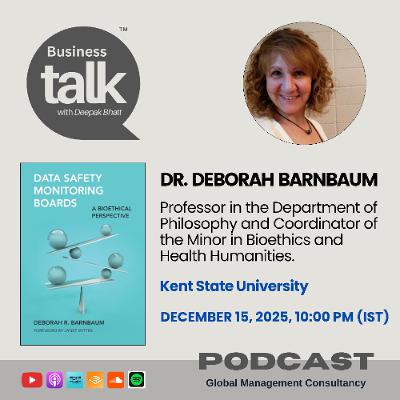
Dr. Deborah Barnbaum, Professor in the Department of Philosophy and Coordinator of the Minor in Bioethics and Health Humanities at Kent State University, shares key insights from her acclaimed book, “Data Safety Monitoring Boards: A Bioethical Perspective,” illuminating a critical yet often overlooked dimension of bioethics - the ethical challenges involved in monitoring data and safeguarding participants during clinical trials.
The episode highlights how Dr. Deborah Barnbaum, a philosopher and bioethicist at Kent State University, uses real clinical trial cases to explain the ethical role of Data Safety Monitoring Boards (DSMBs) in protecting participants while generating reliable knowledge. She describes DSMBs as underexamined yet crucial bodies, distinct from Institutional Review Boards, with bioethicists contributing specialized expertise in policy, confidentiality, and consent rather than clinical or statistical judgment. Through examples like the STRIVE IPF trial and eye-injury stem cell studies, she shows how DSMBs must balance numerical outcomes with patient narratives to judge not only survival but quality of life.
Key themes include equipoise as a precondition for ethical trials, decisions to stop studies for harm or futility, the importance of DSMB independence, and the predominance of consequentialist reasoning in their deliberations. She also flags artificial intelligence as an emerging challenge, warning against replacing human ethical judgment with algorithms.
This podcast is brought to you by Global Management Consultancy. For more information, please visit www.globalmanagementconsultancy.com.
Disclaimer:
A. The background music used in this video is the property of its respective developer and is protected by Copyright. Although it is a free version, Business Talk, Global Management Consultancy and Deepak Bhatt do not hold the rights to this music.
B. Dr. Deborah Barnbaum offered profound insights from her acclaimed book, “Data Safety Monitoring Boards: A Bioethical Perspective,” during her engaging discussion on the Business Talk podcast channel. The uploaded video contains copyrighted material; therefore, any modifications to graphics, music, or the presence of the author or host are strictly prohibited.
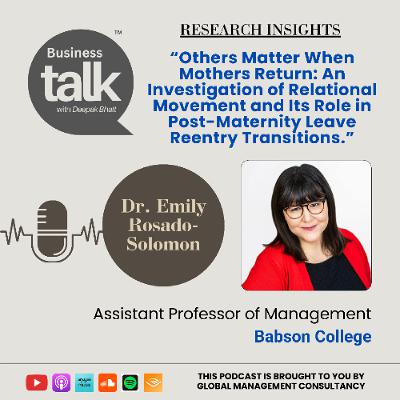
Dr. Emily Rosado-Solomon, Assistant Professor of Management at Babson College, discusses her groundbreaking research titled “Others Matter When Mothers Return: An Investigation of Relational Movement and Its Role in Post-Maternity Leave Reentry Transitions.”
This episode with Dr. Emily Rosado-Solomon delves into how mothers’ workplace relationships shift when they return from maternity leave, a process she terms relational movement. Some relationships deepen through greater authenticity and “infusing family into work,” while others become more distant as mothers set firmer boundaries and prioritize efficiency. Dr. Rosado-Solomon discusses identity asymmetry, where colleagues may wrongly assume returning mothers are less committed, and how even well-intentioned comments can undermine their professional identity. She explains how positive workplace connections foster self-compassion by normalizing imperfection and easing pressure to “do it all.”
The episode also offers practical “micro-moves” for managers and colleagues such as asking how to help, using sensitive language, and offering options rather than assumptions along with advice for mothers to seek supportive networks inside and outside their organizations, challenging deficit narratives about motherhood and careers.
This podcast is brought to you by Global Management Consultancy. For more information, please visit www.globalmanagementconsultancy.com.
Disclaimer:
A. The background music used in this video is the property of its respective developer and is protected by Copyright. Although it is a free version, Business Talk, Global Management Consultancy and Deepak Bhatt do not hold the rights to this music.
B. Dr. Emily Rosado-Solomon shared insightful perspectives drawn from her research, “Others Matter When Mothers Return: An Investigation of Relational Movement and Its Role in Post-Maternity Leave Reentry Transitions”, during her engaging conversation on the Business Talk podcast channel. The uploaded video contains copyrighted material; therefore, any modifications to graphics, music, or the presence of the author or host are strictly prohibited.
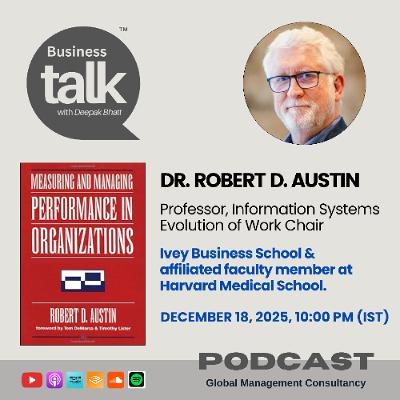
Dr. Robert Austin, Professor of Information Systems at Ivey Business School and affiliated faculty member at Harvard Medical School, explores critical insights from his seminal work, Measuring and Managing Performance in Organizations, a foundational text that examines how performance measurement influences organizational behavior and reveals the often-overlooked risks of measurement dysfunction.
In this episode, Dr. Robert Austin, Professor of Information Systems at Ivey Business School and affiliated faculty member at Harvard Medical School, unpacks how well-intended performance metrics can quietly distort behavior and damage organizations. Drawing on classic work by Ridgway, Blau, and Kerr, he illustrates measurement dysfunction through vivid cases, from police departments gaming clearance rates to GE’s earnings manipulation and costly failure in large defense projects.
Dr. Austin explains the tension between using metrics for information versus motivation, framed through Goodhart’s Law, and shows how individual attribution and high-stakes incentives corrupt data quality. He traces the evolution of software development metrics and argues that creative and R&D-style work cannot be managed like factory output. The conversation closes with design principles for healthier measurement systems, the superiority of trust-based over metrics-obsessed management, and why, even in the digital age, more data can simply mean more sophisticated folly unless culture and cooperation are put at the center.
This podcast is brought to you by Global Management Consultancy. For more information, please visit www.globalmanagementconsultancy.com.
Disclaimer:
A. The background music used in this video is the property of its respective developer and is protected by Copyright. Although it is a free version, Business Talk, Global Management Consultancy and Deepak Bhatt do not hold the rights to this music.
B. Dr. Robert Austin shared insightful perspectives from his acclaimed book, “Measuring and Managing Performance in Organizations,” during his conversation on the Business Talk podcast. The uploaded video contains copyrighted material; therefore, any modifications to graphics, music, or the presence of the author or host are strictly prohibited.
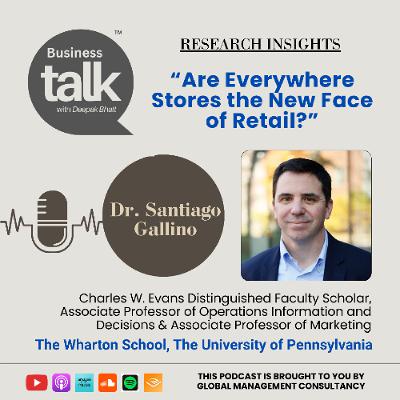
Dr. Santiago Gallino, the Charles W. Evans Distinguished Faculty Scholar and Associate Professor of Operations, Information, and Decisions at the Wharton School of the University of Pennsylvania, joins us to discuss his seminal research, “Are Everywhere Stores the New Face of Retail?”, examining how omnichannel retailers can strengthen customer engagement and optimize logistics by leveraging innovative sales and fulfillment locations.
Everywhere Stores turn everyday spaces homes, backyards, hotels, and other lived environments into authentic retail touchpoints where customers discover, test, and experience products in real use contexts, free from traditional sales pressure. Dr. Santiago Gallino argues that these models complement, rather than replace, existing channels and sit alongside four key omnichannel formats: traditional stores, e-commerce, BOPIS, and showrooms.
By decentralizing discovery and even inventory, retailers can deepen engagement, build trust, and gather rich behavioral insights about how products fit into customers’ lives. Ambassador-style setups, such as Otter’s backyard showrooms, and distributed inventory networks using micro-warehouses in homes illustrate both the promise and operational challenges of this disaggregated retail. Success depends on careful product selection, safeguards for authenticity and consent, strong partner execution, and maintaining brand consistency while leveraging the unique capillarity and data advantages of Everywhere Stores.
This podcast is brought to you by Global Management Consultancy. For more information, please visit www.globalmanagementconsultancy.com.
Disclaimer:
A. The background music used in this video is the property of its respective developer and is protected by Copyright. Although it is a free version, Business Talk, Global Management Consultancy and Deepak Bhatt do not hold the rights to this music.
B. Dr. Santiago Gallino shared thoughtful perspectives from his research, “Are Everywhere Stores the New Face of Retail?”, in his conversation on the Business Talk podcast channel. The uploaded video contains copyrighted material; therefore, any modifications to graphics, music, or the presence of the author or host are strictly prohibited.
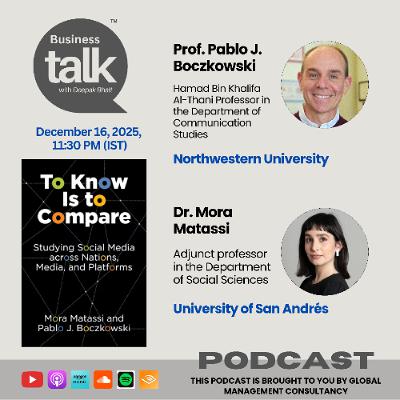
Prof. Pablo Boczkowski and Dr. Mora Matassi discuss their book “To Know Is to Compare: Studying Social Media across Nations, Media, and Platforms” and illustrate how systematic comparative research can advance the understanding and impact of social media scholarship.
This podcast episode delves into how comparative thinking can transform the study of social media by moving beyond single-country, single-medium, or single-platform analyses. It highlights the book To Know Is to Compare: Studying Social Media across Nations, Media, and Platforms, which proposes a three-dimensional framework: cross-national, cross-media, and cross-platform comparison. Through cases such as the Chilean feminist performance “Un Violador en tu Camino,” regional mobilizations after Marielle Franco’s assassination, and the global spread of Black Lives Matter, the discussion shows how similar causes follow different trajectories depending on histories, institutions, and cultures.
The episode also stresses the importance of historical perspective, “dead platforms” like Photolog, and de-westernizing research, while expanding “language” to include emojis, hashtags, and multilingual practices, exemplified by artists like Bad Bunny. Listeners are encouraged to embrace complexity, resist universal claims, and treat comparison as a core research commitment.
This podcast is brought to you by Global Management Consultancy. For more information, please visit www.globalmanagementconsultancy.com.
Disclaimer:
A. The background music used in this video is the property of its respective developer and is protected by Copyright. Although it is a free version, Business Talk, Global Management Consultancy and Deepak Bhatt do not hold the rights to this music.
B. Prof. Pablo Boczkowski and Dr. Mora Matassi shared thought-provoking insights from their acclaimed book “To Know Is to Compare: Studying Social Media across Nations, Media, and Platforms” during their engaging conversation on the Business Talk podcast. The uploaded video contains copyrighted material; therefore, any modifications to graphics, music, or the presence of the author or host are strictly prohibited.
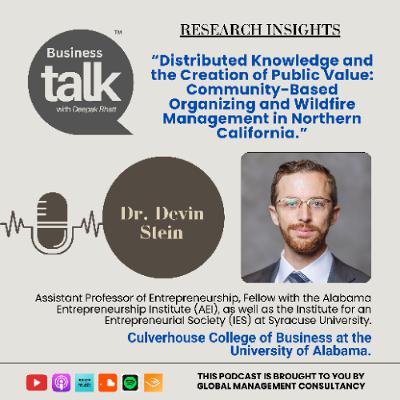
Dr. Devin Stein, Assistant Professor of Entrepreneurship in the Department of Management at the Culverhouse College of Business, The University of Alabama, presented his research titled “Distributed Knowledge and the Creation of Public Value: Community-Based Organizing and Wildfire Management in Northern California.”
This episode examines how community self-organization and local knowledge reduce wildfire damage, drawing on Dr. Devin Stein’s research in Northern California. He introduces “idle local knowledge” - critical, but scattered, insights residents hold about risks, terrain, access routes, and water sources that often remain unused unless actively collected. By studying 20 years of data, he finds that self-organizing communities experience about 5% fewer annual property losses from wildfires, rising to 7–10% when they collaborate deeply with state and federal agencies. The conversation critiques one-size-fits-all “best practices,” showing that prevention must be tailored to contexts such as dense forests, high desert, or wildland–urban interfaces.
It highlights both formal organizations and informal neighbor networks, stressing flexible, trust-based collaboration rather than rigid contracts. The episode concludes that this model of activating local knowledge applies far beyond wildfire management, including floods, hurricanes, public health crises, and homelessness.
This podcast is brought to you by Global Management Consultancy. For more information, please visit www.globalmanagementconsultancy.com.
Disclaimer:
A. The background music used in this video is the property of its respective developer and is protected by Copyright. Although it is a free version, Business Talk, Global Management Consultancy and Deepak Bhatt do not hold the rights to this music.
B. Dr. Devin Stein offered thoughtful perspectives from his research, “Distributed Knowledge and the Creation of Public Value: Community-Based Organizing and Wildfire Management in Northern California”, in his conversation on the Business Talk podcast channel. The uploaded video contains copyrighted material; therefore, any modifications to graphics, music, or the presence of the author or host are strictly prohibited.
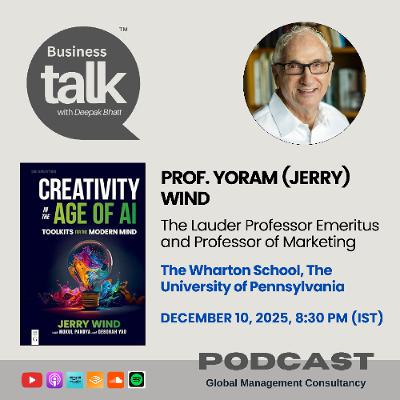
Prof. Yoram (Jerry) Wind, Lauder Professor Emeritus and Professor of Marketing at The Wharton School, University of Pennsylvania, shares profound insights from his acclaimed book, “Creativity in the Age of AI: Toolkits for the Modern Mind”.
This episode with Prof. Yoram (Jerry) Wind delves into how creativity can be cultivated systematically rather than seen as a rare innate gift. He explains that creativity works like a muscle and can be strengthened through deliberate practice, diverse techniques, and by challenging entrenched mental models. The discussion dispels the left-brain/right-brain myth, emphasizing interconnected neural networks and the importance of switching modes stepping away from analytical work to unlock fresh ideas.
Prof. Wind presents AI as a 24/7 “smart research assistant” that helps question assumptions, explore “what if” scenarios, and expand the range of options without replacing human judgment. He introduces the idea of a personal “creativity portfolio” and stresses experimentation, interdisciplinary collaboration, and overcoming organizational resistance as keys to innovation. A simple exercise using AI to design a detailed travel plan illustrates how quickly skeptical users can recognize AI as an essential creativity partner.
This podcast is brought to you by Global Management Consultancy. For more information, please visit www.globalmanagementconsultancy.com.
Disclaimer:
A. The background music used in this video is the property of its respective developer and is protected by Copyright. Although it is a free version, Business Talk, Global Management Consultancy and Deepak Bhatt do not hold the rights to this music.
B. Prof. Yoram (Jerry) Wind offered thoughtful perspectives from his acclaimed book, “Creativity in the Age of AI: Toolkits for the Modern Mind,” in his conversation on the Business Talk podcast channel. The uploaded video contains copyrighted material; therefore, any modifications to graphics, music, or the presence of the author or host are strictly prohibited.
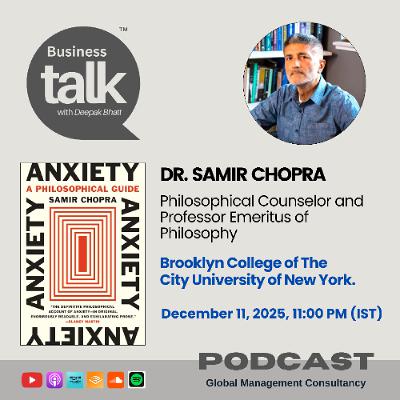
Dr. Samir Chopra, Professor Emeritus of Philosophy at Brooklyn College, The City University of New York, shares key insights from his acclaimed book, “Anxiety: A Philosophical Guide”, exploring how philosophy can help us be less anxious about anxiety by understanding it as an essential part of the human experience.
Dr. Samir Chopra presents anxiety as an inescapable feature of the human condition that, rather than being merely suppressed or over-medicalized, can become a powerful source of insight into our values, histories, and commitments. Drawing on existentialist, Buddhist, and Marxist perspectives, he shows how finite time, uncertainty about the future, constant change, interdependence, and material inequalities all shape the forms our anxiety takes, while philosophy helps us confront these realities with greater honesty and agency. Through his own journey with grief, psychotherapy, and philosophical study, he argues for a shift from the pursuit of happiness to the search for meaning, suggesting that reflecting on our anxiety can deepen self-knowledge, guide life choices, and even reveal anxiety as a signature of love for those we care about. Using metaphors like the hut with a hole in the roof, he urges us to reframe anxiety not as a defect to be eliminated, but as an opening that can connect us to new perspectives, more authentic relationships, and a more meaningful engagement with life.
This podcast is brought to you by Global Management Consultancy. For more information, please visit www.globalmanagementconsultancy.com.
Disclaimer:
A. The background music used in this video is the property of its respective developer and is protected by Copyright. Although it is a free version, Business Talk, Global Management Consultancy and Deepak Bhatt do not hold the rights to this music.
B. Dr. Samir Chopra shared thoughtful insights from his acclaimed book, “Anxiety: A Philosophical Guide”, during his conversation on the Business Talk podcast. The uploaded video contains copyrighted material; therefore, any modifications to graphics, music, or the presence of the author or host are strictly prohibited.
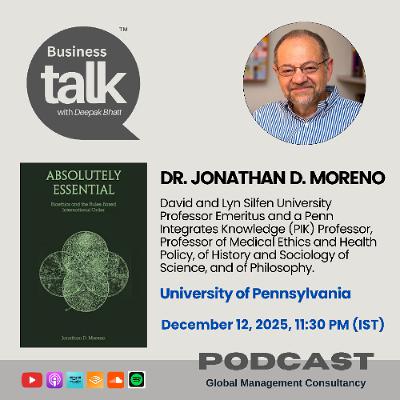
Dr. Jonathan Moreno, the David and Lyn (Silfen) University Emeritus Professor and Penn Integrates Knowledge (PIK) Professor at the University of Pennsylvania, shares key insights from his acclaimed book, “Absolutely Essential: Bioethics and the Rules-Based International Order.”
The document explains how Dr. Jonathan D. Moreno links the birth of modern bioethics to the Nuremberg trials, where informed consent and respect for human dignity became core principles of both medical research and the post WWII liberal democratic order. It shows how these bioethical norms rest on universal human rights and philosophical ideas of equality, and how they are now strained by a fracturing rules based system, rising nationalism, and emerging technologies such as AI. The interview highlights shifts in global science from the decline of Russian research capacity to China’s rise as a peer competitor and stresses that genuine scientific progress remains inherently multinational despite growing geopolitical tensions. COVID 19 is presented as a stress test that exposed weaknesses in global bioethics through vaccine nationalism, corporate dominance, and inequitable access, reinforcing the need to rethink ethics beyond individual autonomy toward a “pandemic era bioethics” balancing personal rights and public health. Dr. Moreno also underscores the importance of international organizations like the WHO, the growing power of corporations relative to states, and key geopolitical events that, in his view, mark the end of the old post war order issues he develops further in his book “Absolutely Essential: Bioethics and the Rules-Based International Order.”
This podcast is brought to you by Global Management Consultancy. For more information, please visit www.globalmanagementconsultancy.com.
Disclaimer:
A. The background music used in this video is the property of its respective developer and is protected by Copyright. Although it is a free version, Business Talk, Global Management Consultancy and Deepak Bhatt do not hold the rights to this music.
B. Dr. Jonathan Moreno offered thoughtful perspectives from his acclaimed book, “Absolutely Essential: Bioethics and the Rules-Based International Order,” in his conversation on the Business Talk podcast channel. The uploaded video contains copyrighted material; therefore, any modifications to graphics, music, or the presence of the author or host are strictly prohibited.
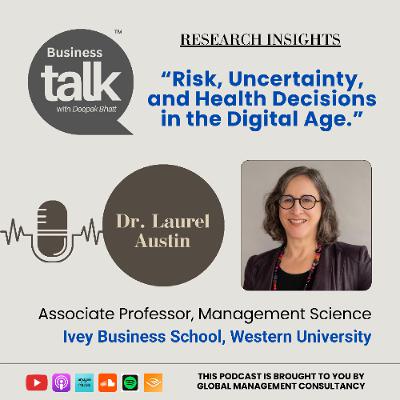
Dr. Laurel Austin, Associate Professor of Management Science at the Ivey Business School, Western University, explores her groundbreaking research, “Risk, Uncertainty, and Health Decisions in the Digital Age,” which investigates how behavioural and decision science shed light on the choices individuals make in healthcare - particularly in times of crisis such as the COVID-19 pandemic.
Dual-process thinking plays a central role in how people navigate health decisions in an increasingly digital world. Dr. Laurel Austin explains how fast, intuitive “System 1” thinking, driven by emotion and gut reactions, often guides choices under stress, uncertainty, or crises like the COVID-19 pandemic. In contrast, slower, analytical “System 2” thinking can support more accurate risk assessment, but requires effort, attention, and numeracy that many patients find difficult to sustain.
In this context, digital self-triage tools emerged as powerful yet imperfect innovations. They help reduce system overload, limit infection risk, and can sometimes match or surpass human experts when using the same information. However, they cannot perform physical exams, struggle with nuanced follow-up, depend on internet access, and often lack full integration with existing health systems. At the same time, trust in traditional providers and media has declined, while many people, especially youth turn to social media for “medical research,” where messages are easily distorted. Dr. Austin’s work underscores the need to design digital tools that complement, rather than replace, clinicians, and to improve risk communication so that people better understand screening results, probabilities, and the real trade-offs in preventive care.
This podcast is brought to you by Global Management Consultancy. For more information, please visit www.globalmanagementconsultancy.com.
Disclaimer:
A. The background music used in this video is the property of its respective developer and is protected by Copyright. Although it is a free version, Business Talk, Global Management Consultancy and Deepak Bhatt do not hold the rights to this music.
B. Dr. Laurel Austin shared thought-provoking insights from her research, “Risk, Uncertainty, and Health Decisions in the Digital Age,” during her engaging conversation on the Business Talk podcast. The uploaded video contains copyrighted material; therefore, any modifications to graphics, music, or the presence of the author or host are strictly prohibited.
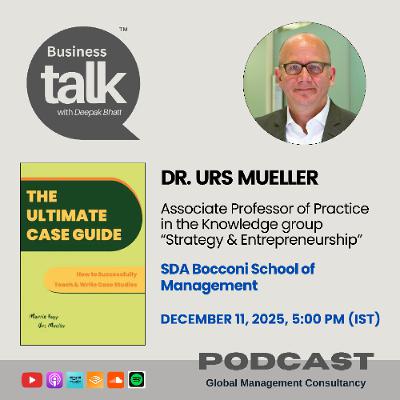
Dr. Urs Mueller, Associate Professor of Practice in the Strategy & Entrepreneurship Knowledge Group at SDA Bocconi School of Management, offers a powerful, practice-tested roadmap for educators and writers who want to design and deliver outstanding case-based learning experiences, drawing from his textbook and workbooks, “The Ultimate Case Guide: How to Successfully Teach and Write Case Studies”.
Dr. Urs Peter Mueller views case teaching as a powerful, participant-centered way to prepare future managers for real-world decision-making by shifting the educator’s role from expert on stage to facilitator at “eye level” with students. He recommends designing sessions as 10–15 minute “building blocks” that mix mini-lectures, full-class and small-group discussions, role plays, and digital tools, so learners continuously discover, reflect, and connect insights to prior knowledge. Effective case teaching, in his view, balances clear learning objectives with flexible discussion flow, respects cultural and language differences, relies on carefully crafted, evidence-based questions, and uses strategic board planning instead of “random graffiti” to structure conversation and acknowledge students who “jump ahead” in their thinking.
This podcast is brought to you by Global Management Consultancy. For more information, please visit www.globalmanagementconsultancy.com.
Disclaimer:
A. The background music used in this video is the property of its respective developer and is protected by Copyright. Although it is a free version, Business Talk, Global Management Consultancy and Deepak Bhatt do not hold the rights to this music.
B. Dr. Urs Mueller offered thoughtful perspectives from his acclaimed book, “The Ultimate Case Guide: How to Successfully Teach and Write Case Studies”, in his conversation on the Business Talk podcast channel. The uploaded video contains copyrighted material; therefore, any modifications to graphics, music, or the presence of the author or host are strictly prohibited.
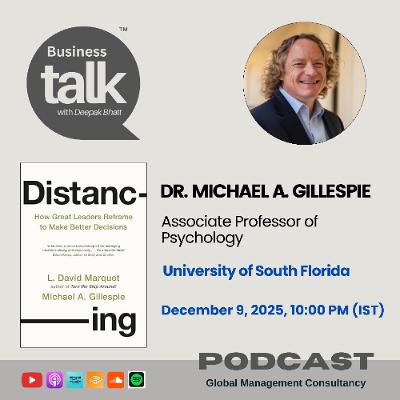
Dr. Michael Gillespie, Associate Professor of Psychology at the University of South Florida, shares key insights from his acclaimed book “Distancing: How Great Leaders Reframe to Make Better Decisions.”
Psychological distancing is a practical method that helps leaders step outside their immediate emotions, habits, and biases so they can see decisions more clearly. Drawing on his work at the University of South Florida and his book “Distancing: How Great Leaders Reframe to Make Better Decisions,” Dr. Michael Gillespie explains that leaders’ biggest obstacle to sound judgment is often their own attachment to past choices and identities.
He outlines three core forms of distancing: self-distancing (seeing your situation as a trusted outsider), spatial distancing (changing your physical or mental vantage point), and temporal distancing (evaluating choices from your future self’s perspective). Simple practices such as journaling in the third person or asking “What would my replacement do?” can improve clarity, reduce anxiety, and counter escalation of commitment. Gillespie encourages leaders and organizations to normalize “timeouts” and build processes that separate decision-making from evaluation to foster more objective, long-term thinking.
This podcast is brought to you by Global Management Consultancy. For more information, please visit www.globalmanagementconsultancy.com.
Disclaimer:
A. The background music used in this video is the property of its respective developer and is protected by Copyright. Although it is a free version, Business Talk, Global Management Consultancy and Deepak Bhatt do not hold the rights to this music.
B. Dr. Michael Gillespie offered thoughtful perspectives from his acclaimed book, “Distancing: How Great Leaders Reframe to Make Better Decisions,” in his conversation on the Business Talk podcast channel. The uploaded video contains copyrighted material; therefore, any modifications to graphics, music, or the presence of the author or host are strictly prohibited.
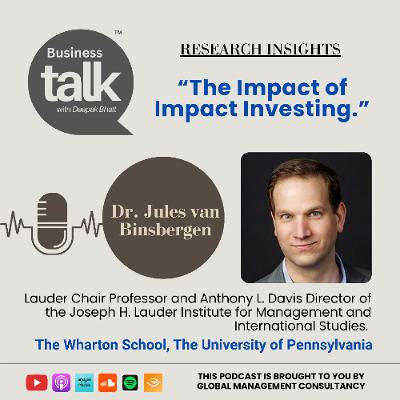
Dr. Jules van Binsbergen, Lauder Professor and Anthony L. Davis Director of the Joseph H. Lauder Institute for Management and International Studies at the University of Pennsylvania, shares key insights from his research, “The Impact of Impact Investing.”
The guest argue that ESG-focused impact investing, especially through divestment, has very limited ability to change firms’ real economic behavior or materially raise the cost of capital for “dirty” companies, because other investors quickly replace the capital that socially conscious investors withdraw. The research discussed shows that the price and cost-of-capital effects of divestment are extremely small under current market conditions and would only become meaningful if a very large majority of global wealth adopted the same exclusions, which is highly unrealistic. Instead, the conversation emphasizes that real impact is more likely to come from active shareholder engagement, clearer and more coherent ESG priorities, support for technological innovations that make harmful activities uneconomic, and in some cases regulation and democratic processes that address problems markets alone cannot solve.
This podcast is brought to you by Global Management Consultancy. For more information, please visit www.globalmanagementconsultancy.com.
Disclaimer:
A. The background music used in this video is the property of its respective developer and is protected by Copyright. Although it is a free version, Business Talk, Global Management Consultancy and Deepak Bhatt do not hold the rights to this music.
B. Dr. Jules van Binsbergen generously shared profound insights from his research, “The Impact of Impact Investing”, during his appearance on the Business Talk podcast channel. The uploaded video contains copyrighted material; therefore, any modifications to graphics, music, or the presence of the author or host are strictly prohibited.
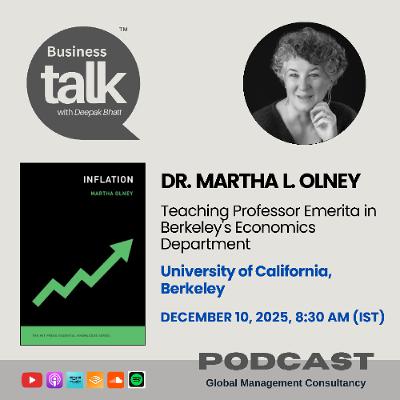
Dr. Martha Olney, Teaching Professor Emerita in the Economics Department at the University of California, Berkeley, discusses key insights from her acclaimed book “Inflation”, an engaging and accessible exploration of the forces behind rising prices and the policies that can help bring the cost of living under control.
Business Talk with Dr. Martha L. Olney explores what inflation is, why it surged in the post-COVID world, and how policymakers can respond, in a way that is accessible to non-economists. Drawing on Dr. Olney’s distinguished career as an award-winning teacher, economic historian, and author of the MIT Press book “Inflation,” the conversation unpacks how inflation is measured through CPI and PCE, clears up common misconceptions, and situates recent price rises in a 40 year historical context. The note explains how demand shifts, supply disruptions, and changing expectations interacted to drive inflation; discusses the evolving Phillips curve trade-off between unemployment and inflation; and examines the limits and challenges of interest-rate policy, the vital importance of central bank independence, the reality of “hidden” inflation such as shrinkflation, and the difficult trade-offs facing policymakers and the public.
This podcast is brought to you by Global Management Consultancy. For more information, please visit www.globalmanagementconsultancy.com.
Disclaimer:
A. The background music used in this video is the property of its respective developer and is protected by Copyright. Although it is a free version, Business Talk, Global Management Consultancy and Deepak Bhatt do not hold the rights to this music.
B. Dr. Martha Olney shared insightful perspectives drawn from her acclaimed book, “Inflation”, during her engaging conversation on the Business Talk podcast channel. The uploaded video contains copyrighted material; therefore, any modifications to graphics, music, or the presence of the author or host are strictly prohibited.

Dr. Cary Coglianese, Edward B. Shils Professor of Law and Professor of Political Science, and Director of the Penn Program on Regulation at the University of Pennsylvania Carey Law School, shares key insights from his research, “On the Need for Digital Regulators.”
Dr. Coglianese argues that the digital era demands a dual approach to governance: we need both regulators of digital technologies and regulators armed with digital tools. Rather than creating a single, centralized "AI czar" - which he views as impractical given the vast diversity of AI applications across sectors like healthcare, finance, and transportation he advocates for empowering existing agencies to upgrade their technological capabilities. This means domain-specific regulators must address new digital manifestations of traditional market failures, such as algorithmic collusion and opaque decision-making, while simultaneously leveraging AI to enhance their own efficiency in processing public comments and engaging with citizens. Ultimately, he posits that effective digital regulation requires a distributed network of agile, tech-savvy agencies that can balance innovation with rigorous, risk-based oversight.
This podcast is brought to you by Global Management Consultancy. For more information, please visit www.globalmanagementconsultancy.com.
Disclaimer:
A. The background music used in this video is the property of its respective developer and is protected by Copyright. Although it is a free version, Business Talk, Global Management Consultancy and Deepak Bhatt do not hold the rights to this music.
B. Dr. Cary Coglianese generously shared profound insights from his research, “On the Need for Digital Regulators,” during his appearance on the Business Talk podcast channel. The uploaded video contains copyrighted material; therefore, any modifications to graphics, music, or the presence of the author or host are strictly prohibited.
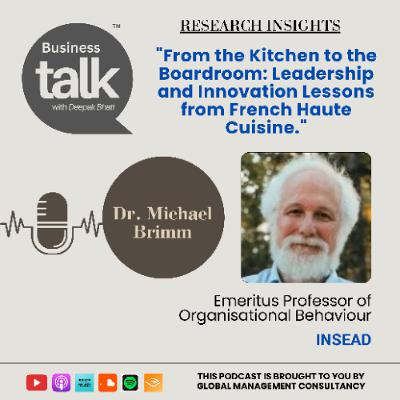
Dr. Michael Brimm, Emeritus Professor of Organisational Behaviour at INSEAD, shares key insights from his research, “From the Kitchen to the Boardroom: Leadership and Innovation Lessons from French Haute Cuisine.”
The podcast argues that three-star Michelin chefs exemplify an “artist-leader” model that offers powerful lessons for corporate leadership by prioritizing craft, quality, and purpose over short-term profit. These chefs build real-time quality feedback systems, insist on uncompromising standards, and deliberately disrupt their own success by removing popular dishes to force continuous innovation. Their close partnerships with suppliers and their deep commitment to mentoring apprentices create rich ecosystems of innovation and talent development that many organizations struggle to replicate. At the same time, they rely on trusted counterpoints such as spouses or dining-room managers to balance creative vision with business realities and customer expectations.
Extending beyond the kitchen, the text links this model to cases like Merck’s river blindness initiative to show how leaders who combine personal mastery, disciplined systems, and purpose beyond profit can transform organizational culture and unlock higher levels of commitment and performance.
This podcast is brought to you by Global Management Consultancy. For more information, please visit www.globalmanagementconsultancy.com.
Disclaimer:
A. The background music used in this video is the property of its respective developer and is protected by Copyright. Although it is a free version, Business Talk, Global Management Consultancy and Deepak Bhatt do not hold the rights to this music.
B. Dr. Michael Brimm generously shared profound insights from his research, “From the Kitchen to the Boardroom: Leadership and Innovation Lessons from French Haute Cuisine,” during his appearance on the Business Talk podcast channel. The uploaded video contains copyrighted material; therefore, any modifications to graphics, music, or the presence of the author or host are strictly prohibited.
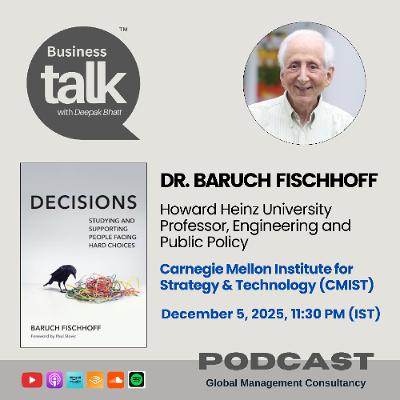
Dr. Baruch Fischhoff, Howard Heinz University Professor in the Department of Engineering and Public Policy and the Institute for Strategy & Technology at Carnegie Mellon University, joins us to share key insights from his influential book, “Decisions: Studying and Supporting People Facing Hard Choices.”
In this conversation, Dr. Baruch Fischhoff unpacks why hard decisions feel so overwhelming, highlighting the roles of uncertainty, complexity, and the limits of our own expertise. Drawing on decades of research, he explains how biases like hindsight and outcome bias distort how we remember and evaluate our choices, why understanding people’s mental models is essential for good risk communication, and what his work reveals about adolescent decision-making competence. He also shares practical guidance for supporting better decisions in high-stakes settings from public agencies to everyday life while emphasizing ethical, person-centered approaches to decision support.
This podcast is brought to you by Global Management Consultancy. For more information, please visit www.globalmanagementconsultancy.com.
Disclaimer:
A. The background music used in this video is the property of its respective developer and is protected by Copyright. Although it is a free version, Business Talk, Global Management Consultancy and Deepak Bhatt do not hold the rights to this music.
B. Dr. Baruch Fischhoff shared insightful perspectives from his acclaimed book, “Decisions: Studying and Supporting People Facing Hard Choices,” during his conversation on the Business Talk podcast channel. The uploaded video contains copyrighted material; therefore, any modifications to graphics, music, or the presence of the author or host are strictly prohibited.

Dr. Charlie Kurth, Professor of Philosophy at Clemson University, shares insights from his widely acclaimed book, “The Anxious Mind: An Investigation into the Varieties and Virtues of Anxiety”, published by The MIT Press.
Anxiety emerges in this document as a nuanced, even constructive, emotion rather than a defect to be eradicated. It is described as a biocognitive state that combines hardwired biological responses with learned, culturally shaped interpretations, enabling people to respond to both immediate dangers and complex modern uncertainties. Through examples ranging from everyday social situations to moral dilemmas and high-stakes leadership decisions, the text shows how anxiety can prompt reflection, sharpen risk assessment, and guide more responsible action when it is recognized, understood, and skillfully managed.
This podcast is brought to you by Global Management Consultancy. For more information, please visit www.globalmanagementconsultancy.com.
Disclaimer:
A. The background music used in this video is the property of its respective developer and is protected by Copyright. Although it is a free version, Business Talk, Global Management Consultancy and Deepak Bhatt do not hold the rights to this music.
B. Dr. Charlie Kurth shared insightful perspectives from his acclaimed book, “The Anxious Mind: An Investigation into the Varieties and Virtues of Anxiety,” during his conversation on the Business Talk podcast channel. The uploaded video contains copyrighted material; therefore, any modifications to graphics, music, or the presence of the author or host are strictly prohibited.

Comments

Download from Google Play

Download from App Store
 United States