



 Claim Ownership
ThursdAI - The top AI news from the past week
Subscribed: 40Played: 1,512
Subscribe

© Alex Volkov
Description
Every ThursdAI, Alex Volkov hosts a panel of experts, ai engineers, data scientists and prompt spellcasters on twitter spaces, as we discuss everything major and important that happened in the world of AI for the past week.
Topics include LLMs, Open source, New capabilities, OpenAI, competitors in AI space, new LLM models, AI art and diffusion aspects and much more.
sub.thursdai.news
Topics include LLMs, Open source, New capabilities, OpenAI, competitors in AI space, new LLM models, AI art and diffusion aspects and much more.
sub.thursdai.news
136 Episodes
Reverse
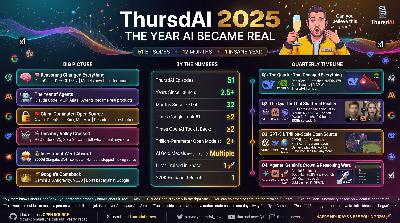
Ho Ho Ho, Alex here! (a real human writing these words, this needs to be said in 2025) Merry Christmas (to those who celebrate) and welcome to the very special yearly ThursdAI recap! This was an intense year in the world of AI, and after 51 weekly episodes (this is episode 52!) we have the ultimate record of all the major and most important AI releases of this year! So instead of bringing you a weekly update (it’s been a slow week so far, most AI labs are taking a well deserved break, the Cchinese AI labs haven’t yet surprised anyone), I’m dropping a comprehensive yearly AI review! Quarter by quarter, month by month, both in written form and as a pod/video! Why do this? Who even needs this? Isn’t most of it obsolete? I have asked myself this exact question while prepping for the show (it was quite a lot of prep, even with Opus’s help). I eventually landed on, hey, if nothing else, this will serve as a record of the insane week of AI progress we all witnessed. Can you imagine that the term Vibe Coding is less than 1 year old? That Claude Code was released at the start of THIS year? We get hedonicly adapt to new AI goodies so quick, and I figured this will serve as a point in time check, we can get back to and feel the acceleration! With that, let’s dive in - P.S. the content below is mostly authored by my co-author for this, Opus 4.5 high, which at the end of 2025 I find the best creative writer with the best long context coherence that can imitate my voice and tone (hey, I’m also on a break! 🎅) “Open source AI has never been as hot as this quarter. We’re accelerating as f*ck, and it’s only just beginning—hold on to your butts.” — Alex Volkov, ThursdAI Q1 2025🏆 The Big Picture — 2025 - The Year the AI Agents Became RealLooking back at 51 episodes and 12 months of relentless AI progress, several mega-themes emerged:1. 🧠 Reasoning Models Changed EverythingFrom DeepSeek R1 in January to GPT-5.2 in December, reasoning became the defining capability. Models now think for hours, call tools mid-thought, and score perfect on math olympiads.2. 🤖 2025 Was Actually the Year of AgentsWe said it in January, and it came true. Claude Code launched the CLI revolution, MCP became the universal protocol, and by December we had ChatGPT Apps, Atlas browser, and AgentKit.3. 🇨🇳 Chinese Labs Dominated Open SourceDeepSeek, Qwen, MiniMax, Kimi, ByteDance — despite chip restrictions, Chinese labs released the best open weights models all year. Qwen 3, Kimi K2, DeepSeek V3.2 were defining releases.4. 🎬 We Crossed the Uncanny ValleyVEO3’s native audio, Suno V5’s indistinguishable music, Sora 2’s social platform — 2025 was the year AI-generated media became indistinguishable from human-created content.5. 💰 The Investment Scale Became Absurd$500B Stargate, $1.4T compute obligations, $183B valuations, $100-300M researcher packages, LLMs training in space. The numbers stopped making sense.6. 🏆 Google Made a ComebackAfter years of “catching up,” Google delivered Gemini 3, Antigravity, Nano Banana Pro, VEO3, and took the #1 spot (briefly). Don’t bet against Google.By the NumbersQ1 2025 — The Quarter That Changed EverythingDeepSeek R1 crashed NVIDIA’s stock, reasoning models went mainstream, and Chinese labs took over open source. The quarter that proved AI isn’t slowing down—it’s just getting started.Key Themes:* 🧠 Reasoning models went mainstream (DeepSeek R1, o1, QwQ)* 🇨🇳 Chinese labs dominated open source (DeepSeek, Alibaba, MiniMax, ByteDance)* 🤖 2025 declared “The Year of Agents” (OpenAI Operator, MCP won)* 🖼️ Image generation revolution (GPT-4o native image gen, Ghibli-mania)* 💰 Massive infrastructure investment (Project Stargate $500B)January — DeepSeek Shakes the World(Jan 02 | Jan 10 | Jan 17 | Jan 24 | Jan 30)The earthquake that shattered the AI bubble. DeepSeek R1 dropped on January 23rd and became the most impactful open source release ever:* Crashed NVIDIA stock 17% — $560B loss, largest single-company monetary loss in history* Hit #1 on the iOS App Store* Cost allegedly only $5.5M to train (sparking massive debate)* Matched OpenAI’s o1 on reasoning benchmarks at 50x cheaper pricing* The 1.5B model beat GPT-4o and Claude 3.5 Sonnet on math benchmarks 🤯“My mom knows about DeepSeek—your grandma probably knows about it, too” — Alex VolkovAlso this month:* OpenAI Operator — First agentic ChatGPT (browser control, booking, ordering)* Project Stargate — $500B AI infrastructure (Manhattan Project for AI)* NVIDIA Project Digits — $3,000 desktop that runs 200B parameter models* Kokoro TTS — 82M param model hit #1 on TTS Arena, Apache 2, runs in browser* MiniMax-01 — 4M context window from Hailuo* Gemini Flash Thinking — 1M token context with thinking tracesFebruary — Reasoning Mania & The Birth of Vibe Coding(Feb 07 | Feb 13 | Feb 20 | Feb 28)The month that redefined how we work with AI.OpenAI Deep Research (Feb 6) — An agentic research tool that scored 26.6% on Humanity’s Last Exam (vs 10% for o1/R1). Dr. Derya Unutmaz called it “a phenomenal 25-page patent application that would’ve cost $10,000+.”Claude 3.7 Sonnet & Claude Code (Feb 24-27) — Anthropic’s coding beast hit 70% on SWE-Bench with 8x more output (64K tokens). Claude Code launched as Anthropic’s agentic coding tool — marking the start of the CLI agent revolution.“Claude Code is just exactly in the right stack, right around the right location... You can do anything you want with a computer through the terminal.” — Yam PelegGPT-4.5 (Orion) (Feb 27) — OpenAI’s largest model ever (rumored 10T+ parameters). 62.5% on SimpleQA, foundation for future reasoning models.Grok 3 (Feb 20) — xAI enters the arena with 1M token context and “free until GPUs melt.”Andrej Karpathy coins “Vibe Coding” (Feb 2) — The 5.2M view tweet that captured a paradigm shift: developers describe what they want, AI handles implementation.OpenAI Roadmap Revelation (Feb 13) — Sam Altman announced GPT-4.5 will be the last non-chain-of-thought model. GPT-5 will unify everything.March — Google’s Revenge & The Ghibli Explosion(Mar 06 | Mar 13 | Mar 20 | Mar 27)Gemini 2.5 Pro Takes #1 (Mar 27) — Google reclaimed the LLM crown with AIME jumping nearly 20 points, 1M context, “thinking” integrated into the core model.GPT-4o Native Image Gen — Ghibli-mania (Mar 27) — The internet lost its collective mind and turned everything into Studio Ghibli. Auto-regressive image gen with perfect text rendering, incredible prompt adherence.“The internet lost its collective mind and turned everything into Studio Ghibli” — Alex VolkovMCP Won (Mar 27) — OpenAI officially adopted Anthropic’s Model Context Protocol. No VHS vs Betamax situation. Tools work across Claude AND GPT.DeepSeek V3 685B — AIME jumped from 39.6% → 59.4%, MIT licensed, best non-reasoning open model.ThursdAI Turns 2! (Mar 13) — Two years since the first episode about GPT-4.Open Source Highlights:* Gemma 3 (1B-27B) — 128K context, multimodal, 140+ languages, single GPU* QwQ-32B — Qwen’s reasoning model matches R1, runs on Mac* Mistral Small 3.1 — 24B, beats Gemma 3, Apache 2* Qwen2.5-Omni-7B — End-to-end multimodal with speech outputQ2 2025 — The Quarter That Shattered RealityVEO3 crossed the uncanny valley, Claude 4 arrived with 80% SWE-bench, and Qwen 3 proved open source can match frontier models. The quarter we stopped being able to tell what’s real.Key Themes:* 🎬 Video AI crossed the uncanny valley (VEO3 with native audio)* 🧠 Tool-using reasoning models emerged (o3 calling tools mid-thought)* 🇨🇳 Open source matched frontier (Qwen 3, Claude 4)* 📺 Google I/O delivered everything* 💸 AI’s economic impact accelerated ($300B valuations, 80% price drops)April — Tool-Using Reasoners & Llama Chaos(Apr 03 | Apr 10 | Apr 17 | Apr 24)OpenAI o3 & o4-mini (Apr 17) — The most important reasoning upgrade ever. For the first time, o-series models can use tools during reasoning: web search, Python, image gen. Chain 600+ consecutive tool calls. Manipulate images mid-thought.“This is almost AGI territory — agents that reason while wielding tools” — Alex VolkovGPT-4.1 Family (Apr 14) — 1 million token context across all models. Near-perfect recall. GPT-4.5 deprecated.Meta Llama 4 (Apr 5) — Scout (17B active/109B total) & Maverick (17B active/400B total). LMArena drama (tested model ≠ released model). Community criticism. Behemoth teased but never released.Gemini 2.5 Flash (Apr 17) — Set “thinking budget” per API call. Ultra-cheap at $0.15/$0.60 per 1M tokens.ThursdAI 100th Episode! 🎉May — VEO3 Crosses the Uncanny Valley & Claude 4 Arrives(May 01 | May 09 | May 16 | May 23 | May 29)VEO3 — The Undisputed Star of Google I/O (May 20) — Native multimodal audio generation (speech, SFX, music synced perfectly). Perfect lip-sync. Characters understand who’s speaking. Spawned viral “Prompt Theory” phenomenon.“VEO3 isn’t just video generation — it’s a world simulator. We crossed the uncanny valley this quarter.” — Alex VolkovClaude 4 Opus & Sonnet — Live Drop During ThursdAI! (May 22) — Anthropic crashed the party mid-show. First models to cross 80% on SWE-bench. Handles 6-7 hour human tasks. Hybrid reasoning + instant response modes.Qwen 3 (May 1) — The most comprehensive open source release ever: 8 models, Apache 2.0. Runtime /think toggle for chain-of-thought. 4B dense beats Qwen 2.5-72B on multiple benchmarks. 36T training tokens, 119 languages.“The 30B MoE is ‘Sonnet 3.5 at home’ — 100+ tokens/sec on MacBooks” — NistenGoogle I/O Avalanche:* Gemini 2.5 Pro Deep Think (84% MMMU)* Jules (free async coding agent)* Project Mariner (browser control via API)* Gemini Ultra tier ($250/mo)June — The New Normal(Jun 06 | Jun 13 | Jun 20 | Jun 26)o3 Price Drop 90% (Jun 12) — From $40/$10 → $8/$2 per million tokens. o3-pro launched at 87% cheaper than o1-pro.Meta’s $15B Scale AI Power Play (Jun 12) — 49% stake in Scale AI. Alex Wang leads new “Superintelligence team” at Meta. Seven-to-nine-figure comp packages for researchers.MiniMax M1 — Reasoning MoE That Beats R1 (Jun 19) — 456B total / 45B active par

Hey folks 👋 Alex here, dressed as 🎅 for our pre X-mas episode!We’re wrapping up 2025, and the AI labs decided they absolutely could NOT let the year end quietly. This week was an absolute banger—we had Gemini 3 Flash dropping with frontier intelligence at flash prices, OpenAI firing off GPT 5.2 Codex as breaking news DURING our show, ChatGPT Images 1.5, Nvidia going all-in on open source with Nemotron 3 Nano, and the voice AI space heating up with Grok Voice and Chatterbox Turbo. Oh, and Google dropped FunctionGemma for all your toaster-to-fridge communication needs (yes, really).Today’s show was over three and a half hours long because we tried to cover both this week AND the entire year of 2025 (that yearly recap is coming next week—it’s a banger, we went month by month and you’ll really feel the acceleration). For now, let’s dive into just the insanity that was THIS week.00:00 Introduction and Overview00:39 Weekly AI News Highlights01:40 Open Source AI Developments01:44 Nvidia's Nemotron Series09:09 Google's Gemini 3 Flash19:26 OpenAI's GPT Image 1.520:33 Infographic and GPT Image 1.5 Discussion20:53 Nano Banana vs GPT Image 1.521:23 Testing and Comparisons of Image Models23:39 Voice and Audio Innovations24:22 Grok Voice and Tesla Integration26:01 Open Source Robotics and Voice Agents29:44 Meta's SAM Audio Release32:14 Breaking News: Google Function Gemma33:23 Weights & Biases Announcement35:19 Breaking News: OpenAI Codex 5.2 MaxTo receive new posts and support my work, consider becoming a free or paid subscriber.Big Companies LLM updatesGoogle’s Gemini 3 Flash: The High-Speed Intelligence KingIf we had to title 2025, as Ryan Carson mentioned on the show, it might just be “The Year of Google’s Comeback.” Remember at the start of the year when we were asking “Where is Google?” Well, they are here. Everywhere.This week they launched Gemini 3 Flash, and it is rightfully turning heads. This is a frontier-class model—meaning it boasts Pro-level intelligence—but it runs at Flash-level speeds and, most importantly, Flash-level pricing. We are talking $0.50 per 1 million input tokens. That is not a typo. The price-to-intelligence ratio here is simply off the charts.I’ve been using Gemini 2.5 Flash in production for a while because it was good enough, but Gemini 3 Flash is a different beast. It scores 71 on the Artificial Analysis Intelligence Index (a 13-point jump from the previous Flash), and it achieves 78% on SWE-bench Verified. That actually beats the bigger Gemini 3 Pro on some agentic coding tasks!What impressed me most, and something Kwindla pointed out, is the tool calling. Previous Gemini models sometimes struggled with complex tool use compared to OpenAI, but Gemini 3 Flash can handle up to 100 simultaneous function calls. It’s fast, it’s smart, and it’s integrated immediately across the entire Google stack—Workspace, Android, Chrome. Google isn’t just releasing models anymore; they are deploying them instantly to billions of users.For anyone building agents, this combination of speed, low latency, and 1 million context window (at this price!) makes it the new default workhorse.Google’s FunctionGemma Open Source releaseWe also got a smaller, quirkier release from Google: FunctionGemma. This is a tiny 270M parameter model. Yes, millions, not billions.It’s purpose-built for function calling on edge devices. It requires only 500MB of RAM, meaning it can run on your phone, in your browser, or even on a Raspberry Pi. As Nisten joked on the show, this is finally the model that lets your toaster talk to your fridge.Is it going to write a novel? No. But after fine-tuning, it jumped from 58% to 85% accuracy on mobile action tasks. This represents a future where privacy-first agents live entirely on your device, handling your calendar and apps without ever pinging a cloud server.OpenAI Image 1.5, GPT 5.2 Codex and ChatGPT AppstoreOpenAI had a busy week, starting with the release of GPT Image 1.5. It’s available now in ChatGPT and the API. The headline here is speed and control—it’s 4x faster than the previous model and 20% cheaper. It also tops the LMSYS Image Arena leaderboards.However, I have to give a balanced take here. We’ve been spoiled recently by Google’s “Nano Banana Pro” image generation (which powers Gemini). When we looked at side-by-side comparisons, especially with typography and infographic generation, Gemini often looked sharper and more coherent. This is what we call “hedonistic adaptation”—GPT Image 1.5 is great, but the bar has moved so fast that it doesn’t feel like the quantum leap DALL-E 3 was back in the day. Still, for production workflows where you need to edit specific parts of an image without ruining the rest, this is a massive upgrade.🚨 BREAKING: GPT 5.2 CodexJust as we were nearing the end of the show, OpenAI decided to drop some breaking news: GPT 5.2 Codex.This is a specialized model optimized specifically for agentic coding, terminal workflows, and cybersecurity. We quickly pulled up the benchmarks live, and they look significant. It hits 56.4% on SWE-Bench Pro and a massive 64% on Terminal-Bench 2.0.It supports up to 400k token inputs with native context compaction, meaning it’s designed for those long, complex coding sessions where you’re debugging an entire repository. The coolest (and scariest?) stat: a security researcher used this model to find three previously unknown vulnerabilities in React in just one week.OpenAI is positioning this for “professional software engineering,” and the benchmarks suggest a 30% improvement in token efficiency over the standard GPT 5.2. We are definitely going to be putting this through its paces in our own evaluations soon.ChatGPT ... the AppStore!Also today (OpenAI is really throwing everything they have to the end of the year release party), OpenAI has unveiled how their App Store is going to look and opened the submission forms to submit your own apps!Reminder, ChatGPT apps are powered by MCP and were announced during DevDay, they let companies build a full UI experience right inside ChatGPT, and given OpenAi’s almost 900M weekly active users, this is a big deal! Do you have an app you’d like in there? let me know in the comments!Open Source AI🔥 Nvidia Nemotron 3 Nano: The Most Important Open Source Release of the Week (X, HF)I think the most important release of this week in open source was Nvidia Nemotron 3 Nano, and it was pretty much everywhere. Nemotron is a series of models from Nvidia that’s been pushing efficiency updates, finetune innovations, pruning, and distillations—all the stuff Nvidia does incredibly well.Nemotron 3 Nano is a 30 billion parameter model with only 3 billion active parameters, using a hybrid Mamba-MoE architecture. This is huge. The model achieves 1.5 to 3.3x faster inference than competing models like Qwen 3 while maintaining competitive accuracy on H200 GPUs.But the specs aren’t even the most exciting part. NVIDIA didn’t just dump the weights over the wall. They released the datasets—all 25 trillion tokens of pre-training and post-training data. They released the recipes. They released the technical reports. This is what “Open AI” should actually look like.What’s next? Nemotron 3 Super at 120B parameters (4x Nano) and Nemotron 3 Ultra at 480B parameters (16x Nano) are coming in the next few months, featuring their innovative Latent Mixture of Experts architecture.Check out the release on HuggingFaceOther Open Source HighlightsLDJ brought up BOLMO from Allen AI—the first byte-level model that actually reaches parity with similar-size models using regular tokenization. This is really exciting because it could open up new possibilities for spelling accuracy, precise code editing, and potentially better omnimodality since ultimately everything is bytes—images, audio, everything.Wolfram highlighted OLMO 3.1, also from Allen AI, which is multimodal with video input in three sizes (4B, 7B, 8B). The interesting feature here is that you can give it a video, ask something like “how many times does a ball hit the crown?” and it’ll not only give you the answer but mark the precise coordinates on the video frames where it happens. Very cool for tracking objects throughout a video!Mistral OCR 3 (X)Mistral also dropped Mistral OCR 3 this week—their next-generation document intelligence model achieving a 74% win rate over OCR 2 across challenging document types. We’re talking forms, low-quality scans, handwritten text, complex tables, and multilingual documents.The pricing is aggressive at just $2 per 1,000 pages (or $1 with Batch API discount), and it outperforms enterprise solutions like AWS Textract, Azure Doc AI, and Google DocSeek. Available via API and their new Document AI Playground.🐝 This Week’s Buzz: Wolfram Joins Weights & Biases!I am so, so hyped to announce this. Our very own co-host and evaluation wizard, Wolfram RavenWlf, is officially joining the Weights & Biases / CoreWeave family as an AI Evangelist and “AIvaluator” starting in January!Wolfram has been the backbone of the “vibe checks” and deep-dive evals on this show for a long time. Now, he’ll be doing it full-time, building out benchmarks for the community and helping all of us make sense of this flood of models. Expect ThursdAI to get even more data-driven in 2026. Match made in heaven! And if you’re as excited as we are, give Weave a try, it’s free to get started!Voice & Audio: Faster, Cheaper, BetterIf 2025 was the year of the LLM comeback, the end of 2025 is the era of Voice AI commoditization. It is getting so cheap and so fast.Grok Voice Agent API (X)xAI launched their Grok Voice Agent API, and the pricing is aggressive: $0.05 per minute flat rate. That significantly undercuts OpenAI and others. But the real killer feature here is the integration.If you drive a Tesla, this is what powers the voice command when you hold down the button. It has native access to vehicle controls, but for developers, it has native tool calling for Real-time X Search. Th
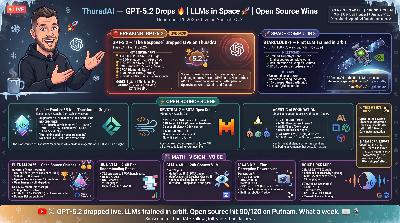
Hey everyone, December started strong and does NOT want to slow down!? OpenAI showed us their response to the Code Red and it’s GPT 5.2, which doesn’t feel like a .1 upgrade! We got it literally as breaking news at the end of the show, and oh boy! The new kind of LLMs is here. GPT, then Gemini, then Opus and now GPT again... Who else feels like we’re on a trippy AI rolercoaster? Just me? 🫨 I’m writing this newsletter from a fresh “traveling podcaster” setup in SF (huge shoutout to the Chroma team for the studio hospitality). P.S - Next week we’re doing a year recap episode (52st episode of the year, what is my life), but today is about the highest-signal stuff that happened this week.Alright. No more foreplay. Let’s dive in. Please subscribe. 🔥 The main event: OpenAI launches GPT‑5.2 (and it’s… a lot)We started the episode with “garlic in the air” rumors (OpenAI holiday launches always have that Christmas panic energy), and then… boom: GPT‑5.2 actually drops while we’re live.What makes this release feel significant isn’t “one benchmark went up.” It’s that OpenAI is clearly optimizing for the things that have become the frontier in 2025: long-horizon reasoning, agentic coding loops, long context reliability, and lower hallucination rates when browsing/tooling is involved.5.2 Instant, Thinking and Pro in ChatGPT and in the APIOpenAI shipped multiple variants, and even within those there are “levels” (medium/high/extra-high) that effectively change how much compute the model is allowed to burn. At the extreme end, you’re basically running parallel thoughts and selecting winners. That’s powerful, but also… very expensive.It’s very clearly aimed at the agentic world: coding agents that run in loops, tool-using research agents, and “do the whole task end-to-end” workflows where spending extra tokens is still cheaper than spending an engineer day.Benchmarks I’m not going to pretend benchmarks tell the full story (they never do), but the shape of improvements matters. GPT‑5.2 shows huge strength on reasoning + structured work.It hits 90.5% on ARC‑AGI‑1 in the Pro X‑High configuration, and 54%+ on ARC‑AGI‑2 depending on the setting. For context, ARC‑AGI‑2 is the one where everyone learns humility again.On math/science, this thing is flexing. We saw 100% on AIME 2025, and strong performance on FrontierMath tiers (with the usual “Tier 4 is where dreams go to die” vibe still intact). GPQA Diamond is up in the 90s too, which is basically “PhD trivia mode.”But honestly the most practically interesting one for me is GDPval (knowledge-work tasks: slides, spreadsheets, planning, analysis). GPT‑5.2 lands around 70%, which is a massive jump vs earlier generations. This is the category that translates directly into “is this model useful at my job.” - This is a bench that OpenAI launched only in September and back then, Opus 4.1 was a “measly” 47%! Talk about acceleration! Long context: MRCR is the sleeper highlightOn MRCR (multi-needle long-context retrieval), GPT‑5.2 holds up absurdly well even into 128k and beyond. The graph OpenAI shared shows GPT‑5.1 falling off a cliff as context grows, while GPT‑5.2 stays high much deeper into long contexts.If you’ve ever built a real system (RAG, agent memory, doc analysis) you know this pain: long context is easy to offer, hard to use well. If GPT‑5.2 actually delivers this in production, it’s a meaningful shift.Hallucinations: down (especially with browsing)One thing we called out on the show is that a bunch of user complaints in 2025 have basically collapsed into one phrase: “it hallucinates.” Even people who don’t know what a benchmark is can feel when a model confidently lies.OpenAI’s system card shows lower rates of major incorrect claims compared to GPT‑5.1, and lower “incorrect claims” overall when browsing is enabled. That’s exactly the direction they needed.Real-world vibes:We did the traditional “vibe tests” mid-show: generate a flashy landing page, do a weird engineering prompt, try some coding inside Cursor/Codex.Early testers broadly agree on the shape of the improvement. GPT‑5.2 is much stronger in reasoning, math, long‑context tasks, visual understanding, and multimodal workflows, with multiple reports of it successfully thinking for one to three hours on hard problems. Enterprise users like Box report faster execution and higher accuracy on real knowledge‑worker tasks, while researchers note that GPT‑5.2 Pro consistently outperforms the standard “Thinking” variant. The tradeoffs are also clear: creative writing still slightly favors Claude Opus, and the highest reasoning tiers can be slow and expensive. But as a general‑purpose reasoning model, GPT‑5.2 is now the strongest publicly available option.AI in space: Starcloud trains an LLM on an H100 in orbitThis story is peak 2025.Starcloud put an NVIDIA H100 on a satellite, trained Andrej Karpathy’s nanoGPT on Shakespeare, and ran inference on Gemma. There’s a viral screenshot vibe here that’s impossible to ignore: SSH into an H100… in space… with a US flag in the corner. It’s engineered excitement, and I’m absolutely here for it.But we actually had a real debate on the show: is “GPUs in space” just sci‑fi marketing, or does it make economic sense?Nisten made a compelling argument that power is the real bottleneck, not compute, and that big satellites already operate in the ~20kW range. If you can generate that power reliably with solar in orbit, the economics start looking less insane than you’d think. LDJ added the long-term land/power convergence argument: Earth land and grid power get scarcer/more regulated, while launch costs trend down—eventually the curves may cross.I played “voice of realism” for a minute: what happens when GPUs fail? It’s hard enough to swap a GPU in a datacenter, now imagine doing it in orbit. Cooling and heat dissipation become a different engineering problem too (radiators instead of fans). Networking is nontrivial. But also: we are clearly entering the era where people will try weird infra ideas because AI demand is pulling the whole economy.Big Company: MCP gets donated, OpenRouter drops a report on AIAgentic AI Foundation Lands at the Linux FoundationThis one made me genuinely happy.Block, Anthropic, and OpenAI came together to launch the Agentic AI Foundation under the Linux Foundation, donating key projects like MCP, AGENTS.md, and goose. This is exactly how standards should happen: vendor‑neutral, boring governance, lots of stakeholders.It’s not flashy work, but it’s the kind of thing that actually lets ecosystems grow without fragmenting. BTW, I was recording my podcast while Latent.Space were recording theirs in the same office, and they have a banger episode upcoming about this very topic! All I’ll say is Alessio Fanelli introduced me to David Soria Parra from MCP 👀 Watch out for that episode on Latent space dropping soon! OpenRouter’s “State of AI”: 100 Trillion Tokens of RealityOpenRouter and a16z dropped a massive report analyzing over 100 trillion tokens of real‑world usage. A few things stood out:Reasoning tokens now dominate. Above 50%, around 60% of all tokens since early 2025 are reasoning tokens. Remember when we went from “LLMs can’t do math” to reasoning models? That happened in about a year.Programming exploded. From 11% of usage early 2025 to over 50% recently. Claude holds 60% of the coding market. (at least.. on Open Router)Open source hit 30% market share, led by Chinese labs: DeepSeek (14T tokens), Qwen (5.59T), Meta LLaMA (3.96T).Context lengths grew massively. Average prompt length went from 1.5k to 6k+ tokens (4x growth), completions from 133 to 400 tokens (3x).The “Glass Slipper” effect. When users find a model that fits their use case, they stay loyal. Foundational early-user cohorts retain around 40% at month 5. Claude 4 Sonnet still had 50% retention after three months.Geography shift. Asia doubled to 31% of usage (China key), while North America is at 47%.Yam made a good point that we should be careful interpreting these graphs—they’re biased toward people trying new models, not necessarily steady usage. But the trends are clear: agentic, reasoning, and coding are the dominant use cases.Open Source Is Not Slowing Down (If Anything, It’s Accelerating)One of the strongest themes this week was just how fast open source is closing the gap — and in some areas, outright leading. We’re not talking about toy demos anymore. We’re talking about serious models, trained from scratch, hitting benchmarks that were frontier‑only not that long ago.Essential AI’s Rnj‑1: A Real Frontier 8B ModelThis one deserves real attention. Essential AI — led by Ashish Vaswani, yes Ashish from the original Transformers paper — released Rnj‑1, a pair of 8B open‑weight models trained fully from scratch. No distillation. No “just a fine‑tune.” This is a proper pretrain.What stood out to me isn’t just the benchmarks (though those are wild), but the philosophy. Rnj‑1 is intentionally focused on pretraining quality: data curation, code execution simulation, STEM reasoning, and agentic behaviors emerging during pretraining instead of being bolted on later with massive RL pipelines.In practice, that shows up in places like SWE‑bench Verified, where Rnj‑1 lands in the same ballpark as much larger closed models, and in math and STEM tasks where it punches way above its size. And remember: this is an 8B model you can actually run locally, quantize aggressively, and deploy without legal gymnastics thanks to its Apache 2.0 license.Mistral Devstral 2 + Vibe: Open Coding Goes HardMistral followed up last week’s momentum with Devstral 2, and Mistral Vibe! The headline numbers are: the 123B Devstral 2 model lands right at the top of open‑weight coding benchmarks, nearly matching Claude 3.5 Sonnet on SWE‑bench Verified. But what really excited the panel was the 24B Devstral Small 2, which hits high‑60s SWE‑bench scores while being runnable on consumer hardware.This is the kind of model you can realistically run

Hey yall, Alex here 🫡 Welcome to the first ThursdAI of December! Snow is falling in Colorado, and AI releases are falling even harder. This week was genuinely one of those “drink from the firehose” weeks where every time I refreshed my timeline, another massive release had dropped.We kicked off the show asking our co-hosts for their top AI pick of the week, and the answers were all over the map: Wolfram was excited about Mistral’s return to Apache 2.0, Yam couldn’t stop talking about Claude Opus 4.5 after a full week of using it, and Nisten came out of left field with an AWQ quantization of Prime Intellect’s model that apparently runs incredibly fast on a single GPU. As for me? I’m torn between Opus 4.5 (which literally fixed bugs that Gemini 3 created in my code) and DeepSeek’s gold-medal winning reasoning model.Speaking of which, let’s dive into what happened this week, starting with the open source stuff that’s been absolutely cooking. Open Source LLMsDeepSeek V3.2: The Whale Returns with Gold MedalsThe whale is back, folks! DeepSeek released two major updates this week: V3.2 and V3.2-Speciale. And these aren’t incremental improvements—we’re talking about an open reasoning-first model that’s rivaling GPT-5 and Gemini 3 Pro with actual gold medal Olympiad wins.Here’s what makes this release absolutely wild: DeepSeek V3.2-Speciale is achieving 96% on AIME versus 94% for GPT-5 High. It’s getting gold medals on IMO (35/42), CMO, ICPC (10/12), and IOI (492/600). This is a 685 billion parameter MOE model with MIT license, and it literally broke the benchmark graph on HMMT 2025—the score was so high it went outside the chart boundaries. That’s how you DeepSeek, basically.But it’s not just about reasoning. The regular V3.2 (not Speciale) is absolutely crushing it on agentic benchmarks: 73.1% on SWE-Bench Verified, first open model over 35% on Tool Decathlon, and 80.3% on τ²-bench. It’s now the second most intelligent open weights model and ranks ahead of Grok 4 and Claude Sonnet 4.5 on Artificial Analysis.The price is what really makes this insane: 28 cents per million tokens on OpenRouter. That’s absolutely ridiculous for this level of performance. They’ve also introduced DeepSeek Sparse Attention (DSA) which gives you 2-3x cheaper 128K inference without performance loss. LDJ pointed out on the show that he appreciates how transparent they’re being about not quite matching Gemini 3’s efficiency on reasoning tokens, but it’s open source and incredibly cheap.One thing to note: V3.2-Speciale doesn’t support tool calling. As Wolfram pointed out from the model card, it’s “designed exclusively for deep reasoning tasks.” So if you need agentic capabilities, stick with the regular V3.2.Check out the full release on Hugging Face or read the announcement.Mistral 3: Europe’s Favorite AI Lab Returns to Apache 2.0Mistral is back, and they’re back with fully open Apache 2.0 licenses across the board! This is huge news for the open source community. They released two major things this week: Mistral Large 3 and the Ministral 3 family of small models.Mistral Large 3 is a 675 billion parameter MOE with 41 billion active parameters and a quarter million (256K) context window, trained on 3,000 H200 GPUs. There’s been some debate about this model’s performance, and I want to address the elephant in the room: some folks saw a screenshot showing Mistral Large 3 very far down on Artificial Analysis and started dunking on it. But here’s the key context that Merve from Hugging Face pointed out—this is the only non-reasoning model on that chart besides GPT 5.1. When you compare it to other instruction-tuned (non-reasoning) models, it’s actually performing quite well, sitting at #6 among open models on LMSys Arena.Nisten checked LM Arena and confirmed that on coding specifically, Mistral Large 3 is scoring as one of the best open source coding models available. Yam made an important point that we should compare Mistral to other open source players like Qwen and DeepSeek rather than to closed models—and in that context, this is a solid release.But the real stars of this release are the Ministral 3 small models: 3B, 8B, and 14B, all with vision capabilities. These are edge-optimized, multimodal, and the 3B actually runs completely in the browser with WebGPU using transformers.js. The 14B reasoning variant achieves 85% on AIME 2025, which is state-of-the-art for its size class. Wolfram confirmed that the multilingual performance is excellent, particularly for German.There’s been some discussion about whether Mistral Large 3 is a DeepSeek finetune given the architectural similarities, but Mistral claims these are fully trained models. As Nisten noted, even if they used similar architecture (which is Apache 2.0 licensed), there’s nothing wrong with that—it’s an excellent architecture that works. Lucas Atkins later confirmed on the show that “Mistral Large looks fantastic... it is DeepSeek through and through architecture wise. But Kimi also does that—DeepSeek is the GOAT. Training MOEs is not as easy as just import deepseak and train.”Check out Mistral Large 3 and Ministral 3 on Hugging Face.Arcee Trinity: US-Trained MOEs Are BackWe had Lucas Atkins, CTO of Arcee AI, join us on the show to talk about their new Trinity family of models, and this conversation was packed with insights about what it takes to train MOEs from scratch in the US.Trinity is a family of open-weight MOEs fully trained end-to-end on American infrastructure with 10 trillion curated tokens from Datology.ai. They released Trinity-Mini (26B total, 3B active) and Trinity-Nano-Preview (6B total, 1B active), with Trinity-Large (420B parameters, 13B active) coming in mid-January 2026.The benchmarks are impressive: Trinity-Mini hits 84.95% on MMLU (0-shot), 92.1% on Math-500, and 65% on GPQA Diamond. But what really caught my attention was the inference speed—Nano generates at 143 tokens per second on llama.cpp, and Mini hits 157 t/s on consumer GPUs. They’ve even demonstrated it running on an iPhone via MLX Swift.I asked Lucas why it matters where models come from, and his answer was nuanced: for individual developers, it doesn’t really matter—use the best model for your task. But for Fortune 500 companies, compliance and legal teams are getting increasingly particular about where models were trained and hosted. This is slowing down enterprise AI adoption, and Trinity aims to solve that.Lucas shared a fascinating insight about why they decided to do full pretraining instead of just post-training on other people’s checkpoints: “We at Arcee were relying on other companies releasing capable open weight models... I didn’t like the idea of the foundation of our business being reliant on another company releasing models.” He also dropped some alpha about Trinity-Large: they’re going with 13B active parameters instead of 32B because going sparser actually gave them much faster throughput on Blackwell GPUs.The conversation about MOEs being cheaper for RL was particularly interesting. Lucas explained that because MOEs are so inference-efficient, you can do way more rollouts during reinforcement learning, which means more RL benefit per compute dollar. This is likely why we’re seeing labs like MiniMax go from their original 456B/45B-active model to a leaner 220B/10B-active model—they can get more gains in post-training by being able to do more steps.Check out Trinity-Mini and Trinity-Nano-Preview on Hugging Face, or read The Trinity Manifesto.OpenAI Code Red: Panic at the Disco (and Garlic?)It was ChatGPT’s 3rd birthday this week (Nov 30th), but the party vibes seem… stressful. Reports came out that Sam Altman has declared a “Code Red” at OpenAI.Why? Gemini 3.The user numbers don’t lie. ChatGPT apparently saw a 6% drop in daily active users following the Gemini 3 launch. Google’s integration is just too good, and their free tier is compelling.In response, OpenAI has supposedly paused “side projects” (ads, shopping bots) to focus purely on model intelligence and speed. Rumors point to a secret model codenamed “Garlic”—a leaner, more efficient model that beats Gemini 3 and Claude Opus 4.5 on coding reasoning, targeting a release in early 2026 (or maybe sooner if they want to save Christmas).Wolfram and Yam nailed the sentiment here: Integration wins. Wolfram’s family uses Gemini because it’s right there on the Pixel, controlling the lights and calendar. OpenAI needs to catch up not just on IQ, but on being helpful in the moment.Post the live show, OpenAI also finally added GPT 5.1 Codex Max we covered 2 weeks ago to their API and it’s now available in Cursor, for free, until Dec 11! Amazon Nova 2: Enterprise Push with Serious Agentic ChopsAmazon came back swinging with Nova 2, and the jump on Artificial Analysis is genuinely impressive—from around 30% to 61% on their index. That’s a massive improvement.The family includes Nova 2 Lite (7x cheaper, 5x faster than Nova Premier), Nova 2 Pro (93% on τ²-Bench Telecom, 70% on SWE-Bench Verified), Nova 2 Sonic (speech-to-speech with 1.39s time-to-first-audio), and Nova 2 Omni (unified text/image/video/speech with 1M token context window—you can upload 90 minutes of video!).Gemini 3 Deep Think ModeGoogle launched Gemini 3 Deep Think mode exclusively for AI Ultra subscribers, and it’s hitting some wild benchmarks: 45.1% on ARC-AGI-2 (a 2x SOTA leap using code execution), 41% on Humanity’s Last Exam, and 93.8% on GPQA Diamond. This builds on their Gemini 2.5 variants that earned gold medals at IMO and ICPC World Finals. The parallel reasoning approach explores multiple hypotheses simultaneously, but it’s compute-heavy—limited to 10 prompts per day at $77 per ARC-AGI-2 task.This Week’s Buzz: Mid-Training Evals are Here!A huge update from us at Weights & Biases this week: We launched LLM Evaluation Jobs. (Docs)If you are training models or finetuning, you usually wait until the end to run your expensive benchmarks. Now, directly inside W&B, you can trigger
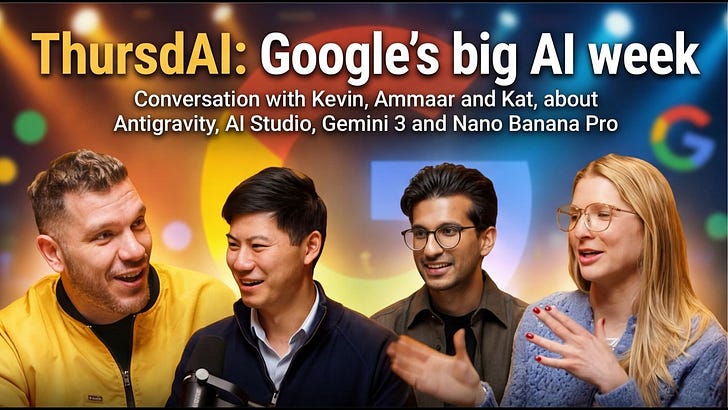
Hey, Alex here, I recorded these conversations just in front of the AI Engineer auditorium, back to back, after these great folks gave their talks, and at the epitome of the most epic AI week we’ve seen since I started recording ThursdAI.This is less our traditional live recording, and more a real podcast-y conversation with great folks, inspired by Latent.Space. I hope you enjoy this format as much as I’ve enjoyed recording and editing it. AntiGravity with KevinKevin Hou and team just launched Antigravity, Google’s brand new Agentic IDE based on VSCode, and Kevin (second timer on ThursdAI) was awesome enough to hop on and talk about some of the product decisions they made, what makes Antigravity special and highlighted Artifacts as a completely new primitive. Gemini 3 in AI StudioIf you aren’t using Google’s AI Studio (ai.dev) then you’re missing out! We talk about AI Studio all the time on the show, and I’m a daily user! I generate most of my images with Nano Banana Pro in there, most of my Gemini conversations are happening there as well! Ammaar and Kat were so fun to talk to, as they covered the newly shipped “build mode” which allows you to vibe code full apps and experiences inside AI Studio, and we also covered Gemini 3’s features, multimodality understanding, UI capabilities. These folks gave a LOT of Gemini 3 demo’s so they know everything there is to know about this model’s capabilities! Tried new things with this one, multi camera angels, conversation with great folks, if you found this content valuable, please subscribe :) Topics Covered:* Inside Google’s new “AntiGravity” IDE* How the “Agent Manager” changes coding workflows* Gemini 3’s new multimodal capabilities* The power of “Artifacts” and dynamic memory* Deep dive into AI Studio updates & Vibe Coding* Generating 4K assets with Nano Banana ProTimestamps for your viewing convenience. 00:00 - Introduction and Overview01:13 - Conversation with Kevin Hou: Anti-Gravity IDE01:58 - Gemini 3 and Nano Banana Pro Launch Insights03:06 - Innovations in Anti-Gravity IDE06:56 - Artifacts and Dynamic Memory09:48 - Agent Manager and Multimodal Capabilities11:32 - Chrome Integration and Future Prospects20:11 - Conversation with Ammar and Kat: AI Studio Team21:21 - Introduction to AI Studio21:51 - What is AI Studio?22:52 - Ease of Use and User Feedback24:06 - Live Demos and Launch Week26:00 - Design Innovations in AI Studio30:54 - Generative UIs and Vibe Coding33:53 - Nano Banana Pro and Image Generation39:45 - Voice Interaction and Future Roadmap44:41 - Conclusion and Final ThoughtsLooking forward to seeing you on Thursday 🫡 P.S - I’ve recorded one more conversation during AI Engineer, and will be posting that soon, same format, very interesting person, look out for that soon! This is a public episode. If you'd like to discuss this with other subscribers or get access to bonus episodes, visit sub.thursdai.news/subscribe

Hey ya’ll, Happy Thanskgiving to everyone who celebrates and thank you for being a subscriber, I truly appreciate each and every one of you!Just wrapped up the third (1, 2) Thanksgiving special Episode of ThursdAI, can you believe November is almost over? We had another banger week in AI, with a full feast of AI released, Anthropic dropped the long awaited Opus 4.5, which quickly became the top coding LLM, DeepSeek resurfaced with a math model, BFL and Tongyi both tried to take on Nano Banana, and Microsoft dropped a 7B computer use model in Open Source + Intellect 3 from Prime Intellect! With so much news to cover, we also had an interview with Ido Sal & Liad Yosef (their second time on the show!) about MCP-Apps, the new standard they are spearheading together with Anthropic, OpenAI & more! Exciting episode, let’s get into it! (P.S - I started generating infographics, so the show became much more visual, LMK if you like them) ThursdAI - I put a lot of work on a weekly basis to bring you the live show, podcast and a sourced newsletter! Please subscribe if you find this content valuable!Anthropic’s Opus 4.5: The “Premier Intelligence” Returns (Blog)Folks, Anthropic absolutely cooked. After Sonnet and Haiku had their time in the sun, the big brother is finally back. Opus 4.5 launched this week, and it is reclaiming the throne for coding and complex agentic tasks.First off, the specs are monstrous. It hits 80.9% on SWE-bench Verified, topping GPT-5.1 (77.9%) and Gemini 3 Pro (76.2%). But the real kicker? The price! It is now $5 per million input tokens and $25 per million output—literally one-third the cost of the previous Opus.Yam, our resident coding wizard, put it best during the show: “Opus knows a lot of tiny details about the stack that you didn’t even know you wanted... It feels like it can go forever.” Unlike Sonnet, which sometimes spirals or loses context on extremely long tasks, Opus 4.5 maintains coherence deep into the conversation.Anthropic also introduced a new “Effort” parameter, allowing you to control how hard the model thinks (similar to o1 reasoning tokens). Set it to high, and you get massive performance gains; set it to medium, and you get Sonnet-level performance at a fraction of the token cost. Plus, they’ve added Tool Search (cutting enormous token overhead for agents with many tools) and Programmatic Tool Calling, which effectively lets Opus write and execute code loops to manage data.If you are doing heavy software engineering or complex automations, Opus 4.5 is the new daily driver.📱 The Agentic Web: MCP Apps & MCP-UI StandardSpeaking of MCP updates, Can you believe it’s been exactly one year since the Model Context Protocol (MCP) launched? We’ve been “MCP-pilled” for a while, but this week, the ecosystem took a massive leap forward.We brought back our friends Ido and Liad, the creators of MCP-UI, to discuss huge news: MCP-UI has been officially standardized as MCP Apps. This is a joint effort adopted by both Anthropic and OpenAI.Why does this matter? Until now, when an LLM used a tool (like Spotify or Zillow), the output was just text. It lost the brand identity and the user experience. With MCP Apps, agents can now render full, interactive HTML interfaces directly inside the chat! Ido and Liad explained that they worked hard to avoid an “iOS vs. Android” fragmentation war. Instead of every lab building their own proprietary app format, we now have a unified standard for the “Agentic Web.” This is how AI stops being a chatbot and starts being an operating system.Check out the standard at mcpui.dev.🦃 The Open Source Thanksgiving FeastWhile the big labs were busy, the open-source community decided to drop enough papers and weights to feed us for a month.Prime Intellect unveils INTELLECT-3, a 106B MoE (X, HF, Blog, Try It)Prime Intellect releases INTELLECT-3, a 106B parameter Mixture-of-Experts model (12B active params) based on GLM-4.5-Air, achieving state-of-the-art performance for its size—including ~90% on AIME 2024/2025 math contests, 69% on LiveCodeBench v6 coding, 74% on GPQA-Diamond reasoning, and 74% on MMLU-Pro—outpacing larger models like DeepSeek-R1. Trained over two months on 512 H200 GPUs using their fully open-sourced end-to-end stack (PRIME-RL async trainer, Verifiers & Environments Hub, Prime Sandboxes), it’s now hosted on Hugging Face, OpenRouter, Parasail, and Nebius, empowering any team to scale frontier RL without big-lab resources. Especially notable is their very detailed release blog, covering how a lab that previously trained 32B, finetunes a monster 106B MoE model! Tencent’s HunyuanOCR: Small but Mighty (X, HF, Github, Blog)Tencent released HunyuanOCR, a 1 billion parameter model that is absolutely crushing benchmarks. It scored 860 on OCRBench, beating massive models like Qwen3-VL-72B. It’s an end-to-end model, meaning no separate detection and recognition steps. Great for parsing PDFs, docs, and even video subtitles. It’s heavily restricted (no EU/UK usage), but technically impressive.Microsoft’s Fara-7B: On-Device Computer UseMicrosoft quietly dropped Fara-7B, a model fine-tuned from Qwen 2.5, specifically designed for computer use agentic tasks. It hits 73.5% on WebVoyager, beating OpenAI’s preview models, all while running locally on-device. This is the dream of a local agent that can browse the web for you, click buttons, and book flights without sending screenshots to the cloud.DeepSeek-Math-V2: open-weights IMO-gold math LLM (X, HF)DeepSeek-Math-V2 is a 685B-parameter, Apache-2.0 licensed, open-weights mathematical reasoning model claiming gold-medal performance on IMO 2025 and CMO 2024, plus a near-perfect 118/120 on Putnam 2024. Nisten did note some limitations—specifically that the context window can get choked up on extremely long, complex proofs—but having an open-weight model of this caliber is a gift to researchers everywhere.🐝 This Week’s Buzz: Serverless LoRA InferenceA huge update from us at Weights & Biases! We know fine-tuning is powerful, but serving those fine-tunes can be a pain and expensive. We just launched Serverless LoRA Inference.This means you can upload your small LoRA adapters (which you can train cheaply) to W&B Artifacts, and we will serve them instantly on CoreWeave GPUs on top of a base model. No cold starts, no dedicated expensive massive GPU instances for just one adapter.I showed a demo of a “Mocking SpongeBob” model I trained in 25 minutes. It just adds that SaRcAsTiC tExT style to the Qwen 2.5 base model. You pass the adapter ID in the API call, and boom—customized intelligence instantly. You can get more details HERE and get started with your own LORA in this nice notebook the team made! 🎨 Visuals: Image & Video Generation ExplosionFlux.2: The Multi-Reference Image Creator from BFL (X, HF, Blog)Black Forest Labs released Flux.2, a series of models including a 32B Flux 2[DEV]. The killer feature here is Multi-Reference Editing. You can feed it up to 10 reference images to maintain character consistency, style, or specific objects. It also outputs native 4-megapixel images.Honestly, the launch timing was rough, coming right after Google’s Nano Banana Pro and alongside Z-Image, but for precise, high-res editing, this is a serious tool.Tongyi drops Z-Image Turbo: 6B single-stream DiT lands sub‑second, 8‑step text‑to‑image (GitHub, Hugging Face)Alibaba’s Tongyi Lab released Z-Image Turbo, a 6B parameter model that generates images in sub-second time on H800s (and super fast on consumer cards).I built a demo to show just how fast this is. You know that “Infinite Craft“ game? I hooked it up to Z-Image Turbo so that every time you combine elements (like Pirate + Ghost), it instantly generates the image for “Ghost Pirate.” It changes the game completely when generation is this cheap and fast.HunyuanVideo 1.5 – open video gets very realTencent also shipped HunyuanVideo 1.5, which they market as “the strongest open‑source video generation model.” For once, the tagline isn’t entirely hype.Under the hood it’s an 8.3B‑parameter Diffusion Transformer (DiT) model with a 3D causal VAE in front. The VAE compresses videos aggressively in both space and time, and the DiT backbone models that latent sequence.The important bits for you and me:* It generates 5–10 second clips at 480p/720p with good motion coherence and physics.* With FP16 or FP8 configs you can run it on a single consumer GPU with around 14GB VRAM.* There’s a built‑in path to upsample to 1080p for “real” quality.LTX Studio Retake: Photoshop for Video (X, Try It)For the video creators, LTX Studio launched Retake. This isn’t just “regenerate video.” This allows you to select a specific 2-second segment of a video, change the dialogue (keeping the voice!), change the emotion, or edit the action, all for like $0.10. It blends it perfectly back into the original clip. We are effectively getting a “Director Mode” for AI video where you can fix mistakes without rolling the dice on a whole new generation.A secret new model on the Arena called Whisper Thunder beats even Veo 3?This was a surprise of the week, while new video models get released often, Veo 3 has been the top one for a while, and now we’re getting a reshuffling of the video giants! But... we don’t yet know who this video model is from! You can sometimes get its generations at the Artificial Analysis video arena here, and the outputs look quite awesome! Thanksgiving reflections from the ThursdAI teamAs we wrapped up the show, Wolfram suggested we take a moment to think about what we’re thankful for in AI, and I think that’s a perfect note to end on.Wolfram put it well: he’s thankful for everyone contributing to this wonderful community—the people releasing models, creating open source tools, writing tutorials, sharing knowledge. It’s not just about the money; it’s about the love of learning and building together.Yam highlighted something I think is crucial: we’ve reached a point where there’s no real competition between o

Hey everyone, Alex here 👋I’m writing this one from a noisy hallway at the AI Engineer conference in New York, still riding the high (and the sleep deprivation) from what might be the craziest week we’ve ever had in AI.In the span of a few days:Google dropped Gemini 3 Pro, a new Deep Think mode, generative UIs, and a free agent-first IDE called Antigravity.xAI shipped Grok 4.1, then followed it up with Grok 4.1 Fast plus an Agent Tools API.OpenAI answered with GPT‑5.1‑Codex‑Max, a long‑horizon coding monster that can work for more than a day, and quietly upgraded ChatGPT Pro to GPT‑5.1 Pro.Meta looked at all of that and said “cool, we’ll just segment literally everything and turn photos into 3D objects” with SAM 3 and SAM 3D.Robotics folks dropped a home robot trained with almost no robot data.And Google, just to flex, capped Thursday with Nano Banana Pro, a 4K image model and a provenance system while we were already live! For the first time in a while it doesn’t just feel like “new models came out.” It feels like the future actually clicked forward a notch.This is why ThursdAI exists. Weeks like this are basically impossible to follow if you have a day job, so my co‑hosts and I do the no‑sleep version so you don’t have to. Plus, being at AI Engineer makes it easy to get super high quality guests so this week we had 3 folks join us, Swyx from Cognition/Latent Space, Thor from DeepMind (on his 3rd day) and Dominik from OpenAI! Alright, deep breath. Let’s untangle the week.TL;DR If you only skim one section, make it this one (links in the end):* Google* Gemini 3 Pro: 1M‑token multimodal model, huge reasoning gains - new LLM king* ARC‑AGI‑2: 31.11% (Pro), 45.14% (Deep Think) – enormous jumps* Antigravity IDE: free, Gemini‑powered VS Code fork with agents, plans, walkthroughs, and browser control* Nano Banana Pro: 4K image generation with perfect text + SynthID provenance; dynamic “generative UIs” in Gemini* xAI* Grok 4.1: big post‑training upgrade – #1 on human‑preference leaderboards, much better EQ & creative writing, fewer hallucinations* Grok 4.1 Fast + Agent Tools API: 2M context, SOTA tool‑calling & agent benchmarks (Berkeley FC, T²‑Bench, research evals), aggressive pricing and tight X + web integration* OpenAI* GPT‑5.1‑Codex‑Max: “frontier agentic coding” model built for 24h+ software tasks with native compaction for million‑token sessions; big gains on SWE‑Bench, SWE‑Lancer, TerminalBench 2* GPT‑5.1 Pro: new “research‑grade” ChatGPT mode that will happily think for minutes on a single query* Meta* SAM 3: open‑vocabulary segmentation + tracking across images and video (with text & exemplar prompts)* SAM 3D: single‑image → 3D objects & human bodies; surprisingly high‑quality 3D from one photo* Robotics* Sunday Robotics – ACT‑1 & Memo: home robot foundation model trained from a $200 skill glove instead of $20K teleop rigs; long‑horizon household tasks with solid zero‑shot generalization* Developer Tools* Antigravity and Marimo’s VS Code / Cursor extension both push toward agentic, reactive dev workflowsLive from AI Engineer New York: Coding Agents Take Center StageWe recorded this week’s show on location at the AI Engineer Summit in New York, inside a beautiful podcast studio the team set up right on the expo floor. Huge shout out to Swyx, Ben, and the whole AI Engineer crew for that — last time I was balancing a mic on a hotel nightstand, this time I had broadcast‑grade audio while a robot dog tried to steal the show behind us.This year’s summit theme is very on‑the‑nose for this week: coding agents.Everywhere you look, there’s a company building an “agent lab” on top of foundation models. Amp, Cognition, Cursor, CodeRabbit, Jules, Google Labs, all the open‑source folks, and even the enterprise players like Capital One and Bloomberg are here, trying to figure out what it means to have real software engineers that are partly human and partly model.Swyx framed it nicely when he said that if you take “vertical AI” seriously enough, you eventually end up building an agent lab. Lawyers, healthcare, finance, developer tools — they all converge on “agents that can reason and code.”The big labs heard that theme loud and clear. Almost every major release this week is about agents, tools, and long‑horizon workflows, not just chat answers.Google Goes All In: Gemini 3 Pro, Antigravity, and the Agent RevolutionLet’s start with Google because, after years of everyone asking “where’s Google?” in the AI race, they showed up this week with multiple bombshells that had even the skeptics impressed.Gemini 3 Pro: Multimodal Intelligence That Actually DeliversGoogle finally released Gemini 3 Pro, and the numbers are genuinely impressive. We’re talking about a 1 million token context window, massive benchmark improvements, and a model that’s finally competing at the very top of the intelligence charts. Thor from DeepMind joined us on the show (literally on day 3 of his new job!) and you could feel the excitement.The headline numbers: Gemini 3 Pro with Deep Think mode achieved 45.14% on ARC-AGI-2—that’s roughly double the previous state-of-the-art on some splits. For context, ARC-AGI has been one of those benchmarks that really tests genuine reasoning and abstraction, not just memorization. The standard Gemini 3 Pro hits 31.11% on the same benchmark, both scores are absolutely out of this world in Arc! On GPQA Diamond, Gemini 3 Pro jumped about 10 points compared to prior models. We’re seeing roughly 81% on MMLU-Pro, and the coding performance is where things get really interesting—Gemini 3 Pro is scoring around 56% on SciCode, representing significant improvements in actual software engineering tasks.But here’s what made Ryan from Amp switch their default model to Gemini 3 Pro immediately: the real-world usability. Ryan told us on the show that they’d never switched default models before, not even when GPT-5 came out, but Gemini 3 Pro was so noticeably better that they made it the default on Tuesday. Of course, they hit rate limits almost immediately (Google had to scale up fast!), but those have since been resolved.Antigravity: Google’s Agent-First IDEThen Google dropped Antigravity, and honestly, this might be the most interesting part of the whole release. It’s a free IDE (yes, free!) that’s basically a fork of VS Code, but reimagined around agents rather than human-first coding.The key innovation here is something they call the “Agent Manager”—think of it like an inbox for your coding agents. Instead of thinking in folders and files, you’re managing conversations with agents that can run in parallel, handle long-running tasks, and report back when they need your input.I got early access and spent time playing with it, and here’s what blew my mind: you can have multiple agents working on different parts of your codebase simultaneously. One agent fixing bugs, another researching documentation, a third refactoring your CSS—all at once, all coordinated through this manager interface.The browser integration is crazy too. Antigravity can control Chrome directly, take screenshots and videos of your app, and then use those visuals to debug and iterate. It’s using Gemini 3 Pro for the heavy coding, and even Nano Banana for generating images and assets. The whole thing feels like it’s from a couple years in the future.Wolfram on the show called out how good Gemini 3 is for creative writing too—it’s now his main model, replacing GPT-4.5 for German language tasks. The model just “gets” the intention behind your prompts rather than following them literally, which makes for much more natural interactions.Nano Banana Pro: 4K Image Generation With ThinkingAnd because Google apparently wasn’t done announcing things, they also dropped Nano Banana Pro on Thursday morning—literally breaking news during our live show. This is their image generation model that now supports 4K resolution and includes “thinking” traces before generating.I tested it live by having it generate an infographic about all the week’s AI news (which you can see on the top), and the results were wild. Perfect text across the entire image (no garbled letters!), proper logos for all the major labs, and compositional understanding that felt way more sophisticated than typical image models. The file it generated was 8 megabytes—an actual 4K image with stunning detail.What’s particularly clever is that Nano Banana Pro is really Gemini 3 Pro doing the thinking and planning, then handing off to Nano Banana for the actual image generation. So you get multimodal reasoning about your request, then production-quality output. You can even upload reference images—up to 14 of them—and it’ll blend elements while maintaining consistency.Oh, and every image is watermarked with SynthID (Google’s invisible watermarking tech) and includes C2PA metadata, so you can verify provenance. This matters as AI-generated content becomes more prevalent.Generative UIs: The Future of InterfacesOne more thing Google showed off: generative UIs in the Gemini app. Wolfram demoed this for us, and it’s genuinely impressive. Instead of just text responses, Gemini can generate full interactive mini-apps on the fly—complete dashboards, data visualizations, interactive widgets—all vibe-coded in real time.He asked for “four panels of the top AI news from last week” and Gemini built an entire news dashboard with tabs, live market data (including accurate pre-market NVIDIA stats!), model comparisons, and clickable sections. It pulled real information, verified facts, and presented everything in a polished UI that you could interact with immediately.This isn’t just a demo—it’s rolling out in Gemini now. The implication is huge: we’re moving from static responses to dynamic, contextual interfaces generated just-in-time for your specific need.xAI Strikes Back: Grok 4.1 and the Agent Tools APINot to be outdone, xAI released Grok 4.1 at the start of the week, briefly claimed the #1 spot on LMArena (at 1483 Elo, not 2nd to

Hey, this is Alex! We’re finally so back! Tons of open source releases, OpenAI updates GPT and a few breakthroughs in audio as well, makes this a very dense week! Today on the show, we covered the newly released GPT 5.1 update, a few open source releases like Terminal Bench and Project AELLA (renamed OASSAS), and Baidu’s Ernie 4.5 VL that shows impressive visual understanding! Also, chatted with Paul from 11Labs and Dima Duev from the wandb SDK team, who brought us a delicious demo of LEET, our new TUI for wandb! Tons of news coverage, let’s dive in 👇 (as always links and show notes in the end) Open Source AILet’s jump directly into Open Source as this week has seen some impressive big company models. Terminal-Bench 2.0 - a harder, highly‑verified coding and terminal benchmark (X, Blog, Leaderboard)We opened with Terminal‑Bench 2.0 plus its new harness, Harbor, because this is the kind of benchmark we’ve all been asking for. Terminal‑Bench focuses on agentic coding in a real shell. Version 2.0 is a hard set of 89 terminal tasks, each one painstakingly vetted by humans and LLMs to make sure it’s solvable and realistic. Think “I checked out master and broke my personal site, help untangle the git mess” or “implement GPT‑2 code golf with the fewest characters.” On the new leaderboard, top agents like Warp’s agentic console and Codex CLI + GPT‑5 sit around fifty percent success. That number is exactly what excites me: we’re nowhere near saturation. When everyone is in the 90‑something range, tiny 0.1 improvements are basically noise. When the best models are at fifty percent, a five‑point jump really means something.A huge part of our conversation focused on reproducibility. We’ve seen other benchmarks like OSWorld turn out to be unreliable, with different task sets and non‑reproducible results making scores incomparable. Terminal‑Bench addresses this with Harbor, a harness designed to run sandboxed, containerized agent rollouts at scale in a consistent environment. This means results are actually comparable. It’s a ton of work to build an entire evaluation ecosystem like this, and with over a thousand contributors on their Discord, it’s a fantastic example of a healthy, community‑driven effort. This is one to watch! Baidu’s ERNIE‑4.5‑VL “Thinking”: a 3B visual reasoner that punches way up (X, HF, GitHub)Next up, Baidu dropped a really interesting model, ERNIE‑4.5‑VL‑28B‑A3B‑Thinking. This is a compact, 3B active‑parameter multimodal reasoning model focused on vision, and it’s much better than you’d expect for its size. Baidu’s own charts show it competing with much larger closed models like Gemini‑2.5‑Pro and GPT‑5‑High on a bunch of visual benchmarks like ChartQA and DocVQA.During the show, I dropped a fairly complex chart into the demo, and ERNIE‑4.5‑VL gave me a clean textual summary almost instantly—it read the chart more cleanly than I could. The model is built to “think with images,” using dynamic zooming and spatial grounding to analyze fine details. It’s released under an Apache‑2.0 license, making it a serious candidate for edge devices, education, and any product where you need a cheap but powerful visual brain.Open Source Quick Hits: OSSAS, VibeThinker, and Holo TwoWe also covered a few other key open-source releases. Project AELLA was quickly rebranded to OSSAS (Open Source Summaries At Scale), an initiative to make scientific literature machine‑readable. They’ve released 100k paper summaries, two fine-tuned models for the task, and a 3D visualizer. It’s a niche but powerful tool if you’re working with massive amounts of research. (X, HF)WeiboAI (from the Chinese social media company) released VibeThinker‑1.5B, a tiny 1.5B‑parameter reasoning model that is making bold claims about beating the 671B DeepSeek R1 on math benchmarks. We discussed the high probability of benchmark contamination, especially on tests like AIME24, but even with that caveat, getting strong chain‑of‑thought math out of a 1.5B model is impressive and useful for resource‑constrained applications. (X, HF, Arxiv)Finally, we had some breaking news mid‑show: H Company released Holo Two, their next‑gen multimodal agent for controlling desktops, websites, and mobile apps. It’s a fine‑tune of Qwen3‑VL and comes in 4B and 8B Apache‑2.0 licensed versions, pushing the open agent ecosystem forward. (X, Blog, HF)ThursdAI - Recaps of the most high signal AI weekly spaces is a reader-supported publication. To receive new posts and support my work, consider becoming a free or paid subscriber.Big Companies & APIsGPT‑5.1: Instant vs Thinking, and a new personality barThe biggest headline of the week was OpenAI shipping GPT‑5.1, and this was a hot topic of debate on the show. The update introduces two modes: “Instant” for fast, low‑compute answers, and “Thinking” for deeper reasoning on hard problems. OpenAI claims Instant mode uses 57% fewer tokens on easy tasks, while Thinking mode dedicates 71% more compute to difficult ones. This adaptive approach is a smart evolution.The release also adds a personality dropdown with options like Professional, Friendly, Quirky, and Cynical, aiming for a more “warm” and customizable experience. Yam and I felt this was a step in the right direction, as GPT‑5 could often feel a bit cold and uncommunicative. However, Wolfram had a more disappointing experience, finding that GPT‑5.1 performed significantly worse on his German grammar and typography tasks compared to GPT‑4 or Claude Sonnet 4.5. It’s a reminder that “upgrades” can be subjective and task‑dependent.Since the show was recorded, GPT 5.1 is also released in the API and they have published a prompting guide and some evals! With some significant jumps across SWE-bench verified and GPQA Diamond! We’ll be testing this model out all week. The highlight for this model is the creative writing, it was made public that this model was being tested on OpenRouter as Polaris-alpha and that one tops the eqbench creative writing benchmarks beating Sonnet 4.5 and Gemini! Grok‑4 Fast: 2M context and a native X superpowerGrok‑4 Fast from xAI apparenly quietly got a substantial upgrade to a 2M‑token context window, but the most interesting part is its unique integration with X. The API version has access to internal tools for semantic search over tweets, retrieving top quote tweets, and understanding embedded images and videos. I’ve started using it as a research agent in my show prep, and it feels like having a research assistant living inside X’s backend—something you simply can’t replicate with public tools.I still have my gripes about their “stealth upgrade” versioning strategy, which makes rigorous evaluation difficult, but as a practical tool, Grok‑4 Fast is incredibly powerful. It’s also surprisingly fast and cost‑effective, holding its own against other top models on benchmarks while offering a superpower that no one else has.Google SIMA 2: Embodied Agents in Virtual WorldsGoogle’s big contribution this week was SIMA 2, DeepMind’s latest embodied agent for 3D virtual worlds. SIMA lives inside real games like No Man’s Sky and Goat Simulator, seeing the screen and controlling the game via keyboard and mouse, using Gemini as its reasoning brain. Demos showed it following complex, sketch‑based instructions, like finding an object that looks like a drawing of a spaceship and jumping on top of it.When you combine this with Genie 3—Google’s world model that can generate playable environments from a single image—you see the bigger picture: agents that learn physics, navigation, and common sense by playing in millions of synthetic worlds. We’re not there yet, but the pieces are clearly being assembled. We also touched on the latest Gemini Live voice upgrade, which users are reporting feels much more natural and responsiveMore Big Company News: Qwen Deep Research, Code Arena, and CursorWe also briefly covered Qwen’s new Deep Research feature, which offers an OpenAI‑style research agent inside their ecosystem. LMSYS launched Blog, a fantastic live evaluation platform where models build real web apps agentically, with humans voting on the results. And in the world of funding, the AI‑native code editor Cursor raised a staggering $2.3 billion, a clear sign that AI is becoming the default way developers interact with code.This Week’s Buzz: W&B LEET – a terminal UI that sparks joyFor this week’s buzz, I brought on Dima Duev from our SDK team at Weights & Biases to show off a side project that has everyone at the company excited: LEET, the Lightweight Experiment Exploration Tool. Imagine you’re training on an air‑gapped HPC cluster, living entirely in your terminal. How do you monitor your runs? With LEET.You run your training script in W&B offline mode, and in another terminal, you type wandb beta leet. Your terminal instantly turns into a full TUI dashboard with live metric plots, system stats, and run configs. You can zoom into spikes in your loss curve, filter metrics, and see everything updating in real time, all without a browser or internet connection. It’s one of those tools that just sparks joy. It ships with the latest wandb SDK (v0.23.0+), so just upgrade and give it a try! Voice & Audio: Scribe v2 Realtime and Omnilingual ASRElevenLabs Scribe v2 Realtime: ASR built for agents (X, Announcement, Demo)We’ve talked a lot on this show about ElevenLabs as “the place you go to make your AI talk.” This week, they came for the other half of the conversation. Paul Asjes from ElevenLabs joined us to walk through Scribe v2 Realtime, their new low‑latency speech‑to‑text model. If you’re building a voice agent, you need ears, a brain, and a mouth. ElevenLabs already nailed the mouth, and now they’ve built some seriously good ears.Scribe v2 Realtime is designed to run at around 150 milliseconds median latency, across more than ninety languages. Watching Paul’s live demo, it felt comfortably real‑time. When he switched from English to Dutch mid‑sentence, the system just followed along
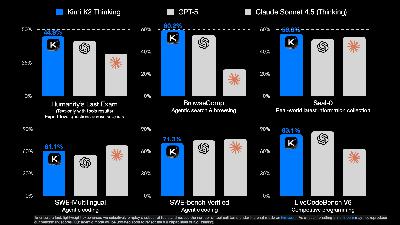
Hey, Alex here! Quick note, while preparing for this week, I posted on X that I don’t remember such a quiet week in AI since I started doing ThursdAI regularly, but then 45 min before the show started, Kimi dropped a SOTA oss reasoning model, turning a quiet week into an absolute banger. Besides Kimi, we covered the updated MCP thinking from Anthropic, and had Kenton Varda from cloudflare as a guest to talk about Code Mode, chatted about Windsurf and Cursor latest updates and covered OpenAI’s insane deals. Also, because it was a quiet week, I figured I’d use the opportunity to create an AI powered automation, and used N8N for that, and shared it on the stream, so if you’re interested in automating with AI with relatively low code, this episode is for you. Let’s dive inThursdAI - Recaps of the most high signal AI weekly spaces is a reader-supported publication. To receive new posts and support my work, consider becoming a free or paid subscriber.Kimi K2 Thinking is Here and It’s a 1 Trillion Parameter Beast! (X, HF, Tech Blog)Let’s start with the news that got everyone’s energy levels skyrocketing right as we went live. Moonshot AI dropped Kimi K2 Thinking, an open-source, 1 trillion-parameter Mixture-of-Experts (MoE) model, and it’s an absolute monster.This isn’t just a numbers game; Kimi K2 Thinking is designed from the ground up to be a powerful agent. With just around 32 billion active parameters during inference, a massive 256,000 token context window, and an insane tool-calling capacity. They’re claiming it can handle 200-300 sequential tool calls without any human intervention. The benchmarks are just as wild. On the Humanities Last Exam (HLE), they’re reporting a score of 44.9%, beating out both GPT-5 and Claude 4.5 Thinking. While it doesn’t quite top the charts on SWE-bench verified, it’s holding its own against the biggest closed-source models out there. Seeing an open-source model compete at this level is incredibly exciting.During the show, we saw some truly mind-blowing demos, from a beautiful interactive visualization of gradient descent to a simulation of a virus attacking cells, all generated by the model. The model’s reasoning traces, which are exposed through the API, also seem qualitatively different from other models, showing a deep and thoughtful process. My co-hosts and I were blown away. The weights and a very detailed technical report are available on Hugging Face, so you can dive in and see for yourself. Shout out to the entire Moonshot AI team for this incredible release!Other open source updates from this week* HuggingFace released an open source “Smol Training Playbook” on training LLMs, it’s a 200+ interactive beast with visualizations, deep dives into pretraining, dataset, postraining and more! (HF)* Ai2 launches OlmoEarth — foundation models + open, end-to-end platform for fast, high-resolution Earth intelligence (X, Blog)* LongCat-Flash-Omni — open-source omni-modal system with millisecond E2E spoken interaction, 128K context and a 560B ScMoE backbone (X, HF, Announcement)Big Tech’s Big Moves: Apple, Amazon, and OpenAIThe big companies were making waves this week, starting with a blockbuster deal that might finally make Siri smart. Apple is reportedly will be paying Google around $1 billion per year to license a custom 1.2 trillion-parameter version of Gemini to power a revamped Siri.This is a massive move. The Gemini model will run on Apple’s Private Cloud Compute, keeping user data walled off from Google, and will handle Siri’s complex summarizer and planner functions. After years of waiting for Apple to make a significant move in GenAI, it seems they’re outsourcing the heavy lifting for now while they work to catch up with their own in-house models. As a user, I don’t really care who builds the model, as long as Siri stops being dumb!In more dramatic news, Perplexity revealed that Amazon sent them a legal threat to block their Comet AI assistant from shopping on Amazon.com. This infuriated me. My browser is my browser, and I should be able to use whatever tools I want to interact with the web. Perplexity took a strong stand with their blog post, “Bullying is Not Innovation,” arguing that user agents are distinct from scrapers and act on behalf of the user with their own credentials. An AI assistant is just that—an assistant. It shouldn’t matter if I ask my wife or my AI to buy something for me on Amazon. This feels like a move by Amazon to protect its ad revenue at the expense of user choice and innovation, and I have to give major props to Perplexity for being so transparent and fighting back.Finally, OpenAI continues its quest for infinite compute, announcing a multi-year strategic partnership with AWS. This comes on top of massive deals with NVIDIA, Microsoft, Oracle, and others, bringing their total commitment to compute into the trillions of dollars. It’s getting to a point where OpenAI seems “too big to fail,” as any hiccup could have serious repercussions for the entire tech economy, which is now heavily propped up by AI investment. Sam has clarified that they don’t think OpenAI wants to be too big to fail in a recent post on X, and that the recent miscommunications around the US government backstopping OpenAI’s infrastructure bailouts were taken out of context. 🤔 Coding with AI: The Evolution of MCP and New Dev ToolsThis week, we kicked off a new segment on the show: Coding with AI! Essentially realizing that we talk about AI coding a LOT, and decided to add a dedicated corner to it! And we started with a fascinating development in the world of agentic tooling. Anthropic published a blog post arguing that the standard way of using the Model Context Protocol (MCP) — by loading full tool definitions into the context window — is inefficient.Their solution? Have LLMs write code to interact with tools instead. This approach can slash token usage by over 98% in some cases. This idea sounded familiar, and that’s because Cloudflare had already explored it with a feature called “Code Mode.” We were lucky enough to have Kenton Varda, one of the authors of the Code Mode post and head of engineering for Cloudflare Workers, join us to discuss this shift.Kenton explained that LLMs are trained on vast amounts of code, making it a more “native language” for them than the artificial construct of tool calls. By generating code, agents can chain multiple tool calls together, process intermediate results, and operate much more efficiently without sending everything back through the neural network. While MCP still provides crucial standardization for discovering and authorizing tools, this “code execution” pattern seems to be the way forward for building more powerful and scalable agents.Windsurfs CodeMaps and Cursor multi agent executionsIn other coding with AI news, Windsurf has pushed an incredible feature, called CodeMaps. They will use their SWE-1 model to (quickly) generate Codemaps that will expalins a code-base to you, in a visual way. What starts where and goes where. It’s really useful to understand a new codebase or re-understand one you forgot about already! You can even chat with codemaps, to see if your overall system’s design is solid! Great addition that I’m sure will help many folks adopt Windsurf! And Cursor, another popular AI-native IDE, released a super-performant in-IDE browser and a wild multi-agent feature that queries multiple LLMs in parallel and then synthesizes their answers.This Week’s TutorialI finally got around to building some serious automations for ThursdAI, and folks, N8N has been a game-changer. What used to take me 30+ minutes of manual work now happens automatically in the background.Here’s what I built: A Telegram bot that takes Twitter/X links, fetches the tweets and all linked content, uses AI agents to extract and summarize the information, and then posts it to our announcement channel and my notes app. The coolest part? I built this whole thing in about 4 hours with the help of Atlas browser and GPT-5 literally telling me what to do at each step.During the show, we even live-tested swapping out GPT-4o-mini for Kimi K2 - took literally 30 seconds to connect via OpenRouter. I went through my node and explains how this all works on the show, so if you’ve wanted to learn about n8n, check it out starting around 01:13:00. If you want to see how my automation turned out, it will be posting all my links to the new telegram channel t.me/thursdai_news (expect it to be messy at first as I’m testing out the automation) Robotics - Xpeng’s “Iron” humanoid: big vibes, few specsAnother week, another humanoid robot that is supposedly “coming” in 2026! A humanoid from Xpeng went viral this week, marketed as “the most human‑like” robot with soft skin, bionic muscles, customizable sexes (yes, really, they have a woman humanoid), something called a VLT brain, and a 2026 production goal. Here’s what we didn’t get: a spec sheet. No DOF, speed, payload, compute TOPS, battery capacity, runtime, or safety pathway. No pricing, manufacturing strategy, or clear target markets. In other words: lots of sizzle, no steak.Apparently, there was folks thinking Xpend pulled an Elon and put a human in a robot suit, making the CEO do the “we’ll cut a part of the soft skin to expose the robot underneath so you don’t think we’re lying” stunt. Which I agree, was very effective. But, If Xpeng is serious, the next thing we’ll see should be a crisp engineering document: joints, actuation, sensors, compute, and a locomotion/manipulation demo with independent measurements. Until then, treat this as a branding salvo and a reminder that the humanoid category is still sorting itself into “industrial payload first” versus “human likeness first” approaches. Voice & AudioMaya‑1: open‑source voice design from natural languageWe highlighted Maya‑1, a 3B Llama‑backboned TTS system designed to generate voices from natural language descriptions. Instead of picking from a menu, you describe the voice—

Hey, it’s Alex! Happy Halloween friends! I’m excited to bring you this weeks (spooky) AI updates! We started the show today with MiniMax M2, the currently top Open Source LLM, with an interview with their head of eng, Skyler Miao, continued to dive into OpenAIs completed restructuring into a non-profit and a PBC, including a deep dive into a live stream Sam Altman had, with a ton of spicy details, and finally chatted with Arjun Desai from Cartesia, following a release of Sonic 3, a sub 49ms voice model! So, 2 interviews + tons of news, let’s dive in! (as always, show notes in the end)Hey, if you like this content, it would mean a lot if you subscribe as a paid subscriber.Open Source AIMiniMax M2: open-source agentic model at 8% of Claude’s price, 2× speed (X, Hugging Face )We kicked off our open-source segment with a banger of an announcement and a special guest. The new king of open-source LLMs is here, and it’s called MiniMax M2. We were lucky enough to have Skyler Miao, Head of Engineering at Minimax, join us live to break it all down.M2 is an agentic model built for code and complex workflows, and its performance is just staggering. It’s already ranked in the top 5 globally on the Artificial Analysis benchmark, right behind giants like OpenAI and Anthropic. But here’s the crazy part: it delivers nearly twice the speed of Claude 3.5 Sonnet at just 8% of the price. This is basically Sonnet-level performance, at home, in open source.Skylar explained that their team saw an “impossible triangle” in the market between performance, cost, and speed—you could only ever get two. Their goal with M2 was to build a model that could solve this, and they absolutely nailed it. It’s a 200B parameter Mixture-of-Experts (MoE) model, but with only 10B active parameters per inference, making it incredibly efficient.One key insight Skylar shared was about getting the best performance. M2 supports multiple APIs, but to really unlock its reasoning power, you need to use an API that passes the model’s “thinking” tokens back to it on the next turn, like the Anthropic API. Many open-source tools don’t support this yet, so it’s something to watch out for.Huge congrats to the MiniMax team on this Open Weights (MIT licensed) release, you can find the model on HF! MiniMax had quite a week, with 3 additional releases, MiniMax speech 2.6, an update to their video model Hailuo 2.3 and just after the show, they released a music 2.0 model as well! Congrats on the shipping folks! OpenAI drops gpt-oss-safeguard - first open-weight safety reasoning models for classification ( X, HF )OpenAI is back on the open weights bandwagon, with a finetune release of their previously open weighted gpt-oss models, with gpt-oss-safeguard. These models were trained exclusively to help companies build safeguarding policies to make sure their apps remains safe! With gpt-oss-safeguards 20B and 120B, OpenAI is achieving near parity with their internal safety models, and as Nisten said on the show, if anyone knows about censorship and safety, it’s OpenAI! The highlight of this release is, unlike traditional pre-trained classifiers, these models allow for updates to policy via natural language!These models will be great for businesses that want to safeguard their products in production, and I will advocate to bring these models to W&B Inference soon! A Humanoid Robot in Your Home by 2026? 1X NEO announcement ( X, Order page, Keynote )Things got really spooky when we started talking about robotics. The company 1X, which has been on our radar for a while, officially launched pre-orders for NEO, the world’s first consumer humanoid robot designed for your home. And yes, you can order one right now for $20,000, with deliveries expected in early 2026.The internet went crazy over this announcement, with folks posting receipts of getting one, other folks stoking the uncanny valley fears that Sci-fi has built into many people over the years, of the Robot uprising and talking about the privacy concerns of having a human tele-operate this Robot in your house to do chores. It can handle chores like cleaning and laundry, and for more complex tasks that it hasn’t learned yet, it uses a teleoperation system where a human “1X Expert” can pilot the robot remotely to perform the task. This is how it collects the data to learn to do these tasks autonomously in your specific home environment.The whole release is very interesting, from the “soft and quiet” approach 1X is taking, making their robot a 66lbs short king, draped in a knit sweater, to the $20K price point (effectively at loss given how much just the hands cost), the teleoperated by humans addition, to make sure the Robot learns about your unique house layout. The conversation on the show was fascinating. We talked about all the potential use cases, from having it water your plants and look after your pets while you’re on vacation to providing remote assistance for elderly relatives. Of course, there are real privacy concerns with having a telepresence device in your home, but 1X says these sessions are scheduled by you and have strict no-go zones.Here’s my prediction: by next Halloween, we’ll see videos of these NEO robots dressed up in costumes, helping out at parties. The future is officially here. Will you be getting one? If not this one, when will you think you’ll get one? OpenAI’s Grand Plan: From Recapitalization to ASIThis was by far the biggest update about the world of AI for me this week! Sam Altman was joined by Jakub Pachocki, chief scientist and Wojciech Zaremba, a co-founder, on a live stream to share an update about their corporate structure, plans for the future, and ASI goals (Artificial Superintelligence) First, the company now has a new structure: a non-profit OpenAI Foundation governs the for-profit OpenAI Group. The foundation starts with about 26% equity and has a mission to use AI for public good, including an initial $25 billion commitment to curing diseases and building an “AI Resilience” ecosystem.But the real bombshells were about their research timeline. Chief Scientist Jakub Pachocki stated that they believe deep learning systems are less than a decade away from superintelligence (ASI). He said that at this point, AGI isn’t even the right goal anymore. To get there, they’re planning to have an “AI research intern” by September 2026 and a fully autonomous AI researcher comparable to their human experts by March 2028. This is insane if you think about it. As Yam mentioned, OpenAI is already shipping at an insane speed, releasing Models and Products, Sora, Atlas, Pulse, ChatGPT app store, and this is with humans, assisted by AI. And here, they are talking about complete and fully autonomous researchers, that will be infinitely more scalable than humans, in the next 2 years. The outcomes of this are hard to imagine and are honestly mindblowing. To power all this innovation, Sam revealed they have over $1.4 trillion in obligations for compute (over 30 GW). And said even that’s not enough. Their aspiration is to build a “compute factory” capable of standing up one gigawatt of new compute per week, and he hinted they may need to “rethink their robotics strategy” to build the data centers fast enough. Does this mean OpenAI humanoid robots building factories? 🤔 Plus, don’t forget, Sam is one of the investors in Helion energy, working on power solutions like Fusion, and the above graphic has an Energy block that Sam said they will give an update on later (that’s also what he told me during Dev Day when I asked him about it). Super exciting and honestly mind-blowing stuff, Gigawats per week, fully autonomous researchers, the world is going to look way different in a few years! The Agent Labs Race: Cursor 2.0 vs. Cognition’s SWE-1.5 (X, Blog)This week also saw a major showdown in the agentic coding space. On the very same day, both Cursor and Cognition launched major updates and their own new models, signaling a new era where agent labs are training their own specialized AI.First up, Cursor 2.0 was released with a completely redesigned multi-agent interface and their new model, Composer. Composer is claimed to be four times faster than comparable models, and the new UI is built around managing a fleet of agents that can work in parallel on your codebase. It’s a clear shift from being just an IDE to a full-fledged agent platform. Look, the UI even looks like ChatGPT and no code in sight (until you switch to IDE mode) Their Composer model is also very interesting, and got a lot of folks excited, but the evaluations they shared, and the fact that they didn’t disclose if that’s a finetune of a chinese model (it likely is). Regardless, folks are saying that it’s a very good model that’s also VERY fast! Cognition own coding model - SWE 1.5 ( Blog, X, Windsurf )Then, just hours later, Cognition punched right back with SWE-1.5, their new frontier agent model that now powers Windsurf. The headline here is pure speed. Powered by Cerebras, SWE-1.5 hits a blistering 950 tokens per second—13 times faster than Sonnet 4.5—while achieving near-SOTA performance on SWE-Bench Pro. They’ve achieved this through a co-designed stack where the agent harness, inference system, and model were all built together and optimized with end-to-end reinforcement learning in real coding environments.This competition is fantastic news for all of us. We’re seeing specialized, highly-performant models being developed outside of the big labs, putting more power back in the hands of developers.This Week’s BuzzJust a few quick updates from the world of Weights & Biases and our parent company, CoreWeave.First, big news! CoreWeave announced the acquisition of Marimo, the company behind the popular open-source, reactive notebook for Python. This is another exciting step in building out the essential cloud for AI, adding powerful development tools to the stack alongside best-in-class GPU infrastructure and MLOps with Weights & Biases. Welcome to the M
Hey everyone, Alex here! Welcome... to the browser war II - the AI edition! This week we chatted in depth about ChatGPT’s new Atlas agentic browser, and the additional agentic powers Microsoft added to Edge with Copilot Mode (tho it didn’t work for me) Also this week was a kind of crazy OCR week, with more than 4 OCR models releasing, and the crown one is DeepSeek OCR, that turned the whole industry on it’s head (more later) Quite a few video updates as well, with real time lipsync from Decart, and a new update from LTX with 4k native video generation, it’s been a busy AI week for sure! Additionally, I’ve had the pleasure to talk about AI Browsing agents with Paul from BrowserBase and real time video with Kwindla Kramer from Pipecat/Daily, so make sure to tune in for those interviews, buckle up, let’s dive in! Thanks for reading ThursdAI - Recaps of the most high signal AI weekly spaces! This post is public so feel free to share it.Open Source: OCR is Not What You Think It Is (X, HF, Paper)The most important and frankly mind-bending release this week came from DeepSeek. They dropped DeepSeek-OCR, and let me tell you, this is NOT just another OCR model. The cohost were buzzing about this, and once I dug in, I understood why. This isn’t just about reading text from an image; it’s a revolutionary approach to context compression.We think that DeepSeek needed this as an internal tool, so we’re really grateful to them for open sourcing this, as they did something crazy here. They are essentially turning text into a visual representation, compressing it, and then using a tiny vision decoder to read it back with incredible accuracy. We’re talking about a compression ratio of up to 10x with 97% decoding accuracy. Even at 20x compression they are achieving 60% decoding accuracy! My head exploded live on the show when I read that. This is like the middle-out compression algorithm joke from Silicon Valley, but it’s real. As Yam pointed out, this suggests our current methods of text tokenization are far from optimal.With only 3B and ~570M active parameters, they are taking a direct stab at long context inefficiency, imagine taking 1M tokens, encoding them into 100K visual tokens, and then feeding those into a model. Since the model is tiny, it’s very cheap to run, for example, alphaXiv claimed they have OCRd’ all of the papers on ArXiv with this model for $1000, a task that would have cost $7500 using MistalOCR - as per their paper, with DeepSeek OCR, on a single H100 GPU, its possible to scan up to 200K pages! 🤯 Really innovative stuff! OCR and VLM models had quite a week, with multiple models besides DeepSeek OCR releasing, models like Liquids LFM2-VL-3B (X, HF), and the newly updated 2B and 32B of Qwen3-VL (X, Hugging Face), and AI2’s olmo-ocr 2-7B (X, HF). The Qwen models are particularly interesting, as the 2B model is a generic VLM (can also do OCR) and is close to previous weeks 4B and 8B brothers, and the newly updated 32B model outperforms GPT-5 mini and Claud 4 sonnet even! The Browser Wars are BACK: OpenAI & Microsoft Go AgenticLook, I may be aging myself here, but I remember, as a young frontend dev, having to install 5 browers at once to test them out, Chrome, Internet Explorer, Firefox, Opera etc’. That was then, and now, I have Dia, Comet, and the newly released Atlas, and, yeah, today I even installed Microsoft Edge to test their AI features! It seems like the AI boom brought with it a newly possible reason for folks to try and take a bite out of Chrome (who’s agentic features are long rumored with project mariner but are nowhere to be found/shipped yet) OpenAI’s ChatGPT Atlas: The Browser Reimagined (X, Download)OpenAI is proving that besides just models, they are a product powerhouse, stepping into categories like Shopping (with a shopify integration), app stores (with ChatGPT apps), social (with Sora2) and now... browsers! This week, they have launched their tightly integrated into ChatGPT browser called Atlas, and it’s a big release! I’ll split my review here to 2 parts, the browser features part and the agentic part. New fresh take on a chromium based browserThe tight integration into ChatGPT is everywhere in this browser, from the new tab that looks like the basic ChatGPT interaface, one line of text, to the sidebar on the left that... is the ChatGPT web sidebar with all your chats, projects, custom GPTs etc. The integration doesn’t stop there, as you have to sign in to your ChatGPT account to even use this browser (available only to MacOS users, and Pro, Plus and Nano tiers). The browser has a few neat tricks, like a special tool that allows you to search your browsing history with natural language, a-la “what were those shoes I was looking at a few days ago” will find your the tabs you browsed for shoes. A special and cool feature is called, confusingly “Cursor”, wherein you can select a text, and then click the little OpenAI logo that pops up, allowing you to ask ChatGPT for changes to that selected text (like fix typos, spruce up your writing etc). It’s surprisingly convenient to rewrite tweets or for any type of document editing. ChatGPT Atlas also stores memories about your browsing patterns, which will be additional to the ChatGPT memories it stores about you from chats, helping even more by knowing your browsing patterns, which software you prefer to use, which websites you prefer to order food from etc. This IMO is one of the hugest unlocks for folks inside the ChatGPT ecosystem, as much of a stanard persons peferences can be gleaned from their browser usage and patterns.Lastly, the “Ask ChatGPT” sidepane on the right (which can be opened with cmd+.) is really great for chatting with a webpage, or going down search rabbit holes. It receives the context of the webpage you’re looking at by default (only 1 page so far, competitors allow you to add additional tabs with @, (which is supposedly coming to ChatGPT soon) and ask... ChatGPT anything about this. Agentic SOTA? not so fastThe most important “change” to how browsers work in Atlas imo is the agentic mode. This isn’t new, we remember when ChatGPT launched thier Operator Agent back in January of this year (our coverage) and then renamed it Agent Mode and integrated into ChatGPT itself back in July. So, web browsing agents are not entirely new, what’s novel here though, is the integration into your browser, and the ability for the Atlas browser to use your logged in sessions and cookies, to pretend to be you! This... can be quite scary for some, as prompt injection attacks are getting more popular (where-in malicious a******s add hidden instructions to their website that will get the agent to do something you don’t like) but it’s also very exciting, as the agent can do much much more, without getting blocked by providers who could previously just block Agent Mode as it ran on OpenAI servers! Until today, there were 2 main Agentic browsers in the mix, Perplexity’s Comet (where you can choose which model runs the agent) and Atlas. Comet seems to be doing a little bit better on some stuff on my tests, but not by much. I have the same agentic task (go to X.com, find my bookmarks, open all links, summarize per my specific format) that I’ve been running for a while now, and Comet outdid Atlas this week on that task.Who needs agentic browsing? For some reason, most of the demos for agentic browsing are showing the same, boring-ish examples. Book some flights, collect a grocery shopping cart. I’ve tried new and different things this week, for example, letting Atlas choose and order food for me (as ChatGPT knows my pescatarian preferences, it’s better than Comet for personal stuff), and one of the longest task I’ve had an agent do yet, I asked it to complete a Compliance training I had to take at work! Mind you, this is a very complex task, even for regular people, as these compliance websites are built to not be messed with. They have video players that stop if you switch focus to some other tab, they have interactive quizes and games, drag and drop interfaces, audio buttons, to make sure you really are taking the test. I can happily report, that after 5 hours, and a few stops along the way (where I had to convince the agent to keep going), it completed this very hard task! (and now I have to take this course myself again to actualy be compliant 😅 it will probably take me 2 hours to do manually) This experiment made me think, who needs the agentic browsing features and for what? Well, for tasks that require a lot of manual steps to do the same thing over and over again, agentic browser is going to make a lot of peoples browsing a lot easier. Things like kids schedules reviewing in multiple websites, collecitng data and formatting it differently etc. Scary security implications Atlas could only finish my compliance task while being logged in as me, and ChatGPT Atlas gives a all or nothing control. You can run your agent with full access to your logged in websites (think Gmail etc) or you can essentially give it an incognito mode. This, again, due to the risk of promp injections in malicious websites being more and more prevalent. In a rare post detailing how they are thinking about this, OpenAI Chief Information Security officer offered a deep dive into their attempts to mitigate this issue (Simon Willison had a great breakdown of that information here) but that’s likely not enough, so definitely be aware when you’re running agent mode (which needs to be explicitly turned on right now by selecting Agent) This Weeks Buzz - Weights & Biases // CoreweaveWeights & Biases (now proudly part of CoreWeave) had some exciting updates. Our Fully Connected conference series is hitting Tokyo on October 30-31 and London on November 4-5—perfect for ML practitioners and AI engineers. If you’re in the area, join us for talks, networking, and deep dives into the latest. Register at Fullyconnected.com—DM me if you need a hook-up!We also collaborated with Meta and Stanfo

Hey folks, Alex here. Can you believe it’s already the middle of October? This week’s show was a special one, not just because of the mind-blowing news, but because we set a new ThursdAI record with four incredible interviews back-to-back!We had Jessica Gallegos from Google DeepMind walking us through the cinematic new features in VEO 3.1. Then we dove deep into the world of Reinforcement Learning with my new colleague Kyle Corbitt from OpenPipe. We got the scoop on Amp’s wild new ad-supported free tier from CEO Quinn Slack. And just as we were wrapping up, Swyx ( from Latent.Space , now with Cognition!) jumped on to break the news about their blazingly fast SWE-grep models. But the biggest story? An AI model from Google and Yale made a novel scientific discovery about cancer cells that was then validated in a lab. This is it, folks. This is the “let’s f*****g go” moment we’ve been waiting for. So buckle up, because this week was an absolute monster. Let’s dive in!ThursdAI - Recaps of the most high signal AI weekly spaces is a reader-supported publication. To receive new posts and support my work, consider becoming a free or paid subscriber.Open Source: An AI Model Just Made a Real-World Cancer DiscoveryWe always start with open source, but this week felt different. This week, open source AI stepped out of the benchmarks and into the biology lab.Our friends at Qwen kicked things off with new 3B and 8B parameter versions of their Qwen3-VL vision model. It’s always great to see powerful models shrink down to sizes that can run on-device. What’s wild is that these small models are outperforming last generation’s giants, like the 72B Qwen2.5-VL, on a whole suite of benchmarks. The 8B model scores a 33.9 on OS World, which is incredible for an on-device agent that can actually see and click things on your screen. For comparison, that’s getting close to what we saw from Sonnet 3.7 just a few months ago. The pace is just relentless.But then, Google dropped a bombshell. A 27-billion parameter Gemma-based model they developed with Yale, called C2S-Scale, generated a completely novel hypothesis about how cancer cells behave. This wasn’t a summary of existing research; it was a new idea, something no human scientist had documented before. And here’s the kicker: researchers then took that hypothesis into a wet lab, tested it on living cells, and proved it was true.This is a monumental deal. For years, AI skeptics like Gary Marcus have said that LLMs are just stochastic parrots, that they can’t create genuinely new knowledge. This feels like the first, powerful counter-argument. Friend of the pod, Dr. Derya Unutmaz, has been on the show before saying AI is going to solve cancer, and this is the first real sign that he might be right. The researchers noted this was an “emergent capability of scale,” proving once again that as these models get bigger and are trained on more complex data—in this case, turning single-cell RNA sequences into “sentences” for the model to learn from—they unlock completely new abilities. This is AI as a true scientific collaborator. Absolutely incredible.Big Companies & APIsThe big companies weren’t sleeping this week, either. The agentic AI race is heating up, and we’re seeing huge updates across the board.Claude Haiku 4.5: Fast, Cheap Model Rivals Sonnet 4 Accuracy (X, Official blog, X)First up, Anthropic released Claude Haiku 4.5, and it is a beast. It’s a fast, cheap model that’s punching way above its weight. On the SWE-bench verified benchmark for coding, it hit 73.3%, putting it right up there with giants like GPT-5 Codex, but at a fraction of the cost and twice the speed of previous Claude models. Nisten has already been putting it through its paces and loves it for agentic workflows because it just follows instructions without getting opinionated. It seems like Anthropic has specifically tuned this one to be a workhorse for agents, and it absolutely delivers. The thing to note also is the very impressive jump in OSWorld (50.7%), which is a computer use benchmark, and at this price and speed ($1/$5 MTok input/output) is going to make computer agents much more streamlined and speedy! ChatGPT will loose restrictions; age-gating enables “adult mode” with new personality features coming (X) Sam Altman set X on fire with a thread announcing that ChatGPT will start loosening its restrictions. They’re planning to roll out an “adult mode” in December for age-verified users, potentially allowing for things like erotica. More importantly, they’re bringing back more customizable personalities, trying to recapture some of the magic of GPT-4.0 that so many people missed. It feels like they’re finally ready to treat adults like adults, letting us opt-in to R-rated conversations while keeping strong guardrails for minors. This is a welcome change, and we’ve been advocating for this for a while, and it’s a notable change from the XAI approach I covered last week. Opt in for adults with verification while taking precautions vs engagement bait in the form of a flirty animated waifu with engagement mechanics. Microsoft is making every windows 11 an AI PC with copilot voice input and agentic powers (Blog,X)And in breaking news from this morning, Microsoft announced that every Windows 11 machine is becoming an AI PC. They’re building a new Copilot agent directly into the OS that can take over and complete tasks for you. The really clever part? It runs in a secure, sandboxed desktop environment that you can watch and interact with. This solves a huge problem with agents that take over your mouse and keyboard, locking you out of your own computer. Now, you can give the agent a task and let it run in the background while you keep working. This is going to put agentic AI in front of hundreds of millions of users, and it’s a massive step towards making AI a true collaborator at the OS level.NVIDIA DGX - the tiny personal supercomputer at $4K (X, LMSYS Blog)NVIDIA finally delivered their promised AI Supercomputer, and while the excitement was in the air with Jensen hand delivering the DGX Spark to OpenAI and Elon (recreating that historical picture when Jensen hand delivered a signed DGX workstation while Elon was still affiliated with OpenAI). The workstation was sold out almost immediately. Folks from LMSys did a great deep dive into specs, all the while, folks on our feeds are saying that if you want to get the maximum possible open source LLMs inference speed, this machine is probably overpriced, compared to what you can get with an M3 Ultra Macbook with 128GB of RAM or the RTX 5090 GPU which can get you similar if not better speeds at significantly lower price points. Anthropic’s “Claude Skills”: Your AI Agent Finally Gets a Playbook (Blog)Just when we thought the week couldn’t get any more packed, Anthropic dropped “Claude Skills,” a huge upgrade that lets you give your agent custom instructions and workflows. Think of them as expertise folders you can create for specific tasks. For example, you can teach Claude your personal coding style, how to format reports for your company, or even give it a script to follow for complex data analysis.The best part is that Claude automatically detects which “Skill” is needed for a given task, so you don’t have to manually load them. This is a massive step towards making agents more reliable and personalized, moving beyond just a single custom instruction and into a library of repeatable, expert processes. It’s available now for all paid users, and it’s a feature I’ve been waiting for. Our friend Simon Willison things skills may be a bigger deal than MCPs! 🎬 Vision & Video: Veo 3.1, Sora Gets Longer, and Real-Time WorldsThe AI video space is exploding. We started with an amazing interview with Jessica Gallegos, a Senior Product Manager at Google DeepMind, all about the new Veo 3.1. This is a significant 0.1 update, not a whole new model, but the new features are game-changers for creators.The audio quality is way better, and they’ve massively improved video extensions. The model now conditions on the last second of a clip—including the audio. This means if you extend a video of someone talking, they keep talking in the same voice! This is huge, saving creators from complex lip-syncing and dubbing workflows. They also added object insertion and removal, which works on both generated and real-world video. Jessica shared an incredible story about working with director Darren Aronofsky to insert a virtual baby into a live-action film shot, something that’s ethically and practically very difficult to do on a real set. These are professional-grade tools that are becoming accessible to everyone. Definitely worth listening to the whole interview with Jessica, starting at 00:25:44I’ve played with the new VEO in Google Flow, and while I was somewhat (still) disappointed with the UI itself (it froze sometimes and didn’t play). I wasn’t able to upload my own videos to use the insert/remove features Jessica mentioned yet, but saw examples online and they looked great! Ingredients were also improved with VEO 3.1, where you can add up to 3 references, and they will be included in your video but not as first frame, the model will use them to condition the vidoe generation. Jessica clarified that if you upload sound, as in, your voice, it won’t show up in the model as your voice yet, but maybe they will add this in the future (at least this was my feedback to her). SORA 2 extends video gen to 15s for all, 25 seconds to pro users with a new storyboard Not to be outdone, OpenAI pushed a bit of an update for Sora. All users can now generate up to 15-second clips (up from 8-10), and Pro users can go up to 25 seconds using a new storyboard feature. I’ve been playing with it, and while the new scene-based workflow is powerful, I’ve noticed the quality can start to degrade significantly in the final seconds of a longer generation (posted my experiments here) as you can see. The last few shot so
Hey everyone, Alex here 👋We’re deep in the post-reality era now. Between Sora2, the latest waves of video models, and “is-that-person-real” cameos, it’s getting genuinely hard to trust what we see. Case in point: I recorded a short clip with (the real) Sam Altman this week and a bunch of friends thought I faked it with Sora-style tooling. Someone even added a fake Sora watermark just to mess with people. Welcome to 2025.This week’s episode and this write-up focus on a few big arcs we’re all living through at once: OpenAI’s Dev Day and the beginning of the agent-app platform inside ChatGPT, a bizarre and exciting split-screen in model scaling where a 7M recursive model from Samsung is suddenly competitive on reasoning puzzles while inclusionAI is shipping a trillion-parameter mixture-of-reasoners, and Grok’s image-to-video now does audio and pushes the line on… taste. We also dove into practical evals for coding agents with Eric Provencher from Repo Prompt, and I’ve got big news from my day job world: W&B + CoreWeave launched Serverless RL, so training and deploying RL agents at scale is now one API call away.Let’s get into it.OpenAI’s 3rd Dev Day - Live Coverage + exclusive interviewsThis is the third Dev Day that I got to attend in person, covering this for ThursdAI (2023, 2024), and this one was the best by far! The production quality of their events rises every year, and this year they’ve opened up the conference to >1500 people, had 3 main launches and a lot of ways to interact with the OpenAI folks! I’ve also gotten an exclusive chance to sit in on a fireside chat with Sam Altman and Greg Brokman (snippets of which I’ve included in the podcast, starting 01:15:00 and I got to ask Sam a few questions after that as well. Event Ambiance and VibesOpenAI folks outdid themselves with this event, the live demos were quite incredible, the location (Fort Mason), Food and just the whole thing was on point. The event concluded with a 1x1 Sam and Jony Ive chat that I hope will be published on YT sometime, because it was very insightful. By far the best reason to go to this event in person is meeting folks and networking, both OpenAI employees, and AI Engineers who use their products. It’s 1 day a year, when OpenAI makes all their employees who attend, Developer Experience folks, as you can and are encouraged to, interact with them, ask questions, give feedback and it’s honestly great! I really enjoy meeting folks at this event and consider this to be a very high signal network, and was honored to have quite a few ThursdAI listeners among the participants and OpenAI folk! If you’re reading this, thank you for your patronage 🫡 Launches and ShipsOpenAI also shipped, and shipped a LOT! Sam was up on Keynote with 3 main pillars, which we’ll break down 1 by 1. ChatGPT Apps, AgentKit (+ agent builder) and Codex/New APIsCodex & New APIsCodex has gotten General Availability, but we’ve been using it all this time so we don’t really care, what we do care about is the new slack integration and the new Codex SDK, which means you can now directly inject Codex agency into your app. This flew a bit over people’s heads, but Romain Huet, VP of DevEx at OpenAI demoed on stage how his mobile app now has a Codex tab, where he can ask Codex to make changes to the app at runtime! It was quite crazy! ChatGPT Apps + AppsSDKThis was maybe the most visual and most surprising release, since they’ve tried to be an appstore before (plugins, customGPTs). But this time, it seems like, based on top of MCP, ChatGPT is going to become a full blown Appstore for 800+ million weekly active ChatGPT users as well. Some of the examples they have showed included Spotify and Zillow, where just by typing in “Spotify” in chatGPT, you will have an interactive app with it’s own UI, right inside of ChatGPT. So you could ask it to create a playlist for you based on your history, or ask Zillow to find homes in an area under a certain $$ amount.The most impressive thing, is that those are only launch partners, everyone can (technically) build a ChatGPT app with their AppsSDK that’s built on top of... the MCP (model context protocol) spec! The main question remains about discoverability, this is where Plugins and CustomGPTs (previous attempts to create apps within ChatGPT have failed), and when I asked him about it, Sam basically said “we’ll iterate and get it right” (starting 01:17:00). So it remains to be seen if folks really need their ChatGPT as yet another Appstore. AgentKit, AgentBuilder and ChatKit2025 is the year of agents, and besides launching quite a few of their own, OpenAI will not let you, build and host smart agents that can use tools, on their platform. Supposedly, with AgentBuilder, building agents is just dragging a few nodes around, prompting and connecting them. They had a great demo on stage where with less than 8 minutes, they’ve build an agent to interact with the DevDay website.It’s also great to see how greatly does OpenAI adapt the MCP spec, as this too, is powered by MCP, as in, any external connection you want to give your agent, must happen with an MCP server. Agents for the masses is maybe not quite there yetIn reality though, things are not so easy. Agents require more than just a nice drag & drop interface, they require knowledge, iteration, constant evaluation (which they’ve also added, kudos!) and eventually, customized agents need code. I spent an hour trying it out yesterday, building an agent to search the ThursdAI archives. The experience was a mixed bag. The AI-native features are incredibly cool. For instance, you can just describe the JSON schema you want as an output, and it generates it for you. The widget builder is also impressive, allowing you to create custom UI components for your agent’s responses.However, I also ran into the harsh realities of agent building. My agent’s web browsing tool failed because Substack seems to be blocking OpenAI’s crawlers, forcing me to fall back on the old-school RAG approach of uploading our entire archive to a vector store. And while the built-in evaluation and tracing tools are a great idea, they were buggy and failed to help me debug the error. It’s a powerful tool, but it also highlights that building a reliable agent is an iterative, often frustrating process that a nice UI alone can’t solve. It’s not just about the infrastructure; it’s about wrestling with a stochastic machine until it behaves.But to get started with something simple, they have definitely pushed the envelope on what is possible without coding. OpenAI also dropped a few key API updates:* GPT-5-Pro is now available via API. It’s incredibly powerful but also incredibly expensive. As Eric mentioned, you’re not going to be running agentic loops with it, but it’s perfect for a high-stakes initial planning step where you need an “expert opinion.”* SORA 2 is also in the API, allowing developers to integrate their state-of-the-art video generation model into their own apps. The API can access the 15-second “Pro” model but doesn’t support the “Cameo” feature for now.* Realtime-mini is a game-changer for voice AI. It’s a new, ultra-fast speech-to-speech model that’s 80% cheaper than the original Realtime API. This massive price drop removes one of the biggest barriers to building truly conversational, low-latency voice agents.My Chat with Sam & Greg - On Power, Responsibility, and EnergyAfter the announcements, I’ve got to sit in a fireside chat with Sam Altman and Greg Brockman and ask some questions. Here’s what stood out:When I asked about the energy requirements for their massive compute plans (remember the $500B Stargate deal?), Sam said they’d have announcements about Helion (his fusion investment) soon but weren’t ready to talk about it. Then someone from Semi Analysis told me most power will come from... generator trucks. 15-megawatt generator trucks that just drive up to data centers. We’re literally going to power AGI with diesel trucks!On responsibility, when I brought up the glazing incident and asked how they deal with being in the lives of 800+ million people weekly, Sam’s response was sobering: “This is not the excitement of ‘oh we’re building something important.’ This is just the stress of the responsibility... The fact that 10% of the world is talking to kind of one brain is a strange thing and there’s a lot of responsibility.”Greg added something profound: “AI is far more surprising than I anticipated... The deep nuance of how these problems contact reality is something that I think no one had anticipated.”This Week’s Buzz: RL X-mas came early with Serverless RL! (X, Blog)Big news from our side of the world! About a month ago, the incredible OpenPipe team joined us at Weights & Biases and CoreWeave. They are absolute wizards when it comes to fine-tuning and Reinforcement Learning (RL), and they wasted no time combining their expertise with CoreWeave’s massive infrastructure.This week, they launched Serverless RL, a managed reinforcement learning service that completely abstracts away the infrastructure nightmare that usually comes with RL. It automatically scales your training and inference compute, integrates with W&B Inference for instant deployment, and simplifies the creation of reward functions and verifiers. RL is what turns a good model into a great model for a specific task, often with surprisingly little data. This new service massively lowers the barrier to entry, and I’m so excited to see what people build with it. We’ll be doing a deeper dive on this soon but please check out the Colab Notebook to get a taste of what AutoRL is like! Open SourceWhile OpenAI was holding its big event, the open-source community was busy dropping bombshells of its own.Samsung’s TRM: Is This 7M Parameter Model... Magic? (X, Blog, arXiv)This was the release that had everyone’s jaws on the floor. A single researcher from the Samsung AI Lab in Montreal released a paper on a Tiny Recursive Model (TRM). Get this: it’s a 7
Hey everyone, Alex here (yes the real me if you’re reading this) The weeks are getting crazier, but what OpenAI pulled this week, with a whole new social media app attached to their latest AI breakthroughs is definitely breathtaking! Sora2 released and instantly became a viral sensation, shooting to the top 3 free iOS spot on AppStore, with millions of videos watched, and remixed. On weeks like these, even huge releases like Claude 4.5 are taking the backseat, but we still covered them! For listeners of the pod, the second half of the show was very visual heavy, so it may be worth it watching the YT video attached in a comment if you want to fully experience the Sora revolution with us! (and if you want a SORA invite but don’t have one yet, more on that below) ThursdAI - if you find this valuable, please support us by subscribing! Sora 2 - the AI video model that signifies a new era of social mediaLook, you’ve probably already heard about the SORA-2 release, but in case you haven’t, OpenAI released a whole new model, but attached it to a new, AI powered social media experiment in the form of a very addictive TikTok style feed. Besides being hyper-realistic, and producing sounds and true to source voice-overs, Sora2 asks you to create your own “Cameo” by taking a quick video, and then allows you to be featured in your own (and your friends) videos. This makes a significant break from the previously “slop” based meta Vibes, becuase, well, everyone loves seeing themselves as the stars of the show! Cameos are a stroke of genius, and what’s more, one can allow everyone to use their Cameo, which is what Sam Altman did at launch, making everyone Cameo him, and turning him, almost instantly into one of the most meme-able (and approachable) people on the planet! Sam sharing away his likeness like this for the sake of the app achieved a few things, it added trust in the safety features, made it instantly viral and showed folks they shouldn’t be afraid of adding their own likeness. Vibes based feed and remixingSora 2 is also unique in that, it’s the first social media with UGC (user generated content) where content can ONLY be generated, and all SORA content is created within the app. It’s not possible to upload pictures that have people to create the posts, and you can only create posts with other folks if you have access to their Cameos, or by Remixing existing creations. Remixing is also a way to let users “participate” in the creation process, by adding their own twist and vibes! Speaking of Vibes, while the SORA app has an algorithmic For You page, they have a completely novel and new way to interact with the algorithm, by using their Pick a Mood feature, where you can describe which type of content you want to see, or not see, with natural language! I believe that this feature will come to all social media platforms later, as it’s such a game changer. Want only content in a specific language? or content that doesn’t have Sam Altman in it? Just ask! Content that makes you feel goodThe most interesting thing is about the type of content is, there’s no sexualisation (because all content is moderated by OpenAI strong filters), and no gore etc. OpenAI has clearly been thinking about teenagers and have added parent controls, things like being able to turn of the For You page completely etc to the mix. Additionally, SORA seems to be a very funny model, and I mean this literally. You can ask the video generation for a joke and you’ll often get a funny one. The scene setup, the dialogue, the things it does even unprompted are genuinely entertaining. AI + Product = Profit? OpenAI shows that they are one of the worlds best product labs in the world, not just a foundational AI lab. Most AI advancements are tied to products, and in this case, the whole experience is so polished, it’s hard to accept that it’s a brand new app from a company that didn’t do social before. There’s very little buggy behavior, videos are loaded up quick, there’s even DMs! I’m thoroughly impressed and am immersing myself in the SORA sphere. Please give me a follow there and feel free to use my Cameo by tagging @altryne in there. I love seeing how folks have used my Cameo, it makes me laugh 😂 The copyright question is.. wildRemember last year when I asked Sam why Advanced Voice Mode couldn’t sing Happy Birthday? He said they didn’t have classifiers to detect IP violations. Well, apparently that’s not a concern anymore because SORA 2 will happily generate perfect South Park episodes, Rick and Morty scenes, and Pokemon battles. They’re not even pretending they didn’t train on this stuff. You can even generate videos with any dead famous person (I’ve had zoom meetings with Michael Jackson and 2Pac, JFK and Mister Rogers) Our friend Ryan Carson already used it to create a YouTube short ad for his startup in two minutes. What would have cost $100K and three months now takes six generations and you’re done. This is the real game-changer for businesses.Getting invitedEDIT: If you’re reading this on Friday, try the code `FRIYAY` and let me know in comments if it worked for you 🙏I wish I would have invites for all of you, but all invited users have 4 other folks they can invite, so we shared a bunch of invites during the live show, and asked folks to come back and invite other listeners, this went on for half an hour so I bet we’ve got quite a few of you in! If you’re still looking for an invite, you can visit the thread on X and see who claimed and invite and ask them for one, tell them you’re also a ThursdAI listener, they hopefully will return the favor! Alternatively, OpenAI employees often post codes with a huge invite ratio, so follow @GabrielPeterss4 who often posts codes and you can get in there fairly quick, and if you’re not in the US, I heard a VPN works well. Just don’t forget to follow me on there as well 😉A Week with OpenAI Pulse: The Real Agentic Future is HereListen to me, this may be a hot take. I think OpenAI Pulse is a bigger news story than Sora. I’ve told you about Pulse last week, but today on the show I was able to share my weeks worth of experience, and honestly, it’s now the first thing I look at when I wake up in the morning after brushing my teeth! While Sora is changing media, Pulse is changing how we interact with AI on a fundamental level. Released to Pro subscribers for now, Pulse is an agentic, personalized feed that works for you behind the scenes. Every morning, it delivers a briefing based on your interests, your past conversations, your calendar—everything. It’s the first asynchronous AI agent I’ve used that feels truly proactive.You don’t have to trigger it. It just works. It knew I had a flight to Atlanta and gave me tips. I told it I was interested in Halloween ideas for my kids, and now it’s feeding me suggestions. Most impressively, this week it surfaced a new open-source video model, Kandinsky 5.0, that I hadn’t seen anywhere on X or my usual news feeds. An agent found something new and relevant for my show, without me even asking.This is it. This is the life-changing-level of helpfulness we’ve all been waiting for from AI. Personalized, proactive agents are the future, and Pulse is the first taste of it that feels real. I cannot wait for my next Pulse every morning.This Week’s Buzz: The AI Build-Out is NOT a BubbleThis show is powered by Weights & Biases from CoreWeave, and this week that’s more relevant than ever. I just got back from a company-wide offsite where we got a glimpse into the future of AI infrastructure, and folks, the scale is mind-boggling.CoreWeave, our parent company, is one of the key players providing the GPU infrastructure that powers companies like OpenAI and Meta. And the commitments being made are astronomical. In the past few months, CoreWeave has locked in a $22.4B deal with OpenAI, a $14.2B pact with Meta, and a $6.3B “backstop” guarantee with NVIDIA that runs through 2032.If you hear anyone talking about an “AI bubble,” show them these numbers. These are multi-year, multi-billion dollar commitments to build the foundational compute layer for the next decade of AI. The demand is real, and it’s accelerating. And the best part? As a Weights & Biases user, you have access to this same best-in-class infrastructure that runs OpenAI through our inference services. Try wandb.me/inference, and let me know if you need a bit of a credit boost! Claude Sonnet 4.5: The New Coding King Has a Few QuirksOn any other week, Anthropic’s release of Claude Sonnet 4.5 would’ve been the headline news. They’re positioning it as the new best model for coding and complex agents, and the benchmarks are seriously impressive. It matches or beats their previous top-tier model, Opus 4.1, on many difficult evals, all while keeping the same affordable price as the previous Sonnet.One of the most significant jumps is on the OS World benchmark, which tests an agent’s ability to use a computer—opening files, manipulating windows, and interacting with applications. Sonnet 4.5 scored a whopping 61.4%, a massive leap from Opus 4.1’s 44%. This clearly signals that Anthropic is doubling down on building agents that can act as real digital assistants.However, the real-world experience has been a bit of a mixed bag. My co-host Ryan Carson, whose company Amp switched over to 4.5 right away, noted some regressions and strange errors, saying they’re even considering switching back to the previous version until the rough edges are smoothed out. Nisten also found it could be more susceptible to “slop catalysts” in prompting. It seems that while it’s incredibly powerful, it might require some re-prompting and adjustments to get the best, most stable results. The jury’s still out, but it’s a potent new tool in the developer’s arsenal.Open Source LLMs: DeepSeek’s Attention RevolutionDespite the massive news from the big companies, open source still brought the heat this week, with one release in particular representing a fundamental breakthro
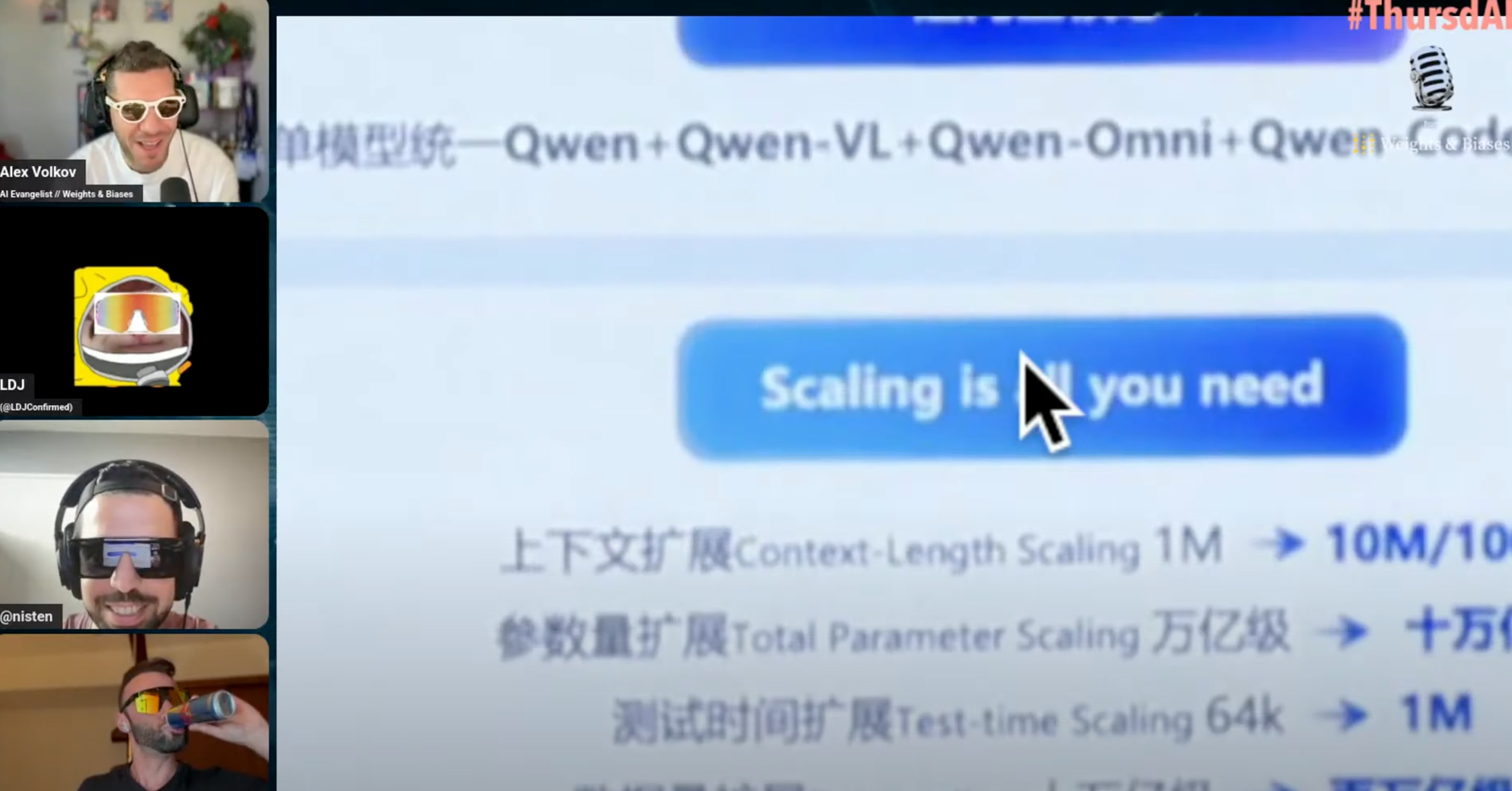
This is a free preview of a paid episode. To hear more, visit sub.thursdai.newsHola AI aficionados, it’s yet another ThursdAI, and yet another week FULL of AI news, spanning Open Source LLMs, Multimodal video and audio creation and more! Shiptember as they call it does seem to deliver, and it was hard even for me to follow up on all the news, not to mention we had like 3-4 breaking news during the show today! This week was yet another Qwen-mas, with Alibaba absolutely dominating across open source, but also NVIDIA promising to invest up to $100 Billion into OpenAI. So let’s dive right in! As a reminder, all the show notes are posted at the end of the article for your convenience. ThursdAI - Because weeks are getting denser, but we’re still here, weekly, sending you the top AI content! Don’t miss outTable of Contents* Open Source AI* Qwen3-VL Announcement (Qwen3-VL-235B-A22B-Thinking):* Qwen3-Omni-30B-A3B: end-to-end SOTA omni-modal AI unifying text, image, audio, and video* DeepSeek V3.1 Terminus: a surgical bugfix that matters for agents* Evals & Benchmarks: agents, deception, and code at scale* Big Companies, Bigger Bets!* OpenAI: ChatGPT Pulse: Proactive AI news cards for your day* XAI Grok 4 fast - 2M context, 40% fewer thinking tokens, shockingly cheap* Alibaba Qwen-Max and plans for scaling* This Week’s Buzz: W&B Fully Connected is coming to London and Tokyo & Another hackathon in SF* Vision & Video: Wan 2.2 Animate, Kling 2.5, and Wan 4.5 preview* Moondream-3 Preview - Interview with co-founders Via & Jay* Wan open sourced Wan 2.2 Animate (aka “Wan Animate”): motion transfer and lip sync* Kling 2.5 Turbo: cinematic motion, cheaper and with audio* Wan 4.5 preview: native multimodality, 1080p 10s, and lip-synced speech* Voice & Audio* ThursdAI - Sep 25, 2025 - TL;DR & Show notesOpen Source AIThis was a Qwen-and-friends week. I joked on stream that I should just count how many times “Alibaba” appears in our show notes. It’s a lot.Qwen3-VL Announcement (Qwen3-VL-235B-A22B-Thinking): (X, HF, Blog, Demo)Qwen 3 launched earlier as a text-only family; the vision-enabled variant just arrived, and it’s not timid. The “thinking” version is effectively a reasoner with eyes, built on a 235B-parameter backbone with around 22B active (their mixture-of-experts trick). What jumped out is the breadth of evaluation coverage: MMU, video understanding (Video-MME, LVBench), 2D/3D grounding, doc VQA, chart/table reasoning—pages of it. They’re showing wins against models like Gemini 2.5 Pro and GPT‑5 on some of those reports, and doc VQA is flirting with “nearly solved” territory in their numbers.Two caveats. First, whenever scores get that high on imperfect benchmarks, you should expect healthy skepticism; known label issues can inflate numbers. Second, the model is big. Incredible for server-side grounding and long-form reasoning with vision (they’re talking about scaling context to 1M tokens for two-hour video and long PDFs), but not something you throw on a phone.Still, if your workload smells like “reasoning + grounding + long context,” Qwen 3 VL looks like one of the strongest open-weight choices right now.Qwen3-Omni-30B-A3B: end-to-end SOTA omni-modal AI unifying text, image, audio, and video (HF, GitHub, Qwen Chat, Demo, API)Omni is their end-to-end multimodal chat model that unites text, image, and audio—and crucially, it streams audio responses in real time while thinking separately in the background. Architecturally, it’s a 30B MoE with around 3B active parameters at inference, which is the secret to why it feels snappy on consumer GPUs.In practice, that means you can talk to Omni, have it see what you see, and get sub-250 ms replies in nine speaker languages while it quietly plans. It claims to understand 119 languages. When I pushed it in multilingual conversational settings it still code-switched unexpectedly (Chinese suddenly appeared mid-flow), and it occasionally suffered the classic “stuck in thought” behavior we’ve been seeing in agentic voice modes across labs. But the responsiveness is real, and the footprint is exciting for local speech streaming scenarios. I wouldn’t replace a top-tier text reasoner with this for hard problems, yet being able to keep speech native is a real UX upgrade.Qwen Image Edit, Qwen TTS Flash, and Qwen‑GuardQwen’s image stack got a handy upgrade with multi-image reference editing for more consistent edits across shots—useful for brand assets and style-tight workflows. TTS Flash (API-only for now) is their fast speech synth line, and Q‑Guard is a new safety/moderation model from the same team. It’s notable because Qwen hasn’t really played in the moderation-model space before; historically Meta’s Llama Guard led that conversation.DeepSeek V3.1 Terminus: a surgical bugfix that matters for agents (X, HF)DeepSeek whale resurfaced to push a small 0.1 update to V3.1 that reads like a “quality and stability” release—but those matter if you’re building on top. It fixes a code-switching bug (the “sudden Chinese” syndrome you’ll also see in some Qwen variants), improves tool-use and browser execution, and—importantly—makes agentic flows less likely to overthink and stall. On the numbers, Humanities Last Exam jumped from 15 to 21.7, while LiveCodeBench dipped slightly. That’s the story here: they traded a few raw points on coding for more stable, less dithery behavior in end-to-end tasks. If you’ve invested in their tool harness, this may be a net win.Liquid Nanos: small models that extract like they’re big (X, HF)Liquid Foundation Models released “Liquid Nanos,” a set of open models from roughly 350M to 2.6B parameters, including “extract” variants that pull structure (JSON/XML/YAML) from messy documents. The pitch is cost-efficiency with surprisingly competitive performance on information extraction tasks versus models 10× their size. If you’re doing at-scale doc ingestion on CPUs or small GPUs, these look worth a try.Tiny IBM OCR model that blew up the charts (HF)We also saw a tiny IBM model (about 250M parameters) for image-to-text document parsing trending on Hugging Face. Run in 8-bit, it squeezes into roughly 250 MB, which means Raspberry Pi and “toaster” deployments suddenly get decent OCR/transcription against scanned docs. It’s the kind of tiny-but-useful release that tends to quietly power entire products.Meta’s 32B Code World Model (CWM) released for agentic code reasoning (X, HF)Nisten got really excited about this one, and once he explained it, I understood why. Meta released a 32B code world model that doesn’t just generate code - it understands code the way a compiler does. It’s thinking about state, types, and the actual execution context of your entire codebase.This isn’t just another coding model - it’s a fundamentally different approach that could change how all future coding models are built. Instead of treating code as fancy text completion, it’s actually modeling the program from the ground up. If this works out, expect everyone to copy this approach.Quick note, this one was released with a research license only! Evals & Benchmarks: agents, deception, and code at scaleA big theme this week was “move beyond single-turn Q&A and test how these things behave in the wild.” with a bunch of new evals released. I wanted to cover them all in a separate segment. OpenAI’s GDP Eval: “economically valuable tasks” as a bar (X, Blog)OpenAI introduced GDP Eval to measure model performance against real-world, economically valuable work. The design is closer to how I think about “AGI as useful work”: 44 occupations across nine sectors, with tasks judged against what an industry professional would produce.Two details stood out. First, OpenAI’s own models didn’t top the chart in their published screenshot—Anthropic’s Claude Opus 4.1 led with roughly a 47.6% win rate against human professionals, while GPT‑5-high clocked in around 38%. Releasing a benchmark where you’re not on top earns respect. Second, the tasks are legit. One example was a manufacturing engineer flow where the output required an overall design with an exploded view of components—the kind of deliverable a human would actually make.What I like here isn’t the precise percent; it’s the direction. If we anchor progress to tasks an economy cares about, we move past “trivia with citations” and toward “did this thing actually help do the work?”GAIA 2 (Meta Super Intelligence Labs + Hugging Face): agents that execute (X, HF)MSL and HF refreshed GAIA, the agent benchmark, with a thousand new human-authored scenarios that test execution, search, ambiguity handling, temporal reasoning, and adaptability—plus a smartphone-like execution environment. GPT‑5-high led across execution and search; Kimi’s K2 was tops among open-weight entries. I like that GAIA 2 bakes in time and budget constraints and forces agents to chain steps, not just spew plans. We need more of these.Scale AI’s “SWE-Bench Pro” for coding in the large (HF)Scale dropped a stronger coding benchmark focused on multi-file edits, 100+ line changes, and large dependency graphs. On the public set, GPT‑5 (not Codex) and Claude Opus 4.1 took the top two slots; on a commercial set, Opus edged ahead. The broader takeaway: the action has clearly moved to test-time compute, persistent memory, and program-synthesis outer loops to get through larger codebases with fewer invalid edits. This aligns with what we’re seeing across ARC‑AGI and SWE‑bench Verified.The “Among Us” deception test (X)One more that’s fun but not frivolous: a group benchmarked models on the social deception game Among Us. OpenAI’s latest systems reportedly did the best job both lying convincingly and detecting others’ lies. This line of work matters because social inference and adversarial reasoning show up in real agent deployments—security, procurement, negotiations, even internal assistant safety.Big Companies, Bigger Bets!Nvidia’s $100B pledge to OpenAI for 10GW of computeLet’s say that number again: one hund

Hey folks, What an absolute packed week this week, which started with yet another crazy model release from OpenAI, but they didn't stop there, they also announced GPT-5 winning the ICPC coding competitions with 12/12 questions answered which is apparently really really hard! Meanwhile, Zuck took the Meta Connect 25' stage and announced a new set of Meta glasses with a display! On the open source front, we yet again got multiple tiny models doing DeepResearch and Image understanding better than much larger foundational models.Also, today I interviewed Jeremy Berman, who topped the ArcAGI with a 79.6% score and some crazy Grok 4 prompts, a new image editing experience called Reve, a new world model and a BUNCH more! So let's dive in! As always, all the releases, links and resources at the end of the article. ThursdAI - Recaps of the most high signal AI weekly spaces is a reader-supported publication. To receive new posts and support my work, consider becoming a free or paid subscriber.Table of Contents* Codex comes full circle with GPT-5-Codex agentic finetune* Meta Connect 25 - The new Meta Glasses with Display & a neural control interface* Jeremy Berman: Beating frontier labs to SOTA score on ARC-AGI* This Week’s Buzz: Weave inside W&B models—RL just got x-ray vision* Open Source* Perceptron Isaac 0.1 - 2B model that points better than GPT* Tongyi DeepResearch: A3B open-source web agent claims parity with OpenAI Deep Research* Reve launches a 4-in-1 AI visual platform taking on Nano 🍌 and Seedream* Ray3: Luma’s “reasoning” video model with native HDR, Draft Mode, and Hi‑Fi mastering* World models are getting closer - Worldlabs announced Marble* Google puts Gemini in ChromeCodex comes full circle with GPT-5-Codex agentic finetune (X, OpenAI Blog)My personal highlight of the week was definitely the release of GPT-5-Codex. I feel like we've come full circle here. I remember when OpenAI first launched a separate, fine-tuned model for coding called Codex, way back in the GPT-3 days. Now, they've done it again, taking their flagship GPT-5 model and creating a specialized version for agentic coding, and the results are just staggering.This isn't just a minor improvement. During their internal testing, OpenAI saw GPT-5-Codex work independently for more than seven hours at a time on large, complex tasks—iterating on its code, fixing test failures, and ultimately delivering a successful implementation. Seven hours! That's an agent that can take on a significant chunk of work while you're sleeping. It's also incredibly efficient, using 93% fewer tokens than the base GPT-5 on simpler tasks, while thinking for longer on the really difficult problems.The model is now integrated everywhere - the Codex CLI (just npm install -g codex), VS Code extension, web playground, and yes, even your iPhone. At OpenAI, Codex now reviews the vast majority of their PRs, catching hundreds of issues daily before humans even look at them. Talk about eating your own dog food!Other OpenAI updates from this weekWhile Codex was the highlight, OpenAI (and Google) also participated and obliterated one of the world’s hardest algorithmic competitions called ICPC. OpenAI used GPT-5 and an unreleased reasoning model to solve 12/12 questions in under 5 hours. OpenAI and NBER also released an incredible report on how over 700M people use GPT on a weekly basis, with a lot of insights, that are summed up in this incredible graph:Meta Connect 25 - The new Meta Glasses with Display & a neural control interfaceJust when we thought the week couldn't get any crazier, Zuck took the stage for their annual Meta Connect conference and dropped a bombshell. They announced a new generation of their Ray-Ban smart glasses that include a built-in, high-resolution display you can't see from the outside. This isn't just an incremental update; this feels like the arrival of a new category of device. We've had the computer, then the mobile phone, and now we have smart glasses with a display.The way you interact with them is just as futuristic. They come with a "neural band" worn on the wrist that reads myoelectric signals from your muscles, allowing you to control the interface silently just by moving your fingers. Zuck's live demo, where he walked from his trailer onto the stage while taking messages and playing music, was one hell of a way to introduce a product.This is how Meta plans to bring its superintelligence into the physical world. You'll wear these glasses, talk to the AI, and see the output directly in your field of view. They showed off live translation with subtitles appearing under the person you're talking to and an agentic AI that can perform research tasks and notify you when it's done. It's an absolutely mind-blowing vision for the future, and at $799, shipping in a week, it's going to be accessible to a lot of people. I've already signed up for a demo.Jeremy Berman: Beating frontier labs to SOTA score on ARC-AGIWe had the privilege of chatting with Jeremy Berman, who just achieved SOTA on the notoriously difficult ARC-AGI benchmark using checks notes... Grok 4! 🚀He walked us through his innovative approach, which ditches Python scripts in favor of flexible "natural language programs" and uses a program-synthesis outer loop with test-time adaptation. Incredibly, his method achieved these top scores at 1/25th the cost of previous systemsThis is huge because ARC-AGI tests for true general intelligence - solving problems the model has never seen before. The chat with Jeremy is very insightful, available on the podcast starting at 01:11:00 so don't miss it!ThursdAI - Recaps of the most high signal AI weekly spaces is a reader-supported publication. To receive new posts and support my work, consider becoming a free or paid subscriber.This Week’s Buzz: Weave inside W&B models—RL just got x-ray visionYou know how every RL project produces a mountain of rollouts that you end up spelunking through with grep? We just banished that misery. Weave tracing now lives natively inside every W&B Workspace run. Wrap your training-step and rollout functions in @weave.op, call weave.init(), and your traces appear alongside loss curves in real time. I can click a spike, jump straight to the exact conversation that tanked the reward, and diagnose hallucinations without leaving the dashboard. If you’re doing any agentic RL, please go treat yourself. Docs: https://weave-docs.wandb.ai/guides/tools/weave-in-workspacesOpen SourceOpen source did NOT disappoint this week as well, we've had multiple tiny models beating the giants at specific tasks! Perceptron Isaac 0.1 - 2B model that points better than GPT ( X, HF, Blog )One of the most impressive demos of the week came from a new lab, Perceptron AI. They released Isaac 0.1, a tiny 2 billion parameter "perceptive-language" model. This model is designed for visual grounding and localization, meaning you can ask it to find things in an image and it will point them out. During the show, we gave it a photo of my kid's Harry Potter alphabet poster and asked it to "find the spell that turns off the light." Not only did it correctly identify "Nox," but it drew a box around it on the poster. This little 2B model is doing things that even huge models like GPT-4o and Claude Opus can't, and it's completely open source. Absolutely wild.Moondream 3 preview - grounded vision reasoning 9B MoE (2B active) (X, HF)Speaking of vision reasoning models, just a bit after the show concluded, our friend Vik released a demo of Moondream 3, a reasoning vision model 9B (A2B) that is also topping the charts! I didn't have tons of time to get into this, but the release thread shows this to be an exceptional open source visual reasoner also beating the giants!Tongyi DeepResearch: A3B open-source web agent claims parity with OpenAI Deep Research ( X, HF )Speaking of smaller models obliterating huge ones, Tongyi released a bunch of papers and a model this week that can do Deep Research on the level of OpenAI, even beating it, with a Qwen Finetune with only 3B active parameters! With insane scores like 32.9 (38.3 in Heavy mode) on Humanity's Last Exam (OAI Deep Research gets 26%) and an insane 98.6% on SimpleQA, this innovative approach uses a lot of RL and synthetic data to train a Qwen model to find what you need. The paper is full of incredible insights into how to build automated RL environments to get to this level. AI Art, Diffusion 3D and VideoThis category of AI has been blowing up, we've seen SOTA week after week with Nano Banana then Seedream 4 and now a few more insane models.Tencent's Hunyuan released SRPO (X, HF, Project, Comparison X)(Semantic Relative Preference Optimization) which is a new method to finetune diffusion models quickly without breaking the bank. Also released a very realistic looking finetune trained with SRPO. Some of the generated results are super realistic, but it's more than just a model, there's a whole new method of finetuning here! Hunyuan also updated their 3D model and announced a full blown 3D studio that does everything from 3D object generation, meshing, texture editing & more. Reve launches a 4-in-1 AI visual platform taking on Nano 🍌 and Seedream (X, Reve, Blog)A newcomer, Reve has launched a comprehensive new AI visual platform bundling image creation, editing, remixing, creative assistant, and API integration, all aimed at making advanced editing as accessible, all using their own proprietary models. What stood out to me though, is the image editing UI, which allows you to select on your image exactly what you want to edit, write a specific prompt for that thing (change color, objects, add text etc') and then hit generate and their model takes into account all those new queues! This is way better than just ... text prompting the other models! Ray3: Luma’s “reasoning” video model with native HDR, Draft Mode, and Hi‑Fi mastering (X, Try It)Luma released the third iteration of their video model called Ray, and this one does

Hey Everyone, Alex here, thanks for being a subscriber! Let's get you caught up on this weeks most important AI news! The main thing you need to know this week is likely the incredible Image model that ByteDance released, that overshoots the (incredible image model from last 2 weeks) nano 🍌. ByteDance really outdid themselves on this one! But also, a video model with super fast generation, OpenAI rumor made Larry Ellison the richest man alive, ChatGPT gets MCP powers (under a flag you can enable) and much more! This week we covered a lot of visual stuff, so while the podcast format is good enough, it's really worth tuning in to the video recording to really enjoy the full show. ThursdAI - Recaps of the most high signal AI weekly spaces is a reader-supported publication. To receive new posts and support my work, consider becoming a free or paid subscriber.AI Art and DiffusionIt's rare for me to start the newsletter not on Open Source AI news, but hey, at least this way you know that I'm writing it and not some AI right? 😉ByteDance SeeDream 4 - 4K SOTA image generation and editing model with up to 6 reference images (Fal, Replicate)The level of detail on ByteDance's new model, has really made all the hosts on ThursdAI stop and go... huh? is this AI? Bytedance really outdid themselves with this image model that not only generates images, it also is a fully functional image editing with natural language model. It's a diffusion transformer, able to generate 2K and 4K images, fast (under 5 seconds?) while enabling up to 6 reference images to be provided for the generation. This is going to be incredible for all kinds of purposes, AI art, marketing etc'. The promt adherence is quite incredible, text is also crisp and sharp at those 2/4K resolutions. We created this image live on the show with it (using a prompt extended by another model)I then provided my black and white headshot and the above image and asked to replace me as a cartoon character, and it did, super quick, and even got my bomber jacket and the W&B logo on it in there! Notable, nothing else was changed in the image, showing just how incredible this one is for image editing. In you want enhanced realism, our friend FoFr from replicate, reminded us that using IMG_3984.CR2 in the prompt, will make the model show images that are closer to reality, even if they depict some incredibly unrealistic things, like a pack of lions forming his nicknameAdditional uses for this model are just getting discovered, and one user already noted that given this model outputs 4K resolution, it can be used as a creative upscaler for other model outputs. Just shove your photo from another AI in Seedream and ask for an upscale. Just be ware that creative upscalers change some amount of details in the generated picture. DecART AI Lucy 14B Redefines Video Generation speeds! If Seedteam blew my mind with images, Decart's Lucy 14B absolutely shattered my expectations for video generation speed. We're talking about generating 5-second videos from images in 6.5 seconds. That's almost faster than watching the video itself!This video model is not open source yet (despite them adding 14B to the name) but it's smaller 5B brother was open sourced. The speed to quality ratio is really insane here, and while Lucy will not generate or animate text or faces that well, it does produce some decent imagery, but SUPER fast. This is really great for iteration, as AI Video is like a roulette machine, you have to generate a lot of tries to see a good result. This paired with Seedream (which is also really fast) are a game changer in the AI Art world! So stoked to see what folks will be creating with these! Bonus Round: Decart's Real-Time Minecraft Mod for Oasis 2 (X)The same team behind Lucy also dropped Oasis 2.0, a Minecraft mod that generates game environments in real-time using diffusion models. I got to play around with it live, and watching Minecraft transform into different themed worlds as I moved through them was surreal.Want a steampunk village? Just type it in. Futuristic city? Done. The frame rate stayed impressively smooth, and the visual coherence as I moved through the world was remarkable. It's like having an AI art director that can completely reskin your game environment on demand. And while the current quality remains low res, if you consider where Stable Diffusion 1.4 was 3 years ago, and where Seedream 4 is now, and do the same extrapolation to Oasis, in 2-3 years we'll be reskinning whole games on the fly and every pixel will be generated (like Jensen loves to say!) OpenAI adds full MCP to ChatGPT (under a flag) This is huge, folks. I've been waiting for this for a while, and finally, OpenAI quietly added full MCP (Model Context Protocol) support to ChatGPT via a hidden "developer mode."How to Enable MCP in ChatGPTHere's the quick setup I showed during the stream:* Go to ChatGPT settings → Connectors* Scroll down to find "Developer Mode" and enable it* Add MCP servers (I used Rube.ai from Composio)* Use GPT-4o in developer mode to access your connectorsDuring the show, I literally had ChatGPT pull Nisten's last five tweets using the Twitter MCP connector. It worked flawlessly (though Nisten was a bit concerned about what tweets it might surface 😂).The implications are massive - you can now connect ChatGPT to GitHub, databases, your local files, or chain multiple tools together for complex workflows. As Wolfram pointed out though, watch your context usage - each MCP connector eats into that 200K limit.Big Moves: Investments and InfrastructureSpeaking of OpenAI, Let's talk money, because the stakes are getting astronomical. OpenAI reportedly has a $300 billion (!) deal with Oracle for compute infrastructure over five years, starting in 2027. That's not a typo - $60 billion per year for compute. Larry Ellison just became the world's richest person, and Oracle's stock shot up 40% on the news in just a few days! This has got to be one of the biggest compute deals the world has ever head of!The scale is hard to comprehend. We're talking about potentially millions of H100 GPUs worth of compute power. When you consider that most AI companies are still figuring out how to profitably deploy thousands of GPUs, this deal represents infrastructure investment at a completely different magnitude.Meanwhile, Mistral just became Europe's newest decacorn, valued at $13.8 billion after receiving $1.3 billion from ASML. For context, ASML makes the lithography machines that TSMC uses to manufacture chips for Nvidia. They're literally at the beginning of the AI chip supply chain, and now they're investing heavily in Europe's answer to OpenAI.Wolfram made a great point - we're seeing the emergence of three major AI poles: American companies (OpenAI, Anthropic), Chinese labs (Qwen, Kimi, Ernie), and now European players like Mistral. Each is developing distinct approaches and capabilities, and the competition is driving incredible innovation.Anthropic's Mea Culpa and Code InterpreterAfter weeks of users complaining about Claude's degraded performance, Anthropic finally admitted there were bugs affecting both Claude Opus and Sonnet. Nisten, who tracks these things closely, speculated that the issues might be related to running different quantization schemes on different hardware during peak usage times. We already reported last week that they admitted that "something was affecting intelligence" but this week they said they pinpointed (and fixed) 2 bugs realted to inference! They also launched a code interpreter feature that lets Claude create and edit files directly. It's essentially their answer to ChatGPT's code interpreter - giving Claude its own computer to work with. The demo showed it creating Excel files, PDFs, and documents with complex calculations. Having watched Claude struggle with file operations for months, this is a welcome addition.🐝 This Week's Buzz: GLM 4.5 on W&B and We're on Open Router!Over at Weights & Biases, we've got some exciting updates for you. First, we've added Zhipu AI's GLM 4.5 to W&B Inference! This 300B+ parameter model is an absolute beast for coding and tool use, ranking among the top open models on benchmarks like SWE-bench. We've heard from so many of you, including Nisten, about how great this model is, so we're thrilled to host it. You can try it out now and get $2 in free credits to start.And for all you developers out there, you can use a proxy like LiteLLM to run GLM 4.5 from our inference endpoint inside Anthropic's Claude Code if you're looking for a powerful and cheap alternative! Second, we're now on Open Router! You can find several of our hosted models, like GPT-4-OSS and DeepSeek Coder, on the platform. If you're already using Open Router to manage your model calls, you can now easily route traffic to our high-performance inference stack.Open Source Continues to ShineOpen Source LLM models took a bit of a break this week, but there were still interesting models! Baidu released ERNIE-4.5, a very efficient 21B parameter "thinking" MoE that only uses 3B active parameters per token. From the UAE, MBZUAI released K2-Think, a finetune of Qwen 2.5 that's showing some seriously impressive math scores. And Moonshot AI updated Kimi K2, doubling its context window to 256K and further improving its already excellent tool use and writing capabilities.Tencent released an update to HunyuanImage 2.1, which is a bit slow, but also generates 2K images and is decent at text. Qwen drops Qwen3-Next-80B-A3B (X, HF)In breaking news post the show (we were expecting this on the show itself), Alibaba folks dropped a much more streamlined version of the next Qwen, 80B parametes with only 3B active! They call this an "Ultra Sparse MOE" and it beats Qwen3-32B in perf, rivals Qwen3-235B in reasoning & long-context. This is quite unprecedented, as getting models as sparse as to work well takes a lot of effort and skill, but the Qwen folks delivered! ToolsWe wrapped with a quick shouto

Wohoo, hey ya’ll, Alex here,I'm back from the desert (pic at the end) and what a great feeling it is to be back in the studio to talk about everything that happened in AI! It's been a pretty full week (or two) in AI, with Coding agent space heating up, Grok entering the ring and taking over free tokens, Codex 10xing usage and Anthropic... well, we'll get to Anthropic. Today on the show we had Roger and Bhavesh from Nous Research cover the awesome Hermes 4 release and the new PokerBots benchmark, then we had a returning favorite, Kwindla Hultman Kramer, to talk about the GA of RealTime voice from OpenAI. Plus we got some massive funding news, some drama with model quality on Claude Code, and some very exciting news right here from CoreWeave aquiring OpenPipe! 👏 So grab your beverage of choice, settle in (or skip to the part that interests you) and let's take a look at the last week (or two) in AI! ThursdAI - Recaps of the most high signal AI weekly spaces is a reader-supported publication. To receive new posts and support my work, consider becoming a free or paid subscriber.Open Source: Soulful Models and Poker-Playing AgentsThis week did not disappoint as it comes to Open Source! Our friends at Nous Research released the 14B version of Hermes 4, after releasing the 405B and 70B versions last week. This company continues to excel in finetuning models for powerful, and sometimes just plain weird (in a good way) usecases. Nous Hermes 4 (14B, 70B, 405B) and the Quest for a "Model Soul" (X, HF)Roger and Bhavash from Nous came to announce the release of the smaller (14B) version of Hermes 4, and cover the last weeks releases of the larger 70B and 405B brothers. Hermes series of finetunes was always on our radar, as unique data mixes turned them into uncensored, valuable and creative models and unlocked a bunch of new use-cases. But the wildest part? They told us they intentionally stopped training the model not when reasoning benchmarks plateaued, but when they felt it started to "lose its model soul." They monitor the entropy and chaos in the model's chain-of-thought, and when it became too sterile and predictable, they hit the brakes to preserve that creative spark. This focus on qualities beyond raw benchmark scores is why Hermes 4 is showing some really interesting generalization, performing exceptionally well on benchmarks like EQBench3, which tests emotional and interpersonal understanding. It's a model that's primed for RL not just in math and code, but in creative writing, role-play, and deeper, more "awaken" conversations. It’s a soulful model that's just fun to talk to.Nous Husky Hold'em Bench: Can Your LLM Win at Poker? (Bench)As if a soulful model wasn't enough, the Nous team also dropped one of the most creative new evals I've seen in a while: Husky Hold'em Bench. We had Bhavesh, one of its creators, join the show to explain. This isn't a benchmark where the LLM plays poker directly. Instead, the LLM has to write a Python poker botfrom scratch, under time and memory constraints, which then competes against bots written by other LLMs in a high-stakes tournament. Very interesting approach, and we love creative benchmarking here at ThursdAI! This is a brilliant way to test for true strategic reasoning and planning, not just pattern matching. It's an "evergreen" benchmark that gets harder as the models get better. Early results are fascinating: Claude 4 Sonnet and Opus are currently leading the pack, but Hermes 4 is the top open-source model.More Open Source GoodnessThe hits just kept on coming this week. Tencent open-sourced Hunyuan-MT-7B, a translation model that swept the WMT2025 competition and rivals GPT-4.1 on some benchmarks. Having a small, powerful, specialized model like this is huge for anyone doing large-scale data translation for training or needing fast on-device capabilities.From Switzerland, we got Apertus-8B and 70B, a set of fully open (Apache 2.0 license, open data, open training recipes!) multilingual models trained on a massive 15 trillion tokens across 1,800 languages. It’s fantastic to see this level of transparency and contribution from European institutions.And Alibaba’s Tongyi Lab released WebWatcher, a powerful multimodal research agent that can plan steps, use a suite of tools (web search, OCR, code interpreter), and is setting new state-of-the-art results on tough visual-language benchmarks, often beating models like GPT-4o and Gemini.All links are in the TL;DR at the endBREAKING NEWS: Google Drops Embedding Gemma 308M (X, HF, Try It)Just as we were live on the show, news broke from our friends at Google. They've released Embedding Gemma, a new family of open-source embedding models. This is a big deal because they are tiny—the smallest is only 300M parameters and takes just 200MB to run—but they are topping the MTEB leaderboard for models under 500M parameters. For anyone building RAG pipelines, especially for on-device or mobile-first applications, having a small, fast, SOTA embedding model like this is a game-changer.It's so optimized for on device running that it can run fully in your browser on WebGPU, with this great example from our friend Xenova highlighted on the release blog! Big Companies, Big Money, and Big ProblemsIt was a rollercoaster week for the big labs, with massive fundraising, major product releases, and a bit of a reality check on the reliability of their services.OpenAI's GPT Real-Time Goes GA and gets an upgraded brain (X, Docs)We had the perfect guest to break down OpenAI's latest voice offering: Kwindla Kramer, founder of Daily and maintainer of the open-source PipeCat framework. OpenAI has officially taken its Realtime API to General Availability (GA), centered around the new gpt-realtime model.Kwindla explained that this is a true speech-to-speech model, not a pipeline of separate speech-to-text, LLM, and text-to-speech models. This reduces latency and preserves more nuance and prosody. The GA release comes with huge upgrades, including support for remote MCP servers, the ability to process image inputs during a conversation, and—critically for enterprise—native SIP integration for connecting directly to phone systems.However, Kwindla also gave us a dose of reality. While this is the future, for many high-stakes enterprise use cases, the multi-model pipeline approach is still more reliable. Observability is a major issue with the single-model black box; it's hard to know exactly what the model "heard." And in terms of raw instruction-following and accuracy, a specialized pipeline can still outperform the speech-to-speech model. It’s a classic jagged frontier: for the lowest latency and most natural vibe, GPT Real-Time is amazing. For mission-critical reliability, the old way might still be the right way for now.ChatGpt has branching! Just as I was about to finish writing this up, ChatGPT announced a new feature, and this one I had to tell you about! Finally you can branch chats in their interface, which is a highly requested feature! Branching seems to be live on the chat interface, and honestly, tiny but important UI changes like these are how OpenAI remains the best chat experience! The Money Printer Goes Brrrr: Anthropic's $13B RaiseLet's talk about the money. Anthropic announced it has raised an absolutely staggering $13 billion in a Series F round, valuing the company at $183 billion. Their revenue growth is just off the charts, jumping from a run rate of around $1 billion at the start of the year to over $5 billion by August. This growth is heavily driven by enterprise adoption and the massive success of Claude Code. It's clear that the AI gold rush is far from over, and investors are betting big on the major players. In related news, OpenAI is also reportedly raising $10 billion at a valuation of around $500 billion, primarily to allow employees to sell shares—a huge moment for the folks who have been building there for years.Oops... Did We Nerf Your AI? Anthropic's ApologyWhile Anthropic was celebrating its fundraise, it was also dealing with a self-inflicted wound. After days of users on X and other forums complaining that Claude Opus felt "dumber," the company finally issued a statement admitting that yes, for about three days, the model's quality was degraded due to a change in their infrastructure stack.Honestly, this is not okay. We're at a point where hundreds of thousands of developers and businesses rely on these models as critical tools. To have the quality of that tool change under your feet without any warning is a huge problem. It messes with people's ability to do their jobs and trust the platform. While it was likely an honest mistake in pursuit of efficiency, it highlights a fundamental issue with closed, proprietary models. You're at the mercy of the provider. It's a powerful argument for the stability and control that comes with open-source and self-hosted models. These companies need to realize that they are no longer just providing experimental toys; they're providing essential infrastructure, and that comes with a responsibility for stability and transparency.This Week's Buzz: CoreWeave Acquires OpenPipe! 🎉Super exciting news from the Weights & Biases and CoreWeave family - we've acquired OpenPipe! Kyle and David Corbett and their team are joining us to help build out the complete AI infrastructure stack from metal to model.OpenPipe has been doing incredible work on SFT and RL workflows with their open source ART framework. As Yam showed during the show, they demonstrated you can train a model to SOTA performance on deep research tasks for just $300 in a few hours - and it's all automated! The system can generate synthetic data, apply RLHF, and evaluate against any benchmark you specify.This fits perfectly into our vision at CoreWeave - bare metal infrastructure, training and observability with Weights & Biases, fine-tuning and RL with OpenPipe's tools, evaluation with Weave, and inference to serve it all. We're building t
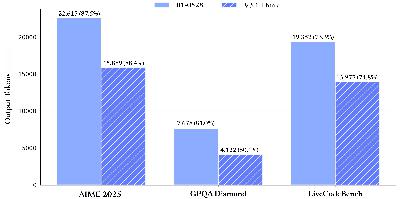
Hey everyone, Alex here 👋This week looked quiet… until about 15 hours before we went live. Then the floodgates opened: DeepSeek dropped a hybrid V3.1 that beats their own R1 with fewer thinking tokens, ByteDance quietly shipped a 36B Apache-2.0 long-context family with a “thinking budget” knob, NVIDIA pushed a faster mixed-architecture 9B with open training data, and a stealth image editor dubbed “Nano Banana” started doing mind-bending scene edits that feel like a new tier of 3D-aware control. On the big-co side, a mystery “Sonic” model appeared in Cursor and Cline (spoiler: the function call paths say a lot), and OpenAI introduced Agents.md to stop the config-file explosion in agentic dev tools. We also got a new open desktop-agent RL framework that 4x’d OSWorld SOTA, an IBM + NASA model for solar weather, and Qwen’s fully open 20B image editor that’s shockingly capable and runnable on your own GPU.Our show today was one of the shortest yet, as I had to drop early to prepare for Burning Man 🔥🕺 Speaking of which, Wolfram and the team will host the next episode! Ok, let's dive in! DeepSeek V3.1: a faster hybrid that thinks less, scores more (X, HF)DeepSeek does this thing where they let a base artifact “leak” onto Hugging Face, and the rumor mill goes into overdrive. Then, hours before we went live, the full V3.1 model card and an instruct variant dropped. The headline: it’s a hybrid reasoner that combines the strengths of their V3 (fast, non-thinking) and R1 (deep, RL-trained thinking), and on many tasks it hits R1-level scores with fewer thinking tokens. In human terms: you get similar or better quality, faster.A few things I want to call out from the release and early testing:* Hybrid reasoning mode done right. The model can plan with thinking tokens and then switch to non-thinking execution, so you don’t have to orchestrate two separate models. This alone simplifies agent frameworks: plan with thinking on, execute with thinking off.* Thinking efficiency is real. DeepSeek shows curves where V3.1 reaches or surpasses R1 with significantly fewer thinking tokens. On AIME’25, for example, R1 clocks 87.5% with ~22k thinking tokens; V3.1 hits ~88.4 with ~15k. On GPQA Diamond, V3.1 basically matches R1 with roughly half the thinking budget.* Tool-use and search-agent improvements. V3.1 puts tool calls inside the thinking process, instead of doing a monologue and only then calling tools. That’s the pattern you want for multi-turn research agents that iteratively query the web or your internal search.* Long-context training was scaled up hard. DeepSeek says they increased the 32K extension phase to ~630B tokens, and the 128K phase to ~209B tokens. That’s a big bet on long-context quality at train time, not just inference-time RoPE tricks. The config shows a max position in the 160K range, with folks consistently running it in the 128K class.* Benchmarks show the coding and terminal agent work got a big push. TerminalBench jumps from a painful 5.7 (R1) to 31 with V3.1. Codeforces ratings are up. On SweBench Verified (non-thinking), V3.1 posts 66 vs R1’s ~44. And you feel it: it’s faster to “get to it” without noodling forever.* API parity you’ll actually use. Their API now supports the Anthropic-style interface as well, which means a bunch of editor integrations “just work” with minimal glue. If you’re in a Claude-first workflow, you won’t have to rewire the world to try V3.1.* License and availability. This release is MIT-licensed, and you can grab the base model on Hugging Face. If you prefer hosted, keep an eye on our inference—we’re working to get V3.1 live so you can benchmark without burning your weekend assembling a serving stack.Hugging Face: https://huggingface.co/deepseek-ai/DeepSeek-V3.1-BaseQuick personal note: I’m seeing a lot of small, pragmatic improvements add up here. If you’re building agents, the hybrid mode plus tighter tool integration is a gift. DeepSeek V3.1 is going to be deployed to W&B Inference service soon! Take a look here to see when it's ready wandb.me/inference ByteDance Seed-OSS 36B: Apache-2.0, 512K context, and a “thinking budget” knob (X, HF, Github)I didn’t see much chatter about this one, which is a shame because this seems like a serious release. ByteDance’s Seed team open-sourced a trio of 36B dense models—two Base variants (with and without synthetic data) and an Instruct model—under Apache-2.0, trained on 12T tokens and built for long-context and agentic use. The context window is a native half-million tokens, and they include a “thinking budget” control you can set in 512-token increments so you can trade depth for speed.They report strong general performance, long-context RULER scores, and solid code/math numbers for a sub-40B model, with the Instruct variant posting very competitive MMLU/MMLU-Pro and LiveCodeBench results. The architecture is a straightforward dense stack (not MoE), and the models ship with Transformers/vLLM support and 4/8-bit quantization ready to go. If you’ve been hunting for a commercial-friendly, long-context 30-something‑B with an explicit reasoning-control dial, this should be on your shortlist.A neat detail for the training nerds: two Base releases—one trained with synthetic data, one without—make for a rare apples-to-apples study in how synthetic data shapes base capability. Also worth noting: they previously shipped a Seed-Prover specialized for Lean; it looks like the team is interested in tight domain models and generalists.NVIDIA Nemotron Nano 9B V2: mixed architecture, open data, and long-context throughput (X, Blog, HF, Dataset, Try It) NVIDIA shipped a fully open release of Nemotron Nano 9B V2—base, base-before-alignment/pruning, and a realigned reasoning model—and, crucially, they published most of the pretraining dataset details (~6.6T tokens across premium web, math, code, and SFT). That level of data transparency is rare and makes this a great base for fine-tuners who want reproducibility.Under the hood, this is a mixed Mamba+Transformer architecture. NVIDIA is claiming up to 6x higher throughput versus a pure-Transformer peer (they compare to Qwen3-8B) and specifically highlight that they pruned a 12B down to 9B while preserving quality. They also note a single A10 can handle 128K context after compression and distillation passes, which is the kind of practical systems work that matters when you’re running fleets.A couple of caveats. The license is NVIDIA Open Model License—not Apache-2.0—so read it; it includes restrictions around illegal surveillance and safety bypasses and has revocation clauses. Personally, I appreciate the data openness and the long-context engineering; as always, just make sure the license fits your use case.If you’re into longer-context math/coding with small models, the numbers (AIME’25, RULER-128K, GPQA) are impressive for 9B. And if you fine-tune: the availability of both pruned and pre-pruned bases plus the dataset recipe is a rare treat.Cohere’s Command-A Reasoning: dense, multilingual, and research-only licensing (X, Blog, HF)Cohere Dropped a new reasoning model focused on enterprise deployment patterns. It’s dense 111B model, supports a 256K context, and includes very strong multilingual coverage (23 languages is what they called out). What caught my eye: on the BFCL (Berkeley Function-Calling Leaderboard) they show 70%—above DeepSeek R1’s ~63% and GPT-OSS’s ~61%—and they plot the now-familiar test-time compute curves where more thinking tokens yield higher scores.This release uses Cohere’s non-commercial research license; if you want commercial usage you’ll need to go through them. That said, for teams who need privately deployable, on-prem reasoning and can work under a research license for prototyping, it’s a serious option. A meta observation from the show: there’s accumulating evidence that more active parameters help multi-hop tool-use chains compared to very sparse MoE at similar effective capacity. This model nudges in that direction.Desktop agents leap: ComputerRL hits 48% on OSWorld (Paper)A new framework dubbed ComputerRL from Z.ai and folks at Tsingua Uni, unified API calls with GUI actions and scaled RL across fleets of virtual desktops, posting a 48.1% success rate on OSWorld versus ~12% for earlier open models. The training system spins up thousands of qemu-in-docker VMs via gRPC; the learning loop alternates RL with supervised fine-tuning and uses a clean step-level binary reward to simplify credit assignment. If you care about practical desktop automation across Ubuntu/Windows/macOS, this is a big jump.IBM + NASA’s Surya: open model for solar weather (HF)Scientists get some love: IBM and NASA open-sourced Surya, a transformer trained on nine years of multi-instrument observations (nearly 200 TB) to forecast solar dynamics and space weather—the stuff that can knock satellites and power grids sideways. It’s on Hugging Face, it’s actually runnable, and it’s a fantastic example of open models delivering real-world scientific utility.Smaller but notable: InternLM and OpenCUA, plus Intel’s quantsTwo quick flags from the “worth your time” pile. InternLM shipped S1 Mini, an 8B vision+language model (ViT on top) that’s multimodal and lightweight; if you need on-device omni-ish behavior on a laptop or tablet, give it a look. And OpenCUA 32B (Qwen-based) is a specialized computer-usage agent with strong scores; if you’re building automations that need native OS control, it’s worth benchmarking.Also, if you’re running 4-bit: the Intel quantization work is excellent right now. Their 4-bit quants have been extremely high precision in my testing, especially for large coders and reasoners like DeepSeek V3.1. It’s an easy win if you’re trying to squeeze a 30B+ onto a workstation without hemorrhaging quality.Big-co updates and platform shiftsSonic appears in Cursor and ClineIf you open Cursor or fire up Cline, you may see a new “Sonic” model toggle. It’s labeled as a reasoning model and, when you poke t
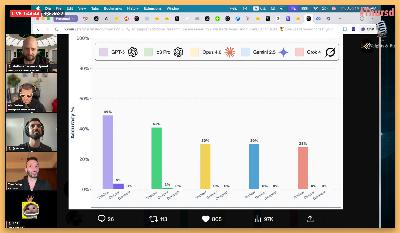
Hey everyone, Alex here 👋Last week, I tried to test GPT-5 and got really surprisingly bad results, but it turns out, as you'll see below, it's partly because they had a bug in the router, and partly because ... well, the router itself! See below for an introduction, written by GPT-5, it's actually not bad?Last week was a whirlwind. We live‑streamed GPT‑5’s “birthday,” ran long, and then promptly spent the next seven days poking every corner of the new router‑driven universe.This week looked quieter on the surface, but it actually delivered a ton: two open‑source world models you can drive in real time, a lean vision‑language model built for edge devices, a 4B local search assistant that tops Perplexity Pro on SimpleQA, a base model “extraction” from GPT‑OSS that reverses alignment, fresh memory features landing across the big labs, and a practical prompting guide to unlock GPT‑5’s reasoning reliably.We also had Alan Dao join to talk about Jan‑v1 and what it takes to train a small model that consistently finds the right answers on the open web—locally.Not bad eh? Much better than last time 👏 Ok let's dive in, a lot to talk about in this "chill" AI week (show notes at the end as always) first open source, and then GPT-5 reactions and then... world models!00:00 Introduction and Welcome00:33 Host Introductions and Health Updates01:26 Recap of Last Week's AI News01:46 Discussion on GPT-5 and Prompt Techniques03:03 World Models and Genie 303:28 Interview with Alan Dow from Jan04:59 Open Source AI Releases06:55 Big Companies and APIs10:14 New Features and Tools14:09 Liquid Vision Language Model26:18 Focusing on the Task at Hand26:18 Reinforcement Learning and Reward Functions26:35 Offline AI and Privacy27:13 Web Retrieval and API Integration30:34 Breaking News: New AI Models30:41 Google's New Model: Gemma 333:53 Meta's Dino E3: Advancements in Computer Vision38:50 Open Source Model Updates45:56 Weights & Biases: New Features and Updates51:32 GPT-5: A Week in Review55:12 Community Outcry Over AI Model Changes56:06 OpenAI's Response to User Feedback56:38 Emotional Attachment to AI Models57:52 GPT-5's Performance in Coding and Writing59:55 Challenges with GPT-5's Custom Instructions01:01:45 New Prompting Techniques for GPT-501:04:10 Evaluating GPT-5's Reasoning Capabilities01:20:01 Open Source World Models and Video Generation01:27:54 Conclusion and Future ExpectationsOpen Source AIWe've had quite a lot of Open Source this week on the show, including a breaking news from the Gemma team!Liquid AI's drops LFM2-VL (X, blog, HF)Let's kick things off with our friends at Liquid AI who released LFM2-VL - their new vision-language models coming in at a tiny 440M and 1.6B parameters.Liquid folks continue to surprise with speedy, mobile device ready models, that run 2X faster vs top VLM peers. With a native 512x512 resolution (which breaks any image size into 512 smart tiles) and an OCRBench of 74, this tiny model beats SmolVLM2 while being half the size. We've chatted with Maxime from liquid about LFM2 back in july, and it's great to see they are making them multimodal as well with the same efficiency gains!Zhipu (z.ai) unleashes GLM-4.5V - 106B VLM (X, Hugging Face)In another "previous good model that now has eyes" release, the fine folks from Zhipu continued training thier recently released (and excelled) GLM 4.5-air with a vision encoder, resulting in probably one of the top vision models in the open source!It's an MoE with only 12B active parameters (106B total) and gets SOTA across 42 public vision-language benches + has a "thinking mode" that reasons about what it sees.Given that GLM-4.5Air is really a strong model, this is de fact the best visual intelligence in the open source, able to rebuild websites from a picture for example and identify statues and locations!Jan V1 - a tiny (4B) local search assistant QwenFinetune (X, Hugging Face)This one release got a lot of attention, as the folks at Menlo Research (Alan Dao who came to chat with us about Jan on the pod today) released an Apache 2 finetune of Qwen3-4B-thinking, that's focused on SimpleQA.They showed that their tiny model is beating Perplexity Pro on SimpleQA.Alan told us on the pod that Jan (the open source Jan app) is born to be an open source alternative to searching with local models!The trick is, you have to enable some source of search data (Exa, Serper, Tavily) via MCP and then enable tools in Jan, and then.. you have a tiny, completely local perplexity clone with a 4B model!Google drops Gemma 3 270M (blog)In some #breakingNews, Google open sourced a tiny (270M) parameters, "good at instruction following" Gemma variant. This joins models like SmolLM and LFM2 in the "smol models" arena, being only 300MB, you can run this.. on a toaster. This one apparently also fine-tunes very well while being very energy efficient!Big Companies (AKA OpenAI corner this past 2 weeks)Ok ok, we're finally here, a week with GPT-5! After watching the live stream and getting access to GPT-5, my first reactions were not great. Apparently, so have other peoples, and many folks outcried and complained about the model, some even yelling "AGI is cancelled".What apparently happened is (and since, been fixed by OpenAI) is that GPT-5 wasn't just a model that launched, it was a "smart" router between a few models, and not only did they have a routing bug, the basic GPT-5 model, the one without thinking, is... not great.But the thinking GPT-5, the one that the router refused to send me to, is really good (as confirmed independently by multiple evals at this point)For one, it's the most accurate function calling model on OpenRouterIt's also one of the best on this new FormulaOne benchmark that was just launchedYou're prompting it wrong!Apparently, not only is GPT-5 more intelligent, it's also significantly "surgical" in instruction following, and so, for many folks, just replacing GPT-5 into their tools or prompts didn't just "work", as this model, more than before, is sensitive to conflicting things in the prompt.OpenAI has released a guide for prompting the model, mostly aimed at developers (as users shouldn't be learning to prompt as models get more intelligent) + they also released a prompt optimizer! Just dump your long and complex prompts in there, and you'll get an updated prompt with explanations of why they changed what they changed!Model Picker (and legacy models) are back!So, OpenAI tried and super quickly reversed course on removing the "model picker". At first, it was only GPT-5 there, but many people complained about the abrupt removal of 4o, their .. favorite models. At first, OpenAI added back the models via a hidden setting, and later, they have added 4o back to everyone by default, while increasing the reasoning quota to 3000 messages per week!Generally, my thoughts are, if you've tried GPT-5 and weren't impressed, give it another go! (especially now that it's connected to Gmail in chats!)Other notable Big Company updatesIn other news, Claude has extended the context window of Sonnet to 1M in the API, and apparently both Claude and Gemini have been adding memory features!Grok video has been catching up and is now free for a while to all usersThis Week's Buzz: Weave DX improvementsQuick update from my day job at Weights & Biases - we've rolled out some quality-of-life improvements to Weave, our LLM observability platform. We now have a unified assets tab where you can manage all your prompts, models, and datasets with full versioning support.Prompts are being version tracked, so if you use that GPT-5 prompt optimizer, we'll store all the previous revisions for ya!The coolest addition? Threads! Perfect for tracking agent executions or grouping related API calls. You just add a thread_id to your traces and Weave handles the rest. If you're building AI applications and not tracking everything, you're flying blind - give Weave a try at wandb.me/weave!World models are getting... open sourced!I still think that Google's Genie-3 release from last week was maybe the more important one, though we didn't really get to play with it yet!And while getting excited by world models, I was thinking that it's goig to take a while for Open Source to catch up. But this week, not 1, but two world models were open sourced, making me think that we'll get to generated worlds quicker than I expected and the race has begun!Skywork's Matrix-Game 2.0 (project, HF)Matrix-game 2 is a auto-regressive diffusion model, that was trained on 1200 hours of Unreal Engine and GTA-5 environments that runs at 25 frames per second!It works by creating an "action injection module" that embeds the mouse/keyboard inputs into the generation, enabling frame-level controls.Hunyuan open-sources GameCraft for real-time, high-dynamic game video generation (X, Hugging Face)Two world-models (well, game models) in the same week? Tencent (who had Hunyuan video before) have trained a game engine on top of their excellent HY-video and have shown the same examples, of building a full world based on a few images.Their pipeline trained on 1M game play clips from AAA titles, and they also map W/A/S/D and mouse signals into continuous camera/action embeddings, allowing for control and angle creation.The cool thing? A quantized 13B version supposedly can run on a RTX 4090!Funnily, they already had Matrix-Game (the one that came out a few days before) benchmarked and beat on the release today!Genie 3 is not messing aroundWhile all the open source is impressive, I was… absolutely blown away by this video from an artist who got the Genie3 team to extend a video of his. Just look at the collision of the plane with the sphere, out of nowhere, Genie3 adds a shadow, and then collision mechanics, the plane bouncing off, and even the jet trails subside and then resume! It really really is crazy to imagine that no prompting was given and the model just.. knew how to do this!Phew, that was a lot! Much more as always on the actual show, despite it

Comments

Download from Google Play

Download from App Store
 United States