


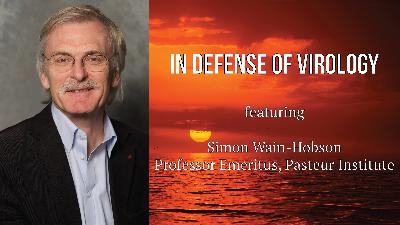
'In Defense of Virology' featuring Simon Wain-Hobson (Episode 3: Do No Harm)
Description
In the third episode of In Defense of Virology, Rutgers Professor and Science From the Fringe host Bryce Nickels and distinguished virologist Simon Wain-Hobson discuss two striking examples of reckless virology research—one well known and the other largely forgotten—and issue a call to change the culture of modern science.
The first example revisits the controversial resurrection of the 1918 Spanish flu, a virus that killed tens of millions worldwide. Simon explains how NIH-funded researchers extracted genetic fragments from frozen cadavers, used PCR to reconstruct the viral genome, and then revived the virus in 2005, publishing the full sequence in Science. Despite claims that the work would aid vaccine development, he argues that no public-health benefit ever materialized, while the potential for misuse dramatically increased.
The second example, less known but equally concerning, involves retroviruses resurrected from fragments within the human genome. In work published in 2006 and 2007, researchers in France and New York chemically synthesized what they believed to be defunct human viruses—naming one “Phoenix.” Although performed with NIH and national-science-foundation support, there was no transparency about biosafety levels or prior ethical review. Simon argues that such experiments, however clever, violate the moral boundary between curiosity and recklessness.
From these examples, Simon and Bryce turn to solutions—chief among them a Hippocratic Oath for scientists. Just as physicians swear to “do no harm,” they propose that life-science researchers and funding agencies adopt a similar pledge to avoid work that makes the world more dangerous. Simon envisions a three-part reform: NIH and major foundations embedding the principle into grants, universities incorporating it into graduation ceremonies, and scientific culture embracing it as a moral baseline.
The conversation closes with a call to action for listeners: write to local universities or newspapers to support a research culture grounded in humility, safety, and moral responsibility.
(Recorded October 23, 2025)
Timestamps
00:31 — Welcome and introduction to Episode 302:23 — “Spin doctoring” in science and how truth becomes a casualty02:43 — Introducing the concept of informational hazards03:47 — Example 1: resurrection of the 1918 Spanish flu06:43 — How NIH-funded teams recovered and sequenced the virus07:41 — Publication of the full genome in Science and public controversy09:26 — No evidence the 2005 research ever improved vaccines10:15 — Why resurrecting extinct pathogens made the world more dangerous11:22 — “Diagnostics, vaccines, and drugs” - the rhetorical trinity used to justify risky work13:21 — Example 2: resurrecting retroviruses from human DNA15:27 — The “Phoenix” virus and synthetic resurrection of endogenous retroviruses16:30 — Unknown risks and missing biosafety disclosures (BSL-2 vs BSL-3)18:25 — How such studies quietly made the world more dangerous19:35 — Lack of discussion, oversight, or institutional memory21:10 — Should dangerous publications be suppressed—or discussed openly?22:04 — Comparing resurrection of retroviruses to the 1918 flu revival23:46 — Cultural problem: institutions hide mistakes to protect funding27:22 — Proposal: a Hippocratic Oath for scientists—“first, do no harm”34:48 — Extending ethical oaths to AI and other technologies38:33 — Prior discussions about a Hippocratic Oath with current NIH Director Jay Bhattacharya42:39 — Bryce pledges to write an op-ed urging Rutgers to adopt the oath44:19 — Closing remarks
intro and outro by Tess Parks
Get full access to Science From the Fringe at sciencefromthefringe.substack.com/subscribe



 United States
