


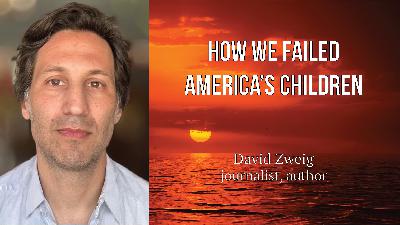
David Zweig on How We Failed America’s Children
Description
In this episode of Science From the Fringe, host Bryce Nickels, speaks with David Zweig—a New York City–based journalist, author, and contributor to The Atlantic, The New York Times, and The Free Press—about his new book, An Abundance of Caution: American Schools, the Virus, and the Story of Bad Decisions.
Their conversation traces David’s motivation for writing the book, beginning with his early recognition of the devastating effects of remote learning on children during the COVID-19 pandemic. David explains how a mix of action bias, politicization, and institutional inertia led to catastrophic decisions on school closures and mitigation measures such as masking, distancing, and barriers.
David critiques the reliance on flawed models, the role of teachers’ unions, and the class divides that deepened the harms, while highlighting how real-time evidence from Europe and elsewhere was ignored. The discussion also explores the erosion of public trust, the suppression of dissent, and the moral grandstanding that replaced evidence-based reasoning.
At its core, this episode examines how “good” intentions and systemic dysfunction combined to produce policies that harmed children with little to no public health benefit, and what it will take to ensure more intellectually honest, transparent, and evidence-driven decision-making in future crises.
(Recorded November 10, 2025)
Timestamps00:31 — Introduction of David Zweig01:35 — Motivation for writing An Abundance of Caution05:12 — Blending personal anecdotes, data, and scientific rigor06:32 — Emotional reactions to the book and persuading skeptics10:56 — Zweig’s evolution on masking and other measures11:58 — The book as a scholarly record of COVID policy failures12:43 — Defining “lockdowns” and related interventions15:09 — Evidence behind interventions and debunking the “fog of war” defense17:34 — Decision-making biases and societal consequences19:04 — Action bias in public health and medicine21:40 — Lack of off-ramps and moral posturing23:45 — Suppression of dissent and personal backlash25:32 — Institutional inertia in prolonging ineffective policies26:56 — The “Red Dawn” emails and early pandemic decisions30:07 — C.S. Lewis on tyranny and moral sanctimony31:14 — Why non-experts sometimes outperformed professionals33:48 — The “laptop class” and unmodeled harms37:33 — Classism and the uneven impact of school closures39:57 — The “Swiss cheese” model as an admission of uncertainty42:27 — Harms to children and the inversion of priorities44:09 — Shifting definitions and moving goalposts47:35 — Media failures and socioeconomic bias49:49 — Parental pushback and excuses to delay reopening51:28 — Financial and political incentives behind closures54:52 — HEPA filters and other misplaced reopening conditions58:00 — Cuomo’s “reimagining education” and tech opportunism01:02:11 — Election-year politics and Trump’s influence01:05:46 — The AAP’s reversal on school guidance01:08:16 — The AAP’s misconduct and other “worst actors”01:10:23 — Accountability and blind allegiance to authority01:14:36 — Lessons for the future and enduring divisions01:16:02 — The current historical narrative and the book as documentation01:18:07 — Scientific resistance to evidence and institutional flaws01:20:51 — Invitation for Zweig to speak at Rutgers01:22:25 — Closing reflections
intro by Tess Parks; outro by David Zweig
Get full access to Science From the Fringe at sciencefromthefringe.substack.com/subscribe




 United States
