


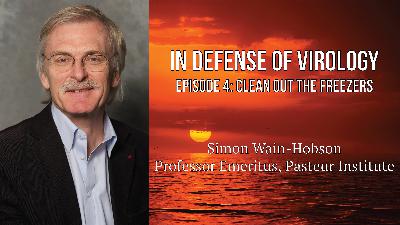
'In Defense of Virology' featuring Simon Wain-Hobson (Episode 4: Clean Out the Freezers)
Description
In the fourth episode of In Defense of Virology, Rutgers Professor and Science From the Fringe host Bryce Nickels and distinguished virologist Simon Wain-Hobson argue that labs should destroy frozen stocks of dangerous, nonessential pathogens produced through gain-of-function research or historical resurrection—simple to do, high-impact for reducing global risk.
Simon highlights precedent—from post-eradication smallpox and rinderpest—and cites a recent Newcastle disease virus re-emergence in China strongly suggestive of a freezer escape. Given that even top labs leak, he argues, destruction of unnecessary stocks is common-sense risk reduction.
The episode concludes with an overlooked puzzle: despite SARS-CoV-2’s devastating impact, fewer than 100 related genomes have been disclosed, compared to more than 240 for SARS-1. Whether due to undersampling or undisclosed sequences, Simon contends the gap is a public-health failure—surveillance is essential, but must not be confused with the risky manipulation that helped create today’s biosafety crisis. Virology must decide between continued high-risk work and responsibly “cleaning house.”
(Recorded November 22, 2025)
Timestamps00:31 — Welcome and introduction02:44 — Simon discusses destroying unnecessary dangerous stocks07:17 — Newcastle disease “extinct” genotype re-emergence (Nov 2025 paper)14:18 — Historical precedent: smallpox & rinderpest stock destruction20:14 — COVID origins: the shocking absence of close SARS-CoV-2 relatives25:10 — Why the dearth of sequences is biologically inexplicable27:26 — The delayed release of the sequence of RaTG1330:41 — Simon suggests the lack of sequences of close SARS-CoV-2 relatives is because they are “too hot to handle”33:47 — Simon argues for the importance of SARS-CoV-2 relatives34:46 — “Leave them in nature” objection rebutted by Simon38:48 — Risky research has delivered zero public-health benefit41:30 — How Peter Daszak “muddied the waters”43:50 — Closing remarks
intro and outro by Tess Parks
Click here to read Simon’s collection of essays on Biosafety Now’s Substack page.
Get full access to Science From the Fringe at sciencefromthefringe.substack.com/subscribe




 United States
