


2026 All America Selections Plant Winners
Description
In this week’s podcast, Diane Blazek, Executive Director of All America Selections (AAS), tells us about the upcoming 2026 gardening season’s latest award-winning plants. We highlight standout varieties like the Bada Bing tomato, Treviso basil, Majesty purple pole bean, and RubyBor kale, each recognized for their adaptability and exceptional qualities. Diane also introduces the Butter Lamp winter squash and Sun Globe coreopsis for ornamental gardens, and shares tips on plant care and spacing. Visit aaswinners.com for a complete list of top varieties and inspiration for your 2026 garden!
Beyond The Garden Basics is a reader-supported publication. To receive new posts, get access to the entire newsletter library, listen to complete podcasts, and support my work, consider becoming a paid subscriber. Thank you.
For those of us who prefer to read instead of listen, here’s the human-corrected transcript of today’s podcast (with pictures):
Farmer Fred:
[0:00 ] So by now, you’re probably looking at gardening catalogs, or scrolling online, trying to figure out what are you going to plant in 2026 among vegetables or flowers. One good place to start is with All America Selections to figure out… what are the winners? What are the good ones? All America Selections is an independent nonprofit organization that tests new, never before sold varieties for the home gardener. There’s a whole season of anonymous trialing that goes on by volunteer horticultural professionals, and only the top garden performers are giving the AAS winner award designation for their superior performance. And all the AAS proceeds go into conducting the trials and promoting AAS winners, both old and new. And there’s a lot of old AAS winners. This is an organization that goes back decades. Here to tell us more is Diane Blazek, the executive director of All America Selections. And golly, it’s getting close to 100 years of AAS winners, Diane.
Diane Blazek:
[1:05 ] Yes, it is. We were founded in 1932, so it’s not too much longer. We’ll be celebrating our century.
Farmer Fred:
[1:13 ] And it has expanded, I guess, to include a lot of other types of winners, like regional winners and gold medal winners.
Diane Blazek:
[1:21 ] Yes. So when the organization was founded, everything was grown from seed and it really was just annuals and edibles. So what we’ve done now is not only expanded from seed, but we also include vegetatively propagated annuals and perennials. And we also now have regional winners, as you mentioned. And what that means is if we get an entry in and it has some very specific regional benefits, when we look at the scores, we notice that it didn’t do well all over North America, but it did well in the Southeast or the Northeast or the Southwest. And that’s how we determine regional winners.
Farmer Fred:
[2:01 ] And you also have a category called gold medal winners, but there aren’t too many of those, are there?
Diane Blazek:
[2:08 ] No, no. There were way back in the beginnings in the 1930s and 40s, because that was considered, it had to be a breeding breakthrough, like just light years ahead of everything else that was being trialed or the comparisons. So we had quite a few in the beginning, and then we went through a lull. There was about 15 years we didn’t have any gold medal winners. And then just recently, we’ve started to have a few more, and we do have two to talk about today. So I will wait until we introduce those. Yes, there are two in this batch of AAS winners.
========================
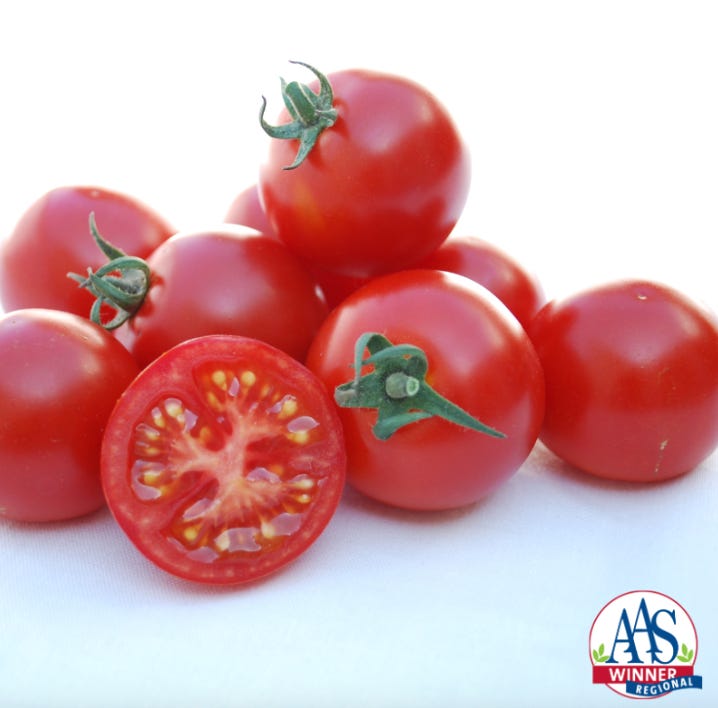
BADA BING TOMATO
Farmer Fred:
[2:44 ] All right. Well, let’s get started then. Let’s talk about vegetables first. Now, of course, my priority this time of year is looking for interesting tomato varieties to try. I always try a couple of new ones as well as some old proven varieties that usually get repeat performances in my yard. And you do have a tomato in the 2026 vegetable winners list called the Bada Bing.
Diane Blazek:
[3:13 ] Yes, the tomato, Bada Bing. So it is a large cherry tomato. So we just put that notation in there in case people look at it and go, well, this is like a cocktail tomato. It’s kind of in between a cherry and a cocktail size. The main thing is it’s disease-resistant, but I don’t want to disregard the taste, the texture, the fact that it’s very, very crack-resistant, nice and juicy like you would expect from a cherry tomato. So we keep calling it the more bang-for-the-buck tomato.
Farmer Fred:
[3:49 ] It looks like, because it has an overall height of just 40 inches, with a large container, you could grow the Bada-Bing tomato.
Diane Blazek:
[3:57 ] Yes, you could. We did not trial it in containers, but you definitely could. In fact, just this morning, I placed an order for a trade show. I’m going to the summer and we always want to show our new winners. So I went ahead and ordered it in a either a 14 or 16 inch container. So hopefully it will be fine for that size plant.
Farmer Fred:
[4:19 ] And I guess if people were saying, well, what tomato variety is it like? I guess it’s pretty close to maybe the Sweet 100.
Diane Blazek:
[4:27 ] Exactly. Yeah, that’s one. And then there’s another AAS winner from a couple of years ago called Crockini, and it was compared against those two, the Sweet 100 and the Crockini. All right.
Farmer Fred:
[4:38 ] And again, like you pointed out, it has resistance to septoria leaf spot, early blight and late blight. Blight’s a big problem, especially in humid climates.
Diane Blazek:
[4:49 ] Exactly. Yeah. And this one did win in the southwest and the southeast, as well as the Great Lakes and Heartland that has a lot of humidity, seeing as how I live there. So we do know that it did perform very well in those regions.
Farmer Fred:
[5:05 ] How many days is it to harvest on this one?
Diane Blazek:
[5:08 ] That was something else I just went over this morning. From transplant, it would be 65 days. So I’m thinking if you’re sowing straight from seed, probably 80 to 90 days.
Farmer Fred:
[5:20 ] Okay. Yeah, usually, the good part about planting tomatoes from seed is they come up fairly quickly, usually within a week to 10 days, unlike pepper seeds. And once they’re up, they start growing fast. So it’s only a few weeks after they’re up and growing that you’d be able to transplant them.
Diane Blazek:
[5:37 ] Correct. Yes.
Farmer Fred:
[5:39 ] All right. So that again, the Bada Bing tomato. Now it’s not a national winner, but it sure sounds like it would be fairly adaptable across the country.
Diane Blazek:
[5:49 ] Exactly. It was four regions. And so, you know, usually when it gets to four regions, it’s very close to being a national winner. So, yeah, this one, you know, I would feel pretty confident in pretty much everywhere. We just know that it did superbly well in those four regions.
After the paywall, paid subscribers get more words and pictures about the 2026 All-America Selection plant winners.





 United States
