


How to Plant a Fruit Tree
Description
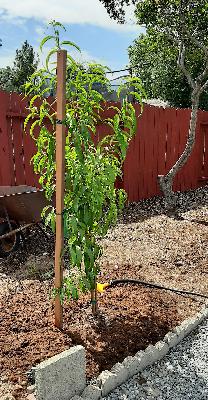
It seemed like a simple enough garden question to answer. The writer of the email, Steve, said: “I have never cared for a young peach tree or any other variety so I don’t know what to do since I got it in the ground. Now what?” Steve included a picture of the tree, which you can see here.
America’s favorite retired college horticulture professor, Debbie Flower, and I ended up having more questions and comments after closely studying the picture. The end result? An episode mostly dedicated to how to plant a fruit tree to insure success. This was originally recorded for the Garden Basics podcast in July of 2020, thus the reference to a hot summer and the muffled sounds of us talking with mandatory masks on.
Paid subscribers get full access to all newsletters and podcasts, and we’re having a holiday sale!
TRANSCRIPT
Q&A: How to Plant and Care for a Young Fruit Tree
Farmer Fred
Let’s delve into the mailbag, more mail coming into Fred at farmerfred.com here on the garden basics podcast. And we bring in Debbie Flower, retired horticultural professor at many universities and colleges, and she owns a peach tree too. So this is right up her alley. Steve writes in and says, “I have never cared for a young peach tree or any other variety. So I don’t know what to do now that I got it in the ground and mulched. I was given good info and how to put it in the ground. And I believe I was successful. But now what? The tree came in a typical pot with all its roots and dirt, I’m watching online videos, and it’s left me unsure of what to do and when.” Well, Steve was very kind to send along a picture of his new peach tree that he just planted. It’s a little difficult to say how tall the tree is currently, but it looks like…well, let’s just play, ‘what’s wrong with this picture’, Debbie? What’s wrong with Steve’s picture of his peach tree? I see several issues there.
Staking Techniques for Young Trees
Debbie Flower
Well, the first thing that jumps out at me is that the stake is taller than the peach tree. We only want to stake a tree, even a newly planted one, if it is unable to stand up on its own. If it is unable to stand up on its own, then we want to tie it. It’s hard to tell, but it looks like it could be tied at two locations. Not sure if that lower one is really there.
Farmer Fred
I think that’s a big branch down there.
Debbie Flower
Okay. Oh, yes. So we only want to tie it as low as we can, to make it stand up straight. He has it tied nearly at the top of the tree.
Farmer Fred
That’s a very good point you’re making there is that when you’re staking a tree, you want the tie to be at that point where the tree would actually bend. So what you do, you run your hand up the trunk of the tree and at that point where you can get the tree to stand up, that’s where you would tie the top loop.
Debbie Flower
Exactly, but he can’t tell if it’s going to fall over because if you look right down at the bottom, it is still attached to the nursery stakes. Nursery stakes are used to get that initial upright growth out of the stem, but it prevents the tree stem, fruit tree or otherwise from moving in the wind and from developing strength.
And so you need to take it off . I think of it as trees in bondage. When they’re tied this close to the stake, it’s very useful in the nursery, employees can pick up the tree and move it and throw it in a truck and take it out of the truck and the upright part of the tree stays stable, but it is not what we want for the ultimate life of the tree. We want that trunk to strengthen. In order to do that the trunk has to move in the wind just like we have to use our muscles in order for them to strengthen. That trunk has to move in the wind to strengthen, so take it off of that nursery stake and take it off of the very tall stake and see what happens and it is very likely to fall over, not right onto the soil; if it falls over and hits the soil you dig it out and take it back to the nursery. That means there’s a root problem. Somewhere along the length of that tree, that trunk will curve and the top of the trunk of the tree will bend down toward the earth. And that’s when you do what you said, which is run your hand up from the bottom of the tree and at some point the top of the tree will zing back up in the air. That’s the point at which you want to attach the trunk of the peach tree to the stake.
Preferably you have two stakes, one on either side of the trunk and you want them a distance from the trunk of the tree, maybe a foot. The reason for that is you don’t want the tree when it is moving in the wind to rub against those stakes and you don’t want them any taller than you need them to be. So the height of the stake would be just maybe five inches above that, about the height of your hand on that trunk. Maybe it’s three inches, just a few inches above, so that you have room to tie. You’re going to tie the trunk to both stakes at about the same location on the tree trunk to each stake, so it looks like one line across from one stake to the tree and back and then from the other stake to the tree and back. It appears when you look at it to be one line across. Does that makes sense?
Farmer Fred
Yes, it makes perfect sense. And again, he would want if the tree needed to be staking and that goes back to see if the tree can stand up by itself. But if the tree needs staking you would use two and to his credit, Steve did use green tape that’s like tree tie tape, It’s called. And what we don’t know because we can’t see into the foliage of how he’s tied it to the tree. If it’s a figure eight or wrapped, really tightly around the tree, it shouldn’t be wrapped tightly on the tree, it should be sort of a loose figure eight configuration, right?
Debbie Flower
Right. And that’s part of using two stakes. Because if it’s loose, then the tree may fall toward the stake. If you have one loosely pulling it toward the stake on the other side, then that corrects that problem.
Farmer Fred
To Steve’s credit, he’s done a lot of things right here we can see that the tree is located in full sun. It looks like he has mulch underneath the tree but the mulch is not touching the trunk of the tree.
Pruning New Deciduous Fruit Trees
Farmer Fred
But I want to go back even further to when he planted the tree. It looks to be a five or six foot tree. Now if he bought this fruit tree, what they call bare root, which would be before it leafed out, and they used to sell fruit trees basically plunked into sawdust and you would go and you’d pull it out of the sawdust and they’d wrap it up a newspaper for you to take it home. Now even though it’s still called bare root, most fruit trees that are sold are come in pots. So we don’t really know if the tree had leafed out before he bought it or if it was still dormant when he did buy it, but the fact of the matter is, when you get a bare root fruit tree home, one of the first things you need to do is basically cut it off at the knee so you get lower branching, this one doesn’t look like it was cut off at the knee.
Debbie Flower
Correct. Some people may Saturday here that you cut a fruit tree off at the knee. But that is to keep the fruit bearing branches low to the ground so that you don’t have to stand on a ladder to take care of them. It’s a really wonderful way to grow fruit.
Farmer Fred
Exactly and and you’re not inhibiting the production of fruit at all. You’d still have plenty of fruit is just going to develop some lower scaffolding to make it easier for you to pick fruit. What’s great about starting with a new tree is it makes it Much easier for keeping that tree at a height that’s manageable. So you never have to get on a ladder. And basically, you stick your hand as far in the air as you can. And you don’t let the tree get any taller than that.
Debbie Flower
Right? The height of the tree is is where your hand and the pruning shears when you raise your hand above your head, the highest it goes. That’s how tall you want the plant to be.
Farmer Fred
If he’s only planted the tree, could he cut it back in half now? Or should he wait until the dormant season? And can you even cut it back one year into its growth?
Debbie Flower
Pruning to fruit trees can happen during the growing season Yes, but right now we’re in the maybe thick of summer. It’s hot,
Farmer Fred
It’s hot.
Debbie Flower
It’s very sunny. We wear sunscreen and hats and things to protect our skin. If we cut that young tree back now, branches would be exposed to the strong sun that have never seen the strong sun before and they will sunburn, and you could lose the tree from that. So I would recommend waiting until it goes dormant.
Farmer Fred
Now that is a hard thing to do, if you’ve ever done it, you’ve probably done demonstrations of cutting back bare root fruit trees in front of a crowd and it always gets gasps of horror. Whenever you take your pruners and cut a six foot stick back to a two and a half or three foot stick. Yes. And in Steve’s case, he’s going to be cutting off a lot of growth that had leaves and he’s going to feel really bad doing it. But he should.
Debbie Flower
He shoul










 United States
