


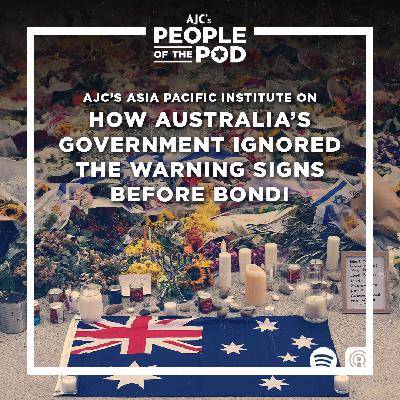
AJC's Asia Pacific Institute on How Australia's Government Ignored the Warning Signs Before Bondi
Description
Once considered a haven for Jews, Australia is reeling after a deadly Hanukkah terror attack at Bondi Beach left 15 dead—the tragic outcome of skyrocketing hate. AJC Asia Pacific Institute Associate Director Hana Rudolph joins the podcast to unpack the crisis, revealing that despite over 2,000 antisemitic incidents in the year following October 7, the government dropped the ball.
Hana details how political inaction and a fear that "supporting Jews is not politically popular" have allowed extremism to fester. She criticizes the delay in implementing the recommendations set forth by Australia's Special Envoy to Combat Antisemitism, noting the government's failure to move beyond basic security measures. Listen as she explains why global pressure is now urgent to ensure Australia takes this massive gap seriously before more lives are lost.
Read the Full Transcript: https://www.ajc.org/news/podcast/ajcs-asia-pacific-institute-on-how-australias-government-ignored-the-warning-signs-before
Resources:
-What To Know About the Antisemitic Terror Attack in Sydney
-Take action: Urgent: Confirm U.S. Special Envoy to Monitor and Combat Antisemitism
Listen – AJC Podcasts:
Follow People of the Pod on your favorite podcast app, and learn more at AJC.org/PeopleofthePod
You can reach us at: peopleofthepod@ajc.org
If you've appreciated this episode, please be sure to tell your friends, and rate and review us on Apple Podcasts or Spotify.
Transcript of the Interview:
Manya Brachear Pashman:
For more than 30 years, American Jewish Committee's Asia Pacific Institute has found Australia to be a nation that has stood shoulder to shoulder with the Jewish people and Israel. But that sense of steadfast support has started to fray as antisemitism has risen exponentially. The massacre at Bondi Beach on the first night of Hanukkah was only the latest and deadliest in a string of antisemitic incidents over the past two years. Here to discuss how we got here is Hana Rudolph, associate director of AJC's Asia Pacific Institute. Hana, welcome to People of the Pod.
Hana Rudolph:
Thank you so much for having me.
Manya Brachear Pashman:
Well, I want to ask you first, can you kind of introduce our listeners to the Australian Jewish community? How many people are we talking about? What is their history in Australia?
Hana Rudolph:
The Australian Jewish community is one of the most historic, long standing communities in the Asia Pacific. It dates back to 1788. So we're talking 18th century over 100,000 Jews. They're a diverse community. They reside primarily in the cities of Melbourne and Sydney, but they range in terms of practice, in terms of political views, similar to as we see in Europe or the US. There's some level of debate in terms of what, what percentage of the population it comprises, but somewhere between .5- 1% of the population.
Manya Brachear Pashman:
And has Australia been a friendly country for the Jewish community for all of that time, and at least until recently?
Hana Rudolph:
Yeah, absolutely. It has been a deep, close friend of Israel. Israeli diplomats have described Australia as an even closer partner to Israel at the UN and in other global forums than even the US. Jews have been living there for centuries, and have oftentimes described Australia as being like a haven. No matter the antisemitism that increases in Europe or in the US, Australia has been safe. It is the one place besides Israel, where they feel they can live in security. So the surge in antisemitism we've seen, especially since October 7, has just been so much more alarming and frightening and shocking for the community, because they just haven't seen incidents at this level anytime prior.
Manya Brachear Pashman:
What is it about Australia's community? I mean, I know that there's been a lot of emphasis on a kind of, give everyone a fair go, right? There's a lot of emphasis on equality. Is that what guides this kind of welcoming atmosphere? Or why are they such good friends with Israel? Is there something about the culture?
Hana Rudolph:
Yeah, Australia takes a lot of pride in its multiculturalism, the harmony and diversity, social cohesion, so they've placed a lot of emphasis on that in terms of, like, the national culture, and I think that's part of what's led to such a safe, thriving space for the Jewish community for so long until now.
Manya Brachear Pashman:
So what changed?
Hana Rudolph:
Million dollar question, right? October 7. It's really important to note that, you know, there have been threads of antisemitism from well before October 7, right? Things don't just happen overnight. And in the Hamas attack took place on October 7, before Israel had even begun its defensive war to recover the hostages and to complete its aims, on October 9, there was a massive protest in front of the Sydney Opera House, and people were yelling, were holding signs, yelling slogans of, where is the Jews, F the Jews. Some accounts of them saying, gas the Jews.
I mean, we're talking about, there's no linkage here of like, Israel's counter defensive war. It's simply about terrorists attacked Israel. Now is a good time for us to talk about like, go find and hunt down the Jews. So October 7 was the trigger. But in the years since, there has been what the Australian Jewish community has really pointed to, a failure of the Australian Government to take the concerns of antiSemitism seriously. So in the year following October 7, there were over 2000 incidents of antiSemitism, which, if you if you break it down by day like it's horrific, especially when you think about the fact that the Jewish community primarily resides in two cities. So we're talking about 2000 incidents over two cities, primarily.
And then in this last year, it was over 1600 incidents. And the Australian government has sought to be responsive. In many ways. They've done $30 million grants for security. They have committed to restoring synagogues that were fire bombed and all of that. But in a lot of ways that matter, kind of going beyond just simply police protection, but more about how do you fundamentally change the way that a society thinks about its Jewish community? They've really dropped the ball and we're seeing the impact of that now.
Manya Brachear Pashman:
What efforts have been made on the part of the Jewish community to change that? In other words, what advocacy have we seen from Australian Jews and their partners?
Hana Rudolph:
They've done everything we can, right, like in this they the Australian Jewish community is well established. They operate very similarly to European Jewish communities or American Jewish communities. So they have both umbrella organizations, and they also have advocacy organizations that run the gamut in terms of political viewpoints. AJC's partner organization, AJAC, the Australia Israel Jewish Affairs Council, has been very active in this space. And they have sought to work with leaders in both Maine political parties to call for various reforms. There has been a special envoy that was appointed by the government, which we laud in July 2024 in July 2025 she released a report containing about 50 recommendations for whole of society action, so some highest levels of government going all the way down to society, museums, media, schools, other institutes and just nothing has been done with the report.
The government has not considered it. It has not acted on the recommendations, and we're talking about five months since that report was released. The Jewish community has really sought to emphasize that this is not simply a reaction to understandable public concerns about Israel's foreign policy, but rather, there is a deeper issue of antisemitism going on that the government needs to take seriously, and that's really where we're seeing just inaction.
Manya Brachear Pashman:
We talk a lot here at AJC about the sources of antiSemitism from the right, from the left, from Islamist sources. Where is it coming from? Primarily in Australia?
Hana Rudolph:
Yeah, it's a really interesting question, especially in Melbourne. My understanding is that the protests that were taking place weekly until the cease fire, and even now it's continued on, but it's morphed a little bit. But those weekly protests were drawing in, similar to what we see in the US, both the far left, people wearing keffiyehs, people calling for Palestinian rights. The same as we see in the US, and then also people on the far right. So it does draw an interesting mix of political views, united in their hatre














 United States
