


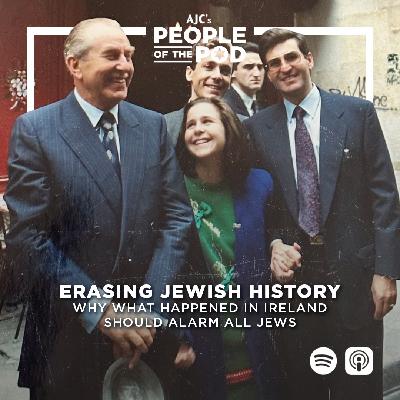
Erasing Jewish History: Why What Happened in Ireland Should Alarm All Jews
Description
When Dublin officials moved to strip the name of Chaim Herzog—Israel's Irish-born sixth president—from a community park, it wasn't just a local dispute. It was an act of erasure.
In this emotional episode, Dr. Alexandra Herzog, AJC's Director of the William Petschek Global Jewish Communities Department, explains why this attempt to rewrite history should alarm not only Jews, but all citizens of goodwill. As anti-Zionist fervor increasingly targets Jewish identity across the West, the push to remove a Jewish name from a park beside Ireland's only Jewish school sends a chilling message: Jewish heritage has now become a political battleground.
Alexandra shares personal memories of her grandfather and illustrates why this fight isn't about a plaque in Ireland—it's about halting the slide from criticism of Israel into the deletion of Jewish memory. Tune in to understand why defending this history is essential to protecting Jewish dignity everywhere.
Key Resources:
-
AJC Welcomes Dublin City Council's Decision to Shelve Renaming of Herzog Park
-
Letter in the Irish Times: Renaming Herzog Park in Dublin Would Be An Act of Erasure Against Ireland's Jews
-
Listen: Will Ireland Finally Stop Paying Lip Service When it Comes to Combating Antisemitism?
-
AJC Directly Addresses Antisemitism and Vilification of Israel in Ireland with the Prime Minister
Listen – AJC Podcasts:
Follow People of the Pod on your favorite podcast app, and learn more at AJC.org/PeopleofthePod
You can reach us at: peopleofthepod@ajc.org
If you've appreciated this episode, please be sure to tell your friends, and rate and review us on Apple Podcasts or Spotify.
Read the full transcript: https://www.ajc.org/news/podcast/erasing-jewish-history-why-what-happened-in-ireland-should-alarm-all-jews
Transcript of the Interview:
Manya Brachear Pashman:
Members of the City Council of Dublin, Ireland have withdrawn a proposal to rename a park that since 1995 has honored former Israeli President Chaim Herzog. The park, located near Dublin's only Jewish school, is named after Herzog, Israel's sixth president, who was born in Belfast.
Here to talk about the now withdrawn proposal is Alexandra Herzog, AJC's Director of the William Petschek Global Jewish Communities Department, and Chaim Herzog's granddaughter. Alexandra, welcome to People of the Pod.
Alexandra Herzog:
Thank you so much for having me, Manya.
Manya Brachear Pashman:
So you have joined us before, but on a different podcast, The Forgotten Exodus, which is our narrative series about Jews from the Middle East and North Africa. You were joining us to talk about your maternal grandfather, Nessim Gaon, the longtime president of the World Sephardi Federation. He came to Israel from Sudan.
But this time, we're talking about your paternal grandfather, Chaim Herzog. How did someone born in Ireland later become President of Israel?
Alexandra Herzog:
Yes, that's a great question. Manya, so my grandfather, Chaim Herzog, was, as you said, born in Belfast. He grew up in Dublin in a very proudly Jewish home. His father actually was a Rabbi Isaac Halevi Herzog, and he served as the Rabbi of Belfast before becoming the chief rabbi of Ireland. So he moved from Belfast to Dublin in 1919. He was affectionately known as the Sinn Féin rabbi, and he was highly respected and close to many of the leaders of the Irish independence movement. So my grandfather really grew up in a house that was deeply steeped in Jewish learning, in Irish patriotism, and he had a very strong sense of moral responsibility.
And as a young man, he had to leave Ireland to study, and he later enlisted in the British Army during World War Two, he fought the Nazis as an intelligence officer. He was one of the first soldiers actually to enter the concentration camp of Bergen Belsen, and he interrogated senior Nazi officials. Now, after the war, he moved to what would become the State of Israel, and he helped build the very young country, almost from its founding, in different positions.
And you know, then later, he became Israel's ambassador to the UN and a member of the Israeli parliament, the Knesset. And by the time he was elected as Israel's sixth president in 1983 he was widely seen really, as a statesman who combined Irish warmth and some storytelling with a very deep sense of Jewish history and Jewish responsibility.
He never stopped describing himself, actually, as an Irish born man. and he often spoke about how Ireland really shaped his worldview, and his commitment to freedom and to democracy.
Manya Brachear Pashman:
And you mentioned that he was the ambassador to the United Nations. He was, in fact, Ambassador when the resolution Zionism is Racism was, was part of the conversation.
Alexandra Herzog:
That's right. Yes, one of the two UN resolutions ever to be withdrawn and canceled, very important one. That's right.
Manya Brachear Pashman:
In fact, if I'm not mistaken, he tore it in half.
Alexandra Herzog:
He did. He tore it in half saying that this was nothing but a piece of paper, and explained how, you know, we could not equate Zionism to racism in any sort of way.
Manya Brachear Pashman:
So were those the reasons why, in 1995, the Dublin City Council decided to name the park after your grandfather? Or were there other reasons? Yeah.
Alexandra Herzog:
I mean, I think that, you know, I think it was a gesture, really, of recognition, of pride. I mean, Dublin was basically honoring an Irish man, you know, one of its own, an Irish born Jew who had gone to become, it's true, a global statesman, the President of Israel, but who really never stopped speaking about his Irish roots. And I think that that was really a source of pride for him, but also for Ireland in general, for many, many years.
And as you said, you know, Herzog Park really sits in a very historically Jewish neighborhood. It's near, actually, where my family lived, where my grandfather grew up, and it's right next to the country's only Jewish school. So naming a park for my grandfather was, I think, really a way of acknowledging this deep Irish Jewish history, and the fact that it is part of Irish history. So I think that my family story is very much woven into the country's broader story of independence, of democracy and of moral courage, really.
Manya Brachear Pashman:
Yet 30 years later, there has been an attempt to rename that park and strip that name from the park. Why? What happened in 30 years?
Alexandra Herzog:
It's a great question. I think that in the past three decades, you know, we've really seen the Israeli Palestinian conflict become a proxy battlefield for broader political debates in Europe, but also really everywhere around the world. In Ireland, the criticism of Israeli policies, of the Israeli government, has increasingly blurred into hostility towards Israel as a whole, and at times even towards Israelis and towards Jews.
What is really striking about this proposal is that it doesn't target a policy or even a government decision within Ireland. It targets a piece of Jewish and Irish history. So instead of creating a new space or a memorial, the proposal really sought to erase an existing Jewish name. And I think that that shift from debate to erasure, because that's really what we're talking about, is what worries me the most. It reflects really a climate in which maybe some feel that expressing solidarity with Palestinians require overriding an important part of Jewish history and Jewish presence. Jewish memory, really.
So one of their proposals is actually to rename it Free Palestine park, or to rename it after, you know, a Palestinian child. Obviously from a personal perspective, it's extremely problematic to remove a Jewish name to replace it by another group. We don't need to do th



 United States
