


Adrian Dahlin: The More SEO Changes The More It Stays The Same (Except Those Tactics!)
Description
In this episode, Jeremy Rivera sits down with Adrian Dahlin, founder of Search to Sale, to explore the intersection of traditional SEO principles and emerging AI technologies. Adrian brings a unique perspective as someone relatively new to SEO—having focused on it for just over three years—combined with a master's degree in applied data science and a background in creative marketing.
The conversation tackles the evolving landscape of search, from Google's helpful content update to the rise of generative engine optimization (GEO). Adrian shares candid insights about the challenges of selling SEO during a period of industry uncertainty, how reframing services around AI unlocked new client conversations, and why the convergence of SEO, digital PR, and Reddit marketing is creating powerful feedback loops for brands.
Key themes include the timeless nature of authentic storytelling (drawing on Simon Sinek's "Start With Why"), the shift from top-of-funnel content to bottom-of-funnel solutions, and Adrian's compelling analogy of AI as "a consultant working for your customer" rather than just another marketing channel. The discussion also explores the darker implications of writing for robots to write for humans, the dilution of authority online, and the challenges of vetting information in an age of AI-generated content.
Key Takeaways
On Fresh Perspectives in SEO
Adrian: "Trust me because I am relatively new to it and so what's normal to me is what's current and I'm not stuck doing it a version from 10 years ago."
Jeremy: "Dinosaurs like me have a lot of baggage. It's interesting because for me, the more that it changes, the more it stays the same."
Adrian: "I think I agree that the principles stay the same, but tactics kind of change."
On the Art and Science of SEO
Adrian: "I am a marketer with a data science background. I got a master's degree in applied data science, but I also really love like flushing out key messaging and like developing a voice and a brand... I love words and numbers and SEO is all about using data to help guide creative content projects."
Jeremy: "I have always seen SEO as part science, part art. There is definitely a heavy data sciences aspect to it... but also, you know, the artistic capability to understand the flaws in the data and understand the incredible multi-layer, multi-tiered black box that we're playing with for organic results."
On Authentic Marketing and Storytelling
Adrian: "I'll start with Simon Sinek. So his TED Talk, Start With Why, was one of the very first things that started to form how I thought about marketing... people don't buy what you do, they buy why you do it."
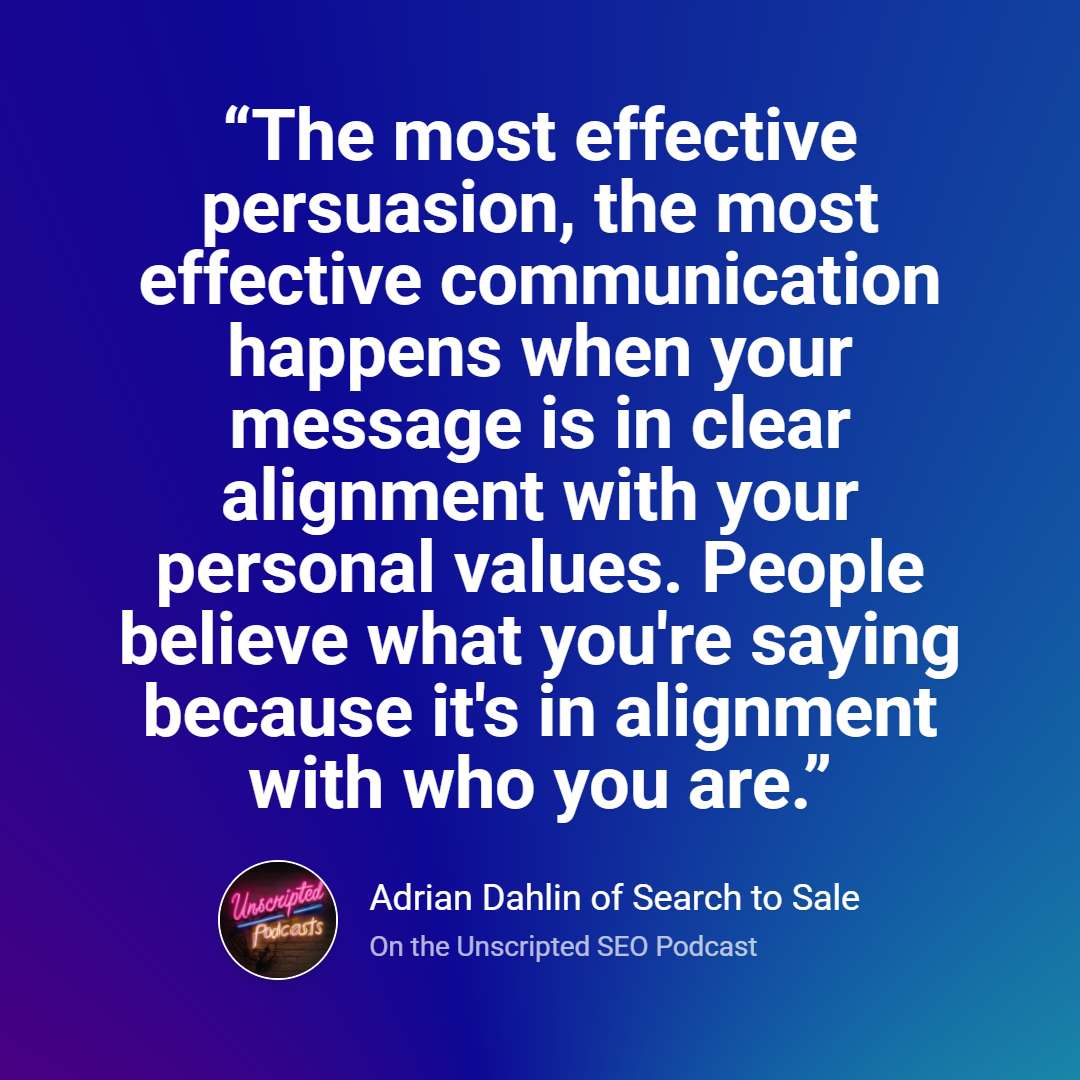
Adrian: "The most effective persuasion, the most effective communication happens when your message is in clear alignment with your personal values... people believe what you're saying because it's in alignment with who you are."
On the paradox of authenticity in marketing: Adrian: "I mean I guess the proof is in the pudding. It's like if it works, probably, it probably was... It's one thing to give people like a sugary snack kind of a message that like, you know, is appealing in the short term... and that's different than the kind of message... that continues to resonate for like years or decades at a time. That's going to be good evidence that it probably is authentic if it just keeps working."
On Google's Helpful Content Update
Jeremy: "Google was being inundated about three or four years ago... there was more and more sites that were programmatic in nature and more and more sites that were ranking that had a bunch of content... And what really shifted is they launched their own LLM-based portion of the search... if your site has a bunch of unhelpful content, then you actually get a negative penalty for the whole site. And if you have a ton of it, it will drag it down a lot. And so it was the return of a site-wide penalty."
Jeremy: "The majority of those that tanked have really never actually been able to recover. I think it's maybe one in a hundred have really come back and many of those are even just partial. Many companies went down entirely. Many travel bloggers are no longer able to do their thing."
On Google's Use of Click Behavior
Jeremy: "For the longest time Google had lied and said, hey, click behavior doesn't affect rankings. And it's not a direct ranking factor. And that word direct, one of my previous interviewees, Jason Barnard said, that word direct in that sentence always gets you because... they say something that's true, but say it in a way that leads you to believe something that's false."
Adrian: "Like the facts are true, but the narrative is false."
Jeremy: "In reality, the court documents that came out because Google got sued and the antitrust, they had it. You know, it's not just in the algorithm, it's one of the three major components of ranking. It's content, it's links, and it's behavior of how people interact with your brand as they do these searches."
Adrian: "Which I think is good. What better evidence would they have that content is actually helpful and useful to people than looking at the behavior on the site. That seems like a very positive thing."
On Google's Market Power
Adrian: "Google doesn't even have to be the best search engine. Google hasn't actually needed to be the best search engine for a long time. Just because they're Google, because of their market share, they have too much power. They're the aggregator of information on the internet. And consumer behavior just changes very slowly. Google is synonymous with search still."
On Selling SEO in the AI Era
Adrian: "I've been focused on SEO entirely in the AI era. And it has been hard to sell SEO during this period because of uncertainty, not because the fundamentals had changed. Maybe the fundamentals are starting to change now three years later. But certainly for the first two years, fundamentals did not change at all. But there was just fear and uncertainty. And that made decision makers just want to invest in channels they had more faith in."
Adrian: "As soon as I kind of made a shift in how I was presenting things and focusing more on AI in about July, so three months ago... I just got a lot more meetings. Like from my existing audience, people wanted to follow up, former clients, people I've been in touch with a long time who'd never bought from us... I think ultimately the greatest reason for that was just that gave them more trust in me that I was able to talk relatively fluently about AI and even if what we ended up working on was mostly traditional SEO website content stuff."
On the Convergence of Digital PR and SEO
Jeremy: "The adoption of what should have been fantastic bedfellows all along of digital PR and SEO... I'd say that there is a pretty hard break between SEOs and digital PR folk... everybody else is focused on, hey, can I get another guest blog placement?... hardcore focus on if it doesn't have a DR, then it doesn't have any value."
Adrian: "Yeah, I think that's right and they are kind of being forced together now and that's probably a good thing."
On Shifting Content Strategy
Adrian: "Two things come to mind. One is shifting the kinds of content that we focus on just away from the top of the funnel... Another is just changing how we think about discovery online. And I use an analogy that AI is like a consultant working for your customer, and you're trying to influence how that consultant thinks, which means that everything on the web is kind of relevant."
Adrian: "The old blog tactics where you'd, like, throw up an article defining an industry term, which Ryan Law at Ahrefs calls rehashed Wikipedia content, that was always kind of an awkward phenomenon... it's a much better user experience for AI to just answer the question when someone's just asking for the definition of a term."
Adrian: "So, you know, it's much less helpful to have that top funnel, higher volume keywords, 'what is blah blah blah jargon' that kind of blogging and so much more focus on the bottom of the funnel stuff like all the searches related to people looking for a solution."
On niche technical content: Adrian: "Where an LLM is trained on the internet, it's going to do a good job of synthesizing commonly available information. But for people who are looking for a really niche subject, where there isn't a lot of good content on the web, there's still an opportunity to kind of own that niche, own that long tail, particularly if it's like highly technical."
On the AI Consultant Analogy
Jeremy (referencing Michael McDougall of Right Thing Agency): "ChatGPT is your least trained customer service representative. So it's detached from you and you kind of have to use a fax machine approach to get new inform




 United States
