


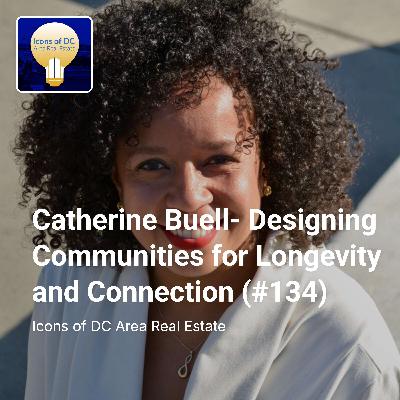
Catherine Buell- Designing Communities for Longevity and Connection (#134)
Description
Catherine Buell is founder of Wellness Real Estate Innovations. Previously director of Amazon Housing Equity Fund, president/CEO of Atlanta Housing Authority, chair of DC Historic Preservation Review Board, and executive director of St. Elizabeth's East Campus Redevelopment. Harvard Kennedy School Loeb Fellow.
(00:00 ) Introduction to second interview. Former Amazon Housing Equity Fund director, Atlanta Housing CEO, Harvard Kennedy School Loeb Fellow.
(03:14 ) New company Wellness Real Estate Innovations - bringing wellness real estate solutions to diverse urban audiences at intersection of health and housing.
(03:42 ) Personal motivation: mother's dementia/loneliness during COVID highlighted lack of aging options even in expensive continuum care facilities.
(05:33 ) Philosophy: housing is healthcare and building with care. Traditional housing continuum has cracks - expensive senior housing, limited diverse options. Beautiful places impact how you feel through social connection, walkability, vibrancy.
(09:05 ) Amazon lessons: Corporate investments influence markets but can't solve entire spectrum. Healthcare organizations increasingly investing in affordable housing targeting high-cost patients. Innovation gap for aging demographic - need co-housing, shared living, wellness communities.
(15:23 ) Combat loneliness through intentional community design - new urbanist model plus different housing types, oversized green spaces, shared amenities for organic connection.
(17:06 ) Alternative models: co-housing, shared living, ADUs. PadSplit's tech approach for $27K income essential workers - streamlined access to furnished shared rooms. Shared models add people without changing community character, help aging in place.
(21:26 ) Key challenge: lack of documented data on wellness community benefits. Need to document outcomes from 1990s/2000s wellness communities.
(23:37 ) Global Wellness Institute trends:
- Wellness as Infrastructure (WAI) - Bhutan mindfulness city
- Wellness as Service (WAAS) - integrated cleaning, nursing, caregiving
- Wellness ROI (WROI) - significantly higher returns
- Longevity Economy (WRELE) - aging population focus
(27:38 ) Gap: middle-income households with $80-120K retirement income can't afford elite wellness solutions ($400K-$1M deposits), don't want to leave social networks.
(32:48 ) Policy needs: data on health/housing intersection, true cost of "do nothing" strategy, economic benefits. Fastest growing DC population is 55+. Loneliness epidemic costs $6.7B annually to Medicaid.
(37:20 ) Example: dementia village in Ward 7 - 13% of DC seniors have dementia (16% east of river). Netherlands-inspired model with store, pub, church, arts room for quality of life vs traditional memory care.
(45:02 ) Vision: "love villages" for all incomes/races, especially African-American women. 20-year plan for third trimester of life - staying engaged, active, socially connected.
(47:47 ) Advice: think outside box, start conversations at zoning stage, consider demographic shifts. Half of five-year-olds today expected to live to 100.
(50:34 ) Data needs: true cost of scattered-site aging approach vs building-based services. Scale understanding - seniors on fixed income ending up in homeless shelters due to high rent.
(55:05 ) Dream: healthcare company partnership like Amazon model. Bold investments shift markets. DC has higher income retirees as asset.
(58:02 ) Large-scale insights: Takes time but start somewhere. Even $2B Amazon investment wasn't enough - need everyone's resources including data, land, support, thought leadership.
(61:12 ) Harvard Loeb Fellowship transformative - stepped back, reflected, met amazing global innovators. Inspired by young people paying attention to details.
(63:47 ) Teaching role keeps energy up, learning from students exploring health/housing innovations.
(64:49 ) Wellness real estate as investment category: Hope integrates into all asset classes, not siloed. References "Bowling Alone" - loss of civic connections, shift to individualism. AI may increase focus on personal wellbeing.
(69:18 ) Asset class integration:
- Hospitality: business travel community experiences, coworking spaces
- Office: well building certifications, air quality, collaboration spaces
- Retail: spas, fitness studios, sensory experiences, food halls as gathering spaces
(71:44 ) Resources: Global Wellness Institute annual real estate report, Jeremy Noble's "Project Unlonely", Ezra Klein



 United States
