


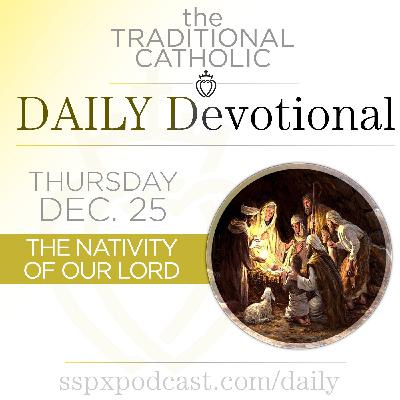
Dec 25 – The Nativity of Our Lord
 1
1Description
It’s the Feast of The Nativity of the Lord, 1st Class, with the color of White. In this episode: the meditation: “The Shepherds at the Manger”, a preview of the Sermon: “Christmas Day: Compulsory Rejoicing”, and today’s thought from the Archbishop.
Have feedback or questions about the DD or our other shows? podcast@sspx.org
Sources Used Today:
- “The Shepherds at the Manger” – From Advent to Epiphany
- “Christmas Day: Compulsory Rejoicing” (SSPX Sermons)
- The Spiritual Life – Archbishop Lefebvre (Angelus Press)
One of the most beautiful and easily overlooked traditions of the Church is the celebration of three distinct Masses on Christmas Day. Far from being a duplication, these Masses unfold the mystery of the Nativity in stages, allowing the faithful to enter more deeply into what it means that God has become man. This custom took shape in Rome during the early centuries and has been preserved in the traditional Roman liturgy as a kind of theological meditation spread across time.
The first Mass is celebrated at midnight. It is the most intimate of the three, drawing the Church into the stillness of Bethlehem. The liturgy is hushed and contemplative, focused on the eternal Word entering the world quietly, almost unnoticed. The Gospel tells of the birth itself, of Mary wrapping the Child in swaddling clothes and laying Him in a manger. In this Mass, the emphasis is on the mystery of divine humility. God comes in darkness, not spectacle. Heaven touches earth while most of the world sleeps.
The second Mass is celebrated at dawn, traditionally called the Shepherds’ Mass. Its tone is gentler and more joyful. The Church now looks outward from the cave to the fields, where ordinary men receive extraordinary news. The Gospel recounts the angels’ message and the shepherds’ haste to find the Child. This Mass highlights revelation. Christ is made known, not to the powerful, but to the watchful and the poor. Light begins to spread, and joy takes root in human hearts.
The third Mass is celebrated during the day and carries a more triumphant character. Its Gospel does not return to Bethlehem at all, but opens with the soaring prologue of Saint John: “In the beginning was the Word.” Here the Church contemplates not the Child alone, but the eternal Son who exists before all ages and now dwells among us. The focus shifts from the event of the birth to its cosmic meaning. The Incarnation is revealed as the turning point of all history.
Together, the three Masses form a single movement of faith. Christ is born in silence, revealed to the humble, and proclaimed to the world. The mystery deepens rather than repeats. Each Mass unveils another dimension of the same truth, allowing the faithful to linger, ponder, and rejoice more fully.
Culturally, this tradition shaped Christian life for centuries. Families planned their celebrations around Midnight Mass. Villages gathered again at dawn. Cathedrals filled during the day. Christmas was not compressed into a moment, but stretched across prayer, time, and wonder.
The three Masses of Christmas teach the Church how to receive the Incarnation: quietly, gratefully, and with eyes lifted toward eternity.
- - - - - -
Please Support this Apostolate with 1-time or Monthly Donation >>
- - - - - -
Explore more:
- Subscribe to the email version of this Devotional- it's a perfect companion!
- Subscribe to this Podcastto receive this and all our audio episodes
- Subscribe to the SSPX YouTube channelfor video versions of our podcast series and Sermons
- FSSPX News Website:https://fsspx.news
- Visit the US District website:https://sspx.org/
What is the SSPX Podcast?
The SSPX Podcast is produced by Angelus Press, which has as its mission the fortification of traditional Catholics so that they can defend the Faith, and reaching out to those who have not yet found Tradition.
What is the SSPX?
The main goal of the Society of Saint Pius X is to preserve the Catholic Faith in its fullness and purity, to teach its truths, and to diffuse its virtues, especially through the Roman Catholic priesthood.
Authentic spiritual life, the sacraments, and the traditional liturgy are its primary means of bringing this life of grace to souls.
Although the traditional Latin Mass is the most visible and public expression of the work of the Society, we are committed to defending Catholic Tradition in its entirety: all of Catholic doctrine and morals as the Church has always defended them. What people need is the Catholic Faith, without compromise, with all the truth and beauty which accompanies it.
https://sspx.org




 United States
