


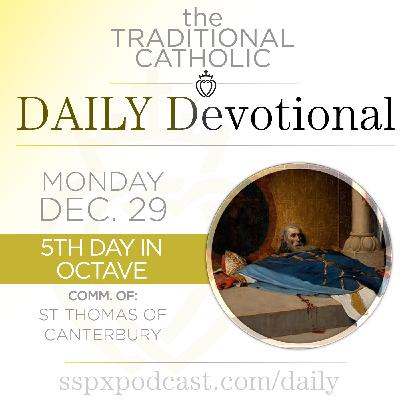
Dec 29 – 5th Day / S Thomas Becket
 1
1Description
It’s the Feast of 5th Day of Christmas, 2nd Class, with the color of White. In this episode: the meditation: “Mary and Joseph at the Manger”, today’s news from the Church: “The Tears of the Melting Iceberg”, a preview of the Sermon: “The Mystery of Christmas”, and today’s thought from the Archbishop.
Have feedback or questions about the DD or our other shows? podcast@sspx.org
Sources Used Today:
- “Mary and Joseph at the Manger” – From Advent to Epiphany
- “The Tears of the Melting Iceberg” (FSSPX.news)
- “The Mystery of Christmas” (SSPX Sermons)
- The Spiritual Life – Archbishop Lefebvre (Angelus Press)
Saint Thomas of Canterbury, better known as Thomas Becket, is remembered as a man whose life became a lesson in how conscience is forged through conflict. Born in London around 1118 to a prosperous merchant family, Thomas rose quickly through education, intelligence, and charm. He became a close friend of King Henry II and was appointed Chancellor of England, living with splendor and wielding real political power. At that stage of his life, few would have guessed he was on a path toward martyrdom. He was loyal to the crown, pragmatic, and very much a man of the world.
Everything changed in 1162 when Henry unexpectedly named him Archbishop of Canterbury. Thomas resisted the appointment, sensing what it would demand of him, and his instincts proved right. Once consecrated, he underwent a profound interior conversion. He set aside luxury, embraced prayer and penance, and began to see himself not as the king’s servant in church clothing, but as a shepherd responsible before God. This shift placed him on a collision course with Henry, who expected obedience and cooperation, especially in limiting the Church’s independence from royal authority.
The conflict centered on whether clergy accused of crimes should be judged by church courts or royal ones. Thomas defended the Church’s ancient rights, not out of pride, but out of conviction that spiritual authority could not be subordinated to political convenience. Years of exile followed. He lived in hardship, misunderstood by many, yet increasingly clear about the cost of fidelity. Letters from this period reveal a man stripped of illusion, sustained only by prayer and a growing trust in God.
When Thomas finally returned to England in 1170, reconciliation with the king proved fragile. After a bitter exchange, Henry uttered words of frustration that four knights interpreted as a command. They rode to Canterbury Cathedral and confronted the archbishop as he prepared for evening prayer. Thomas refused to flee. He was struck down at the altar, dying beneath the sign of the Cross. His last moments were marked by calm surrender, commending himself to God and forgiving his attackers.
His death sent shockwaves across Europe. Miracles were reported almost immediately at his tomb, and Canterbury became one of the greatest pilgrimage sites of the Middle Ages. Kings and peasants alike traveled there seeking healing, forgiveness, and courage. His feast on December 29 was observed with solemnity, and he became a symbol of the Church’s freedom of conscience against coercion.
Saint Thomas of Canterbury remains a witness that holiness is sometimes shaped through painful clarity, and that faithfulness may require standing alone when truth is at stake.
Saint Thomas of Canterbury, bishop and martyr, pray for us!
- - - - - -
Please Support this Apostolate with 1-time or Monthly Donation >>
- - - - - -
Explore more:
- Subscribe to the email version of this Devotional- it's a perfect companion!
- Subscribe to this Podcastto receive this and all our audio episodes
- Subscribe to the SSPX YouTube channelfor video versions of our podcast series and Sermons
- FSSPX News Website:https://fsspx.news
- Visit the US District website:https://sspx.org/
What is the SSPX Podcast?
The SSPX Podcast is produced by Angelus Press, which has as its mission the fortification of traditional Catholics so that they can defend the Faith, and reaching out to those who have not yet found Tradition.
What is the SSPX?
The main goal of the Society of Saint Pius X is to preserve the Catholic Faith in its fullness and purity, to teach its truths, and to diffuse its virtues, especially through the Roman Catholic priesthood.
Authentic spiritual life, the sacraments, and the traditional liturgy are its primary means of bringing this life of grace to souls.
Although the traditional Latin Mass is the most visible and public expression of the work of the Society, we are committed to defending Catholic Tradition in its entirety: all of Catholic doctrine and morals as the Church has always defended them. What people need is the Catholic Faith, without compromise, with all the truth and beauty which accompanies it.
https://sspx.org



 United States
