


Ep 11.The making of Nicolo Amati with Benjamin Hebbert
Description
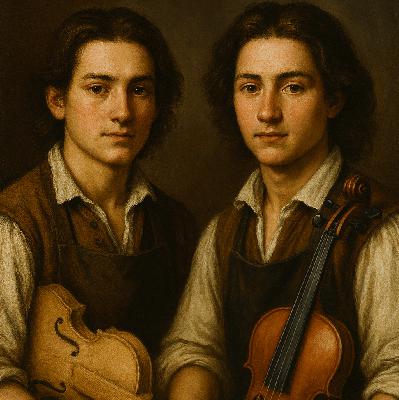
The Amati Brothers were working and living in a time of musical innovation and discovery. Join me as I discover what influences Monteverdi, music and even fashion had on the instruments the brothers were making.
intertwines the stories of the illustrious Amati brothers, renowned violin makers, with the musical genius of Claudio Monteverdi, one of the greatest composers of the Baroque era. Join us on a captivating journey as we explore the parallel worlds of instrument craftsmanship and musical composition during this remarkable period.
Musicians and Luthiers of the renaissance such as the Amati Brothers had to continue their craft amidst famine, plague and war making these instruments musicians play today objects even more remarkable than we could have previously imagined.
We continue to look at the life of Girolamo Amati the father of the very talented Luthier Nicolo Amati who would in turn change the course of violin making in Italy for ever.
In this episode I speak to Dr Emily Brayshaw fashion historian and Benjamin Hebbert Oxford based Violin expert.
Transcript
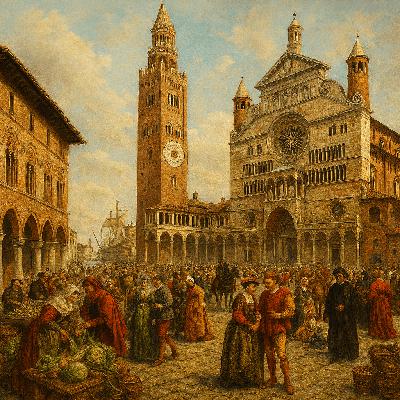
Once upon a time on the northern plains of Italy, there roamed a hero who went by the name of Romulus. You may have heard of him as the legendary founder of Rome, perhaps? But what's a strapping god like young man to do once he's founded one of the world's greatest cities? One day, as he was travelling through the Po Valley, Romulus came upon a group of people who were struggling to defend their village from the fierce Gaelic tribes roaming the region. The people were in need of a strong leader, and Romulus knew just the man for the job, himself. He gathered the people together and said, “I will help you defend your village from these invaders, but we must build a great fortress to protect ourselves”. The people thought this was such a great idea that they set to work building a mighty fortress immediately on the banks of the Po River.
The people began to dream of a great city that could rival the power and glory of Rome itself. Romulus, who had been a beloved leader of the people, heard their dreams and knew that he could help them achieve their goal. He said to them, If we are to build a great city, we must first establish a strong foundation. We must build our city upon the principles of justice, wisdom, and strength. And so the people of the village began to build their city. They laid the foundation stones with great care and constructed a wall around the city to protect it from invaders. Romulus oversaw the construction and he ensured that the city was built to the highest standards possible.
As the city grew, Romulus knew that it needed a name. He looked out over the fertile fields of the Po Valley and saw the bright flames of the forges that dotted the landscape. He turned to the people and said, We shall call this city Cremona, which means to burn, for it is the fires of our forges that will light the way to our greatness. And so the city of Cremona was born. It grew to become a powerful centre of trade and culture in northern Italy and was revered by many as a shining example of the principles of justice, wisdom, and strength that Romulus had taught them.
And this is the legend of how Romulus founded the city of Cremona.
Hello and welcome to the Violin Chronicles, a podcast in which I, Linda Lespets, will attempt to bring to life the story surrounding famous, infamous, or just not very well known, but interesting violin makers of history. I'm a violin maker and restorer. I graduated from the French Violin Making School some years ago now, and I currently live and work in Sydney with my husband Antoine Lespets, who is also a violin maker and graduate of the French school, l'Ecole Nationale de Luthierie au Mircourt.
As well as being a luthier, I've always been intrigued with the history of instruments I work with, and in particular, the lives of those who made them. So often when we look back at history, I know that I have a tendency to look at just one aspect, But here my aim is to join up the puzzle pieces and have a look at an altogether fascinating picture. So join me as I wade through tales not only of fame, famine, and war, but also of love, artistic genius, revolutionary craftsmanship, determination, cunning, and bravery, that all have their part to play in the history of the violin.
Welcome back to the story of Andrea Amati's two boys, the Amati brothers, Girolamo Amati and Antonio Amati. In the last episode, we left them after they split the workshop and Antonio Amati went off to set up on his own, leaving Girolamo Amati with the house and shop to continue alone. The Amati brothers stopped working together in 1588, but if you remember the episodes on Gasparo Da Salo over in Brescia, you would realize that their Brescian competition was still working away, and in 1580, eight years earlier, a future employee of Da Salo's was born. His name was Gio Paolo Maggini, and he would go on to become a roaring success. Girolamo Amati, however, had other things on his mind. As I mentioned earlier, his first wife, Lucrenzia, had died shortly after having their daughter, Elizabeth, and his new wife, Laura, had a full house to look after and a famine looming on the horizon. Girolamo Amati, in this decade, made some beautiful instruments, including the one played by Ilya Izakovich in the Australian Chamber Orchestra, the Baron Knoop violin, and a painted violin for the French King Henry IV, to name a few. Girolamo Amati was now in his late 30s, and Laura was pregnant again. The news wasn't good. The Po River was rising and the plains around Cremona were flooding. The crops would be ruined again, like they had last year. The grain yields were a third of the previous years, and outbreaks of typhus were hitting the rural areas, affecting those who grew the grain, and the disease was even worse in the heavily populated cities.
After several years of bad weather, flooding, and storms, the cities were deeply in debt from having to buy grain from abroad. For the next two years, matters only got worse. News was coming from other cities on the Po Plains, Bologna had expelled the so called useless mouths, people without citizenship, beggars, jobless foreigners, and even those who were employed but not highly skilled in a trade. They were saying that it was to reserve the scant food supplies and to prevent overcrowding and outbreaks of epidemics. The governing bodies in the cities were afraid that the poor would revolt and steal the little food that was left in the city's reserves. But the people from rural areas where the crops were spoiled were flocking to the cities where they knew there were grain stores. Four fifths of the population lived in rural areas but would be turned away at the city gates. Bologna was 150km from Cremona. The same could happen here. Already 10, 000 people had died in that city and 30, 000 in the surrounding countryside. In just 10 years, Cremona had gone from a boom to simply struggling to stay afloat.
In 1594 and 1597, there was a famine and an economic downturn in the region. And it was also the year Shakespeare's Romeo and Juliet was premiered. Throughout these lean years, Girolamo Amati was still making beautiful instruments, violas, violins, and cellos. His choice of materials were of the finest standard and so was his workmanship. The sound quality of his instruments differed as well from that of his competition in Brescia. But he was keeping afloat and even had a recent order for a set of instruments for the chapel of the new king of France, Henry IV, who had managed to survive the religious wars by converting to Catholicism, saying famously that Paris was worth a mass. Paris vaut bien une messe. This new set of instruments were to be decorated with the coat of arms and in Latin gold leaf red. King Henry IV, by the grace of God, King of France and Navarre. I speak to Benjamin Hebbert about the authenticity of the Amati Charles IX instruments and musicians at this time. Which is the end of Catherine de Medici's reign and the beginning of Henry of Navarre's reign.
Well, I think Catherine de Medici is, in France, is just such a huge influence. Charles IX is a child king and really has no power. And then he dies, is sickly. And then his brother who had become king of Poland is brought back and he becomes Henry IV. And then Catherine de Medici dies. I'm going to say 1587, I know I'm wrong, but around about that time there's a wonderful quote about, you know, people would give more regard to a dead goat than they would to Catherine de Medici. There was a point at which her power was over. Henry is assassinated within a year of her death, and Henry of Navarre, who is a Protestant, a Huguenot, comes in and becomes, becomes king. And at that time I think what we have to consider is that, you know, so right up until, right up until the end of the Valois dynasty, you know, it's all Catherine, it's all about Catherine de Medici, it's all about her, it's all about her triumphs and her successes. And then one of the things that happens there's been actually sort of various Musicologists have speculated that the Andrea Amatis aren't, aren't authentic. And one of the reasons is that the earliest French orchestral music is for a completely different orchestration than these Italian instruments offer. And what I think when you look at these things, the propaganda of the painting all over them is very specific to the Valois. The Valois were hated. Uh, they massacred enough Huguenots to be really, really hated. When Henry comes in, he's set, you know, they're played by Italian musicians. They're playing music in every corner of the court. Their eyes and ears, which are open for Catherine de Medici, they're, there's not. A lot of difference between a spy and a musician in the 16th century and there's, you kno








 United States
